Wednesday, August 21, 2013

Mets Teams That Played Their Best Against The Best


With a 77-49 record, the Atlanta Braves have the best record in the major leagues.  And yet, somehow the Mets have a 8-8 record against them.  It's by far the most wins they have against an opponent this year, as the Mets have not been able to defeat any other team more than five times.  (They're 5-7 against both Philadelphia and Washington, and 5-10 vs. Miami.)

It's quite unusual for a team with a sub-.500 record to play its best against the best team in the league.  But it's happened before for the Mets. 

Just three years ago, in 2010, the Mets finished the year with a 79-83 record.  However, they split their 18 games against the Philadelphia Phillies, who boasted the league's best record at 97-65.  The Mets did not win more than nine games against any other team in 2010.  They also went 9-9 against the Washington Nationals.

The only other time the Mets won more games against the league's best team than they did against any other team was in 2003.  That Mets squad had a forgetful season, going 66-95.  But they did go 8-11 against the Atlanta Braves, who won a league-high 101 games.  The eight wins were one more than they had against the Marlins and Phillies, against whom the Mets went 7-12.

Should the Mets win their final series against the Braves in two weeks, they will clinch a winning record versus Atlanta for the season.  If Atlanta maintains its grip on the best record in baseball, it would mark the first time the Mets finish with a winning record against a team that led its league in victories in a year the Mets defeated that team more times than they defeated anyone else.  (Got that?)

2003.  2010.  2013.  Neither year produced many great memories for the Mets.  But they did produce a statistical oddity.  Those three seasons are the only ones in which the Mets won more games against the league's best team than they did against anyone else.  They may not have had winning records in those seasons, but they certainly played their best against the best.

Sunday, August 18, 2013

Marlon Byrd Could Do What No Met Has Done Before

Power hitters don't usually run very well.  And speedsters aren't prone to hitting home runs.  So it would be reasonable to say that players who are among the league leaders in home runs don't usually find their names near the top of the triples leader board.  Of course, there have been some exceptions over the years.

Hall of Famer Stan Musial led the league in triples in 1948, 1949 and 1951.  He hit 39, 36 and 32 homers in those years, respectively.  More recently, in 2007, Jimmy Rollins led the league with 20 triples while hitting 30 homers to capture the National League Most Valuable Player Award.

Only three players in the modern era of baseball (since 1900) have led their respective leagues in triples and homers in the same season.  Those players are Willie Mays (13 triples, 51 homers in 1955), Mickey Mantle (11 triples, 37 homers, also in 1955) and Jim Rice (15 triples, 46 homers in 1978).  All three are in the Hall of Fame.

As you can see, it's quite rare for a player to be among the league leaders in both triples and home runs.  Just nine players have finished in his league's top ten in triples and homers over the past 20 years, as seen in the chart below.


Player
Year
Triples
Place
Home Runs
Place
Sammy Sosa
1994
6
T-6th
25
9th
Ellis Burks
1996
8
T-5th
40
T-5th
Vladimir Guerrero
1998
7
T-8th
38
T-6th
Barry Bonds
1998
7
T-8th
37
9th
Nomar Garciaparra
1998
8
T-4th
35
T-10th
Vladimir Guerrero
2000
11
T-2nd
44
T-4th
Luis Gonzalez
2001
7
T-8th
57
3rd
Ryan Braun
2007
7
T-6th
37
T-4th
Carlos Gonzalez
2010
9
6th
34
4th
Curtis Granderson
2011
10
3rd
41
2nd


Of the nine players in the last 20 years who have finished in the top ten in both three-base hits and homers, only Vladimir Guerrero accomplished the feat twice, doing so for the Expos in 1998 and 2000.  But notice that none of the nine players played for the Mets.  That shouldn't be surprising.  After all, only 16 Mets have ever cracked the year-end top ten in triples.  And of those 16 players, none of them hit as many as 20 homers. (Jose Reyes' 19 homers in 2006 are the most.)  Obviously, that means no Met has ever finished in the top ten in both triples and homers in the same season.

But that could all change this season.  And it might be done by an unlikely candidate.

Word.

Marlon Byrd currently has five triples and 20 home runs.  His five triples are good for a ninth place tie in the National League, while his 20 homers are tied for the eighth highest total in the Senior Circuit.  Should Byrd finish in the top ten in the league in triples, he would become the first Met to hit 20 homers in a season in which he cracked the top ten in triples.  In addition, should Byrd remain in the top ten in both triples and homers, he'd also become the first Met ever to do so.

Not Jose Reyes.  Not David Wright.  Not Darryl Strawberry.

Marlon Freakin' Byrd.

No one expected Marlon Byrd to do much for the Mets this year.  He was supposed to be part of a rotating outfield who could perhaps hit well against left-handed pitching.  But instead, he's become the team leader in home runs, runs batted in, and slugging percentage.  He also has a chance to be among the league leaders in both triples and homers.  That's something very few players can claim over the past 20 years.  That's something no Met has ever been able to claim.  Until now.  Maybe.

This has truly been a remarkable season for Marlon Byrd.  And it also has a chance to be an historic one.

Saturday, August 17, 2013

Daniel Murphy Joins An Exclusive Club

High-fives all around for Daniel Murphy, who has become quite an all-around player. (Getty Images)

Daniel Murphy hit his 10th home run of the season last night at Petco Park, a two-run shot off former 20-game winner Ian Kennedy.  The blast allowed Murphy to reach double digits in home runs for only the second time in his career and the first time since 2009 when he led the team with 12 homers.

Murphy had already achieved a career high in stolen bases, having swiped 14 bags as of Friday night.  That puts Murphy in an exclusive club among Mets' second basemen.


Player
Year
Home Runs
Stolen Bases
Gregg Jefferies
1989
12
21
Gregg Jefferies
1990
15
11
Roberto Alomar
2002
11
16
Daniel Murphy
2013
10
14


By reaching double digits in home runs and stolen bases, Murphy has become only the third second sacker in franchise history to accomplish the feat.  Murphy's rare feat has been accomplished only by Gregg Jefferies (twice) and Roberto Alomar.  Ironically, both Jefferies and Alomar were said to have underachieved in New York, despite posting power/speed numbers that had never been seen before by a second baseman in club annals.

Whether or not Murphy will be seen in the same negative light as Jefferies and Alomar remains to be seen.  But all indications are that he will not.  As of today, he is a fan favorite who has worked his way to becoming a major league second baseman.  He has also worked his way to accomplishing a rare feat for a Mets second baseman, combining the ability to drive the ball out of the park with a keen eye for when to steal a base.

Murphy is not the strongest guy on the team, nor is he the swiftest.  But he is a member of an exclusive club - one that never opened its doors for fellow Mets second basemen Edgardo Alfonzo, Jeff Kent or Ken Boswell.  It's an honor that shouldn't be taken lightly.

I Believe The Children Are Our Future


Since Sandy Alderson took over as Mets general manager following the 2010 season, there has been a commitment to shedding the team of its bad contracts and promoting a youth movement.  Through various trades, Alderson has energized the franchise with an influx of fresh talent.

He traded Carlos Beltran and received Zack Wheeler.  He dealt a reigning Cy Young Award winner in R.A. Dickey and got back Noah Sydergaard and Travis d'Arnaud.  Alderson also believed in players like Juan Lagares, who spent his first five professional seasons (2006-2010) bouncing around in the low minors before storming his way through the system after Alderson and his crew took over.

Lagares is now the team's starting centerfielder, playing Gold Glove caliber defense while displaying a strong and accurate arm.  Wheeler is also shining at the big league level.  Since being promoted in June, Wheeler is 5-2 with a 3.43 ERA, averaging nearly a strikeout per inning.  Syndergaard is progressing as well.  The right-hander is 6-0 with a 1.59 ERA, 0.92 WHIP and 11.3 K/9 IP at AA-Binghamton.  If he continues at this pace, he will begin the 2014 season at AAA-Las Vegas and should be delighting fans at Citi Field by mid-summer.

That brings us to Travis d'Arnaud.  After being considered the top catching prospect in baseball, d'Arnaud's progress has been slowed by a variety of injuries.  But d'Arnaud is healthy now and has gone back to being an offensive force, reaching base 38 times in 19 games at Las Vegas.  His ability to reach base and hit for power (d'Arnaud has a 1.041 OPS for the 51s) makes him a player to build an offense around.  And that building will add a new brick tonight when d'Arnaud makes his major league debut for the Mets.

Since Wheeler made his debut in June, the Mets have gone 31-24.  That record has been achieved without d'Arnaud or Syndergaard contributing to the team's success.  Wilmer Flores (an Omar Minaya player who didn't make it past Single-A until his fifth professional season - or Alderson's second year with the team) has also made his presence felt on the parent club, driving in nine runs in his first eight games.

Famous crooner Randy Watson once sang "I believe the children are our future.  Teach them well and let them lead the way."  As Mets fans, we believe that Wheeler, Syndergaard and Flores are part of that future (not to mention Matt Harvey, whose future looks as bright as his present).  Travis d'Arnaud will also become part of that future when he takes the field tonight at Petco Park for his major league debut.  Along with the other bright young stars, d'Arnaud has been taught well and will now do his best to lead the way.  Where he will lead the team is yet to be seen.  But d'Arnaud and the rest of our "children" have a bright future ahead of them.  So does the team.

Travis d'Arnaud - Sexual Chocolate (Photo by Alejandra Villa/Newsday)

Friday, August 16, 2013

Phillies Tell Their Manager To Get The Fuqua Out

"You can stop right there, Charlie.  I know your firing is totally Fuqua-ed up."

Charles Fuqua Manuel is the winningest manager in the 130-plus year history of the Philadelphia Phillies.  The team from the city of Brotherly Love never posted a losing record in any of Manuel's first eight seasons at the helm.  But with a 53-67 record through Thursday's games, Manuel was relieved of his duties by Phillies general manager Ruben Amaro, Jr.  His replacement on an interim basis will be Hall of Famer (and former Phillies draft pick) Ryne Sandberg.

At Studious Metsimus, we find it sacrilegious to defend anyone who is (or was) employed by the team with the most losses in baseball history.  However, we do feel for Manuel for losing his job over something that's not his fault.

Did Charlie Manuel give Ryan Howard a five-year, $125 million contract extension?  Howard has combined to produce 25 homers and 99 RBI in the first two years of his deal.  The first baseman has also struggled to stay healthy since he started collecting the big bucks.

Was Charlie Manuel responsible for signing Roy Halladay to a three-year, $60 million extension?   Halladay's wins have dropped from 19 to 11 to 2 since 2011, while his ERA his risen from 2.35 to 4.49 to 8.65 over the same time period.

What about Cole Hamels' seven-year, $153 million deal?  Did Charlie Manuel have anything to do with giving that contract to a pitcher who is currently leading the league in losses and is posting his highest ERA and WHIP since 2009?

And although Cliff Lee (five years, $120 million), Jonathan Papelbon (four years, $50 million) and Jimmy Rollins (three years, $33 million) have all been reasonably productive, they will all be expected to continue their production at a high rate of pay until they're in their mid-to-late thirties.

Charlie Manuel didn't give these players eight and nine-figure deals.  Ruben Amaro, Jr. did.  It was Amaro who made the trades, free agent signings and re-signings that are now coming back to bite the team.  And it was Amaro who had the dubious distinction of removing the manager, because of course, it was the manager's fault that players past their prime got injured or stopped producing at the same rate they did when they were in their 20s.

As Mets fans, we're quite pleased that the Phillies have gone from the self-proclaimed team to beat in 2007 to a team that gets beaten quite often in 2013.  And if the Phillies continue to expect thirty-somethings to play like twenty-somethings, they're going to remain behind the Mets in the division standings for years to come.

Manuel did a fantastic job with the Phillies, leading them to five division titles, two pennants and a World Series championship.  But he did this with players who were in their prime.  Those players are now past their prime, and the general manager who put and kept the team together has done nothing to make the team any younger.  Oh wait.  He did.  He replaced the winningest manager in franchise history with an interim manager who is fifteen years his junior.  Our bad.

Charles Fuqua Manuel is out as Phillies manager after nearly nine years at the helm.  It's too bad for Philadelphia that the man who should have lost his job for the small fortune he doled out to aging players is still collecting a paycheck of his own.

Thursday, August 15, 2013

This Is What You Get When You #ScoreWithKeith

Over the past few weeks, SNY has given its viewers an extra reason to watch their telecasts of late-season Mets games by allowing them to score with Keith Hernandez.  No, we're not talking about scoring with him the way he wanted Elaine Benes to score with him in a classic episode of Seinfeld.  We're talking about the opportunity to win Keith's scorecard - the one he meticulously fills in using an assortment of colored markers during every Mets game. 

This past Friday, the cast and crew of Studious Metsimus decided to try our hardest to score with Keith.  To win an autographed scorecard, we had to provide the 17th correct answer to the question "how many Silver Sluggers did I win in my career?".  While everyone else searched his baseball-reference.com page for the answer, we already knew that Keith won a Silver Slugger Award as a member of the Cardinals in 1980 and took home a second Silver Slugger four years later as a member of the Mets.  Therefore, without wasting any additional seconds, we tweeted the following response to SNY.


Within a few minutes, we had a direct message sent to us by SNY congratulating us for being the 17th correct answer.  After a shocked thank you response and an exchange of the address of the Studious Metsimus batcave (don't you wish you knew what it was), we watched the rest of the Mets game, which ended when Arizona's Paul Goldschmidt hit the schmidt out of the ball for a walk-off homer.

The game might have ended in nightmare fashion, but the following morning, SNY's Twitter account confirmed my wonderful dream had indeed come true.


After a few moments channeling our inner Richard Pryor and Gene Wilder, we spent the next few days going stir crazy waiting for the scorecard to arrive.  Well, to quote Keith Hernandez's boothmate, "It.  Has.  Happened."

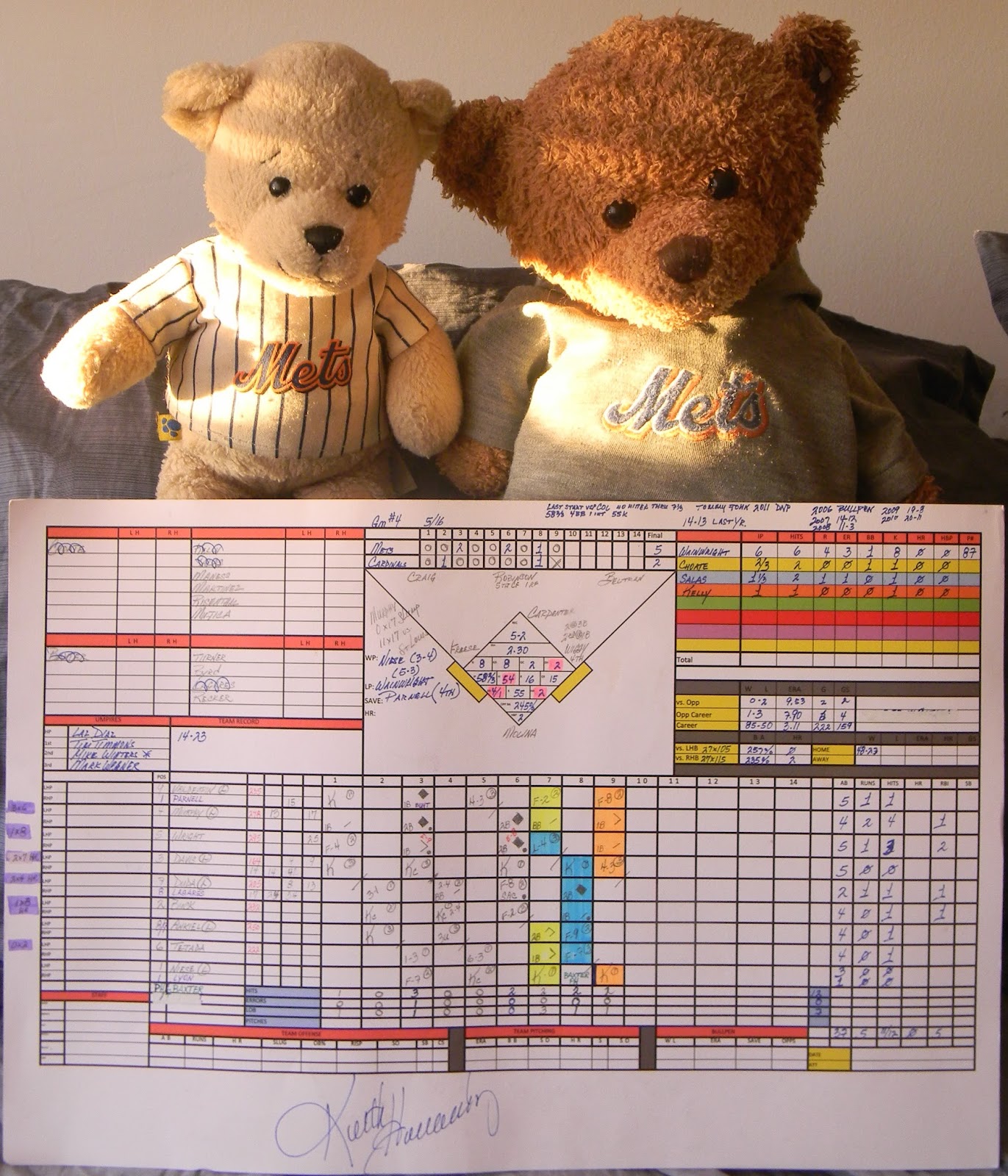
Lo and behold, we give to you our #ScoreWithKeith prize - an autographed game-used Keith Hernandez scorecard, in living (and lots of) color, as shown off by our Studious Metsimus models, Iggy and Joey Beartran.  (You may enlarge the photo by clicking on it.)


The scorecard is of the May 16, 2013 contest between the Mets and Cardinals - a 5-2 victory by the Mets at Busch Stadium.  The side that was autographed by Keith has the Mets' lineup.  The other side (not autographed) features the Cardinals' lineup.

Anytime a team is held scoreless, Keith writes a "0" on the linescore (top center of the scorecard) in pencil.  Whenever a team scores in its half-inning, Keith writes the number of runs scored in ink.  Hernandez also writes a player's career hitting statistics against the day's starting pitcher on the left side of the scorecard, highlighted in purple next to the player's name.

Note the colors used on the scorecard when the Mets were batting during the 7th, 8th and 9th innings.  Hernandez used yellow for all but one batter (David Wright) in the seventh.  He used blue for Wright's at-bat.  Keith also used blue in the eighth and orange in the ninth.  Now take a peek at the top right of the scorecard where Keith lists the pitchers used by the Cardinals.  In particular, look at the relievers used by St. Louis.  Randy Choate is highlighted in yellow, while Fernando Salas is in blue and Joe Kelly is shaded orange.  Therefore, Choate pitched the seventh inning in relief of starter Adam Wainwright.  When David Wright came up to bat, Salas relieved Choate.  Salas retired Wright and was allowed to pitch the entire eighth inning.  Kelly then came in to pitch the ninth.  It's so easy, all you kids out there can follow it with ease!

Interestingly, Keith does not write a batting average the way it is normally seen in a boxscore.  For example, Cardinals' starting pitcher Adam Wainwright had allowed a .245 batting average to opposing hitters entering the May 16 tilt versus the Mets.  But instead of writing it that way (.245), Keith wrote it as 245%.  Hernandez also writes an "x" in lieu of the word "for" when talking about a hitter's performance at the plate.  He made note of the fact that Daniel Murphy was in an "0 x 17 slump", but was "11 x 17 vs. St. Louis", meaning he was 0-for-17, but was 11-for-17 against the Cardinals.

Keith also writes various notes on his scorecard to help him during the telecast.  For example, he made a small note at the top right of the scorecard that Wainwright had pitched a no-hitter for 7⅓ innings in his last start.  He also wrote Wainwright's won-loss record in 2012 (14-13) and the fact that he missed the 2011 campaign because of Tommy John surgery.

Hernandez's penmanship in quite legible, and his use of markers, pens and pencils in a variety of colors make his scorecard very easy to interpret.  Clearly, we have no quibbles about his scribbles.  (He did misspell Matt Holliday's last name, leaving off one of the Ls, but his fundies were still excellent.)

We'd like to thank Keith Hernandez and SNY for the opportunity to score with Keith.  We hope all our readers get the opportunity to do the same before the season is over.

Here are some more photos of the scorecard, as shown off by Joey and Iggy, and some guy in a Mets jersey who decided to photobomb one of the shots.  Once again, you can enlarge any of the photos by simply clicking on it.  Enjoy!


Sunday, August 11, 2013

Wilmer Flores: The Anti-Gregg Jefferies

Be very thankful Wilmer Flores is nothing like Gregg Jefferies.

Say the name Gregg Jefferies to any long-time Mets fan and you'll get various reactions.  Some people loved his spunk and appreciated his contributions to the team as it pushed toward the 1988 NL East title.  Other cringe upon hearing his name because of the negative effects he had on the clubhouse and the team's chemistry.

Gregg Jefferies had a remarkable final five weeks of the 1988 season.  When he played his first game after his promotion on August 28, the Mets held a 6½-game lead over the second place Pittsburgh Pirates.  But Jefferies collected 24 hits in his first 13 games after the call-up, including seven doubles, two triples and five homers.  During that 13-game stretch, the Mets increased their division lead to 11 games.  With Jefferies leading the offensive charge, the Mets ended up outpacing the Pirates by 15 games to win their second division title in three years.

Jefferies fared well in his first playoff experience, reaching base 14 times (nine hits, four walks, one hit-by-pitch).  But the Mets failed to advance to the World Series, losing the NLCS to the underdog Dodgers in seven games.  Some say the reason for the team's failures in the postseason was due to Jefferies breaking up the lineup, reducing several regulars to part-time players and sending some part-time players to the bench.

You see, Jefferies was a man without a position.  His best position on the field was hitter.  When Jefferies started at third base, which he did 19 times during the regular season and in all seven playoff games, Howard Johnson moved into a platoon with shortstop Kevin Elster.  A southpaw on the mound would have Jefferies and Elster manning the left side of the infield, while a right-handed pitcher would allow for switch-hitters Jefferies and Johnson (who was a far better hitter from the left side of the plate) to play together.  Jefferies also played ten games at second base (eight starts).  That put him in a platoon with the right-handed hitting Tim Teufel, sending Wally Backman to the bench.  The veteran Backman would only start when Jefferies was needed at third base and only against right-handed pitchers.  Needless to say, that irked a lot of the established players on the team.  It also didn't help that Jefferies was a spoiled brat.

After a stellar 1988 campaign, a year in which he finished sixth in the Rookie of the Year vote despite retaining his rookie status for 1989, Jefferies suffered at the plate in his "second" rookie season.  The 21-year-old batted .258 in 1989 with 12 homers, 56 RBI and 21 stolen bases.  Those numbers weren't horrible for such a young player, but they were far short of what the Mets were expecting from him.  After all, his .314 on-base percentage was lower than his batting average (.321) the year before.

Jefferies actually led the league in doubles in 1990, becoming only the second Met to reach 40 doubles in a season (Howard Johnson became the first in 1989).  Jefferies also raised his batting average to .283, hit 15 homers and scored a team-high 96 runs, which at the time was the sixth-highest total in franchise history.  But he ran less (only 11 steals) and pouted more.  He was also becoming more of a liability in the field.

Gregg Jefferies.  Alone.  Which is where most of the team wanted to see him.

As the team's second baseman in 1989 and 1990, Jefferies finished with the third-most errors at the position in '89 and the fifth-most errors in '90.  In each season, he committed a dozen errors.  He was also terrible at turning the double play, combining to participate in 90 double plays during the two seasons.  How low was that total compared to his fellow second basemen around the league?  Well, in 1989 alone, second baseman (and former Met) Jose Oquendo turned 109 double plays.  Also in 1989, second baseman (and future Met) Roberto Alomar participated in 91 double plays.  That's more double plays than Jefferies helped turn in 1989 and 1990 combined.

By 1991, the Mets got fed up waiting for Jefferies to blossom into what they thought he'd become following the 1988 season.  Jefferies failed to reach double digits in home runs and saw his batting average drop to .272 in '91.  After a 40-double campaign in 1990, Jefferies produced only 30 extra-base hits (19 doubles, two triples, nine homers) in his final season as a Met.  That offseason, Jefferies was shipped off to Kansas City as part of a five-player deal that brought two-time Cy Young Award winner Bret Saberhagen to New York.

Jefferies did blossom after Kansas City traded him to St. Louis following the 1992 campaign, achieving career highs in batting average (.342), home runs (16), RBI (83) and stolen bases (46) with the Cardinals in 1993.  In fact, from 1993 to 1998, Jefferies batted .304, collected 233 extra-base hits and stole 111 bases despite missing nearly 200 games due to an assortment of injuries.

Gregg Jefferies was a man without a position when he was promoted to the Mets for good in 1988 (he played in six games for the Mets in 1987), but hit his way into the lineup.  Unfortunately, his teammates didn't like losing playing time to a player who whined and complained more often than he reached base during his time with the Mets.

That brings us (finally!) to Wilmer Flores.  Over the past two seasons, Flores has torn up minor league pitching to the tune of a .310 batting average, 66 doubles, six triples, 33 homers and 161 RBI in only 917 at-bats.  He's done this while bouncing around from position to position in the infield.  He played third base at St. Lucie.  Upon being promoted to Binghamton, he started to play more at second base.  This year, he played 11 games at first base at Las Vegas.

Now Wilmer Flores is with the big club, where he has moved back to third base to fill in for the injured David Wright.  In his first six games with the Mets, Flores hasn't produced all the extra-base hits Jefferies did a quarter century ago.  However, he is driving in a boatload of runs.  After an 0-for-4 debut on August 6, Flores has driven in runs in each of his last five games.  Flores hit his first homer on Sunday and has nine RBI in less than a week of service time, becoming only the third Met to drive in that many runs in his first six games with the team.  (Mike Jacobs and John Buck are the others.)  Flores has also had two games with three RBI, something that Jefferies did only once in 1988.

Both Flores and Jefferies were infielders in their early 20s when they became everyday players with the Mets.  Additionally, neither player had a true position when he was called up to the big leagues.  But there's one big difference between the two players.  Humility.

Unlike Gregg Jefferies, Wilmer Flores is not going to embarrass himself or his teammates on the field.  He still admits that he's nervous every time he steps onto the field and is not trying to take anyone's job, unlike Jefferies, who felt it was his right to be out there.  Flores is still learning.  Jefferies thought he knew it all.  It's because of that that Flores has a much better chance to be a success as a Met than Jefferies ever was.

Gregg Jefferies came up to the Mets in the middle of a pennant race.  After flourishing for a few weeks, Jefferies started showing that he was not a hitting machine like his idol, Ty Cobb.  However, he did rub people the wrong way like Cobb did.  Wilmer Flores is playing for a team that is not in playoff contention.  He's enjoying the moment, rather than trying to prove that he is the second coming of someone he's not.

Soon after Jefferies became a regular with the Mets, the team started falling apart.  The 2013 Mets are a team on the rise.  And Wilmer Flores is trying to become part of that rising team.  The word "team" was never a part of Gregg Jefferies' vocabulary while he was on the Mets.  We should all be thankful that Wilmer Flores is the anti-Gregg Jefferies when it comes to being a part of the team.  Success as a group is far more satisfying.