Sunday, August 20, 2017

Broken News: Curtis Granderson, The Underappreciated Met

Curtis Granderson smiles one last time in a Mets uniform.  (Elsa/Getty Images)

Welcome to another edition of Broken News, where someone else breaks the news and then we break it some more.  As most of you know, Curtis Granderson was traded on Friday to the Los Angeles Dodgers, a team that's currently one thousand games over .500 (give or take a couple of games) and planning its World Series parade in August.

The departure of the veteran Granderson to the Dodgers was a move that many people expected to happen for months.  However, one thing that wasn't expected was the outpouring of love for a player who heard a few boos earlier this year after a slow start to the season.  One particular fan on Twitter couldn't help but notice that Saturday's first post-Granderson game caused others to dust off their Granderson apparel to wear at Citi Field.


Curtis Granderson went through his share of slumps in nearly four years as a Met, as evidenced by his .239 career batting average with the team.  However, in his short tenure in Flushing, he earned every penny of the free agent contract he signed prior to the 2014 season and provided several moments that caused many a fan to get out of their seats and cheer.  He was also much more valuable than most people think.

For example, as much as people say Daniel Murphy was a postseason hero in 2015, and he was, at least in the NLDS and NLCS, did you know that it was Granderson who led the team in RBIs during that magical playoff run?

Murphy may have hit seven home runs in 14 playoff games in 2015, but that only led to 11 RBIs.  Granderson drove in a dozen runs batting out of the leadoff spot in the batting order.  The right fielder reached base 24 times in those fourteen October and November games, stole four bases and scored ten runs, all while striking out just seven times in 64 plate appearances.  Compare that to Murphy, who struck out seven times in the World Series alone when he forgot that the postseason didn't end after the Mets won the pennant.

In the Division Series, Murphy hit three of his seven postseason homers and almost single-handedly won Game Five.  But there may not have been a Game Five had the Mets not won the critical Game Three, and Granderson collected the series-turning hit in that contest.  After the Mets lost the second game of the series on Chase Utley's leg-breaking slide, the Dodgers took an early 3-0 lead in Game Three.  Not wanting to face elimination in Game Four with Clayton Kershaw on the mound, the Mets stormed back against starter Brett Anderson.  New York scored a run in the third and loaded the bases for Granderson, who promptly cleared them with a long double to center field.  With that blast, the Mets took a lead they would not relinquish and went on to win the series.

Granderson continued to give the Mets leads in the NLCS, driving in the go-ahead run in the fifth inning of Game One against the Cubs.  His two-out RBI single broke a 1-1 tie and the Mets would never trail in the series; a four-game sweep in which Granderson reached base five times, scored three runs and stole three bases.

Had the Mets defeated the Royals in the World Series - a Fall Classic Murphy famously didn't show up for - Granderson would have been the odds-on favorite to take home the World Series MVP trophy.  In the five-game series, Granderson hit three homers and scored six runs.  No one else on the team crossed the plate more than two times.  Each of Granderson's three homers gave the Mets a lead, but unfortunately, the Mets could not capitalize on Granderson's penchant for providing emotional lifts with the fly balls he lifted into the outfield seats.  New York coughed up all three leads Granderson gave them and lost a heartbreaking World Series.

Murphy got all the accolades (and the lucrative free agent contract) for what he did in the 2015 postseason, but Granderson was the most consistent player the Mets had during their October run.  His clutch hitting should not be buried behind Murphy's exploits.

So what else did Granderson do as a Met that went largely ignored by his detractors?  During his tenure with the Mets, no position player had a higher WAR than Granderson.  His 10.4 bWAR is higher than the runner-up in this category, Juan Lagares, who posted an 8.0 bWAR from 2014 to 2017.  Everyday players like Yoenis Céspedes (6.3 WAR) and Michael Conforto (5.9 WAR) didn't play for the Mets in 2014 and the first half of 2015, but Granderson's 5.1 bWAR in 2015 alone was higher than the combined WAR put up by Céspedes (2.3) and Conforto (2.1) in just over 400 plate appearances between the two.  To put Granderson's Mets career in perspective, the only player on the team with a higher WAR since 2014 is Jacob deGrom, who has a 15.5 bWAR since his Rookie of the Year award-winning 2014 campaign.

Finally, had Granderson stayed a Met for another few weeks, he would have joined some elusive company.  Granderson hit 19 HR in 2017 before being traded to the Dodgers.  In his first three seasons with the team, he clubbed 20, 26 and 30 home runs.  Had he hit one more homer before the trade, he would have become just the sixth Met to reach 20 home runs in four consecutive seasons.  The other five?  You may have heard of them.  Their names are Darryl Strawberry, Kevin McReynolds, Howard Johnson, Mike Piazza and David Wright.  Not a stinker in the bunch.

Granderson finished his Mets career needing five homers to reach 100 with the team.  Had he reached triple digits, the Mets would have been the third team for which he hit 100 homers, as he accomplished the feat with the Tigers (102 HR) and the Yankees (115 HR).  Only five men have ever homered at least 100 times for three different teams.  Four of the five are Hall of Famers and potential Hall of Famers (Reggie Jackson, Jim Thome, Alex Rodriguez, Adrian Beltre).  The other is Darrell Evans, who hit 414 HR in his career and won a World Series ring with the 1984 Tigers, something Granderson is now shooting for as a member of the Los Angeles Dodgers.

Perhaps most importantly, in this era when Mets trainer Ray Ramirez is Public Enemy No. 1 because of all the injuries that have befallen Granderson's former Mets teammates, it should be noted that Granderson played in 573 of a possible 606 games during his time as a Met.  He played in 150+ games in each of his three full seasons with the team and had played in 111 games this season before the trade, putting him on pace for another 150-game campaign.  To put that in layman's terms, Granderson never went on the disabled list as a member of the Mets.  The Hospital For Special Surgery - also known as the second home for many members of the Mets - only saw him during the 2015 off-season, when he went in for thumb surgery.  But I'm sure he made several appearances visiting patients while he was there.  Because that's the kind of guy Granderson is.

Curtis Granderson was loved by his teammates and by members of the community.  His charitable efforts and work with children and the needy earned him the Roberto Clemente Award in 2016.  His performance in the 2015 World Series could very well have brought him an MVP trophy had the Mets not surrendered the crown to the Royals.  His career numbers with the team in less than four full seasons are among the best in franchise history.  And lest we forget, his final hit as a Met was a grand slam against the Yankees.  Despite all this, Granderson was very much underappreciated by Mets fans.  Or so we thought.  The love on Twitter after his departure and the plethora of Granderson shirts and jerseys at Citi Field last night tell another story.

Granderson was actually very much appreciated by supporters of the Mets.  It's too bad it took his departure for most of them to realize his value to the team and the city he played in.
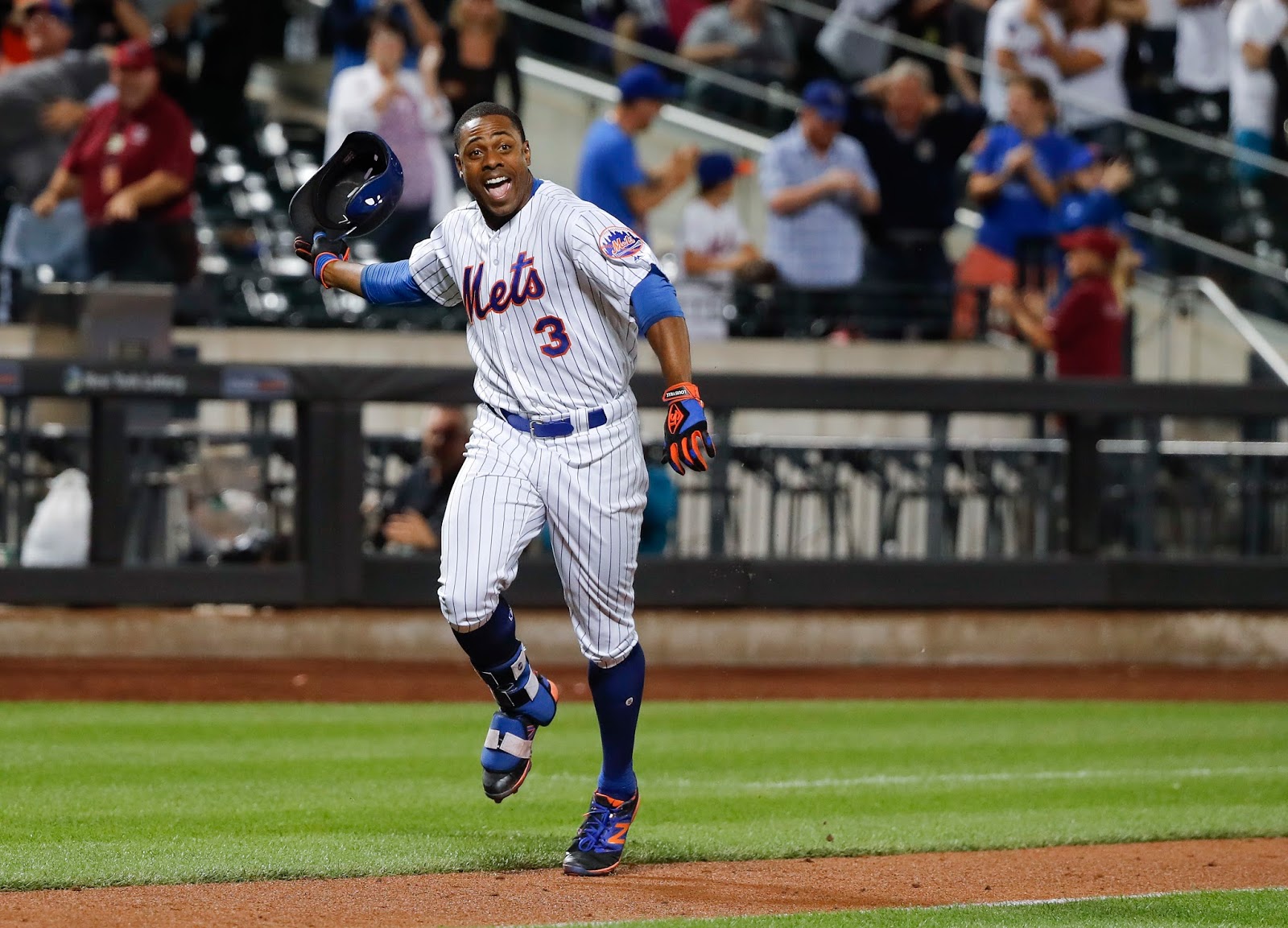
We tip our cap to Curtis Granderson, who walks off to Los Angeles as a great Met. (Julie Jacobson/AP)

Wednesday, August 16, 2017

30 Years Ago Today: Mets Score Club Record 23 Runs in a Game

The late Harry Caray probably wishes he hadn't been taken out to the ballgame on August 16, 1987.

The New York Mets are currently playing the crosstown rival Yankees in a four-game home-and-home series.  Thirty years ago today, the Mets were playing another of baseball's storied franchises, taking on the Chicago Cubs on a lazy Sunday afternoon at Wrigley Field.  One year after winning the 1986 World Series, the Mets were battling the St. Louis Cardinals for the division title and needed to win the finale of their four-game set against the Cubs after dropping the first three games.  They were in the throes of a poor stretch that saw them lose six out of eight games after they had cut the Cardinals’ lead in the division from 10½ to 3½ games.  In that eight-game stretch, they had scored only 20 runs.  They needed to bust out of their slump quickly if they were going to continue to stay in the race with St. Louis.  Fortunately, the wind was blowing out at Wrigley Field on August 16, 1987 and the Mets’ bats were ready to take advantage.

The starting pitchers were Ron Darling for the Mets and a kid for the Cubs who had just been recalled from the minors after being sent down two weeks earlier due to a poor 6-10 start for the big club.  You may have heard of him.  He was a scrawny 21-year-old kid named Greg Maddux.

The Mets jumped out of the box quickly, scoring three runs in the first inning to take an early lead.  The lead had extended to 7-0 by the time the Cubs came up to bat in the bottom of the fourth inning.  However, Darling struggled in the fourth, giving up a grand slam to catcher Jody Davis.  That was followed up by a home run from the next batter, a rookie who was pinch-hitting for Cubs reliever (and former Met) Ed Lynch.  That neophyte was Rafael Palmeiro, who hit the tenth of his 569 career home runs to cut the Mets lead to 7-5.

Fortunately for Darling, manager Davey Johnson did not remove him from the game despite the poor inning.  He was allowed to put out the fire he started and pitch the minimum five innings required to qualify for the victory.  Because of that, Darling was able to stick around to reap the benefits of the additional fireworks displayed by his teammates as they continued to ride the jet stream out of Wrigley Field.

The Mets immediately responded to the Cubs’ five-run fourth by scoring three runs in the fifth inning and seven additional runs in the sixth.  They now had a commanding 17-5 lead, but the Cubbie carnage continued.  Not satisfied with a lead of a dozen runs, they scored three additional runs in both the seventh and eighth innings.  Jesse Orosco relieved Darling in the seventh and gave up four runs in his inning of work, but by then, the Mets had already put the game away.  A run by Chicago in the ninth inning off Jeff Innis produced the final tally in the Mets’ 23-10 shellacking of the Cubs.

The offense was powered by Lenny Dykstra and Darryl Strawberry.  Eights were wild for the two Met outfielders, as they combined for eight hits, eight runs scored and eight runs batted in.  Strawberry in particular smoked the Cubs’ pitchers, as all four of his hits went for extra bases (two doubles, a triple and a home run).

Dykstra and Strawberry - two smiling California kids who put lots of frowns on Cubs fans' faces on August 16, 1987.

In doing so, Strawberry became just the third Met to produce four extra-base hits in one game, joining Joe Christopher, who accomplished the feat in 1964, and Tim Teufel, who turned the trick just six weeks prior to Strawberry.  Strawberry added a stolen base in the second inning, making him the first Met to collect four extra-base hits and a stolen base in the same game.  The Straw Man was the only Met to accomplish this feat until Yoenis Céspedes matched him with four extra-base hits (three homers, one double) and a steal against the Colorado Rockies on August 21, 2015.

Strawberry also became just the third Met to score five runs in a game, after Lenny Randle in 1978 and Lee Mazzilli in 1979.  In addition, the Straw Man drove in five runs, making him the first Mets player to have a five-run, five-RBI game in franchise history.  The only other Mets to accomplish that rare feat since August 16, 1987 are Edgardo Alfonzo, who produced six runs and five RBI against the Houston Astros on August 30, 1999, and Céspedes in the aforementioned 2015 affair.  He had seven RBI to go with his five runs scored.

Dykstra also made Mets history in the game, becoming the first Met to collect seven at-bats in a nine-inning game.  The only Met to match Dykstra since then is Luis Hernandez, who went 3-for-7 in an 18-5 thrashing of the Cubs in 2010, which, just like Dykstra's record-setting effort 23 years earlier, took place on a lazy Sunday afternoon at Wrigley Field.

Strawberry and Dykstra victimized several Cubs pitchers that day, including starting pitcher Greg Maddux.  Maddux collected almost 10% of his 355 career wins against the Mets.  His 35 victories (against 19 losses) are the most by any pitcher against New York.  However, one of his worst pitching performances against the Mets (or any other club) took place on that Sunday afternoon in the North Side of Chicago.

Throughout his major league career, which resulted in a much-deserved call to the Baseball Hall of Fame this year, Maddux was always known as a control pitcher, as he walked fewer than 1,000 batters in over 5,000 innings.  But on August 16, 1987 against the Mets, Maddux pitched 3⅔ innings and was charged with seven earned runs allowed.  He gave up six hits and a very un-Maddux-like five bases on balls.  Let's dissect Maddux's effort to see just how much of an anomaly this game was for him.

Greg Maddux would have preferred starting at Shea Stadium on August 16, 1987.

Greg Maddux made 740 starts in his big league career.  He issued five bases on balls or more in just 20 of those starts.  But in 14 of those 20 starts, he lasted at least six innings, giving him more time to issue those free passes.  Maddux wouldn't have another game in which he lasted fewer than four innings and allowed five or more walks until 2004, a year in which he produced his first ERA above 4.00 since - you guessed it - 1987.

Maddux also allowed seven earned runs in the game, which was the first time he had ever allowed that many runs in one of his starts.  Maddux would go on to allow seven or more earned runs in a start a total of 27 times in his career, including three more times against the Mets, but he never walked more than three batters in any of his other seven-run efforts.  The game on August 16, 1987 was the only time in his 23-year career that Maddux allowed seven or more runs and walked more than three batters.  And that was from a future Hall of Famer who beat the Mets more than any other pitcher in the 56-year history of the club.

Going into their series finale against the Cubs on August 16, 1987, the Mets were in a hitting slump and got out of it in a major way at Wrigley Field.  They scored more runs in that one game than they did in their previous eight contests combined.  By doing so, the Mets established a new franchise record with their 23-run outburst in Chicago and were able to use that game as a stepping stone that carried them all the way until the last week of the season, when they were eliminated from playoff contention by the Cardinals.  And it all happened exactly 30 years ago today.


Thursday, August 3, 2017

Michael Conforto Could Join an Exclusive OBP Club

Make way for Michael Conforto, the OBP Machine!  (Mike Stobe/Getty Images)

In Wednesday's 10-5 victory over the Colorado Rockies, Michael Conforto reached base twice in five plate appearances, holding his on-base percentage at an impressive .401.  Despite Conforto's inability to crack the starting lineup early on (he started just four of the team's first 15 games), his 359 plate appearances currently qualify him for all full-season leaderboards, and as such, allow him to rank seventh in the National League in OBP.

Should Conforto maintain his .400-plus on-base percentage and reach the minimum 502 plate appearances to qualify for the batting title (or OBP title), he would join a very exclusive club of Mets players to accomplish that feat.  In fact, during the team's first 55 seasons, only seven players have reached base in at least 40% of their plate appearances when they had a sufficient number of trips to the plate.


Rk Player Year OBP PA AB R H 2B 3B HR RBI BB HBP SH SF BA SLG OPS
1Cleon Jones1969.42255848392164254127564713.340.482.904
2Keith Hernandez1984.40965755083171310159497109.311.449.859
3Keith Hernandez1986.41365255194171341138394403.310.446.859
4Dave Magadan1990.41754145174148286672742410.328.457.874
5John Olerud1997.4006305249015434122102851308.294.489.889
6John Olerud1998.44766555791197364229396417.354.551.998
7Rickey Henderson1999.42352643889138300124282213.315.466.889
8John Olerud1999.42772358110717339019961251106.298.463.890
9Edgardo Alfonzo2000.425650544109176402259495506.324.542.967
10David Wright2007.4167116041131964213010794607.325.546.963
11Michael Conforto2017.4013593026189191215647802.295.573.974
Provided by Baseball-Reference.com: View Play Index Tool Used
Generated 8/3/2017.


Cleon Jones became the first Met to do so in 1969, reaching base at a .422 clip and propelling the team to a World Series title.  It wasn't until the Mets' 23rd season that Jones had company in this formerly one-man club, as Keith Hernandez produced a .409 on-base percentage in 1984; the Mets' first 90-win season since Jones and his teammates won it all 15 years prior.

Hernandez repeated his .400-plus OBP feat two years later, when he helped the Mets take home their second World Series trophy.  Keith's fill-in at first base in the 1986 division clincher became the third Met to play a full season with an on-base percentage greater than .400, as Dave Magadan flirted with a batting title in 1990 before settling for third place in that race, but still managed to produce a lofty .417 OBP in 541 plate appearances.

After Magadan's one-year wonder campaign, the Mets played musical chairs at first base.  From 1991 to 1996, the Mets had a plethora of players who became their everyday first baseman, including Magadan himself in '91, future Hall of Famer Eddie Murray in '92 and '93, David Segui in '94, Rico Brogna in '95 and Butch Huskey in '96.  It wasn't until they made one of the most one-sided trades in club history that they found a starter for more than two seasons, and he became the team's all-time OBP king.

John Olerud was a Met for only three seasons, but he reached base at least 40% of the time in all three campaigns.  In 1997, he became the first Met with a .400 OBP over a full season in seven years.  He then followed it up with a .447 OBP in 1998, which remains a single-season franchise record, and a .427 OBP in 1999, when he helped the team advance to within two victories of a World Series berth.  His 1999 teammate, Rickey Henderson, didn't want Olerud to party alone in the .400 club, so he crossed the velvet rope and put up a .423 on-base percentage of his own.

A year after Olerud and Henderson became the team's first pair of .400 OBP players, they were both gone, as Olerud signed a free-agent contract to return home to Seattle and Henderson played his way out of New York, earning his release from the team in May.  But a new man took over the reins as the team's resident .400 on-base guy in 2000, as Edgardo Alfonzo posted a career-high .425 OBP in helping the team win its fourth National League pennant.

In the 16 seasons since Fonzie went over .400 in the OBP column, only one Met has joined him in the .400 club.  That would be David Wright, who in 2007 became the most recent player to achieve an on-base percentage of .400 or greater, as he reached base at a .416 clip for the 88-win Mets.

For the past ten seasons, Cleon Jones, Keith Hernandez, Dave Magadan, John Olerud, Rickey Henderson, Edgardo Alfonzo and David Wright have been the only seven players to post a .400 OBP over a season of at least 502 plate appearances.  Now Michael Conforto and his .401 on-base percentage are threatening to make this an eight-man club.  But one other thing stands out among the members of the .400 club that Conforto could have a tough time duplicating.

When Jones became the first Met to post a .400 OBP over a full season in 1969, he did so for a 100-win team.  Hernandez had his .400 seasons in 1984 and 1986 when the Mets won 90 and 108 games, respectively.  Magadan's 1990 campaign ended with 91 Mets victories, while Olerud's three .400 OBP seasons occurred during 88, 88 and 97-win campaigns.  (Rickey's season gave us 97 wins as well.)  When Fonzie did it, the Mets won 94 regular season games.  And Wright's high OBP helped the Mets win 88 games.

See a pattern forming there?  Every player who produced a .400 OBP over a full season played for a Mets team that finished with a winning record.  In fact, the worst record by a Mets team that had such a player was 88-74.  That's a far cry from the current Mets team, which is currently seven games under .500 at 49-56.

This year has been an anomaly for the Mets; a year in which the pitching has been the team's greatest disappointment when it was supposed to be an asset.  If Michael Conforto finishes the season with an on-base percentage above .400, it will be anomaly for another reason.  Barring a late-season push in the standings, it would mark the first time a Mets team employed a player with a .400-plus OBP and failed to produce a winning record.  Even with a surge in August and September, the team would be hard pressed to reach 88 victories; the minimum number of wins produced a Mets club that had a .400 OBP player.

Michael Conforto has been a steady presence in the field and at the plate.  He's also been a steady presence on the basepaths, reaching base more than 40% of the time in 2017.  However, his team hasn't been able to take advantage of his keen ability to not make outs.  The potential to join an exclusive seven-man club that includes several all-time Mets greats is a fine accomplishment.  It would be far better if Conforto could match Jones, Hernandez, Magadan, Olerud, Henderson, Alfonzo and Wright by joining that club while playing for a competitive Mets team.


Saturday, July 15, 2017

Move Along, People! No Unicorn Score to See Here!


On Friday, the Mets defeated the Colorado Rockies by a final score of 14-2.  As blogfather, author and respected Unicorn Score researcher Greg Prince noted, it was the first time in the team's 56-year history that they had won a game by that exact score.  Hence, 14-2 is referred to as a Unicorn Score, which as defined by our fervent Faith and Fear friend is "a score by which the Mets win once and never again."

As of this writing, the fewest runs scored by the Mets in a Unicorn Score game is 11, which they accomplished on May 20, 1999 when they defeated the Milwaukee Brewers, 11-10.  Not only is that the only time in Mets history that the team has won a game by an 11-10 score, but that May 20 affair was the first of two games played by the Mets that day; a day in which Robin Ventura clubbed grand slams in each game, which made him the first - and still only - player in big league history to accomplish that feat.

In addition, the Mets have never won a game by a 12-11 score in franchise history.  That remains the fewest runs needed by New York to win a game by a Unicorn Score.  (They've lost two games by a 12-11 score, but like the numbers of ringzzzz the Yankees have, we don't care about those.)

But what about anti-Unicorn Scores?  Which scores are the most common in Mets history when the team has taken care of business and emerged victorious?  I'm glad you asked.  (Trust me, you asked.  I heard you through the screen.)

The most common score in a Mets victory - an anti-Unicorn Score, if you will - is not surprisingly, a low-scoring game that was decided by one run.  The Mets have won 291 games by the exact final score of 3-2.  In their 1969 championship season alone, the Mets won 11 games by that score.  Incredibly, the Mets have won at least one game by a 3-2 score in each of their first 55 seasons.  However, they have yet to win a 3-2 game in 2017.

There are two other scores that have resulted in happy recaps more than 200 times.  Those scores are 2-1 (Mets have won 247 games by that score) and 4-3 (241 of those).

Want more?  The most repeated final score in Mets victories that weren't decided by a single tally is 4-2.  New York has celebrated 182 of those identical wins.  And the team the Mets have beaten the most by the exact same final result?  That one is a surprise.  Despite never playing in the same division and thereby having fewer games scheduled against them than they would against N.L. East squads, the Mets have defeated the Cincinnati Reds 33 times by a 3-2 score.  All but one of those 3-2 victories happened from 1962 to 2002, as the Mets have only defeated the Reds once in the last 15 years by a 3-2 margin.

Blue and orange unicorns do exist.
In 2015, the Mets won a 14-9 game for the first time in team history, defeating the Rockies by that score.  That Unicorn Score lasted 24 hours, as the following day, the Mets beat Colorado by that twice-in-a-lifetime score.  Last night, the Mets put up another Unicorn Score against the Rockies in their 14-2 victory.  Perhaps this time around, they'll follow it up by winning with the most common anti-Unicorn Score of 3-2.  If they do, it would be the first time they've defeated anyone by that score this year.

As the saying goes, if you watch baseball long enough, you'll end up seeing something you've never seen before, like a Unicorn Score.  Or maybe you'll see something you've seen over 200 times before, like a 3-2 Mets victory.  I wonder what the team has in store for us tonight.


Sunday, June 11, 2017

The Mets Have Been BABIP'ed to Death in 2017

Steven Matz was a BABIP-buster in his first start of 2017.  (Daniel Shirley/Getty Images)

The Mets have been living in a bizarro world in 2017; a world in which their offense has been decent (third in homers, seventh in runs scored, .285 BA w/RISP) but their pitching has been suspect.  The team's 4.82 ERA is third-highest in the majors, with only the cellar-dwelling Padres (4.98 ERA) and Phillies (5.00 ERA) faring worse and all American League teams (a.k.a. the league that has to face a D.H.) faring better.

Although the Mets have allowed a ton of runs over their first 60 games of the season, it could actually be a lot worse, as the team has the highest WHIP in the National League (1.478), which is just barely better than the poorest mark in the American League, held by Baltimore (1.480).

Opposing hitters are constantly getting on base against the Mets, whether it be via base hits or one of the shockingly high number of walks allowed by the team's pitchers.  And it doesn't take a rocket scientist to tell you that those lofty baserunner totals will in turn lead to crooked numbers on the scoreboard.

Batting average against, WHIP and ERA tell us part of the story of the 2017 Mets' failures on the mound, but not the complete story.  In fact, something not found in the daily boxscores could be more significant in determining how the Mets will fare for the remainder of the season.  And that something is sponsored by the letters B, A, B, I and P.

Batting average on balls in play (BABIP) is calculated by taking the number of hits that don't leave the yard and dividing that by at-bats minus strikeouts minus home runs plus sacrifice flies.  To the mathematically inclined, it looks a little something like this:

(Hits - HR) / (AB - SO - HR + SF)

At-bats that result in strikeouts and home runs cannot be affected by a defensive player, so those numbers are subtracted.  Sacrifice flies, on the other hand, are caught by the player on defense, but do not count as an at-bat for the hitter, hence why they are added in the denominator.  In layman's terms, BABIP measures the percentage of balls in play that result in base hits.

In general, a .300 BABIP is considered average.  Therefore, a pitcher who allows a BABIP under .300 generally has a solid defense behind him (they're good at getting to balls and converting them into outs).  Luck can also be a determining factor in a low BABIP, as the pitcher may be giving up line drive after line drive, but those liners may be headed directly at the defensive players' gloves.  Therefore, if a pitcher has a low BABIP, eventually it is to be expected that that figure will regress to the mean of .300 at some point.  Likewise, a pitcher who allows a BABIP over .300 can expect the balls that are put in play to find the gloves of his defense reasonably soon.

According to fangraphs.com, Mets pitchers have allowed the highest BABIP (.321) of any team in baseball this season.  No other National League team is even close, as the Pittsburgh Pirates have the second-worst BABIP against them at .308.

Jacob deGrom's BABIP?  It's an unsustainable .350, which means his 4.75 ERA is bound to go down once his BABIP begins to do the same.  Similarly, Robert Gsellman (.317 BABIP) and Zack Wheeler (.305) should also improve as the season progresses, with Gsellman already showing signs of his BABIP returning to the typical .300 level.  Even Noah Syndergaard, who was pitching extremely well before a lat injury sent him to the sidelines, had a .329 BABIP against him in five starts, which suggested that his best efforts were yet to come.

The BABIP bug that has affected deGrom, Gsellman and the plethora of spot starters on the team has also found its way to the bullpen, as Fernando Salas (31 appearances, .313 BABIP), Josh Smoker (21 appearances, .357 BABIP) and Paul Sewald (17 appearances, obscenely high .422 BABIP) have had difficulty with batted balls finding the outfield grass instead of their defense's gloves.

Unfortunately, most of these high BABIP figures are the fault of the Mets' subpar defense.  If the defense doesn't have the range or speed to get to ground balls in the hole or fly balls in the gaps, then more hits will result.  It is why teams like the Twins, Yankees and Rockies are in first place in their respective divisions, as all three of those teams rank in the top five in defensive efficiency, converting many of the balls put in play against them into outs.

For the record, the Mets' .664 defensive efficiency is the worst in the majors.

The unwritten laws of BABIP say that pitchers with a figure north of .300 will eventually allow fewer hits on balls put in play.  With the Mets sporting a major league-worst .321 BABIP entering today's game, the days of 7-6 and 9-8 losses could be coming to an end.  Saturday's doubleheader sweep of the Braves, in which the Mets allowed a total of two runs could become the norm in the very near future.  Of course, the defense is going to have to step up its game so that those BABIPs don't continue to be the downfall of what was supposedly one of the best pitching staffs in baseball.

Oh, and while on the topic of BABIP, Matt Harvey better put on his big boy pants soon.  His 5.02 ERA may be an eyesore, but it could (and should) be far worse.  Through his first 12 starts, the BABIP against him is a ridiculously low .259.  The Dark Knight may very well be looking forward to some dark nights at Citi Field once that number starts to creep up closer to the norm.

************

Speaking of the Dark Knight, it is with great sadness that we mourn the passing of TV's Batman, Adam West.  West was anything but dark in the campy program, entertaining viewers through the show's reruns for half a century.  He also lent his voice and name to the mayor on "Family Guy".  West remained quite popular with fans and pop culture enthusiasts until his death Friday night at the age of 88.  His Family Guy character may have hated baseball cards, but baseball and non-baseball fans alike loved Adam West.  May he rest in peace.


Monday, May 29, 2017

Memorial Day and My Mets Fandom

Today is Memorial Day, a day in which we honor the men and women who served in the military and gave up their lives to protect the United States and its people.  Memorial Day is also special to me as a Mets fan, for it was on the day we observed the holiday in 1981 that I became a Mets fan.

On Monday, May 25, 1981, I was off from school.  I had been looking forward to Memorial Day for weeks because my father promised we'd have a barbecue in the backyard.  Something about having burgers while fending off mosquitoes always made eight-year-old me giddy with anticipation.  But unfortunately, that outdoor food and fly-swatting fest was not to be, as my father did not feel well and was bedridden all day.

Of course, as most children my age would do, I was more upset about not having burgers and potato salad that day than I was about the condition of my father.  Instead of counting down the hours and minutes to the unveiling of the grill, I spent all morning and early afternoon moping in the living room.  Eventually, I took advantage of the fact that my father was in bed, which left his favorite recliner that no one was allowed to sit on open for the taking.  So of course, I turned on the TV and plopped myself in his comfortable chair.  Since it was 1981 and we weren't a remote control household, I didn't feel like getting up to change the channel.  The last thing anyone had watched the night before was on WOR (Channel 9), so that's what I would make myself watch to take my mind off the postponed barbecue.

Channel 9 had always been the TV home of the New York Mets, but in 1980, fledgling cable network Sportschannel began to air Mets games as well.  Fortunately, the Memorial Day game in 1981 was scheduled to be broadcast on Channel 9 and the allure of the velour prevented me from getting off the recliner to change the channel.  So it was the Mets for me on that day.  And it's been the Mets for me ever since.

The Mets played the Philadelphia Phillies in the Memorial Day matinee and they showed no brotherly love for their division rivals, defeating them in a 13-3 laugher.  Although many players performed well for the Mets that day (Hubie Brooks, Lee Mazzilli and Joel Youngblood had three hits apiece, Dave Kingman hit a grand slam and starting pitcher Greg Harris earned his first major league victory), it was Mookie Wilson who captured my attention and made me thankful that we didn't possess a remote control.  Mookie reached base four times that day (two hits, two walks).  He also scored three runs and drove in two.  After leading off the game with a walk, Mookie proceeded to swipe second and scored the first of the Mets' four runs in that inning.  It was the first time I had been exposed to Mookie's baserunning abilities, and I was utterly amazed.  Six innings later, Mookie crushed a long drive to center off former Met Tug McGraw that went for a two-run triple.  His gazzelle-like speed mesmerized eight-year-old me to the point where I checked the TV guide - I had to get off the couch eventually - for when the next Mets game was going to be aired on WOR.


Less than three weeks after discovering Mookie and the Mets, baseball went on strike.  For two months, I couldn't indulge in my new passion - my New York Mets passion, that is.  Fortunately, my father recovered from his illness and we were able to have many barbecues to pass the time during baseball's two-month hiatus.  Baseball returned to my TV screen in August, and I quickly eschewed burgers and hot dogs on the grill for Mookie and the Mets in front of my grill.

Thirty-six Memorial Days later, I'm still a Mets fan and I will be attending today's game against the Milwaukee Brewers at Citi Field.  But just think of how everything had to fall into place for my Mets fandom to begin the way it did.

Had my father not been ill, I never would have watched the Mets that day.  It would have taken longer for me to develop an interest in baseball, especially since my father wasn't a sports fan and couldn't tell me the difference between an infield fly and an unzipped fly.

Also, if someone had left the TV on a channel other than Channel 9 the previous night, I might have become a daytime soap opera fan instead of a Mets fan and this blog post would be about the wedding of Luke and Laura and not the running of Mookie Wilson.

And last, but certainly not least, had the Yankees been playing a day game rather than a night game in Baltimore, I might be bragging about ringzzzz today.  Fortunately, the Yankees had no day game on the docket and even if they had, they were blown out by the Orioles on Memorial Day 1981 so I wouldn't have looked forward to their next game as much as I was for the Mets after their philleting of the Phillies.

My father is now 81 years old.  He has taught me many things about life and love.  On May 25, 1981, he probably wanted to teach me how to make a well-done burger.  But on a day when he was too sick to gave me any instruction, he inadvertently taught me how to be a Mets fan.  And my life would not have been the same had I not developed that love and passion for the team.  I met my wife because of the Mets and I've made many new friends due to our shared love of the orange and blue.

Memorial Day will always be special to me, thanks to my now-healthy father, a chair of incredible comfort and the fleet feet of Mookie Wilson.  I still need that lesson on how to make a perfect burger, but my father can teach me whenever the Mets aren't playing.

The grill master to the left, the former eight-year-old couch potato to the right.

Sunday, May 7, 2017

How Are the Mets Scoring All These Runs?

High fives at the plate have become more prevalent for the Mets these days.  (Jim McIsaac/Getty Images)

On Saturday, the Mets defeated the Miami Marlins, 11-3.  The drubbing of the Fish was the ninth consecutive game in which the team scored five or more runs.  It was also just the fifth time in franchise history that such a streak had been reached, surpassed only by a 12-game stretch in 2007.

What makes this current streak all the more impressive is that the Mets are doing it without the services of disabled sluggers Yoenis Céspedes and Lucas Duda, and with middle-of-the-order hitter Curtis Granderson batting .139.  Even the healthy players have been having a rough time during the season's first five weeks, as their combined .233 batting average is tied with the San Francisco Giants for the second-lowest in the National League.  (Only the San Diego Padres are lower, at .217.  It should be noted that the Giants and Padres have the the two worst records in the N.L., as they have combined to go 23-40 through Saturday's games.)

So what exactly have the Mets been doing to produce all these runs during this recent outburst of offense?  Smoke, mirrors and the threat of Ray Ramirez paying a visit to the visitors' clubhouse can only go so far.  Let's take a look at how a depleted team has become an offensive juggernaut practically overnight.

Rk Strk Start End Games R H 2B 3B HR BB SB CS BA
1NYM2007-08-112007-08-2412831302311754272.304
2NYM2017-04-272017-05-0697191281153552.287
3NYM2006-06-062006-06-159741083041237162.319
4NYM2002-09-062002-09-139611031411529122.307
5NYM1990-06-081990-06-16985128351174024.370
Provided by Baseball-Reference.com: View Play Index Tool Used
Generated 5/7/2017.


In scoring nearly eight runs per game over their last nine contests, the Mets have been able to move from last place in the division to second place.  However, despite the fact that the players have been doing a conga line around the bases for the last week and a half, the team has managed to bat just .287 during those nine games.  Although this a marked improvement from their low Mendoza-like average, it's still the lowest batting average of the five Mets teams that have produced nine-game streaks of 5+ runs (see chart above).  In fact, it's the only time the Mets have had such a streak without batting over .300 or collecting 100 hits to accomplish it.

The Mets have been bunching their hits together to produce crooked numbers on the scoreboard.  During their nine-game skein, the team has come to bat in 79 innings.  They've failed to score in 50 of those frames and scored one run in ten of the innings.  For all you kids out there, that's a total of ten runs scored in 60 innings.  That means the other 61 runs during the streak have been scored in just 19 turns at bat.

In last night's game, the Mets pushed across 11 runs.  Every time they scored in an inning, they scored at least three times.  (They scored five times in the first and touched the plate three times in both the fifth and seventh.)  In their come-from-behind victory on Friday, they used another five-run seventh inning to complete their comeback.  In each of the last five games, the Mets have had at least one inning in which they scored four or more runs.  That'll certainly help a team continue a streak of 5+ runs per game.

In addition to the big innings, the Mets have also been teeing off on opposing teams' bullpens in the late innings.  The Mets have batted 25 times during the streak from the seventh inning on.  They've scored 26 runs in those 25 innings.  Included in this is Jay Bruce's grand slam with two outs in the ninth inning against the Braves on Tuesday, which pushed the Mets' run tally for the night from three runs to seven.  Yup, without the four-run blast, the 5+ run streak would have ended and I'd be writing about the sex toy in Kevin Plawecki's locker or Matt Harvey's suspension instead.  (What do you mean those would have made better topics?)

The main reason the Mets have been scoring a handful of runs a night is because they're killing it with runners in scoring position.  Prior to the streak, the Mets were doing fairly well with runners on second and/or third, batting .277 in those situations (28-for-101).  That number for the season is now up to a whopping .328 (62-for-189), as the Mets have gone 34-for-88 (.386) with runners in scoring position in their last nine games.  That would also explain why the team hasn't needed to follow their usual formula of home runs or nothing to score their runs.  The Mets failed to hit a homer in their two highest scoring games of their nine-game streak (16 runs, no homers on Wednesday; 11 runs, no homers last night).

Here's the crazy thing about this streak.  It could very well continue, or at the very least, be interrupted by no more than a game or two before a similar streak begins.  Why is that?  Because the team still has a ridiculously low .252 BABIP this season.  Eventually that number has to get closer to .300, and when it does (as it's trying to do now), the runs will light up the scoreboard.  As you can see in the chart below, over the last 14 days (ten games), the Mets have produced a slight lower-than-normal .291 BABIP and have still managed to average 7.3 runs per game.  They're averaging nearly double-digit runs per game with a .320 BABIP over the last week.

Split GS R BAbip
2017 Totals29152.252
Last 7 days549.320
Last 14 days1073.291
Provided by Baseball-Reference.com: View Original Table
Generated 5/7/2017.


Hot streaks come and go.  The one the Mets are currently on could come to an end soon.  But the low BABIP over the first five weeks and the production with runners in scoring position all season leads me to believe that it won't come to a crashing halt.  In fact, the Mets might actually not have their annual June swoon next month, especially since most of their injured everyday players could be back by then.

It's not smoke.  It's not mirrors.  It's just a good baseball team finally doing what they were supposed to do when they were put together.