Showing posts with label All-Star Game. Show all posts

Monday, February 17, 2014

The Best On The Worst: Ron Hunt

Throughout the years, a number of men have handled second base duties for the Mets.  Some of those second sackers contributed to World Series champions (Ken Boswell, Wally Backman), while others used their bats and gloves to lead their teams to pennants (Felix Millan, Edgardo Alfonzo).  Yet for all their successes from a team standpoint, those four players were rarely recognized on a national level, as Boswell, Backman, Millan and Alfonzo combined to make one All-Star team (Fonzie in 2000) and none of them started a Midsummer Classic.

But there is one second baseman in franchise history who received All-Star treatment on more than one occasion, and to this day he remains the only Met to earn a starting nod at second base in the All-Star Game.  All this from a player who wallowed for years in Milwaukee's minor league system before becoming the first young star in Mets history.

Don't let that smile fool you.  Ron Hunt was as tough as any player the Mets had in their early days.

Ronald Kenneth Hunt was signed by the Milwaukee Braves in 1959 as an 18-year-old fresh out of high school.  From 1959 to 1962, Hunt's minor league production resembled a roller coaster ride, going from to a .284 batting average in 1959 all the way down to .191 in 1960.  Then in 1961, Hunt produced 16 home runs but dropped to two homers in 1962 despite playing in seven more games than he did in '61.

Going into the 1963 season, the Mets were looking to get younger after a season in which familiar faces (which is a polite way to say old faces) "helped" the team break a modern major league record for futility.  Gone were players like future Hall of Famer Richie Ashburn, as well as former Brooklyn Dodgers Joe Pignatano and Don Zimmer.  In all, 24 players took the field for the Mets for the first and last times in 1962.  The novelty of their inaugural season had worn off.  It was time for the Mets to put a competitive team on the field.  And the first piece of that puzzle was going to be Ron Hunt.

The Braves had plenty of depth in their middle infield and the Mets had just as much depth in their pockets.  Less than two weeks after the Mets put their half-memorable, half-forgetful 40-120 season to rest, they purchased Ron Hunt from the Braves for $50,000.  Six months later, the 22-year-old Hunt would become the Mets' regular second baseman.  And Hunt started his major league career with a bang.

After watching Larry Burright start the first six games of the 1963 season at second base, Hunt made his major league debut on April 16, 1963.  The rookie reached base all four times he batted, going 2-for-3 with a walk (he also reached base on an error) and a run scored.  But of course, the Mets lost Hunt's debut, dropping a 7-4 decision to the Cincinnati Reds.

Three days later, Hunt contributed greatly to the Mets' first victory of the season, going 3-for-5 with three RBI, falling a homer short of a cycle.  Hunt's two-run double in the bottom of the ninth inning gave the Mets a thrilling and improbable 5-4 walk-off win.  Making the victory more special for Hunt was that it came against the Braves - the team that sold him to the Mets just half a year earlier.  The Mets went on to sweep the four-game series from Milwaukee, with Hunt reaching base eight times in the four games.  It was the first four-game winning streak for the Mets in the team's short history.  It also marked the end of Larry Burright's time as the team's starting second baseman, as he only made seven more starts at the position for the Mets.

Hunt was an on-base machine for the Mets in the season's first few months, as the second baseman found a way to get on base by any means possible.  Hunt reached base safely in 36 of his first 39 games and by the end of May, his on-base percentage was still hovering around the .400 mark.  There were just nine games in which Hunt failed to collect a hit through late May.  However, despite going hitless in those nine contests, Hunt still managed to draw nine walks and get hit by a pitch once.  No matter what they threw when he was at the plate, opposing pitchers just could not keep the pesky Hunt off the bases.

By season's end, Hunt was the team leader in several offensive categories.  Hunt finished first in batting average (.272), hits (145), doubles (28) and runs scored (64).  He also led the team in various "unsexy" categories such as sacrifice hits (8), sacrifice flies (6) and times hit by a pitch (13).  The latter category would eventually become the one most associated with Hunt as his career progressed.  Hunt also stroked ten homers and drove in 42 runs, numbers that don't look all that impressive, but they came for a team that finished the season with a .315 slugging percentage, which to this day remains the lowest team slugging percentage in club annals.

For his efforts, Hunt was the runner-up to Pete Rose in the National League Rookie of the Year vote, receiving two votes to Rose's seventeen.  Rose may have dominated the Rookie of the Year ballot, but he didn't dominate Hunt statistically, as Hunt finished the year with more doubles, homers and RBI than the future all-time hits leader.  Additionally, both players had virtually identical batting averages and on-base percentages (Rose hit .273 and reached base at a .334 clip - the same OBP as Hunt).  Rose did score 37 more runs than Hunt, but he did so in almost 100 more at-bats and he had a far more potent lineup batting behind him.

The 1964 season saw the Mets move from the Polo Grounds to the state-of-the-art Shea Stadium.  Shea was also going to serve host to the All-Star Game that year, but since the team had already said goodbye to Richie Ashburn (an All-Star in 1962) and Duke Snider (a 1963 All-Star), it did not have a surefire All-Star in its lineup.  That is, until Ron Hunt proved that he could avoid having a sophomore slump.

After starting the season well, batting .291 through May 24, Hunt went on a one-month tear.  From May 26 to June 18, Hunt batted .425, reaching base 39 times in 19 games.  By the end of his hot streak, Hunt was among the league leaders in batting average with a .338 mark and was approaching a .400 on-base percentage just weeks before the Midsummer Classic.  Because of a ballot-stuffing incident by fans of the Cincinnati Reds in 1957, players were given the honor of voting for the All-Star Game participants through the 1970 season, meaning Hunt's All-Star fate would be left in the hands of his peers.  His fellow players would not disappoint him.

Hunt was voted to be the National League's starting second baseman in the only All-Star Game played at Shea Stadium, becoming the first Met to start in a Midsummer Classic.  Hunt went 1-for-3 for the Senior Circuit and almost had a chance to be the hero before the hometown fans.  But with two on and one out in the bottom of the ninth, manager Walter Alston had Hank Aaron pinch-hit for Hunt, a move that nearly backfired when Aaron struck out.  One batter later, the decision to remove Hunt from the game was forgotten by the Mets fans in attendance, as Phillies' right fielder Johnny Callison launched a three-run homer near the right field foul pole to give the National League a 7-4 victory.

Ron Hunt looked right at home in Shea Stadium's only All-Star Game.  (Photo by Whitney Curtis/NY Daily News)

The All-Star Game start wasn't the only time Hunt received national recognition in 1964, as the Mets' second baseman became the first player in team history to receive an MVP vote at the end of the season.  Hunt finished 25th in the race for the NL MVP Award, ending the year with a team-record .303 batting average, .357 on-base percentage and a career-high .406 slugging percentage, leading all National League second basemen in each category.  Hunt also became one of the toughest hitters to strike out in the league, fanning just 30 times in 521 plate appearances.  As hard as it was to strike Hunt out, it was just as easy to strike Hunt - anywhere on his body.  Once again, Hunt had a target on his Mets uniform, as he was hit by 11 pitches, the second-highest total of plunks taken by a National Leaguer in 1964.  Hunt did not just earn MVP consideration because of his ability to handle the bat.  He also vastly improved his defense at second base, reducing his errors from 26 in his rookie year to 12 in his sophomore season.  More importantly, the team improved their performance in 1964, losing fewer than 110 games for the first time - not that a 53-109 record is something to get overly excited about.

The Mets had increased their win total by nearly one-third from 1962 to 1964 and there was reason to believe the team could continue their rise to respectability in 1965.  But two events caused the team to backpedal in its fourth season.  An off-season finger injury caused Hunt to miss the team's first 15 games in 1965.  Then, after reaching base 14 times in his first ten games following his DL stint, Hunt suffered a shoulder injury that kept him out of action for nearly three months.  Although Hunt's shoulder had him disabled for half a season, another injury changed the team forever, as manager Casey Stengel was forced to retire after breaking his hip in a fall.  Stengel never returned to a big league dugout, but Hunt did.  Unfortunately, once Hunt returned to the Mets, he was not the same player he was before his shoulder injury, as he batted .235 and reached base at a .298 clip over his last 47 games.  Hunt's full season totals (.240, 1 HR, 10 RBI, 14 walks) were his worst as a Met.  The team didn't didn't fare much better, regressing to a 50-112 record in 1965.

Hunt began the 1966 campaign not knowing if he could return to his pre-1965 form.  His first month didn't help ease his concerns, as Hunt was batting just .220 through May 4.  It was then that manager Wes Westrum sat Hunt on the bench for the first time, allowing Eddie Bressoud to play second base for a game.  When Hunt returned after his one-game respite, he was a changed man.  In his first dozen games following his unexpected day off, Hunt batted .479 (23-for-48), reaching base an astounding 29 times.  Hunt wasn't just slapping singles either.  In those 12 contests, Hunt collected four extra-base hits, drove in seven runs and scored 12 times.  Hunt's greatest game during his hot streak came on May 20, when he reached base five times (three hits, one walk, one HBP) and drove in a career-high five runs against the San Francisco Giants.  Hunt's three-run homer in the eighth inning broke a 4-4 tie, helping the Mets defeat the Giants, 7-5.

By early June, Hunt was hitting above .300 and was still one of the top offensive producers at his position, which proved to be key when his colleagues put together the 1966 All-Star Game roster, taking Hunt for the second time in three seasons.  Although Hunt didn't start the game, he did play a key role in the National League's victory.  Hunt entered the game as a defensive replacement in the seventh inning.  Three frames later, Hunt dropped a perfect sacrifice, moving Tim McCarver to second base after the Cardinals' catcher led off the bottom of the tenth inning with a single.  Hunt's bunt was immediately followed by Maury Wills' single, which plated McCarver with the winning run in the Senior Circuit's 2-1 victory.

As important as Hunt's sacrifice was to the National League's victory in the 1966 All-Star Game, the scrappy second baseman received little recognition for his contribution, just as he received little to no mention for what he did a week before the Midsummer Classic.  On July 7, Hunt lined a single to center in the second inning of a game against the Phillies.  He would score one batter later on Jerry Grote's two-run homer, which gave the Mets a 3-1 lead in a game they eventually won, 9-6.  At the time, Hunt's hit was viewed solely for what it was - it began a rally in an inning where the Mets broke an early tie.  But for a team playing in just its fifth season, it was a much bigger deal, as it gave Hunt 415 career hits as a Met, making him the team's all-time hits leader as he passed Jim Hickman for the club record.  It was a record Hunt would hold until Ed Kranepool - the man who held the mark for most of the next 35 years - passed him a year later.

By the time the 1966 season came to a close, Hunt had pounded out 474 hits in four seasons as a Met.  Once again, Hunt finished the year as the team leader in an assortment of categories, including batting average (.288), on-base percentage (.356), hits (138), sacrifice hits (10) and times hit by a pitch (11).  Hunt also finished second on the team in runs scored (63), doubles (19), stolen bases (8) and walks (41), while remaining the toughest player to strike out on the team (34 Ks in 543 plate appearances).  Hunt's performance helped the Mets avoid a 100-loss season and finish out of the National League basement for the first time in team history.  The Mets were on the rise, and so was Hunt, as one of the peskiest players in the league.  But when Bing Devine became the team's general manager at the end of the 1966 campaign, Hunt did not factor into the new GM's long-term plans.

The Mets had always been a poor hitting team, finishing near the bottom of the league in batting average in each of their first five seasons, and never hitting above .246 as a team despite Hunt's .282 career batting average.  So when the opportunity arose for Devine to acquire a two-time batting champion with a .304 career average in seven big league seasons, he had to pull the trigger on the deal, even if it involved trading the Mets' all-time hits leader and the man he replaced atop the hits leader board.  On November 29, 1966, the trade was consummated, as Ron Hunt and Jim Hickman were shipped off to Los Angeles for two-time All-Star outfielder Tommy Davis.

Davis played well as a Met in 1967, leading the team in almost every major offensive category and setting the single-season franchise record for hits (174) and doubles (32).  But Davis wasn't a second baseman, and Hunt's departure left a huge void at the position, as five players started at least ten games at second base for the Mets in 1967.  Jerry Buchek played most of the games at second, starting 92 games there, but he only batted .236 and had more strikeouts (101) than hits (97).  Buchek's on-base percentage (.283) was barely higher than Hunt's career batting average (.282) as a Met.  Davis was just a Met for one year, as the Mets dealt the high-priced outfielder to the White Sox in December for former Rookie of the Year and two-time All-Star Tommie Agee, along with middle infielder Al Weis.  Both players would become instrumental in the Mets' rise from perennial cellar dwellers to unexpected penthouse occupants just two years later.

Meanwhile, Ron Hunt continued to excel at what he did best, which was getting on base by any means possible.  From 1968 to 1974, Hunt led the league in being hit by pitches all seven years.  Hunt set a modern major league record in 1971 when he was plunked 50 times as a member of the Montreal Expos.  Those bruising free passes helped Hunt finish the year with a .402 on-base percentage.  Two years later, he bettered that mark, reaching base at a .418 clip.

Getting hit by a pitch was just one of the many ways Hunt tried to reach base against an opposing pitcher.  He became so adept at it that he later admitted to doing whatever he could to get plunked intentionally, including getting a mirror involved.  Hunt went on to say:


"I worked and practiced in full uniform in a mirror to make sure it was perfect.  I'd stand right on top of the plate.  An inside pitch had to be right on the corner, or it would hit me.  The umpires never called me for being hit on purpose."


There were just sixteen National League players who reached base at least 1,400 times from 1968 to 1974.  Nine of them are in the Hall of Fame (Lou Brock, Billy Williams, Tony Perez, Joe Torre, Joe Morgan, Johnny Bench, Willie Stargell, Hank Aaron, Willie McCovey).  Six of the others (Pete Rose, Rusty Staub, Bobby Bonds, Jimmy Wynn, Don Kessinger, Willie Davis) combined to make the All-Star team 37 times.  The sixteenth player is Ron Hunt, who reached base 1,437 times during those seven seasons.  Unfortunately, by the time Hunt had becoming one of the best OBP-men in the National League, the Mets had long since traded their long-time second baseman, although Hunt was still playing for mostly non-contending teams while the Mets had become perennial contenders in the NL East.

When looking at Ron Hunt's overall numbers with the Mets, nothing really jumps out at you.  In four seasons with the team, he batted .282 and had a .344 on-base percentage, which rank 12th and 21st, respectively, on the Mets' all-time lists through the end of the 2013 season.  Hunt also produced 78 doubles, 13 triples and 20 homers, while driving in 127 runs and scoring 207 times.  Again, none of those numbers place Hunt in the team's all-time top ten lists.  But Hunt was exceptional at the intangibles of the game.

Hunt didn't need to lead the league in hits to be a table setter for the Mets, as evidenced by the 41 times he was hit by a pitch during his tenure with the team - a lifetime figure that has yet to be surpassed by any Met (although David Wright has since tied Hunt with 41 HBP, even though it took Wright ten seasons to do what Hunt did in four).  Hunt was also one of the toughest Mets to strike out in team history, as the second baseman fanned just 133 times in 1,887 plate appearance, averaging a strikeout every 12.7 at-bats.  A total of nine Mets players have struck out at least 135 times in a single season, or two more whiffs than Hunt combined to produce in four years with the team.

The biggest names in franchise history are the ones who filled up the stat sheet with gaudy numbers.  They're also players who played for some of the best Mets teams.  Ron Hunt was neither.  But he was a key contributor to the few successful moments the Mets had as a team during their formative years.  Hunt was a scrappy player who was tossed aside by the Milwaukee Braves, only to become a two-time All-Star and a near-Rookie of the Year who received MVP consideration for a team that finished the year with a 53-109 record.  Hunt was the best he could be on a team that played as bad as any team could play.  And he still has the bruises to prove it.

                                     "Some people give their body to science.  I give mine to baseball."  -- Ron Hunt                                     (Photo by Whitney Curtis/NY Daily News)

Note:  The Best On The Worst is a thirteen-part weekly series spotlighting the greatest Mets players who just happened to play on some not-so-great Mets teams.  For previous installments, please click on the players' names below:

January 6, 2014: Todd Hundley 
January 13, 2014: Al Jackson
January 20, 2014: Lee Mazzilli
January 27, 2014: Steve Trachsel
February 3, 2014: Rico Brogna
February 10, 2014: Skip Lockwood

Thursday, July 11, 2013

Marlon Byrd: The Almost All-Star

Photo by Eric Risberg/AP
To say Marlon Byrd has resuscitated his career in New York would be a gross understatement.  Byrd was supposed to be a small piece in a puzzling outfield situation.  But instead, he has become one of the top run-producing outfielders in the National League.

After a grand slam on Tuesday and a two-run homer in yesterday's sweep-completing victory over the Giants, Byrd now has 15 home runs and 49 RBI, making him the team leader in both categories.  In addition, Byrd's 15 homers are tied for sixth-most in the N.L. and his 49 RBI are also the sixth-highest total in the Senior Circuit.

The only National League hitters with more home runs and runs batted in than Byrd are Carlos Gonzalez (24 HR, 63 RBI), Domonic Brown (23 HR, 64 RBI), Carlos Beltran (19 HR, 52 RBI) and Jay Bruce (18 HR, 62 RBI).  Justin Upton's 16 homers are one more than Byrd's total, but Upton only has 44 RBI - five less than Byrd.  Similarly, Michael Cuddyer's 52 RBI are three more than Byrd's output, but Cuddyer is tied with Byrd with his 15 homers.

In case you didn't know, Gonzalez, Brown, Beltran and Cuddyer are all going to be at Citi Field on Tuesday as members of the National League All-Star team.  Byrd, who plays half his games at Citi Field, will not be joining them.  But it's not as if he hasn't earned the right to be mentioned in the same breath as those fine players.

Marlon Byrd's most productive season in the majors occurred in 2009, when he swatted 20 homers and drove in 89 runs for the Texas Rangers.  Naturally, it was in that campaign that Byrd achieved a career high in RBI before the All-Star Break, with 44.  The following year, as a member of the Chicago Cubs, Byrd was selected to his only All-Star team.  At the break, he was hitting .317 with 27 doubles, nine homers and 40 RBI.  The nine homers were a career-best for Byrd at the midsummer hiatus.

Those career highs in homers (9) and RBI (44) by the break have been wiped out, courtesy of Byrd's unexpected first-half performance for the Mets in 2013.  And Byrd reached his new highs in homers (15) and RBI (49) in fewer at-bats (265) than he needed to achieve his previous career highs in those marks (287 AB in 2009, 331 AB in 2010).

As seen in the chart below, which details Marlon Byrd's first-half performances since his first full season in the majors in 2003, Byrd had never been much of a run producer in the season's first half.  His 2009 and 2010 campaigns were the only ones in which he hit more than five homers and drove in more than 25 runs.  You can now add the 2013 season to the short list of All-Star caliber first halves for Marlon Byrd.

Year G AB R H 2B 3B HR RBI SB BA OBP SLG OPS
2003 65 198 31 57 14 0 2 18 3 .288 .362 .389 .750
2004 58 214 25 48 7 2 2 18 2 .224 .297 .304 .600
2005 48 144 5 37 6 1 0 16 1 .257 .311 .313 .623
2006 78 197 28 44 8 1 5 18 3 .223 .317 .350 .667
2007 40 143 23 54 8 3 3 25 0 .378 .438 .538 .976
2008 59 175 28 43 9 2 4 15 2 .246 .328 .389 .717
2009 77 287 36 82 28 1 8 44 3 .286 .327 .474 .801
2010 87 331 47 105 27 0 9 40 4 .317 .365 .480 .845
2011 53 205 27 62 9 1 3 13 2 .302 .347 .400 .747
2012 47 143 10 30 2 0 1 9 0 .210 .243 .245 .488
2013 76 265 37 71 14 2 15 49 1 .268 .313 .506 .818
Career Total 688 2302 297 633 132 13 52 265 21 .275 .333 .412 .745
Provided by Baseball-Reference.com: View Original Table
Generated 7/10/2013.


Marlon Byrd is not going to the All-Star game this season.  In fact, Byrd wasn't even one of the top 24 vote-getters among National League outfielders.  Players such as Jason Heyward (.221, 7 HR, 21 RBI in 249 AB) and Gregor Blanco (.274, 1 HR, 27 RBI in 263 AB) received more support from the fans than Byrd did.  Even B.J. Upton, who had an Ike Davis-like first half (.179, 8 HR, 20 RBI in 273 AB) got more votes than Byrd.

Byrd might not have the name recognition or track record that Heyward and Upton have in Atlanta.  He also doesn't play for a team that has won two of the last three World Series, a la Gregor Blanco.  But there's no denying that he has put up the best run-producing first-half numbers in his career.  And there's also no denying that he has quietly become one of the best run-producing outfielders in the National League.  But he's also performed well in clutch and late-inning situations.

Going into the ninth inning of their game on June 16, the Mets were down 3-0 to the Cubs and were three outs away from having a 24-40 record.  As many Mets fans know, Kirk Nieuwenhuis' three-run walk-off homer gave the Mets an unlikely victory at Citi Field, but it was Marlon Byrd's homer to start the inning that set the stage for Nieuwenhuis' game-ending heroics.  Byrd's blast was the catalyst for the Mets' resurgence over the last month, as the team has gone 16-9 since the morning of June 16.

Byrd's ninth-inning shot on June 16 should come as no surprise to fans who have been Byrd-watching all season.  Of the 29 extra-base hits (14 doubles, 15 homers) collected by Byrd in 2013, more than half of them (eight doubles, seven homers) have taken place in the seventh inning or later.

Photo by Ed Leyro/Studious Metsimus

The Mets are 10-4 when Byrd hits a home run and they are 18-12 when he drives in a run (10-4 when he drives in more than one run).  That means the Mets are 14 games under .500 when Byrd doesn't produce a homer or RBI.

Marlon Byrd may have been overlooked as an All-Star, but he has certainly not been overlooked by his teammates, his manager and by those who have a vested rooting interest in the team.  His teammates know how instrumental he has been to their recent success.  His manager can't take him out of the lineup (Byrd has played in each of the last 40 games).  And his fans go crazy on Twitter after every big hit or RBI ("Byrd is the word", "There goes another Byrd dropping in the outfield seats", etcetera).

Byrd is most definitely the word.  And those words are part of wonderful narrative for a career that looked dead after the 2012 season.  Byrd may not be an All-Star this year, but he's certainly been one of the most productive outfielders in the league in 2013.  Word.

Sunday, July 7, 2013

Bobbing For Apples - The All-Star Game Edition

Have you been searching in vain for all 35 All-Star Game apples?  Did you even know there were 35 of them?  Would you like some directions on how to get to all of them?  The Studious Metsimus cast and crew is here to help you!

With Ed Leyro behind the camera and Joey Beartran posing for photos with each apple, here is every one, listed in alphabetical order.  There is also commentary on where each apple is located, whether it's indoors, outdoors, locked away from the public or in someone's basement.  (And yes, there is one apple that you can't get to and two that are in a basement.)

Thanks for reading and good luck with your search, which is hopefully made easier by these photos and directions.  For a better look of each apple (and Joey Beartran), please feel free to click on the photos to enlarge them.


Arizona Diamondbacks

Location:  Modell's - 1293 Broadway (between 33rd and 34th Streets)

Inside or Outside:  Inside the store, down the escalator, and slightly to the left once you reach the basement level.


Atlanta Braves

Location:  Time Warner Center (southwest "corner" of Columbus Circle)

Inside or Outside:  Inside, near the main entrance, but it can easily be seen from outside.


Baltimore Orioles

Location:  Chelsea Market - 75 9th Avenue (between 15th and 16th Streets)

Inside or Outside:  Inside, but you'll have to go to the end of the hallway, before it turns to the left.  It's located just outside the Chelsea Wine Vault, a store inside the Market.


Boston Red Sox

Location:  Party City - 223 West 34th Street (between 7th and 8th Avenues)

Inside or Outside:  Inside, to the left of the main entrance and easily seen from outside the store.


Chicago Cubs

Location:  Staybridge Suites - 340 West 40th Street (between 8th and 9th Avenues)

Inside or Outside:  Outside, but not on the sidewalk.  It's on hotel property, to the left of the main entrance before you enter the hotel.


Chicago White Sox

Location:  Toys "R" Us - 1514 Broadway (northeast corner of 44th Street)

Inside or Outside:  Inside, directly ahead once you enter, but it's not lit very well and there are so many tourists jockeying to take photos of anything and everything with no regard for people who are just there to take photos of the apple.


Cincinnati Reds 

Location:  Modell's - 607 6th Ave (near the southwest corner of 18th Street)

Inside or Outside:  Inside, near the escalator and easily visible from the street.


Cleveland Indians

Location:  Topps - 1 Whitehall Street (between Stone and Bridge Streets)

Inside or Outside:  Outside, but it can easily be missed.  It's between a Duane Reade and a post office, but closer to the Duane Reade.


Colorado Rockies

Location:  World Financial Center - 225 Vesey Street (between North End Avenue and West Street)

Inside or Outside:  Outside, smack dab in the middle of the sidewalk outside the World Financial Center.  (Please note that you will need to cross a pedestrian bridge to get to the western side of Vesey Street, where the apple is located.)


Detroit Tigers

Location:  Duane Reade - 1657 Broadway (near the southwest corner of 52nd Street)

Inside or Outside:  Inside, through the main entrance and to the left.  It's easily visible from the street.


Houston Astros

Location:  Westin - 212 East 42nd Street (between 2nd and 3rd Avenues)

Inside or Outside:  Outside, but not on the sidewalk.  It's to the right of the main entrance before you enter the hotel.


Kansas City Royals

Location:  FOX News Building - 1211 Avenue of the Americas (a.k.a. 6th Avenue, between 47th and 48th Streets)

Inside or Outside:  Outside, on a raised platform above the sidewalk, but is cordoned off from the public.  You will need your zoom lens to get a close-up shot of the apple, as it's about 15-20 feet away from the blocked entrances.


Los Angeles Angels

Location:  Bed Bath and Beyond - 410 East 61st Street (on the southeast corner of 1st Avenue)

Inside or Outside:  Inside, through the main entrance and to the left.  The apple is clearly visible from the street.


Los Angeles Dodgers

Location:  T-Mobile - 322 West 125th Street (between 8th and St. Nicholas Avenues)

Inside or Outside:  Inside, through the main entrance and to the left.  Just watch out for the floor, which is undergoing some kind of repair.


Miami Marlins

Location:  Grace Building - 1114 6th Avenue (southeast corner of 43rd Street)

Inside or Outside:  Outside, but not on the sidewalk.  It's at the back end of the plaza outside the building.


Milwaukee Brewers

Location:  Office of the Commissioner - 245 Park Avenue (northeast corner of 46th Street)

Inside or Outside:  Outside, up a short flight of stairs above the sidewalk, where Bud Selig can look down on you taking a photo of his favorite team's apple.


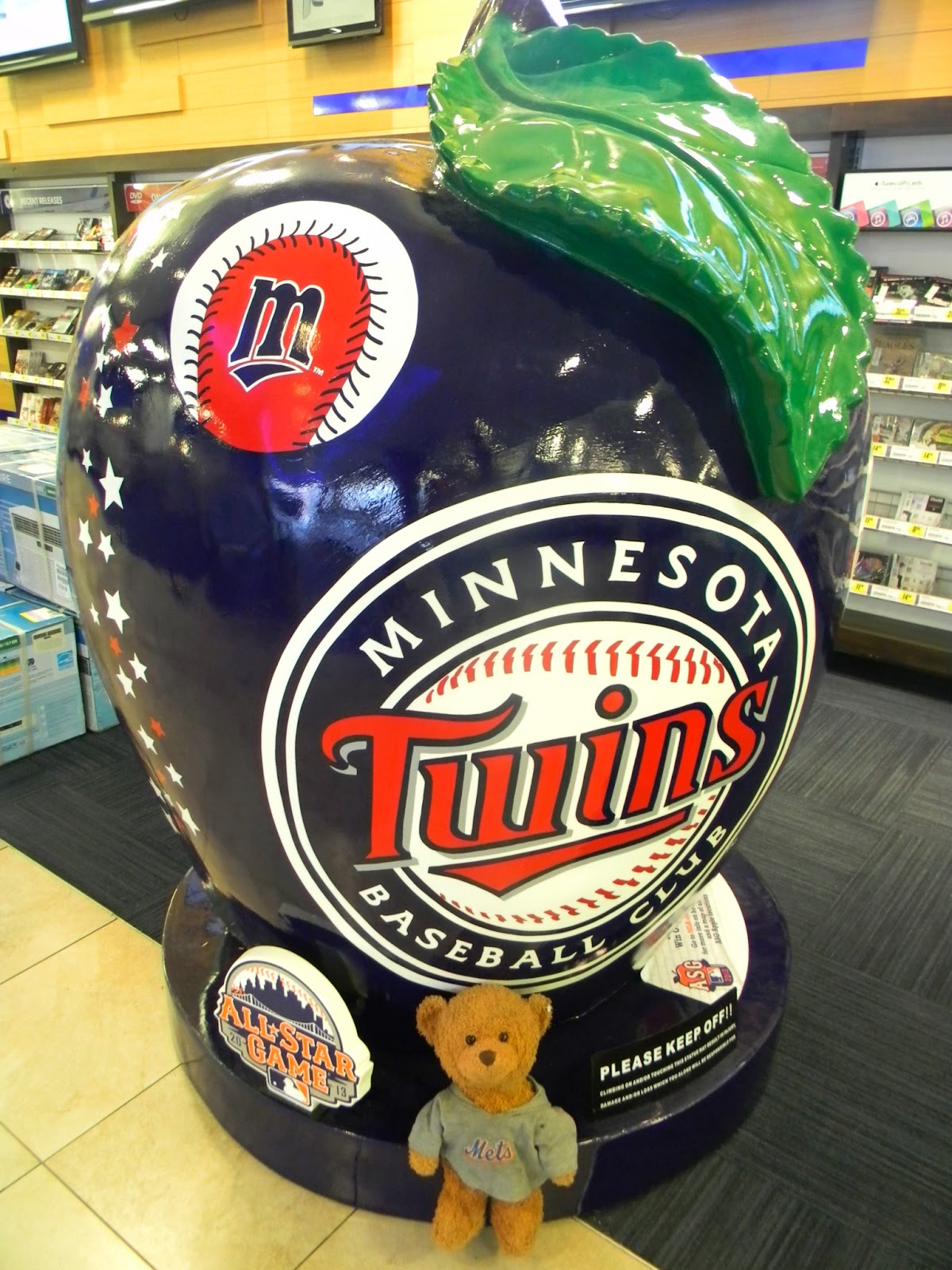
Minnesota Twins

Location:  Best Buy - 1 Union Square South (southwest corner of 14th Street)

Inside or Outside:  Inside, up the escalator to the second floor.  The apple is directly at the top of the escalator.


New York Mets

Location:  SNY Studios - 75 Rockefeller Center (a.k.a. 6th Avenue, between 50th and 51st Streets)

Inside or Outside:  Outside, on the sidewalk.  Even Stevie Wonder couldn't miss it.


New York Yankees

Location:  Modell's - 234 West 42nd Street (between 7th and 8th Avenues)

Inside or Outside:  Inside, slightly to the left after going through the main entrance.  I'm not saying anything else about it, as it pains me to even think about this apple.


Oakland Athletics

Location:  Modell's - 795 Columbus Avenue (near 98th Street)

Inside or Outside:  Inside, to the right of the main entrance at the top of the escalator.  Quite visible from the street.


Philadelphia Phillies

Location:  Party City - 38 West 14th Street (between 5th and 6th Avenues)

Inside or Outside:  Inside, to the left of the main entrance.  It's too hideous to miss.


Pittsburgh Pirates

Location:  Niketown - 6 East 57th Street (between Madison and 5th Avenues)

Inside or Outside:  Outside, on the sidewalk to the left of the main entrance.


San Diego Padres

Location:  Sony - 550 Madison Avenue (between 55th and 56th Streets)

Inside or Outside:  Inside.  WAY inside.  The store is split into two halves.  Go into the half that's closest to 56th Street.  Once you go through the doors, find the escalator going down and get on it.  You'll see the apple at the bottom of the stairs, although the lighting could be better where the apple is.


San Francisco Giants

Location:  Tommy Bahama - 551 5th Avenue (northeast corner of 45th Street)

Inside or Outside:  Inside, but you'll have to go through a maze of Hawaiian shirts to get to the apple.  Once you enter the store, stay to your right.  Walk to the back of the store and after the first divider, you'll see the apple to the left, behind the divider.


Seattle Mariners

Location:  Nintendo - 10 Rockefeller Plaza (off 48th Street between 5th and 6th Avenues)

Inside or Outside:  Inside.  Once you find the store, which is the first one in the plaza after you turn off 48th Street, the apple is easily visible on the other side of the store entrance.


St. Louis Cardinals

Location:  Buy Buy Baby - 270 7th Avenue (between 25th and 26th Streets)

Inside or Outside:  Inside, through the main entrance and to the left.  Very visible from the street.


Tampa Bay Rays

Location:  41 Madison Avenue - building name and address are the same (southeast corner of 26th Street)

Inside or Outside:  Outside, in the plaza above the sidewalk.  The apple is so obvious, it can probably be seen from Tampa.


Texas Rangers

Location:  Zuccotti Park - 1 Liberty Plaza (corner of Liberty Street and Trinity Place)

Inside or Outside:  Outside, in the northwest corner of the park.  Just don't tell anyone you're part of the 1% and you'll be fine.

Toronto Blue Jays

Location:  Intercontinental - 111 East 48th Street (between Lexington and Park Avenues)

Inside or Outside:  Outside, but not on the sidewalk.  It's up a few steps to the right of the main entrance and behind a column.  It's not very visible from the street even though it's technically outside.


Washington Nationals

Location:  Intrepid Museum - 1 Intrepid Square (12th Avenue @ West 46th Street)

Inside or Outside:  Outside.  You don't even have to get on the ship.  It's extremely visible.


Besides the apples for each of the 30 current major league teams, there are also five other special apples scattered throughout the city.  These apples represent the two former teams that played in New York before they moved out west, plus the American League apple, the National League apple and the special All-Star Game apple.

Below are photographs and the locations for each of the five additional apples.  Once again, you can click on each photo to see an enlarged version of Joey and the apples.


Brooklyn Dodgers

Location:  Grand Central Terminal @ 42nd Street (between Lexington and Vanderbilt Avenues)

Inside or Outside:  Inside.  Go west through the Main Concourse toward the Vanderbilt Avenue side of the terminal.  Stay on the right side of the concourse and go through a narrow hallway.  The apple will be at the end of the hallway, near the Transit Museum annex.


New York Giants

Location:  Grand Central Terminal @ 42nd Street (between Lexington and Vanderbilt Avenues)

Inside or Outside:  Inside.  Go east through the Main Concourse toward the Lexington Avenue side of the terminal.  Look for the escalator that takes you down to the Dining Concourse.  The apple will be between the up and down escalators.


American League

Location:  New York Public Library - 11 West 40th Street (@ 5th Avenue)

Inside or Outside:  Outside, near the lion sculpture on the left side of the main entrance of the library.  The apple is on 5th Avenue.


National League

Location:  New York Public Library - 11 West 40th Street (@ 5th Avenue)

Inside or Outside:  Outside, near the lion sculpture on the right side of the main entrance of the library.  The apple is on 5th Avenue.


All-Star Game Apple

Location:  Citi Field - 123-01 Roosevelt Avenue (@ 126th Street, Flushing)

Inside or Outside:  Outside, near the Mets Team Store before the Hodges entrance.