Showing posts with label Ed Kranepool. Show all posts

Monday, February 20, 2017

The Thrill of Victory, The Agony of the Mets: Joan Whitney Payson

All things considered, I've had a pretty fortunate run as a Mets fan.  Shortly after signing up to bleed Met blue at a very young age, they won a championship shortly into my run as a fan and were a very celebrated team.  An organization comprised of very colorful individuals (Mex, Kid, to name a few) and budding superstars (Straw, Doc, to complement the veterans) helped cement me as a Mets fan for life.

Thanks, Dad.

Being a student of history and literature as well, I was always fascinated by the Mets' overall past and how they came to be.  Little did I know, at age 10, that 1962 was just a mere 25 seasons prior in 1986.  As someone who celebrated her Tom Seaver birthday recently, 25 years is a drop in the hat.

Then by watching the video An Amazin' Era, I realized how the Mets were born.  It was hard for me to imagine at age 10, and even later in my 20s and 30s by reading books like Bums, Amazin', and Boys of Summer, what it might be like to see one of my teams (or my teams' rivals) leave town and go straight cross the country.  Because without the loss of the Brooklyn Dodgers (now of Los Angeles) and New York (baseball) Giants (now San Francisco), the Mets may not exist.  I'm sure I'd still love baseball.  But the idea of no Mets is disconcerting to me, despite how much they like to mess with my feelings.                                                                                                                                             

In the 2007 HBO documentary, The Ghosts of Flatbush, an older fan who was quite young when the Dodgers left town in 1957 said that "Los Angeles may have been Siberia, it was so far away."  So from 1958 through 1961, there was no New York National League baseball team.  And according to many amateur baseball historians (like my father, who I have to blame for being in this mess), New York always was and always will be a National League city.  Despite what those pinstripe dummies in the Bronx try to tell you.

Meanwhile, in that same documentary, not to mention countless books written about those bums of Kings County, a few lines were devoted to "that other" National League ball club that shared success in the same municipality but rival boroughs, and their fans shared a heated passion that was reminiscent of the Hatfields and the McCoys.  You'd never know, given the ink and video devoted to reminding us about the Brooklyn Dodgers, that the other team that inspired the Mets' color orange played at the Polo Grounds, the Mets' first home.  The other team that won a championship as late as 1954 in New York.  And had storied players like Willie Mays, who made the infamous "Catch" in that same World Series. (And Mays is why I believe I'd have been a Polo Grounds inhabitant).

And the other team, that according to the many books written on the era, made majority owner Horace Stoneham out to be a "patsy" who was cajoled by Dodger owner Walter O'Malley to provide a natural rival to the Dodgers on the west coast, who had one proverbial foot out the door to L.A. 

Stoneham's team was his primary source of income.  It was an eat or be eaten situation for him to move the team to make it more profitable.  While he originally thought "midwest," to go further west wasn't much of a stretch for him.

Yet, a Giants' minority shareholder was very vocal about the team not leaving town.  In fact, hers was the only dissenting vote to move the team to San Francisco.  Several years later, that voter got her own wish: to bring National League baseball back to the Big Apple in a big way.

(Photo courtesy of National Baseball Hall of Fame and Museum)

Joan Whitney Payson was not only a philanthropist, coming from a very well-known and well-to-do socialite family, but she was a huge baseball fan as well.  She was a known art collector, but she mostly wanted to collect ticket stubs to baseball games.  (I also believe her to be my spirit animal).

Yet for how revered Mrs. Payson (as she is still referred to this day by several prominent former Mets like Tom Seaver and Ed Kranepool) was and is in Mets lore, she presided over some of the most disastrous Mets teams.  While no one would ever question her Mets love and baseball fandom, her baseball legacy was tarnished by her family who inherited the team after she passed.  A family who didn't give a hoot about baseball or running a team, and allowed the team franchise player to be traded on their watch, a move that ultimately led to several years of hardship in Queens.

We know how the current front office ownership is viewed by most fans today.  But would Mrs. Payson been given the benefit of the doubt had she owned the team today?  I mean, would Joan Payson have been essentially "Frederica" Wilpon, someone who loved baseball so much that they just wanted to own a team, and thought fans were a means to an end to obtain that goal?

That may be a bit of an unfair judgment, but let's take a look at how the team operated in the Payson years.  (This also accounts for the de Roulet ownership after her death, since they inherited the team.)

It goes without saying that in 1962, the Mets were historically bad.  Monumentally bad.  Horrific.  Yet, fans were so hard up for National League baseball in the Big Apple, that they went and root root rooted for the Metsies (and went home not too happy 120 times in '62, but that's okay).  Though by 1968, they didn't have another 100+ loss season.  So that's a plus, I guess. 


Year W L W-L% Finish
1962 40 120 0.250 10th of 10
1963 51 111 0.315 10th of 10
1964 53 109 0.327 10th of 10
1965 50 112 0.309 10th of 10
1966 66 95 0.410 9th of 10
1967 61 101 0.377 10th of 10
1968 73 89 0.451 9th of 10
1969 100 62 0.617 1st of 6
1970 83 79 0.512 3rd of 6
1971 83 79 0.512 3rd of 6
1972 83 73 0.532 3rd of 6
1973 82 79 0.509 1st of 6
1974 71 91 0.438 5th of 6
1975 82 80 0.506 3rd of 6
1976 86 76 0.531 3rd of 6
1977 64 98 0.395 6th of 6
1978 66 96 0.407 6th of 6
1979 63 99 0.389 6th of 6


And yet the two standout seasons, 1969 and 1973, almost happened by accident.  The Mets were hardly world beaters during Payson's ownership, but they did have success that ultimately made the struggles worth it.  Some high highs, and low lows, if you will. 

On the back end of the operation, though, Payson seemed to be a shrewd investor, but establishing her own level of cronyism that impacted the team well after her death.  According to Amazin' by Peter Golenbock, Mrs. Payson was approached to be an investor in the "Continental League" team that would be based in New York.  Initially, she declined, until she was given a piece of information that this was a ploy to get the National League to expand in New York.  She later bought out the original minority shareholders, ultimately acquiring 80% of the team (A percentage, related in her obituary, that she wasn't even sure of, and responded with child-like glee, "Oh I think I own somewhere around 80-85%!").

The remaining 20% was held by a relative of the political Bush family, Herbert Walker...and M. Donald Grant, her personal stockbroker.

Oh.

Yet, from a business standpoint, the Mets probably would not exist had she not been eager to bring baseball back to New York.  But she did not seem interested in fielding a winning team, or at the very least, not willing to invest much in the team.  Also according to Amazin', when Branch Rickey was approached to run the new team, he insisted on a $5 million budget.  (In today's dollars, it would be in the neighborhood of $41 million...which is chump change for today's baseball, but back then probably astronomical, pre-free agency era).

They declined Rickey's demands...and named Grant team president.  On the general manager front, they hired George Weiss to run the team who had a reputation of being, shall we say, "frugal."  Weiss was tasked with finding "retreads" (i.e. ex-Giants and Dodgers who were beloved by the fans who stayed behind).  These players were also tasked to bring fans back to the Polo Grounds.  Basically, every Mets game early on was a Old Timers' Day parade featuring old Dodgers or Giants.

Until 1967, though, when a young upstart pitcher named Tom Seaver joined the team, the Mets had a nondescript team fielding some flashy but mostly nondescript players. 

If you think about it, the team got lucky when they got Seaver.  THEY WON A FREAKING LOTTERY DRAWING, FOR PETE'S SAKE.

Sporting News/Getty Images)
Yet the drafting of Seaver, not to mention the breakout of 1968 rookie pitcher Jerry Koosman (who finished in second to future Hall of Famer Johnny Bench in the ROY awards that year...I just like throwing that out there), the addition of former Brooklyn Dodger great Gil Hodges as team manager, plus some trades that got the likes of Tommie Agee, along with Mets old schoolers Cleon Jones and Ed Kranepool got them to a 100-win season in 1969...AND a World Championship. 

Mrs. Payson, from most reports though, preferred to stay in the shadows, and was more than happy to just funnel the funds and be a matronly figure for her boys.  Yet, by anointing Grant (not a baseball guy) with decision-making powers, well, she may have had more of a Nelson Doubleday attitude towards being an owner (minus getting the correct baseball guys making the baseball decisions).  Grant himself certainly operated from a Wilpon very-hands-on perspective.

While the Mets finished in third place in each of the 1970-72 seasons, the only time Mrs. Payson "intervened," for lack of a better term, in baseball operations was to bring Willie Mays back to New York.  As legend had it, Mays was her favorite former New York Giant, and wanted him so badly on the Mets that, as Golenbock reported in Amazin', she offered to buy him from the San Francisco team for $1 million years before the actual trade went down.  Horace Stoneham ultimately acquiesced in 1972, and she brought Mays back to the city where he started defining his legacy as one of the all-time greats.

1973 was Mays' last year in baseball, but he managed to be part of a wild run for the "Ya Gotta Believe" team that won the NL East, went on to win the National League Championship, but lost to the Oakland A's in a seven-game World Series. 

By 1975, the Mets had finished two seasons, finishing in fifth and third place, respectively, after their YGB run.  Yet, the biggest loss of all that was a catalyst for sending the team into relative obscurity in the late '70s was the loss of Mrs. Payson herself, who passed away in September of '75.   Unfortunately, her love for baseball wasn't inherited by her family, who were now in charge of the Mets.  The de Roulet family entrusted M. Donald Grant with more baseball powers, preferring to follow his lead.

Generally, the landscape of baseball as we know it today also changed after the 1975 season with the advent of free agency.  With Mrs. Payson gone, and her family knowing little about baseball and caring less, M. Donald Grant had more reign over the team's payroll than ever before.

Under her family's watch, the team lost Tom Seaver in the "Steve Henderson" trade (Joe Torre once referred to the deal as such, and it always made me laugh).  Grant got rid of basically anyone who contributed to the Mets' successful years, because Grant had unquestioned power, and therefore, wanted to keep the payroll as low as possible.  The new baseball team owners didn't know squat about running a baseball team.

I have to wonder, actually, if that Midnight Massacre trade that has defined so many Mets fans' identities, would have taken place if Mrs. Payson was still alive. Here's my genuine curiosity: if free agency existed on the level when Mrs. Payson was still alive, would she have encouraged Grant to write out the blank checks?  I have to believe she would have personally intervened with Seaver and not allowed that infamous hatchet job by Dick Young to happen.  Even she knew how important Tom Terrific was to the Mets' name.

Evidence points to the fact that while the team loved her and thought she was a good owner who didn't meddle, it's possible that she, too, might have listened to Grant's suggestions to keep payroll low.  The alternative is that she would have done what she needed to do to keep her players happy - namely Seaver, Koosman and Dave Kingman - and would've made sure they were paid to market standards.

Joan Whitney Payson, original Mets owner.  Source: Pinterest

There aren't many quotes attributed to Joan Payson, mostly because she let her front office do the talking for her.  Her talking was to sign the checks and go to the games.  Unfortunately, it wasn't enough.

But with the passing of Mrs. Payson, and the Mets being sold to the Doubleday/Wilpon consortium in 1980, it was the end of an era.  That era being a throwback to how baseball used to operate under a "gentlemen's agreement" where owners called the shots and were nice enough to give jobs to scrappy baseball players.

But one woman broke that glass ceiling, and it's a shame we never knew how the team would have operated had she not put cronies at the top who didn't keep her best interests and wishes for a successful team at heart. 

So to recap, Joan Whitney Payson was a wealthy woman who loved baseball so much, she owned her own team.  Preferring to stay in the background, she let people loyal to her do the baseball work for her.  Yet, under her ownership, the team had two very successful years culminating in a World Championship and a National League Championship.  For those "highest of highs," the team suffered some abominable lows, like their 120-loss inaugural season to the trade of the team's "Franchise player" after her death, whose loss took years to overcome, even after the team was sold by the surviving de Roulet family.

Since 1962, the Mets have had four major ownership changes: Mrs. Payson, the de Roulets (her surviving family), Nelson Doubleday/Fred Wilpon, then the Wilpon/Katz Sterling Equities consortium.  There's been some overlap, yet no owner was quite as beloved as Mrs. Payson, who was the old grande dame of the organization and of baseball.

As Terence Mann spoke in Field of Dreams, the one constant through the years has been baseball.  It has been erased, rebuilt and erased again.  Mrs. Payson's ownership brings us back to a simpler time of baseball, and clearly could adapt to changes that sadly the people she put in the charge were not able to do.  There are signs of Mrs. Payson around Citi Field today, especially in the Mets Hall of Fame, where she was enshrined as a member in 1981.

Yes, under Joan Payson, the Mets had the thrill of some victorious years, but there was plenty of agony to go around.


Editor's note:  In case you hadn't noticed, this piece was written by Taryn "The Coop" Cooper", because she knows a thing or two about being a woman who loves baseball.


Note: The Thrill of Victory, The Agony of the Mets is a thirteen-part weekly series spotlighting those Mets players and personnel who experienced the best of times and the worst of times with the team.  For previous installments, please click on the names below:

January 2, 2017: Tom Seaver
January 9, 2017: Mike Piazza
January 16, 2017: Wally Backman
January 23, 2017: Daniel Murphy
January 30, 2017: Frank Cashen
February 6, 2017: Ed Kranepool
February 13, 2017: Doug Sisk


Monday, February 6, 2017

The Thrill of Victory, The Agony of the Mets: Ed Kranepool

In the film "Forrest Gump", the titular character ran across the country from one ocean to the other just because he "felt like runnin' ".  His travels took him across flat land, up the highest mountain, back down again, and even through a pile of dog ... ahem ... poo.  After spending three years, two months, 14 days and 16 hours on the roads of America, Gump decided to stop running because he was tired.  There was no fanfare as his run came to an end.  He just quit and went home.

Gump's spirited jog commenced around October 1, 1979, as a news broadcast that was airing at the beginning of his cross-country trek was reporting that President Jimmy Carter had collapsed that day while attempting to complete a six-mile race.  Just one day before Gump began his long run in the fictional town of Greenbow, AL, another long run was coming to an end in the very real city of St. Louis, MO.  And when this run of 18 seasons with a single major league franchise came to an end, it also had no fanfare.  It just marked the quiet close to the career of the last man who played for the original Mets.

He was steady.  He was Eddie.  But as a teenager, was he ready?  (Bettmann/Getty Images)

Edward Emil Kranepool was barely out of his James Monroe High School cap and gown when the Mets signed the amateur free agent to an $85,000 contract in June 1962.  The new expansion team was enamored with the young man who broke Hall of Famer Hank Greenberg's home run records at Monroe, promoting him to the big club before its inaugural season was over.  At age 17 and just three months out of high school, the Bronx-bred Kranepool collected his first major league hit at Manhattan's Polo Grounds - an opposite field double off Cubs reliever Don Elston.

In 1963, Kranepool split his time between AAA-Buffalo and the Mets, producing an impressive .310 batting average and .507 slugging percentage in 53 minor league games, while being overmatched at the major league level, batting .209 and slugging .289 in 86 games.  The following year, his last as a teenager and his first at the newly opened Shea Stadium, Kranepool became just the 13th player to appear in 100 or more games in a single season prior to blowing out 20 candles on his birthday cake.  The first baseman improved greatly during that 1964 campaign, batting .257 and finishing among the team leaders in hits (108), doubles (19) and home runs (10).

Although Kranepool was blossoming into an offensive talent, the Mets continued to bring up the rear in the National League standings.   After losing 111 and 109 games in 1963 and 1964, respectively, the Mets found a way to regress in 1965, finishing the year with a 50-112 record.  The team could actually have been a lot worse had it not been for Kranepool's performance in the first half of the season.

Through games of June 3, Kranepool batted a hefty .344 and produced a .922 OPS, while racking up 21 extra-base hits and 29 RBI.  As a result, Kranepool was chosen to be the Mets' sole representative in the All-Star Game, his first and only selection for the Midsummer Classic.  Kranepool didn't get to play in the game, as N.L. manager Gene Mauch chose to play Ernie Banks at first base during the entire contest, but the Mets' first baseman did become the youngest player at that position to become an All-Star - a distinction Kranepool still holds to this day.

Kranepool ran out of gas in the second half of the 1965 campaign, as evidenced by his .216/.268/.292 post-All-Star Game slash line.  He also had to deal with the unexpected retirement of the only manager he had ever played for in the big leagues, Casey Stengel, who broke his hip in a fall in late July and called it a career a month later.

When the Mets signed Kranepool in 1962, they were hoping to get the player who broke all of Hank Greenberg's high school records.  Instead, they got a mediocre player who seemed to be living out a real life "Groundhog Day" situation, doomed to repeat the same campaign year after year.  From 1964 to 1967, an average season for Steady Eddie saw him put up a .258/.312/.383 slash line with 19 doubles, 12 homers and 52 RBI.  Kranepool never hit below .253 or above .269 in any of those four seasons.  He also hit exactly ten home runs in three of the four years (he flexed his muscles in 1966 when he bashed a career-high 16 homers) and produced between 45 and 57 RBI during the quadrennium.  Kranepool was also playing almost every day, averaging over 500 plate appearances per season.  That all changed in 1968, when a new manager came aboard and ended up extending Kranepool's career by playing him less.

Prior to 1968, the Mets had lost 100 or more games in five of their first six seasons.  They had also established a permanent residency in the National League cellar, coming out for a sniff of ninth place just once in 1966.  But after six seasons of playing like a first-year expansion team, the arrival of skipper Gil Hodges shifted the mindset of the team.

"Spring Training, Gil Hodges wanted you to lead by example," Kranepool said about his former teammate and current manager.  "He built the ballclub around leadership."

Kranepool made his debut as a defensive replacement for Hodges, then played under him.  (Herb Scharfman/Getty Images)

The Mets won 73 games in '68, fueled by the pitching of rookie Jerry Koosman and sophomore starter Tom Seaver.  Unfortunately, Kranepool had his worst season since 1963, batting .231 with only three homers and 20 RBI despite getting the majority of the starts at first base.  Kranepool continued to get the bulk of the playing time at first base during the early part of the 1969 season as the team got off to an 18-23 start.  But after a club-record 11-game winning streak in late May and early June suddenly thrust the Mets into second place, the team felt the need to upgrade its offense, especially after being held to three runs or fewer in 34 of their first 56 games.  The team addressed the problem by trading for veteran slugger Donn Clendenon.

At the time of the trade, Kranepool was back to his typical pre-1968 self, which meant he was batting .256 with six homers and 26 RBI while getting most of the starts at his customary position. The lefty-swinging Kranepool and the right-handed batting Clendenon were then platooned at first base by Hodges, which maximized power production at the corner infield spot.

From June 15 until season's end, Kranepool and Clendenon combined to produce 17 homers and 60 RBI in 441 plate appearances.  Kranepool also produced some huge hits along the way.  His walk-off RBI single off future Hall of Famer Ferguson Jenkins on July 8 capped a three-run, ninth-inning rally and gave the Mets a thrilling victory over the rival Cubs, just one day before Seaver shut down Chicago with his Imperfect Game.  Five days after his hit against Jenkins, Kranepool delivered another game-winner, this time a tie-breaking RBI double in the eighth inning against Montreal that gave New York a 4-3 victory.  The Expos were once again victimized by Kranepool on September 18, when the veteran homered and drove in both runs in the Mets' 2-0 victory.  Six days later, the Mets wrapped up their first N.L. East division title.

"We kept applying the pressure, and the Cubs knew they were in a pennant race," Kranepool said.  "Every time we played a big series, we won it.  We beat the Cubs head to head in every series after that.  We got some breaks - but look, a winning team makes its breaks."

Buoyed by their late-season push for the playoffs, the Mets miraculously won it all in 1969, sweeping the Atlanta Braves in the inaugural National League Championship Series and needing just five games to upset the heavily favored Baltimore Orioles in the World Series.  Kranepool started four of the Mets' eight postseason games, collecting a hit in each contest.  In the Mets' first-ever playoff game, Kranepool scored two runs and delivered the fielder's choice that plated the go-ahead run in the eighth inning.  The following day, Kranepool got the Mets on the board first with an RBI single in the first inning.  Kranepool played in just one World Series game because the Orioles started left-handed pitchers in four of the five games, but he made the most out of his sole appearance, clubbing a home run in the Mets' Game Three victory - the first Fall Classic game ever played in Flushing.

The look of a champion.  (Focus On Sport)
Although he was only 24 at the time, Kranepool had become the longest tenured Met.  He was also a world champion and one of the leaders in the tight-knit clubhouse.  Third baseman Ed Charles, the poet laureate of the Mets, said it best when he discussed the team's camaraderie during their championship season.

"We felt like a family," Charles said.  "It started with Mrs. Joan Payson, the owner, who had a habit of making people feel at home.  It included the leadership of Gil Hodges.  And there was the chemistry of the team.  We were all close.  I went to barbecues at the home of Kranepool, (Art) Shamsky, (Ron) Swoboda.  We went out together on the road.  I never saw a team with so much closeness."

As close as Kranepool was to his teammates in 1969, he ended up playing far away from them for most of the 1970 campaign.  Kranepool batted just .222 in April, then went 0-for-May, failing to collect a hit in the 12 games he appeared in during the month.  After not collecting a hit in five June games, which dropped his batting average to a pitcher-like .118, Kranepool was unceremoniously demoted to AAA-Tidewater, spending the next two months there trying to regain his hitting stroke.  Kranepool batted .310 in 47 games with the Tides and was called back up to the Mets in mid-August, where he was used exclusively as a pinch-hitter.  His final major league stats for the year: .170 batting average, eight hits, no homers and three RBI in 43 games.

While Kranepool was in the minors in 1970, his bat wasn't missed in the starting lineup, as Clendenon batted .288 with 22 homers and a then-franchise record 97 RBI.  But Clendenon saw a significant drop-off across the board in 1971 (.247, 11 HR, 37 RBI in 88 games), which allowed Kranepool to re-establish himself in the big leagues.  Kranepool's renaissance season ended with a .280 batting average, 14 homers and a career-high 58 RBI.

At the conclusion of the 1971 campaign, Clendenon was released by the Mets, allowing Kranepool to take over first base on a full-time basis for the first time since before Clendenon's arrival.  But the sudden death of Gil Hodges prior to the start of the 1972 season changed the direction of the club, with Yogi Berra tabbed to replace the beloved Hodges.  The passing of his manager and mentor also affected the play of Kranepool, who batted just .204 with four homers and 14 RBI through the team's first 87 games.  Kranepool eventually recovered after a three-month mourning period, batting .326 with 15 extra-base hits and 20 RBI over his final 195 plate appearances.

As good as Kranepool was during the second half of the 1972 season, he was surely going to lose playing time the following season to John Milner, who finished third in the National League Rookie of the Year vote in '72.  Milner played mostly in left field during his stellar rookie season, but was more suited to play first base.  In 1973, Milner and Kranepool switched positions, with Milner getting most of his starts at first base and Kranepool splitting time between first and left.  Kranepool did not respond well to the switch, batting .239 in 1973 with just one homer and 35 RBI.  He was also mostly a spectator during the Mets' run to their second division title in five seasons, appearing solely as a pinch-hitter during the last two weeks of the regular season.  But even in limited action, Kranepool was instrumental in getting the Mets back to the World Series.

The Mets played a dozen games during the 1973 postseason; Kranepool started one of them.  That lone start occurred in the first do-or-die playoff game in franchise history and only happened because right fielder Rusty Staub injured his shoulder in Game Four of the NLCS while making a spectacular catch against the outfield wall.  With the Mets and Cincinnati Reds having split the first four games of the best-of-five series, Kranepool got the nod from Berra to start Game Five in left field, with Cleon Jones moving to right in lieu of the injured Staub.  Kranepool rewarded his manager immediately, driving in the first two runs of the game with a bases-loaded single.  The Mets never trailed in the game and advanced to their second World Series, which they lost in seven games to the Oakland A's with the underhand-throwing Staub returning to right field and the healthy Kranepool returning to the bench.

The bench became a familiar place for Kranepool for the rest of his career.  From 1974 to 1978, Kranepool started just 317 games over the five-year period, making more than 82 starts in just one of the five seasons (1976).  Although he performed well as a part-time starter, batting .286 with a .399 slugging percentage, Kranepool was lethal as a pinch-hitter.  When he came off the bench from 1974 to 1978, Kranepool batted an eye-popping .396 (57-for-144) and slugged .590.  Included in the torrid stretch was a .486 batting average as a pinch-hitter in 1974 - the first of four consecutive seasons in which Kranepool batted .400 or higher as a sub - and a .300 pinch-hitting average in 1978, which doesn't seem as impressive until you consider that he hit .065 (2-for-31) during the season when he batted in other roles.

In the mid-to-late '70s, Kranepool was the team's top pinch-hitter and top mustache-grower.  (Michael Zagaris/Getty Images)

By the time 1979 rolled around, the team was in shambles.  Gone were Seaver and Koosman, with The Franchise being traded to Cincinnati as part of the Midnight Massacre in 1977 and Kooz being dealt to the Minnesota Twins following the 1978 campaign.  Not a single player from the '73 pennant-winning team remained at the start of the 1979 season.  Except for Kranepool.  And his days as a Met were also about to come to an end.

Following the death of team owner Joan Payson in 1975, control of the club went to her husband, Charles, and daughter, Lorinda de Roulet, neither of whom shared the same passion for the game that Mrs. Payson had.  Baseball operations fell into the hands of team chairman M. Donald Grant, who had no intention of spending much money to better the team.  Instead, he pared the roster of veteran players who were asking to be paid like their counterparts in other cities.  The camaraderie that existed between the players when the Mets won the World Series in 1969 was completely gone a decade later, and so was Grant, who was removed as the team's chairman by the club's board of directors prior to the 1979 season.

Kranepool, who was never one to mince his words, had some harsh feelings about the questionable transactions made by the team during the ill-fated M. Donald Grant era.

"Look at some of the deals they made," Kranepool said.  "They were horrendous.  They unloaded everybody and didn't make a good deal."

And although most of the negativity surrounding the team following the death of Payson fell on Grant, Kranepool always dished out more vitriol towards general manager Joe McDonald.

"I didn't have a good relationship with Joe McDonald," Kranepool said matter-of-factly.  "I didn't respect him.  I didn't like him; he didn't know anything about baseball.  There were termites who ate away at the organization, and he was part of the termites.  Donald Grant got blamed for it, but Joe McDonald was the one who made the trades."

Because of his testy relationship with McDonald, Kranepool knew that when his contract expired at the end of the 1979 season, he would no longer be a Met, regardless of how he performed.  In what would be the final year of his long career, Kranepool batted .232 and managed just two homers and 17 RBI in 174 plate appearances.  To add insult to injury, the Mets closed out their season at Shea Stadium on September 23 by honoring Lou Brock of the Cardinals, who set a major league record when he stole the 938th base of his career in his final appearance at Shea.  Kranepool, the only man to play for the Mets in each of the franchise's first 18 seasons, didn't even get to play in the game and received no ovation from the home crowd.

Following the season, Kranepool was not tendered a contract and became a free agent.  Although he was only 34 at the conclusion of the 1979 campaign, Kranepool never played another game in the majors.  He finished his career as the Mets' all-time leader in nearly offensive category, even though a good chunk of his career was spent riding the pine.

Ed Kranepool wasn't just a hometown kid living out his dream on the baseball diamond.  He was also a stockbroker and a restaurateur.   He appeared in commercials, movies and TV shows, doing everything from plugging shaving cream to being accused of stealing Chico Escuela's soap in a classic Saturday Night Live sketch.  And on multiple occasions, he used his business savvy to try to purchase the team he once played for.

Krane.  (Paul Hawthorne/Getty Images)
Following the 1979 campaign, the newly-retired Kranepool joined forces with a small group of investors in a failed attempt to buy the Mets from the Payson/de Roulet family.  The Mets were eventually sold to the team of publisher Nelson Doubleday and real estate investor Fred Wilpon.  Three decades later, when Wilpon encountered financial difficulties due to his connections with Ponzi scheme swindler Bernard Madoff, he attempted to sell a small percentage of the team to increase his cash flow.  Once again, Kranepool stepped up to the plate, this time with a group of investors that included Martin Luther King III, but no purchase was ever made.

When Doubleday and Wilpon bought the Mets in 1980, Kranepool officially ended his career in baseball.  His retirement as a player ensured that he couldn't affect the Mets on the field, and his inability to purchase a part of the team meant that he couldn't have a say off it.  But despite his numerous failures - not being able to buy a part of the team, not developing into a perennial All-Star and not even being an everyday player for the majority of his career - Kranepool remains beloved by Mets fans to this day.

His career began as a 17-year-old when the expansion Mets called the Polo Grounds home.  He developed into a serviceable player as the team moved into their new home in Queens.  He owned a World Series ring before he turned 25.  He thrived as a pinch-hitter during the latter part of his career.  And he was inducted into the Mets Hall of Fame after his playing days were over.

Forrest Gump got to experience and influence many key moments in American history just by being there.  Ed Kranepool's longevity did the same for him, as he witnessed and participated in many of the Mets' seminal moments.  Kranepool was there for the highs of two pennants and one World Series championship.  He was also present for the decline and dismantling of a once-proud team.  And when his run as the longest tenured Met was done, the native New Yorker just went home.

Kranepool will always have a home when it comes to the Mets.


Note: The Thrill of Victory, The Agony of the Mets is a thirteen-part weekly series spotlighting those Mets players and personnel who experienced the best of times and the worst of times with the team.  For previous installments, please click on the names below:

January 2, 2017: Tom Seaver
January 9, 2017: Mike Piazza
January 16, 2017: Wally Backman
January 23, 2017: Daniel Murphy
January 30, 2017: Frank Cashen

Thursday, November 24, 2016

A Joey and Iggy Beartran Thanksgiving (2016)

We missed the start of the parade because Mother Nature called.  After all, that's what bears do in the woods.

Greetings and salutations, Mets fans!  We're Joey and Iggy Beartran and today is our favorite holiday of the year - Thanksgiving!  While most people are thankful for their health, their families and whatnot, we're mostly thankful that this is the one day of the year we get to eat anything and everything we want, especially turkey!  Oh, and we're also thankful that we're one day closer to the beginning of the next baseball season.  That's also kind of important to us.

The Mets gave their fans so many things to be thankful for since the last time Thanksgiving came around.  They gave us a full season of Yoenis Céspedes.  They gave us Noah Syndergaard and his Amazin' social media skills.  (He also has a pretty decent fastball.)  They gave us Bartolo Colón's home run.  And they also provided us with a second consecutive postseason appearance.

All Mets fans can be appreciative of those things.  But what are Iggy and I most thankful for this year?  And what will make us feel better about the upcoming 2017 season?  We have all the answers right here.  All you have to do is sit back and relaxBut don't relax too much!  You don't want to end up looking like Keith Hernandez during a day game after a night of barhopping in Sag Harbor.


Video courtesy of YouTube user watchablethings


Joey:  I'm thankful Iggy and I got to enjoy several baseball road trips together, as we visited Denver, Detroit and Cooperstown for the first time.  And even though I didn't get to meet Steve Gelbs in Detroit, that trip to Comerica Park set off a chain of events that eventually led to our first meet-and-greet at Citi Field.

Iggy:  I'm thankful we never have to go to Detroit again.  Going there was like getting in line at Citi Field's Shake Shack, missing three innings of the game and then being told they're sold out of Shackburgers.  In other words, it was a total waste of time.  (And it didn't help that the Mets lost every road game we attended.)

Meeting Steve Gelbs was one of our off-the-field highlights of the season.

Joey:  I'm thankful that we got to see Mike Piazza go into the Hall of Fame wearing a Mets cap on his plaque.  He was one of the best players to ever play for the team and I'm glad he got to share the day in Cooperstown with another of the game's all-time greats, Ken Griffey Jr.

Iggy:  I'm thankful I didn't get in this picture with Joey at Cooperstown.  The last thing I would want is for two guys from the 1969 World Champion Mets to laugh at me while I was posing in front of them.

Do I amuse you?  Apparently, I amused the good fellas behind me.

Joey:  I'm thankful we were able to spend the past three seasons marveling at the work of art that is Bartolo Colón.  He was a gem to watch on the mound and at the plate.  And he's also an inspiration to those of us who consider the act of eating to be as much of a national pastime as baseball has been throughout the years.

Iggy:  I'm thankful I bought Bartolo Colón's workout video.  It really helped me become more flexible while burning off those extra calories we consumed last Thanksgiving and throughout the baseball season.

We'll certainly miss this world class athlete.

Joey:  Finally, I'm thankful the Mets are going to make a push for an unprecedented third straight playoff appearance in 2017.  With Matt Harvey, Steven Matz and Zack Wheeler hopefully back at or near full strength, and the continued improvement of Jacob deGrom and Noah Syndergaard, the pitching should overcome whatever the Mets lose in offense this off-season.  And if Yoenis Céspedes ends up signing that long-term deal to remain in New York, we'll have a whole lot more to be thankful for.

Iggy:  And I'm thankful we each only have four things to be thankful for.  Our Thanksgiving feast has been sitting around since the days of the dinosaurs.  Let's eat!

Is that you, Scott Atchison?

So that's what we're thankful for this Thanksgiving.  Hopefully, you'll have many things to be thankful for as well.  Which reminds us, we're also thankful that even though you could be watching NFL football right now or perhaps picking away at the turkey on the dinner table like a 21st century version of the Old Man from "A Christmas Story", you chose to take the time to read our annual Thanksgiving Day post.  Hey, it's the least you could do after not inviting us over to share in your turkey day feast!

From our family to yours, we'd like to wish you a Happy Thanksgiving and may all your wishes for the upcoming baseball season come true, as long as those wishes all involve the Mets winning a World Series and Bryce Harper playing golf in October.  Ya gotta believe!

LET'S GO METS!!


When you wish upon a star, your dreams come true.  We're greedy, so wished upon two of them.


Saturday, September 10, 2016

Pitching Wins Don't Matter ... Tell That to Bartolo Colón

It's been very difficult to cool down Bartolo Colón recently.  (Joe Robbins/Getty Images)

Decades ago, pitching victories were viewed as the standard by which to judge a pitcher's success.  If he won a lot of games, he was considered to be a good pitcher.  That was then, this is now.  And wins don't mean what they used to.  Just ask Seattle Mariners pitcher Felix Hernandez, who won the American League Cy Young Award in 2010 despite finishing the season with a mediocre 13-12 won-loss record.

In the days of yore, the man known as King Felix wouldn't have been considered a candidate for the ultimate pitching honor with that record, but Hernandez led the American League during the 2010 campaign in innings pitched, ERA and fewest hits per nine innings, while also finishing high among the league leaders in the new stats of the day, like ERA+ (174; 2nd in A.L.), FIP (3.04; 4th in A.L.) and WAR for pitchers (7.1; 1st in A.L.).

Not only did Hernandez win the Cy Young over 19-game winner David Price and 21-game winner CC Sabathia, but the voting wasn't particularly close, as Hernandez earned 21 of the 28 first-place votes cast for the award in 2010.

Voters for regular season awards already know that there is more to determine the value of a pitcher than pitching wins.  But Mets pitcher Bartolo Colón doesn't have time for that talk.  He's too busy helping the Mets inch closer to an unlikely postseason berth by racking up win after win.  And in doing so, he finds himself just one victory away from joining an exclusive Mets pitching club.

Most of the time, when a player becomes "one of only so-and-so players to do something in club history", he's joined by a hodgepodge of players.  Some of these players are usually among the better players to suit up for the team, while others can sometimes be of the "what's he doing on this list?" variety.

For example, when you think of the top home run hitters in Mets history, your thoughts usually turn to guys like Darryl Strawberry, Mike Piazza and Dave Kingman - three guys who were known for their prodigious power.  But rounding out the top ten on the team's all-time home run list is Ed Kranepool, who never hit more than 16 home runs in any season and averaged a long ball every 50.8 plate appearances in his career.  Longevity had more to do with him appearing on this list than anything else.

Similarly, when one thinks of the top strikeout pitchers to put on the orange and blue, immediately visions of the Seavers, Koosmans and Goodens of the Mets universe come to mind.  No one would ever think of including a player like Jonathon Niese in the conversation, but there he is, sitting at No. 9 among the top strikeout pitchers in team history.  That's more a testament to how few great strikeout pitchers have managed to stick around with the Mets than it is of Niese's ability to throw strike three by an opposing batter.

That brings us back to Bartolo Colón, who currently sports a 13-7 won-loss record.  His excellent 2016 campaign comes on the heels of a 14-win season in 2015 and a 15-victory campaign in his inaugural season as a Met in 2014.  A win on Saturday against the Atlanta Braves would give him his third consecutive year with 14 or more victories and would put him on the short list of players who have accomplished that feat in a Mets uniform.  And believe me when I say that the players he'd be joining are not of the Ed Kranepool and Jonathon Niese ilk.

Steve Trachsel (Getty Images)
Entering 2016, a total of 27 pitchers (including Colón) had won 14 or more games for the Mets in a single season.  By accomplishing the feat in each of his first two seasons with the team, Colón had become one of ten Mets hurlers to post multiple seasons of 14+ victories.  However, one of the other nine was Steve Trachsel, which suggests that the company wasn't really that exclusive.  But should Colón win his 14th game of the season tonight or in any of his subsequent starts over the final three weeks of the season, he'd join pitchers like Jon Matlack, Ron Darling, Sid Fernandez and Al Leiter as three-time 14-game winners.  It's a slightly more impressive list, but none of those guys would ever appear on the Mount Rushmore of Mets starting pitchers.

Matlack, Darling, Fernandez and Leiter all had varying degrees of success with the Mets, but none of them put together at least three consecutive seasons of 14 or more victories while they were on the team.  Only four pitchers have ever done that.  You may have heard of them.  Those players are:

  • Tom Seaver (1967-73)
  • Jerry Koosman (1973-76)
  • Dwight Gooden (1984-88)
  • David Cone (1988-91)

If you were going to sculpt a Mets-style Mount Rushmore using the top four starting pitchers in Mets history, the noggins of those four players would more than likely be permanently chiseled in granite.  Basically, any positive pitching records in team history will feature most, if not all of those pitchers.  Their constant success from year to year made them aces or co-aces of the staffs they pitched for and resulted in lots of wins for the team and themselves.

And to think, Bartolo Colón is just one victory away from joining them.

Over the years, the importance of the pitching victory has been lessened.  A leaky pen can cost a starting pitcher a well-deserved win just as easily as an explosive offense can help a starter earn an ugly "W".  But a win is a win is a win, and pitchers still love getting them.  (Just ask Rick Porcello.)

Bartolo Colón has been in baseball long enough that he remembers when pitching victories were still used to determine how valuable a pitcher was.  But you don't have to tell anyone in this day and age just how valuable Colón has been to the Mets.  And should he earn a victory tonight over the Braves, his value as a winning pitcher will elevate him into the pantheon that includes the best starting pitchers in the history of the franchise.

Yeah, wins for pitchers don't matter as much as they used to.  But I don't think anyone is complaining  that Bartolo Colón is still racking up that "meaningless stat" for the Mets.


Sunday, July 31, 2016

Joey's World Tour: Won't You Take Me To ... Cooperstown?

My sister, Bee, joined me as Mike Piazza and Ken Griffey Jr. entered the Hall of Fame.  (Ed Leyro/Studious Metsimus)

Hi, everyone!  This is your fav'rit roving reporter, Joey Beartran.  And this edition of my baseball world tour took me to a place where there is no major league baseball team, but there's certainly no shortage of baseball.

With Mike Piazza and Ken Griffey Jr. being elected into the Hall of Fame this year, it seemed like a perfect time for me (a Mets fan) and my sister, Bee (a Mariners fan), to venture 200 miles northwest of Citi Field to Cooperstown.  The Hall is located on Main Street, in an area full of baseball themed stores.  And during Hall of Fame weekend, those stores hosted many former athletes, including several Mets players of days gone by.

My photographer took several photos of these former players, but he failed to inform me that two members of the 1969 World Champion Mets found it amusing that among the many websites covering Hall of Fame weekend, one of them sent a bear instead of a human.  Needless to say, they smiled a little too much for the camera.

It's almost as if Art Shamsky and Ed Kranepool had never seen a roving reporter that's also a bear.  (EL/SM)

In addition to members of the Mets' first championship squad, there were also players from their second title team, such as Mookie Wilson, Howard Johnson and Lenny Dykstra.  I heard Jesse Orosco was also signing autographs and posing for photos with fans, but I was eating a hot dog at the time and didn't want mustard to accidentally appear on the side of my mouth in the photo.  If Shamsky and Kranepool were laughing when my face was mustard-free, how would Messy Jesse have reacted at the sight of Messy Joey?

At least Mookie, Lenny and HoJo didn't make fun of me.  (EL/SM)

Soon after meeting the Mets, meeting the Mets (again), stepping right up and greeting the Mets (for a small fee), the Hall of Fame parade began.

Thousands of people lined up on Main Street to see their favorite former players go by in the back of a Ford pickup truck.  Because who doesn't want to see Tom Glavine being taken hostage hanging out in the back of a moving pickup truck?  Missing among the living Hall of Famers were three former Mets (Nolan Ryan, Tom Seaver, Roberto Alomar), but hey, at least we got Glavine to make up for them.

No comment.  (EL/SM)

Other Hall of Famers who took part in the parade included Jim Bunning, Johnny Bench, Reggie Jackson, Rollie Fingers, Eddie Murray, Pedro Martinez and Randy Johnson, to name a few.  They were all smiles throughout the route.  (Even Eddie Murray!)  But of course, my photographer captured players like Mike Schmidt, George Brett and Dennis Eckersley at their surliest.  Because his sense of timing is awful.

Smile!  You're on Candid Studious Metsimus Camera!  (EL/SM)

The parade ended at the Hall of Fame building, which is the crown jewel of Cooperstown.  We entered the Hall three and a half hours before closing time.  By the time we got around to the gift shop, the employees were getting ready to kick us out.  (Not literally.  They were actually very polite.)  There was so much to see and do in the Hall, we could have easily spent more than three and a half hours there.

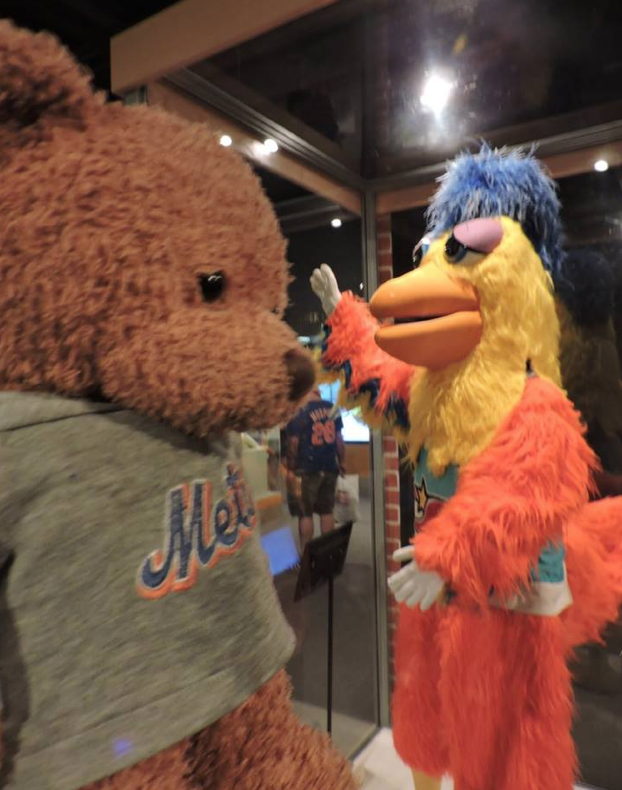
Exhibits included Women In Baseball, The African-American Baseball Experience and Viva Baseball (Latin-American baseball).  There were also wings devoted to baseball by the decades and baseball records, as well as a locker room featuring memorabilia from every team.  The area devoted to the 1970s was particularly interesting to me, even though that era was way before my time.  Two objects that stood out for me were the Andy Warhol painting of Tom Seaver (circa 1977 - not the happiest time to be Tom Seaver or a Mets fan) and the full costume of the San Diego Chicken, who entertained Padres fans at a time when the team wore brown and mustard colored uniforms and still didn't have a no-hitter.  (Well, at least they no longer wear those uniforms.)

The Chicken was lucky he didn't end up inside a Campbell's Soup can that was eventually painted by Warhol.  (EL/SM)

Once I left the '70s behind, I wish I hadn't.  You see, there was also a wing in the Hall of Fame devoted to the 2015 World Series, which I was not too keen on seeing.  (Yes, I took a photo there, but I'm not very happy about it.  If you absolutely must see it, just click here.  If the link doesn't take you to the photo, consider it a good thing.)

But enough about last year.  You want to see the Hall of Fame plaques, right?  Of course you do.  Well, you can always Google those.  There's an abundance of those photos on the interwebs.  At the time I went to see the plaques, the spots were still open for Mike Piazza and Ken Griffey Jr.  But at least both players were well-represented in the gift shop.

By the time you read this, the plaques will be there.  Please buy a jersey while you wait.  (EL/SM)

Another place they were well-represented was in their special wings.  Both Piazza and Griffey had their own section in the Hall featuring memorabilia and photos taken at various points of their distinguished careers.

Bee and I enjoyed this section very much, although I was disappointed that Piazza's area had too much focus on the other teams he played for compared to Griffey.  Griffey was a member of the Cincinnati Reds longer than Piazza was a Met, but Mariners fans like Bee will be happy to know that his wing almost exclusively features him as a Seattle Mariner.   With Piazza, it was as if the Mets were just a stop on his baseball journey.  Take a look at the photos to see what I mean.

At least Bee got what our petty cash tin paid for in the Griffey wing.  (EL/SM)

Finally, on Sunday we attended the Hall of Fame induction ceremony at the Clark Sports Center, which is about a one mile trudge from the Hall of Fame building.  We had left our blankets and lawn chairs there overnight just to reserve a spot.  By the time we got there Sunday morning, there were nearly 50,000 other people who had claimed spots around us.  That's more people than the capacity at Citi Field, even when they're selling standing room only tickets!

We were sitting too far away for my photographer to get any clear shots of the dozens of Hall of Famers sitting on the stage and the two new ones standing at the podium, but all you need to know about the ceremony can be summed up in this one photo taken off the big screen after both Piazza and Griffey had given their spectacular tear-filled speeches.

During the ceremony, Mets fans gave Piazza lots of TLC, while Griffey wore his hat 2 da back.  (EL/SM)

So that's all for this special edition of Joey's World Tour.  The next installment will come sooner than you expect, as we are planning on following the Mets to Detroit's Comerica Park next weekend.  I wonder what food options they have there...

Oh, before I forget, I have one more anecdote to share with you.  You see, a week after Mike Piazza entered the Hall of Fame in Cooperstown, the Mets had a special ceremony of their own at Citi Field to retire Piazza's No. 31.  And about that plaque I mentioned before that wasn't at Cooperstown when I was there - well, it made the trip to Citi Field, and I was fortunate enough to get a photo with it before it made its return trip to the National Baseball Hall of Fame and Museum.  (You don't have to Google it like I said before.  I'll be kind enough to share it with you here.)  My photographer also took lovely photos (for a change) of Piazza's former Mets teammates - Cliff Floyd, Edgardo Alfonzo and Al Leiter - who attended the Citi Field ceremony, as well as the new retired No. 31 that now sits atop the ballpark.

The Piazza celebration is complete now that the No. 31 has been retired at Citi Field.  (EL/SM)

Mike Piazza was very special to me.  You see, on the day I was "born" at Shea Stadium in 2004, Piazza was being celebrated in an on-field celebration (which seems to be a common theme in this blog post).  A dozen years ago, the Mets were celebrating the fact that he had just become the game's top home run hitting catcher.  They invited Carlton Fisk and Johnny Bench to attend the ceremony, and Ivan Rodriguez was also there in uniform as a member of the Detroit Tigers, the Mets' opponent that day.  That was my first baseball experience - seeing a celebration of Mike Piazza.  So it's fitting that I got to see him receive the ultimate honors of being inducted into the Baseball Hall of Fame and having his number retired by the Mets.

So on that note, now that I'm done with Cooperstown and the two-weekend celebration of Mike Piazza, I think I'm going to rest up to make sure I'm fully awake for next weekend's getaway to Michigan to see the Mets play the Tigers, which is a rematch of that first Mets game I saw in person back in 2004.  Got any suggestions where I can hibernate for the week?  Maybe a large place where a bear can feel like home?


This place on the way back from Cooperstown seems like a good place for a bear to crash.  (EL/SM)

Take care, Mets fans.  I hope to talk to you again once I've completed the next leg of my baseball world tour!


For previous installments of Joey's World Tour, please click on the links below, where you will be entertained by Joey's wit, photos and love of ballpark cuisine:

World Tour Stop #1: Baltimore
World Tour Stop #2: Washington, DC
World Tour Stop #3: Pittsburgh
World Tour Stop #4: Texas
World Tour Stop #5: Los Angeles
World Tour Stop #6: San Diego
World Tour Stop #7: Toronto
World Tour Stop #8: Chicago (NL)
World Tour Stop #9: Milwaukee
World Tour Stop #10: Seattle
World Tour Stop #11: Cleveland
World Tour Stop #12: Brooklyn (Ebbets Field site) and Manhattan (Polo Grounds site)
World Tour Stop #13: Baltimore (again) and Pittsburgh (part deux)
World Tour Stop #14: Cincinnati
World Tour Stop #15: Colorado