Showing posts with label Bullpen Meltdown. Show all posts

Sunday, June 3, 2018

This Isn't the First Time an ERA Leader Had Trouble Winning Ballgames For the Mets

Jacob deGrom has been brilliant in his first dozen starts with the Mets this season.  In 72⅓ innings pitched, the right-hander has struck out 98 batters while walking just 21.  DeGrom is also leading the National League with a scintillating 1.49 ERA.  And yet, despite putting up Cy Young caliber numbers, deGrom has earned just four wins in those 12 starts,

DeGrom's low win count is partly due to the team's non-existent offense when he takes the hill.  But mostly, it's been the club's shoddy bullpen that has turned potential victories into frustrating no-decisions.  And it's not the first time this has happened to a Mets pitcher.

Jacob deGrom, meet Craig Swan.

Decisions, decisions.  DeGrom and Swan don't know anything about that.  (Al Bello/Getty Images, Diamond Images)

Forty years ago, the Mets were coming off an embarrassing 1977 campaign, one in which the team posted its worst record in nearly a decade and traded its franchise player, Tom Seaver, to the Cincinnati Reds.  As a result, Craig Swan, who had never pitched more than 150 innings in his previous five seasons with the Mets, was expected to increase his workload for the 1978 campaign.  He did not disappoint, even if his teammates did when he took the mound.

Swan made 28 starts and one relief appearance in 1978, setting a career high with 207⅓ innings pitched.  The team's new ace held opposing batters to a .219 batting average and .597 OPS, which enabled him to win the National League ERA title - something Seaver had accomplished three times as a Met - with a 2.43 mark.  Yet despite his ability to keep his opponents from crossing the plate, he had difficulty adding wins to his ledger, as Swan finished the season with only nine of them.

As unfortunate as deGrom has been, with four wins and eight no-decisions in his first 12 starts of the 2018 campaign, it was far more frustrating for Swan, who managed just one victory in his first 16 starts in 1978 despite a stellar 2.59 ERA through mid-July.  Like deGrom, Swan was occasionally let down by his offense, as the Mets scored three runs or fewer in ten of those appearances, which included three shutout losses.  But on days when the bats showed up, it was Swan's bullpen that let the team down.  In four of those first 16 starts, Swan left the game with a lead, only to see the relievers cough it up before you could say Grant's Tomb.

Swan pitched five complete games in 1978 (winning four of those five contests), meaning he needed help from his bullpen in 23 of his 28 starts.  In only eight of those 23 starts did he leave the game with the Mets trailing, yet he went 5-5 with 13 no-decisions in those affairs.  Incredibly, Swan allowed two runs or fewer in 19 of his 28 starts, but was saddled with a no-decision in 11 of those 19 games.  And perhaps the most frustrating stat of all for Swan was that he pitched better in games in which he failed to earn a decision.  His ERA in those games was 2.16.

Like Swan forty years before him, Jacob deGrom knows what it's like to be at the top of his game only to see a potential "W" taken away from him.  In three of his eight no-decisions this year, deGrom has left the game in the hands of the bullpen with a lead, only to see it vanish within a matter of minutes.  How ineffective has the bullpen been in deGrom's starts in 2018?  The answer to this question deserves its own paragraph.

DeGrom has allowed 13 runs in his 12 starts.  The bullpen has allowed 35 runs in those starts after deGrom was removed from the game.  Somewhere, Craig Swan is saying, "I know the feeling."

In 1978, Craig Swan went 9-6 with 13 no-decisions.  Forty years later, Jacob deGrom is 4-0 with eight no-decisions in his first 12 starts.  At least they can take comfort in the fact that they both had winning records in the games in which they did earn a decision.  It could be worse.  Just ask another former Met, Nolan Ryan, who went 8-16 in 1987 when he led the National League in ERA as a member of the Houston Astros.

Hold my beer, indeed.


"No-decisions are better than losses." -- Nolan Ryan, probably.  (Focus On Sport/Getty Images, Todd Spoth)

Saturday, April 23, 2016

Matt Harvey and the Mets' Mediocrity in His Starts

Until last night, the Mets hadn't won a regular season game started by Matt Harvey since last season's division clincher.  (Photo by Ed Leyro/Studious Metsimus)

Matt Harvey earned his first regular season victory in last night's 6-3 win over the Atlanta Braves.  But more importantly, the Mets earned their first win in a Matt Harvey start since last year's division clincher.  Harvey had made four regular season appearances since the team won the N.L. East crown on September 26.  Those four contests included his un-Harvey-like three-game start to this season and the next-to-last regular season game of 2015 - a game in which the Mets were no-hit by Max Scherzer.

All told, Harvey has made 69 starts in his Mets career and the team has lost more than half of them, going 34-35 in the Dark Knight's appearances.  There are many reasons for the Mets' mediocrity in starts made by the pitcher many deemed to be the future of the franchise.

Harvey's bullpen has failed to protect his leads.  Like Johan Santana in 2008, who had seven leads blown by the team's bullpen, turning a potential 23-win, Cy Young campaign into a 16-win, third place finish in the balloting for top pitcher in the National League, Harvey has been occasionally victimized by his relief corps as well.  It all began in his final start in 2012, when Harvey pitched seven innings of one-hit ball against the Phillies, leaving the game with a 2-1 lead, only to see Josh Edgin surrender a two-run homer to Ryan Howard with two outs in the ninth.  The Mets lost that game, 3-2.

In 2013, the Mets won each of Harvey's first five starts, but then went 8-13 in his next 21 starts before his season was cut short in August due to the injury that caused him to undergo Tommy John surgery.  In three of those 13 losses, the Mets were leading the game when Harvey was removed by Terry Collins, only to see the bullpen become BFFs with opposing hitters, giving up Harvey's leads in eventual Mets losses.

Upon returning from Tommy John surgery in 2015, Harvey finally had some success helping the Mets earn victories, but the team still lost a dozen times in Harvey's 29 starts.  Once again, New York dropped three games in which Harvey left them with a lead to protect.  Add it all up and the Mets have lost seven games when Harvey was removed with the lead - or the same number of times the Mets' bullpen blew leads for Johan Santana in 2008 alone.  Had the bullpen been more successful for Harvey and the Mets in those seven instances, the team's 34-35 record in Harvey's starts could have been a more impressive 41-28.

But don't just blame the bullpen for the team's mediocrity in Harvey's starts.  In fact, the team has saved Harvey from a number of losses several times during his career as well.

On April 24, 2013, Harvey allowed three runs to the Dodgers in six innings.  When he left the game, the Mets trailed Los Angeles, 3-1.  New York tied the game in the ninth, then won it in the tenth on Jordany Valdespin's walk-off grand slam.  A month later, Harvey was all set to pick up a hard-luck loss when he pitched eight masterful innings against the Yankees but left the game with his team down, 1-0.  The Mets rallied for two runs in the ninth, marking the only time in Mariano Rivera's career that he came into a save situation and earned the loss without retiring a batter.

Fast forward two years later during the Mets' run to the N.L. East title in 2015.  On September 8, Harvey pitched an awful game in Washington, allowing seven runs to the Nats before he was removed with one out in the sixth and his team trailing by six.  Then Wilmer Flores happened (RBI single).  Then Curtis Granderson happened (bases-loaded walk).  Then Yoenis Cespedes joined the party (three-run bases-clearing double).  Then Lucas Duda remained patient (game-tying bases-loaded walk).  Finally, an inning later, Kirk Nieuwenhuis hit his final homer as a Met, taking Jonathan Papelbon deep for what became the winning run in the Mets' 8-7 victory.

There were also a game in 2015 where Harvey was actually helped out by his bullpen to help the Mets earn a victory.  On July 31, Harvey was removed from a 1-1 game against the Nationals with two runners on base.  But Tyler Clippard won a 13-pitch battle against Jayson Werth, striking out the hirsute slugger to preserve the tie.  Had Werth driven in a run or two against Clippard, those runs would have been charged to Harvey and the game might never have gone to extra innings.  But because Clippard and the rest of the bullpen (and eventually Wilmer Flores in the 12th inning) did their jobs, Harvey escaped with a no-decision and the Mets escaped with a much-needed win.

So that's four wins where Harvey could very well have been saddled with a loss, but the Mets stormed back to victory.  That 34-35 overall record by the team could have been a more disturbing 30-39 had those rallies not ensued.

It's true that Harvey has been more effective than not.  His 2.66 ERA and 1.03 WHIP in his career says that's the case.  It's also true that the Mets' bats have had a tendency to hit the snooze button more than they've hit baseballs in too many of Harvey's starts.  Harvey has allowed two runs or fewer in 45 of his 69 starts, or 65.2% of the time.  In those starts, the Mets are just 27-18, for a .600 winning percentage.  That might seem okay until you look at how the Mets have fared when Jacob deGrom has allowed two runs or fewer.  DeGrom has held opponents to two runs or fewer in 36 of his 53 starts, or 67.9% of the time, which is not much higher than Harvey's percentage.  However, New York has a phenomenal 29-7 record when deGrom holds opponents to no more than two tallies.  That's good for an .806 winning percentage, which is far higher than Harvey's mark in similar outings.

To summarize, Matt Harvey has been a victim of everything that can contribute to his team's mediocre record in his starts.  He's been a victim of an occasionally shoddy bullpen.  He's also had his teammates take several days off at the plate when he's been on the mound.  But on the flip side, both the bullpen and the offense have also bailed Harvey out a few times.

Sometimes, it's better to be lucky than good.  In Matt Harvey's case, he's been very good throughout his career, but he also hasn't had the best of luck.  Put it all together and you have a four-year career that has produced just 34 victories by his team in his 69 starts.  It's a trend that's been going on for far too long and needs to change very soon if Harvey is ever going to be the type of pitcher everyone expects him to be.  His win against Atlanta last night needs to be the stepping stone for bigger and better things in the future.

Wednesday, November 11, 2015

The Mets Look to the Future by Trying to Avoid a Repeat of the Past

Matt Harvey and his teammates hope to turn their frowns upside down in 2016.  (David J. Phillip/AP)

The 2015 Mets had a wonderful season that ended in disappointment, as the team's fifth World Series appearance resulted in their third Fall Classic defeat.  The two previous times the Mets won the pennant but lost the title, they had poor seasons in the year immediately following their World Series appearance, with the 1974 squad going 71-91 and the 2001 club needing a sizzling September to barely finish the year with a winning record (82-80).

Clearly, the 1974 and 2001 squads are not the the same as the team that what will become the 2016 Mets.  But there are some similarities with the '74 squad that should be looked at if the Mets want to avoid regressing to the style of play that permeated Citi Field from 2009 to 2014.

During the 2015 regular season, Mets pitchers were decent at keeping opponents off the scoreboard from the eighth inning until the game's conclusion.  They allowed 139 runs in 331 innings after the seventh frame - an average of 3.78 runs per nine innings.  (The team as a whole allowed 613 runs in 1,462 IP, an average 3.77 runs per nine innings.)  But that changed in the postseason, as Mets pitchers combined to give up 22 runs in 34 innings in the eighth frame and beyond - an average of 5.82 runs per nine innings.

Now let's compare this to what happened in 1973 and 1974.  The 1973 Mets allowed 112 runs after the seventh inning.  In 1974, the pitching staff combined to give up 150 runs from the eighth inning on.  That's nearly a 34% increase in runs allowed in the late innings and in extra frames from their pennant-winning season to their lackluster 71-91 followup campaign.

The 2015 postseason began to show a crack in the late inning armor.  That cannot continue in 2016 if the Mets don't want a repeat of what happened in 1974.  Making sure the bullpen - especially Jeurys Familia - is not overworked, is critical to the success of next year's team.

Speaking of Familia, let's look at the closer in 1973 - Tug McGraw.  McGraw recorded 25 saves in the Mets' pennant-winning season and allowed runs in 18 of his 58 relief appearances.  A year later, McGraw struggled, giving up runs in 20 of his 37 relief efforts and recording a mere four saves.  (The Mets bullpen as a whole had just 14 saves in 1974 - the lowest total by any Mets team since the save became an official statistic in 1969.)  It should be noted that between the regular season and the playoffs, McGraw pitched a whopping 137 innings in 1973, which was 26⅓ innings more than his previous career high.  Similarly, Familia reached a career high in innings pitched in 2015, tossing 92⅔ innings last season after never having pitched more than 77 innings in parts of three major league seasons before 2015.  Familia's workload cannot be as heavy in 2016 if the Mets want him to continue to be one of the most reliable closers in the game.
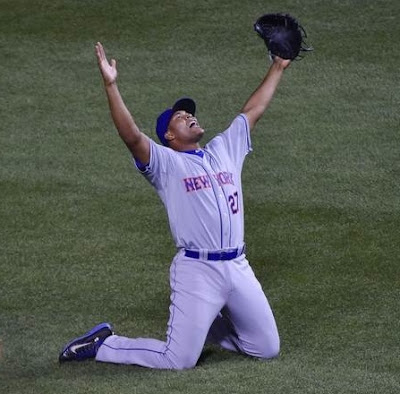
Do I have to get on my knees for the Mets not to overuse Familia in 2016?  (John Starks/Daily Herald)

Moving on to the hitting, the 2015 Mets batted .244 as a team, which was only one percentage point ahead of the San Diego Padres, who finished the season with a league-worst .243 team batting average.  However, the Mets finished near the league average in on-base-plus-slugging (OPS), posting a .712 OPS which was just under the league average of .713.  Both numbers improved when there were runners in scoring position, as the Mets batted .252 with a .736 OPS in RISP situations.

The same thing could be said for the 1973 squad, a team that batted .246 overall with a .653 OPS in all situations during the regular season.  But when there were runners in scoring position, those numbers increased to .254 and .702, respectively.  A year later, the 1974 club could only manage a .238 batting average and .644 OPS with runners in scoring position.  Both of those numbers were worse than what the 1973 squad put up in all situations.

By not being able to drive in runners from second or third base, the 1974 team put more pressure on their pitchers to allow fewer runs and the moundsmen were not up to the task, as Tom Seaver posted the first non-winning season of his career and Jon Matlack had a 13-15 won-loss record despite his 2.41 ERA and seven complete-game shutouts.  The 2016 Mets must continue to drive in runners when they reach scoring position.  If they lose Yoenis Cespedes and Daniel Murphy to free agency, the two players must be replaced with guys who are effective in RISP situations.

Another crucial hitting situation is the one that involves a runner on third base with two outs, where a hitter cannot settle for a fly ball to drive in the runner as he would when there are fewer than two men out.  In 2015, the Mets were not very good in these situations, batting .209 with a .648 OPS.  However, the 1974 squad would have loved to have had that type of production with two outs and a runner on third.  That team batted just .198 and had a measly .547 OPS when those situations occurred - a far cry from the .236/.652 marks the team put up in its pennant-winning 1973 campaign.  The .209/.648 performance by the 2015 club with a runner on third and two outs was not very good and must be improved in 2016 if the team wants to compete for another postseason berth.  If those numbers get any worse, the team could be looking at a sequel to the 1974 season.

Finally, let's look at the Mets' ability to win close games.  The 2015 team was 25-24 in games decided by one run, went 9-6 in extra-inning affairs and only lost four games via the walk-off.  All of those numbers are quite acceptable.  The 1973 pennant-winning Mets - a team that finished the regular season with an 82-79 record - wasn't nearly as good as their 2015 counterparts in close games, as they went 31-32 in one-run contests, 7-12 in extra innings and 6-9 in walk-off games.  However, those numbers were superior to what the Mets produced in 1974 - a year in which they finished 17-36 in one-run games, 4-16 in extra-inning contests and 3-14 in games that ended on a walk-off.  Clearly, the 2016 club must continue to play well in tight ballgames.  To fall as far as the 1974 squad did in the late innings and in extra innings would be disastrous.

The 2015 Mets went places that no one expected them to go.  Although they fell just short of a World Series title, they have the pieces in place to make another run at the team's third championship.  But they can't fall into the trap that befell the 1974 Mets.  That team had a closer that was overused in the previous pennant-winning campaign, could not keep opponents off the scoreboard in the late innings, had difficulty driving in runs with runners in scoring position and was absolutely useless in getting runners in from third base when the other team needed one out to get out of the inning.  The 1974 club followed up their World Series-losing season by winning 71 games.

The 2016 squad still has many players who participated in all or most of the six straight losing seasons the team recorded from 2009 to 2014.  Although those players have wonderful memories of 2015, the memories of those sub-.500 campaigns are also still fresh in their minds.  Next year's team should look at what happened in 1974 and learn from that team's mistakes so as not to repeat history.  Terry Collins cannot overuse Jeurys Familia next year.  Sandy Alderson has to put together a bullpen that will not give up run after run in the late innings, a la the 1974 squad.  And the team has to show that even with the potential loss of Murphy and Cespedes, it can drive in runs in critical situations.

A dropoff in several key categories and positions killed the Mets' chances to return to the World Series in 1974.  It can do the same for the 2016 team.  Alderson, Collins and the players have to make sure the Mets don't repeat the past if they want to be successful in the future.

Monday, March 31, 2014

Joey's Unhappy Recap: A National Disaster On Opening Day

Hi, everyone.  This is Joey Beartran.  In addition to my roving reporter and culinary expert duties for Studious Metsimus, I occasionally write a happy game recap.  More often than not, that recap comes on Opening Day, but today's season opener was anything by happy for the Mets and their fans.

Everything started out happy for me and my Studious Metsimus colleagues.  We attended a tailgate outside the ballpark where we had a tasty burger.  And that, my friends, was the extent of our happiness.

Happy days are here again.  Then the game started.

Oh, sure, the Mets took an early 3-0 lead on a home run into our section by Andrew Brown (I didn't have my glove with me so I let some kid catch it).  And yes, after a poor second inning in which he allowed a long two-run homer to Adam LaRoche, Dillon Gee settled down to retire 15 consecutive batters.  But you have to consider this.  Dillon Gee wasn't going to pitch a complete game.  And Andrew Brown was the Mets' offensive star.

You had a feeling this wasn't going to end well.

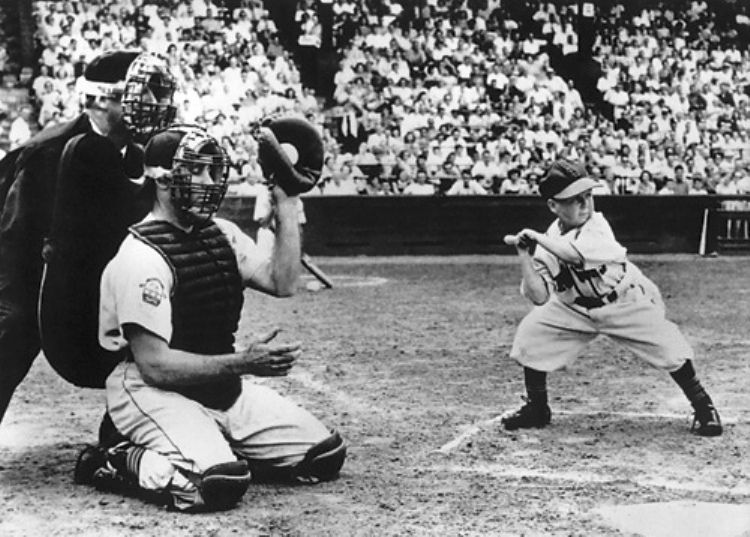
Once Gee was removed from the game in the seventh inning, the bullpen pitched as if every Nationals hitter was named Eddie Gaedel.  Entering the game with the Mets still leading, 4-3, Carlos Torres threw four straight balls to pinch-hitter Nate McLouth.  Then Scott Rice came into the game and thought he was playing Horse.  That's the only explanation I can see for Rice throwing four consecutive balls to Denard Span - he didn't want to get saddled with an "H".

The back-to-back free passes allowed the Nats to tie the game.  And somewhere in the dugout, Dillon Gee sulked.

Dillon Gee walks dejectedly off the mound in the seventh.  Many other Met pitchers would follow suit.

The Mets eventually got out of the inning when Jose Valverde (reliever No. 3 in the inning) struck out Mr. National himself, Ryan Zimmerman.  After retiring the side in order in the eighth, Valverde was in line to pick up the win after Juan Lagares gave the Mets a 5-4 lead with a home run in the bottom of the eighth.

But these are the Mets.  And even though they're the most successful Opening Day team in big league history, they still found a way to send the sellout crowd home disappointed.

Down to their last out, the Nationals tied the game in the ninth off Mets closer Bobby Parnell.  Then Washington scored four runs in the tenth off Jeurys Familia and ex-Nationals pitcher John Lannan.  The big blow came off Lannan, as the southpaw allowed a three-run homer to Anthony Rendon.  In six years with Washington, Lannan won 42 games.  Looks like he won another one for them today.

By the time David Wright hit a meaningless two-run homer in the Mets' half of the tenth (the third time in six seasons Wright has homered in the Mets' home opener), the number of empty seats outnumbered the number of filled ones.

All you need to know about this game is that Dillon Gee allowed four hits and two walks in six and two-thirds innings.  Then six relievers combined to give up five hits and four walks in just three and a third innings.  And oh yeah, Curtis Granderson went 0-for-5 with three strikeouts and the first base combo of Ike Davis and Lucas Duda both went 0-for-2.  The Mets as a team struck out 18 times, led by Eric Young, Jr., who fanned four times.  I mean, if he wanted to wear a golden sombrero so badly, he could have just borrowed Ballapeño's rally sombrero and painted it gold.

So that's it, Mets fans.  Although this past weekend's rainy weather left before the first pitch was thrown, the game itself was still a washout.  It's never a good thing to write an unhappy recap.  It's even worse when it comes on Opening Day.  Let's hope I don't have to write too many of these in 2014.

Washington's Bryce Harper goes down in the second inning.  The Mets would do the same eight innings later.