Showing posts with label Neil Allen. Show all posts

Monday, February 10, 2014

The Best On The Worst: Skip Lockwood

When the New York Mets won the World Series in 1969, the trophy they received was quite unique.  In addition to it being the first World Series trophy handed out to a team that had to win a league championship series before winning the Fall Classic, it was also the only trophy to feature a pennant for the Seattle Pilots.

The Pilots were an American League expansion team in 1969, joining the Kansas City Royals as Junior Circuit neophytes.  But after just one season in the Pacific Northwest, the team packed its bags days before the beginning of the 1970 season and headed to Milwaukee to become the Brewers.

Only four players who were members of the 1969 Pilots ended up joining the Mets after their short time in Seattle.  One was Jim Gosger, the only non-pitcher to play for the 1969 and 1973 Mets who never appeared in a postseason game for either team.  Two others were pitchers Jack Aker (1974) and Mike Marshall (1981), both of whom never appeared in a major league game after their one season with the Mets.  The fourth former Pilot who eventually touched down in Flushing as a member of the Mets had a far more respectable (and longer) career in New York.  In fact, he became one of the few dependable relief pitchers on a team that needed more than just a little relief.

The bespectacled Skip Lockwood had an eye for being a great relief pitcher for the Mets.

Claude Edward Lockwood (or "Skip" as he was better known) was a career American Leaguer prior to becoming a Met in 1975.  After his one season in Seattle, Lockwood was used mostly as a starting pitcher by the Brewers from 1970 to 1973, then became a full-time reliever as a member of the California Angels in 1974.  Lockwood spent one miserable season with the Halos (2-5, 4.32 ERA, 1.39 WHIP) and was then traded to the Yankees, who released him prior to the start of the 1975 season.  One week after he was let go by the Yankees, he was signed by the Oakland Athletics, but Lockwood never pitched for the A's, as Oakland sent the six-year veteran to the minor leagues, where he remained until he was purchased by the Mets in July.

After the departure of Tug McGraw following the 1974 season, the Mets turned to Bob Apodaca to close out games for the team in 1975.  Apodaca had a wonderful season for the Mets in '75, saving 13 games and posting a stellar 1.49 ERA.  But he had two stints on the disabled list during his first season as the team's closer, which included a one-month stay on the DL that kept him off the mound until late July.  Needing a dependable and healthy arm in the bullpen, the Mets turned to Lockwood, who surprised himself and the team by dominating National League hitters over the season's final two months.

Lockwood pitched in 24 games for the Mets in 1975, allowing just 28 hits in 48⅓ innings.  Opposing hitters batted just .174 against him and he matched Apodaca with a 1.49 ERA.  But what was more surprising was the number of strikeouts Lockwood was recording.  From 1969 to 1974, Lockwood fanned 450 batters in 810⅔ innings, an average of 5.0 K/9 IP.  But in less than 50 innings for the Mets in 1975, Lockwood struck out 61 batters, averaging 11.4 K/9 IP.  In 14 of his 24 appearances, Lockwood fanned three or more batters, despite pitching two or fewer innings in nine of those 14 games.  Perhaps his greatest effort came in the season's final game, a game in which he was called upon to pitch the Mets to a winning record, and help Tom Seaver win his third Cy Young Award.

The Mets went into Game No. 162 with an 81-80 record, needing a win to secure its sixth winning season in seven years.  Tom Seaver entered the game with a 21-9 record and 2.29 ERA.  But San Diego's Randy Jones had also recorded a 20-win season in 1975 and was leading the league with a 2.24 ERA.  Jones also had three more complete games and one more shutout than Seaver.  The one thing Seaver had going for him was that he was leading the league in strikeouts, while Jones pitched to contact, as evidenced by his 108 Ks in 285 innings.  Seaver was not very good in his final start of the season, allowing four runs in five-plus innings against the Philadelphia Phillies.  Seaver was pitching in and out of trouble all game, allowing four hits and five walks.  After allowing the first four batters to reach base against him in the sixth inning, manager Roy McMillan pulled Seaver for Skip Lockwood.  Lockwood retired all 12 batters he faced, striking out six of them, allowing the Mets to hold on for a 5-4 victory over the Phillies and preserving Seaver's league-leading 22nd victory.

Lockwood's perfect four-inning performance in the season finale earned him a save, but he saved more than just the game.  He saved Seaver's bid for the Cy Young Award, which he earned by just ten votes over Randy Jones.  He also saved the Mets' quest for a winning season, allowing the team to finish an otherwise mediocre season with an 82-80 record.

When the 1976 season started, new Mets manager Joe Frazier decided that Lockwood was going to be the team's primary closer, with Apodaca pitching earlier in games if he was needed to do so.  Lockwood responded to his new role brilliantly, going 10-7 with a 2.67 ERA, 1.02 WHIP and a team-leading 19 saves.  With 10 wins and 19 saves, Lockwood became the first pitcher in team history to reach double digits in both categories in the same season.  Only Jesse Orosco (1983, 1984) and Roger McDowell (1986) have been able to match Lockwood's feat.

Skip Lockwood circa 1976
Lockwood also recorded 108 strikeouts in 94 innings in 1976, making him the first Mets relief pitcher to strike out over 100 batters in a single season.  (Tug McGraw struck out 109 batters in 1971, but he started one game that year, striking out nine batters in that start.  Therefore, he recorded exactly 100 Ks in relief in 1971.)  The only Mets reliever since Lockwood to have at least 108 Ks in one season is Armando Benitez, who whiffed 128 batters in 1999.

Once again, Lockwood was virtually unhittable, as he held opposing hitters to a .186 batting average in 1976.  That gave Lockwood a combined .182 batting average against him in 1975 and 1976.  According to baseball-reference.com, that made Lockwood the hardest pitcher to hit of all pitchers who threw at least 100 innings in '75 and '76.  Only three other pitchers (Dave LaRoche, Mark Littell, Charlie Hough) held opposing batters to a sub-.200 batting average over those two seasons, but all of them allowed a batting average of .192 or higher.

The Mets finished the 1976 campaign with an 86-76 record.  It was the second-highest win total in franchise history after the 1969 World Championship team.  But it would also be the last time the Mets sniffed a winning record until 1983.  As good as Skip Lockwood had been in 1975 and 1976, even he couldn't prevent the Mets from falling to the bottom of the NL East in subsequent seasons.

The 1977 season started off poorly for the Mets.  By late May, the team was in last place with a 15-30 record and manager Joe Frazier was out of a job.  By year's end, the Mets had lost 98 games, as well as top pitcher Tom Seaver (traded to Cincinnati) and top slugger Dave Kingman (traded to San Diego).  The team couldn't hit, finishing dead last in the National League in batting average, on-base percentage, slugging percentage, home runs and runs scored.  Additionally, the team's top starting pitchers after Seaver (Jerry Koosman, Jon Matlack) combined to go 15-35 with an ERA approaching 4.00.  Skip Lockwood also had what would be a considered a down year for him, but his down year still made him one of the most dependable pitchers on an otherwise inconsistent team.

For the year, Lockwood went 4-8 with a 3.38 ERA and 1.13 WHIP, striking out 84 batters in 104 innings.  Although he was still very stingy against opposing hitters, allowing them to bat just .227 against him, it was the highest batting average recorded against him in his first three years as a Met.  Even so, Lockwood recorded his first 20-save season in 1977 while blowing only four saves.  The never-ending turmoil between the players and the front office seemed to have an effect on Lockwood's performance over the first three months of the season.  Through June 29 (two weeks after the notorious Midnight Massacre), Lockwood had a 4.23 ERA and had lost four out of five decisions.  But from June 30 to September 12, Lockwood pitched like he always had for the Mets, posting a 1.87 ERA in 30 appearances and holding opposing batters to a .196 batting average while recording 11 saves.

Lockwood had a similar season for the Mets in 1978, going 7-13 with a 3.57 ERA, 1.20 WHIP and 73 strikeouts in 90⅔ innings.  But Lockwood only recorded 15 saves in 1978, mainly because he had to be shut down with a shoulder injury after making just one appearance in September.  It's not like the Mets needed him during the season's final month, as the team finished in last place with a 66-96 record.

After two consecutive so-so seasons with the Mets, Lockwood was primed for a comeback season in 1979, especially since he was in the final year of a three-year contract he signed prior to the 1977 campaign.  With free agent dollars on the horizon, Lockwood was on a personal mission to succeed, even if his teammates appeared to be on their own missions to fail.  The Mets lost 99 games in 1979, but Lockwood was absolutely brilliant.  Over the first two months of the season, Lockwood was nine-for-nine in save opportunities and posted a 1.49 ERA, matching his earned run average from his first year as a Met.  But after allowing a run on June 6, Lockwood tore a shoulder muscle, ending his outstanding season prematurely, even though the team's physician, Dr. James C. Parkes, originally thought he was not seriously injured.

Skip Lockwood


"He has stiffness in the back of the shoulder.  He pulled some small muscle fibers.  But with heat and massage and rest, he should be ready to pitch Saturday.  We don't think it's serious."

--Dr. James C. Parkes, Mets team physician


The Mets tread water over the next two months without their top reliever, but the lack of an experienced closer came back to haunt them, as the team lost 40 of 50 games from August 5 to September 25, going 2-14 in one-run games over that time period.  Relievers were responsible for eight of the 14 losses, with future Mets closer Neil Allen earning four "L"s.  How bad was the team's relief corps after Lockwood succumbed to his injury in June?  Lockwood's nine saves led the team in 1979, even though he didn't throw a pitch after June 6.

Despite his penchant for losing one-run affairs, the Mets decided to keep Allen as their closer in 1980, waving goodbye to Skip Lockwood.  Allen would go on to save 69 games for the Mets in four-plus years with the team, but he was never as dominant as Lockwood was, posting a 3.54 ERA and 1.45 WHIP.  Allen also lost 40 games and blew 23 save opportunities from 1979 until his departure on June 15, 1983 in the trade that netted the Mets their future captain, Keith Hernandez.

Skip Lockwood pitched his last game for the Mets on June 6, 1979.  He signed a free agent contract with his hometown team, the Boston Red Sox, prior to the 1980 season, but never saw eye-to-eye with manager Don Zimmer, who constantly misused him.  The Red Sox released him after the season came to an end.  Lockwood then signed a minor league contract with the Montreal Expos, but his career came to an end during the 1981 players' strike without ever playing a game for the Expos.

When you look back at the numbers posted by Skip Lockwood during his 12-year major league career, it appears as if Lockwood was a less-than-ordinary pitcher.  He had a very low winning percentage, going 57-97 as a starter and reliever.  Lockwood also had a 3.55 ERA and 1.31 WHIP, numbers that were fairly average for the era in which he pitched.  But during his five years as a Met, Lockwood was as good a relief pitcher as the team had ever seen.

From 1975 to 1979, Lockwood pitched in 227 games for the Mets, all in relief.  In those five seasons, Lockwood recorded 24 wins and 65 saves, posting a 2.80 ERA, 1.11 WHIP and striking out nearly a batter an inning (368 Ks in 379⅔ innings).  What made this all the more impressive was that the Mets' combined record over those five seasons was 361-449.  In other words, Lockwood pitched beautifully on a team that played horribly.

On a team that has had its share of great pitchers over the years, Skip Lockwood's name is usually overlooked.  However, of all pitchers in Mets history with at least 300 innings pitched for the team, Lockwood ranks very highly in several categories.  Through the 2013 season, Lockwood is among the team's all-time leaders in ERA (2.80; 4th all-time), WHIP (1.11; 4th), batting average against (.213; 4th), on-base percentage against (.285; 5th), slugging percentage against (.319; T-4th) and strikeouts per nine innings (8.72 K/9 IP; 2nd).  Also, his 65 saves rank him 9th all-time in Mets history.  Prior to becoming a Met, Lockwood never allowed opposing batters to finish a season with an on-base percentage under .300 against him.  In five years with the Mets, his opponents' year-by-year OBP against him was .287, .265, .288, .298 and .292, respectively.  Basically, Lockwood had opposing hitters on lockdown once he became a Met.

Skip Lockwood became a Met after spending six seasons with the Pilots, Brewers and Angels - teams that never posted a winning record during his time with them.  He played a key role in helping the Mets to a winning record - his first as a major leaguer - in 1975.  He then became the team's top closer in 1976, also a winning season for the Mets.  But Lockwood never got to play for a winning Mets team again, as the team spiraled its way to the bottom of the division.

Lockwood was one of the greatest and most unheralded relief pitchers in the history of the Mets franchise.  It's a shame that he never got to experience the thrill of a pennant race with the team.  But then again, when you're one of the best players on some of the worst Mets teams, that kind of deal comes with the territory.

You can't discuss the best closers in Mets history without mentioning Skip Lockwood.


Note:  The Best On The Worst is a thirteen-part weekly series spotlighting the greatest Mets players who just happened to play on some not-so-great Mets teams.  For previous installments, please click on the players' names below:

January 6, 2014: Todd Hundley 
January 13, 2014: Al Jackson
January 20, 2014: Lee Mazzilli
January 27, 2014: Steve Trachsel
February 3, 2014: Rico Brogna


Saturday, August 10, 2013

Some Trivia About Mets Walk-off Losses

On Friday night, the Mets dropped the opener of their four-city, 11-game road trip, losing to the Arizona Diamondbacks, 5-4.  They were defeated when MVP candidate Paul Goldschmidt hit the schmidt out of a Scott Atchison offering, leading the Diamondbacks to the walk-off win.

Walk-offs are nothing new against the Mets.  Friday night's defeat was the Mets' tenth walk-off loss of the season and the 421st against the team in franchise history, which includes three postseason walk-off losses.  (For the record, the Mets have won 387 regular season and postseason games via the walk-off, including eight such wins in 2013.)

Game-ending hits, walks, errors, wild pitchers, balks, etc. are common against the Mets, but I'm willing to wager a Scott Atchison autographed sundial (he still uses them to tell time) that you don't know everything there is to know about walk-off losses against the Mets.  So sit back, pop open a Rheingold, and enjoy a little bit of Mets trivia - Studious Metsimus-style - on those dang blasted walk-off losses.

Another day, another walk-off loss.  (Photo by Matt York/AP)

The Mets' first walk-off loss occurred on May 26, 1962, when Willie Mays took Jay Hook deep at Candlestick Park in San Francisco, turning a 6-5 Mets lead into a 7-6, ten-inning defeat.  However, by that time, the Mets had already experienced four walk-off victories, all of which came in a span of five days between May 12 and May 16.  Of course, by the next time the Mets won a game via the walk-off on July 7, 1962, the team had dropped five more games in this fashion.

The most walk-off losses registered by the Mets in a single season is 14, first accomplished by the 1974 Mets and then matched by the 1978 squad.  The fewest regular season walk-off losses in a single year is one, accomplished by the 1999 Mets (Armando Benitez allowed a game-ending homer to the Marlins' Mark Kotsay on June 30, 1999).  Unfortunately, the Mets' season ended that year on a walk-off walk by Kenny Rogers to Andruw Jones in Game 6 of the National League Championship Series.

Many players have delivered game-ending hits (or other type plays) against the Mets over the years.  Several players have been a triple threat, beating the Mets three times via the walk-off.  Those players include Hall of Famers (Andre Dawson, Tony Gwynn, Tony Perez), former All-Stars (Dusty Baker, Cesar Cedeño, Ron Cey, Jim Davenport, Jim Edmonds, Dale Murphy), several active players (Dan Uggla, Ryan Zimmerman), a journeyman slugger (Bob Bailey), a former Rookie of the Year (Jerome Walton) and two guys named Manny (Manny Mota, Manny Trillo).  But only one player has delivered four walk-off hits against the Mets in team history.  That would be one Michael Jack Schmidt, who hit walk-off homers to defeat the Mets in 1974, 1975 and 1978, then kept it in the park for a game-ending RBI single against Roger McDowell in 1987.

Of their 418 regular season and three postseason walk-off losses, the most common way the Mets have lost via the walk-off has been on a single (194 losses).  That's followed by home runs (123, including ten grand slams), doubles (23), errors (21), walks (17) and sacrifice flies (17).  The Mets have also been victims of the walk-off loss through uncommon plays.  They've lost three games on walk-off balks and have been witnesses to two game-ending triples.  But the Mets have suffered only one walk-off loss because of a passed ball.  That occurred on July 27, 1967, when Tommie Reynolds could not handle a pitch by Jack Fisher, allowing Nate Oliver to score the winning run for the Dodgers in the bottom of the 11th.  Although Reynolds played for four teams from 1963 to 1972 (including 101 games for the Mets in 1967), it was his first and last appearance behind the plate in a big league game.

What don't you see in this photo of Tommie Reynolds?  Catching equipment.  That's because he wasn't a catcher.

Including last night's affair, the Mets have now lost 123 times on a game-ending home run.  Two pitchers share the team record for most walk-off homers surrendered, as both Jesse Orosco and Randy Myers allowed six game-ending home runs during their time with the Mets.  But Myers is alone when it comes to walk-off homers allowed in a single season.  In 1989, Myers gave up four such blasts, as he watched Rey Quiñones, Von Hayes, Mark Grace and Chris James circle the bases into the arms of smiling teammates.  Although he only pitched three full seasons in New York (he had cups of coffee with the Mets in 1985 and 1986), Myers was on the mound for ten walk-off losses, making it more palatable for the Mets to trade him to the Cincinnati Reds for John Franco (more on him later).  But those ten walk-off losses are not the most in Mets history.  In fact, they were eight short of the record at the time.

Neil Allen pitched for the Mets from 1979 until he was traded to the St. Louis Cardinals for Keith Hernandez on June 15, 1983.  In his four-plus seasons with the Mets, Allen was victimized by the walk-off an incredible 18 times.  In 1980 alone, Allen walked off the mound six times while the opposing team celebrated their late victory.  Changing uniforms in 1983 did nothing to change Allen's penchant for the late-inning loss.  In the two seasons following the trade from the Mets to the Cardinals, Allen watched the Mets celebrate four walk-off victories against him, with the most memorable coming on Opening Day 1985, when Gary Carter took him deep in his first game as a Met.

Allen is no longer the team record-holder when it comes to being on the mound while the opponent is walking off with a win.  That distinction belongs to John Franco, who witnessed 25 walk-off celebrations from a distance of 60 feet, six inches.  Two players walked off against Franco twice.

Glenallen Hill hit a two-run homer off Franco on September 5, 1993 to give the Cubs a 2-1 victory over the Mets.  Hill then hit another game-ending homer off the longtime Met nearly two years later, giving the Giants a 6-5 win on September 1, 1995.

Steve Finley is the only other player to be at the plate against John Franco when Franco delivered the pitch that gave the opponent a victory.  However, one of those two walk-offs was made possible by an untimely error.  On September 7, 1993, just two days after he watched Glenallen Hill hit a game-ending two-run homer against him, Franco was on the mound for another walk-off celebration, although this one was created by poor defense.  A gaffe by Jeff Kent on a ball hit by Finley allowed the winning run to score in a 4-3, 10-inning loss to the Astros.  Nearly ten years later, Finley victimized Franco again, but this time the blame was all on Franco's shoulders.  On August 9, 2003, Finley became the first Diamondback to hit a walk-off home run against the Mets, connecting on a solo blast in the bottom of the ninth inning to give Arizona a 2-1 victory.

Steve Finley might have walked off against the Mets twice, but he couldn't prevent this walk-off from happening.

And that brings us back to last night and Paul Goldschmidt's game-ending homer.  Goldschmidt's bomb came on the ten-year anniversary of Finley's homer.  Those two homers are also the only times the Diamondbacks have defeated the Mets with a walk-off homer.  The only other time Arizona walked off with a victory against New York was on July 21, 2010, when Chris Snyder delivered an RBI single off Fernando Nieve to end a 14-inning marathon in the desert.

The Mets have lost thousands of games over their 50-plus years of existence.  But there is nothing more heartbreaking than a walk-off loss.  And the Mets have had their share of those.  Whether it be on a game-ending homer or a passed ball by a catcher who had never played the position before, it never gets easier to watch a team you don't root for celebrating a late victory against the team you do.  That's just baseball for you.

I hope you enjoyed this piece on game-ending trivia and related minutia.  By reading it, you will no longer be at a loss when you walk off to tell your friends about it.
 

Saturday, June 15, 2013

Keith, The Mets & Me: A Thirty-Year Love Affair

I became a Mets fan on Memorial Day 1981.  My father wasn't feeling well that day so we had to cancel our annual Memorial Day barbecue, leaving eight-year-old me to find something to do since I was home from school that day.  My ill father was in bed all day, so I decided to lay back on his comfortable-beyond-words recliner and watch TV.  The last person who watched the tube had left it on Channel 9 and since 1981 was the pre-remote control era of television (at least it was in our household), I didn't feel like getting up to physically change the channel, so I just watched was on WOR at the time.  It was a Mets-Phillies game.  And it was beautiful.

The Mets destroyed Philadelphia, showing no brotherly love for their division rivals in a 13-3 romp.  Although many players performed well for the Mets that day (Hubie Brooks, Lee Mazzilli and Joel Youngblood had three hits apiece and Dave Kingman hit a grand slam), it was Mookie Wilson who captured my attention and made me thankful that we weren't a remote control household.  Mookie reached base four times that day (two hits, two walks).  He also scored three runs and drove in two.  After leading off the game with a walk, Mookie proceeded to swipe second and scored the first of the Mets' four runs in that inning.  It was the first time I had been exposed to Mookie's baserunning abilities, and I was utterly amazed.  Six innings later, Mookie crushed a long drive to center off former Met Tug McGraw that went for a two-run triple.  His gazzelle-like speed mesmerized the eight-year-old me to the point where I checked the TV guide (I had to get off the couch eventually) for when the next Mets game was going to be aired on WOR.

Less than three weeks after discovering Mookie and the Mets, baseball went on strike.  For two months, I couldn't indulge in my new passion - my New York Mets passion, that is.  Fortunately, my father recovered from his illness and we were able to have many barbecues to pass the time during baseball's two-month hiatus.  Baseball returned to my TV screen in August, and I quickly eschewed burgers and hot dogs on the grill for Mookie and the Mets on my grill.

Run, Mookie, Run!

Although my father hails from Puerto Rico, an island paradise that loves its baseball, he has never been much of a sports fan.  He knows the object of the game, but can't differentiate between an infield fly and an unzipped fly.  So naturally, you can imagine how difficult it was for me to get him to take me to a Mets game at Shea Stadium.  Every conversation would start the same way ("We're not doing anything this weekend, right?  Can you get us tickets for this game?") and unfortunately, they would also end the same way ("No.").  It took over two years for me to finally make it out to Shea to meet the Mets, meet the Mets, step right up and greet the Mets.  And when I did, it was because my Little League team went as a group.  The date was June 15, 1983 - thirty years ago today - and it became a memorable day not just for the then ten-year-old me, but for all Mets fans.

When we got to the game, I remember how disappointed I was that Mookie Wilson was not in the starting lineup (Danny Heep took Mookie's place as the leadoff hitter and centerfielder for the game.  It was only the second time all year that Mookie wasn't in the starting lineup for the Mets.)  My fleet-footed hero didn't start, but Craig Swan did, taking the mound for the Mets against future Hall-of-Famer Ferguson Jenkins.  Unfortunately, Swan was not graceful that night.  By the time I got back from my second bathroom break in the second inning (my Little League teammates were not amused that I kept stepping on their feet every time I tried to squeeze by them in our upper deck seats), Swan was out of the game and the Mets were down 4-0.

The bullpen pitched very well after Swan’s early exodus and the Mets rallied to tie the game.  Mookie did pinch-hit in the fifth inning, but struck out against Jenkins, denying me the opportunity to see him fly around the bases.  Of course, his one-day replacement in center field, Danny Heep, followed Wilson's strikeout with the game-tying hit, causing my Little League teammates to tease me by saying that Heep was going to be the centerfielder of the future.  I'm glad they were wrong.

Neither team scored after Heep knotted the game, necessitating extra innings and causing some of the parents and chaperones to wonder if they should take the kids home.  They decided to stick around for the tenth, but told us all that if the game went to the 11th, we would have to leave.  We did get to see the game to its conclusion, but it wasn't the conclusion I wanted.  The Mets lost the game to the Chicago Cubs in ten innings by the score of 7-4.  An error by first baseman Rusty Staub and a timely bunt by Bill Buckner set the Cubs up for their big inning and my bigger disappointment.  But errors by Mets' first basemen were about to become a thing of the past, thanks to a brilliant trade engineered by general manager Frank Cashen.

A Gold Glove, a sweet swing, a killer 'stache.  Keith Hernandez brought it all to the table.

Earlier in the evening, the Mets announced that they had acquired first baseman Keith Hernandez from the defending World Series champion St. Louis Cardinals in a trade for pitchers Neil Allen and Rick Ownbey.  I remember how happy the sparse crowd of 11,631 was when the announcement was flashed on DiamondVision.  I also remember how confused I was that the biggest cheer of the night was reserved for the “big TV screen in left field” rather than the events taking place on the field.  But as the years went by and my love of the Mets grew, I realized just how special Keith Hernandez truly was, both as a player and as a team leader.

As you all know, the trade for Keith Hernandez set off a chain of events that led to a World Series championship three years later (a World Series that turned my man Mookie into a Mets legend for all time).  Hernandez's arrival gave instant credibility to the languishing franchise, although it took until the following season for that off-the-field credibility to translate into on-the-field wins.

In hindsight, it didn’t matter that the Mets lost on June 15, 1983.  It was one of 94 games they lost that season anyway.  That day was important to me for more than just a game.  That day began my love affair with Shea Stadium and my subsequent appreciation of Keith Hernandez.  I should have known the Mets had acquired someone special when I listened to the sweet voice of Bob Murphy after the game during the radio post-game show when he said “the Mets lost the game tonight, but they have gained a superstar.”  Thirty years ago today, the magic that was the Mets entered my life.  It has never left.
 

Monday, February 4, 2013

The Mets That Got Away: Jeff Reardon

The Mets have a history of trading away young pitchers for offensive help.  In 1971, Nolan Ryan was traded to California for Jim Fregosi in what many consider to be the worst trade in club annals.  Two decades later, David Cone was shipped to Toronto for Ryan Thompson and the eventual all-time leader in home runs by a second baseman, Jeff Kent.  (Of course, the Mets traded Kent away before anyone realized he would become the most prodigious power hitter at his position.)  Cone wasn't the only strikeout king to be traded north of the border, as just this past off-season, R.A. Dickey took his Thesaurus and Cy Young Award to Toronto for top catching prospect Travis d'Arnaud, ace-in-waiting Noah Syndergaard and catcher of the moment John Buck.

Ryan threw seven no-hitters after leaving New York and is the proud owner of a Hall of Fame plaque.  Cone pitched a perfect game, won a Cy Young Award and wears five World Series rings on his pitching hand.  Dickey left a 74-win team to join a vastly improved Blue Jays squad that is looking to win its first AL East title in 20 years.

But it's not just starting pitchers who have been dealt for players who were supposed to provide an offensive spark.  Occasionally, the Mets have traded a relief pitcher for offensive help.  And unfortunately, on occasion that offensive help fizzled while the relief pitcher sizzled for his new team.

One such reliever spent parts of three seasons in New York, but was blocked from being anything but a middle reliever because the Mets already had a full-time closer.  Deemed expendable when the Mets were searching for a bat, he was traded to a team that didn't have a full-time closer, but had a surplus of outfield talent.  In one of Frank Cashen's rare poor trades, Ellis Valentine became a Met, sending Jeff Reardon to Montreal.

Jeff Reardon took a knee in this photo, but after he left the Mets, he had opposing hitters on their knees.

Jeffrey James Reardon was originally drafted by the Montreal Expos in the 23rd round of the 1973 amateur draft.  But Reardon did not sign with Montreal, instead choosing to attend and play baseball at the University of Massachusetts Amherst.  Four years after spurning the Expos, Reardon signed a minor league contract with the New York Mets.  One day after Reardon became property of the Mets, Tom Seaver and Dave Kingman became former Mets, as "The Franchise" and the "Sky King" were dealt away in separate trades by penny-pinching chairman M. Donald Grant.

The team was about to enter into its darkest period, playing before sparse crowds at Grant's Tomb, as Shea Stadium was known in the post-Midnight Massacre era.  But the lack of talent at the major league level meant that Reardon would have a short stay in the minors, provided he could pitch somewhat successfully there.  To say Reardon was somewhat successful as a Mets minor leaguer would be a massive understatement.

In his first professional baseball season, Reardon pitched well at Single-A Lynchburg, going 8-3 with a 3.30 ERA in 1977, with most of his appearances on the mound coming as a starting pitcher.  In 1978, Reardon once again pitched primarily as a starter and was dominant, posting a 17-4 record and a 2.54 ERA at AA-Jackson.  Upon his promotion to AAA-Tidewater in 1979, Reardon was converted to a relief pitcher, making 29 of his 30 appearances out of the bullpen.  The transition went without a hitch, as Reardon's ERA dropped to 2.09 and his WHIP was a stellar 0.97.  By late August, Reardon was in the major leagues.

Reardon appeared in his first major league game at Shea Stadium on August 25, 1979, losing to the Cincinnati Reds when he failed to hold a one-run lead in the ninth.  Two days later, he was on the mound again at Shea, this time against the Atlanta Braves.  Reardon was called upon by manager Joe Torre to pitch the ninth inning of a game that was suspended on June 17 with the score tied, 1-1.  After Reardon pitched a scoreless top of the ninth, his teammates came through in the bottom of the ninth, scoring the winning run on an RBI single by Alex Treviño.  Reardon was credited with the victory in only his second big league appearance.  Because of an interesting statistical twist, Reardon earned his first win two months before making his major league debut, as the game went in the record books as having happened on June 17, even though Reardon was still at Tidewater on that date.  Similarly, Reardon is credited with having made his major league debut on June 17, even though he didn't step on a major league mound until August 25.

Although Reardon gave up runs in two of his first three outings with the Mets, he was brilliant in the season's final month, posting a 0.51 ERA and holding opposing hitters to a .123 batting average.  The Mets closed out the 1979 season by winning their final six games to avoid the team's first 100-loss campaign since 1967, with Reardon playing a large part in the season-ending skein.  Reardon pitched in four of the six games, facing 13 batters and allowing only one of them to reach base - and he reached on an error.  He also recorded the first two saves of his career in the season's final week.

By pitching only 20⅔ innings for the Mets in 1979, Reardon retained his rookie status for the 1980 campaign.  His first full season in the majors was arguably the best by a Mets rookie reliever in the team's first two decades of existence.  Reardon appeared in 61 games for the Mets in 1980, racking up 110⅓ innings in the process.  The right-hander was at his best when he pitched at least two innings, which he did in 38 of his 61 appearances.  Reardon posted a 1.62 ERA in his multi-inning appearances, holding the opposition scoreless in 28 of those 38 games.  Reardon's tremendous season (8-7, six saves, 2.61 ERA, 101 Ks) earned him a sixth-place finish for the National League Rookie of the Year Award, making him the first relief pitcher in Mets history to get Rookie of the Year consideration.

Even though the Mets were still near the bottom of the National League East standings in 1981, they had developed quite a bullpen.  Seven relievers pitched in at least 20 games for the Mets in 1981.  None of them had an ERA above 3.68 and five of the seven posted ERAs under 3.00.  As the June 15 trade deadline was approaching, it was clear that the bullpen was the team's strength.  At the same time, the offense was struggling to score runs.  The Mets won only eight of their first 33 games in 1981, averaging 2.9 runs per game over that stretch.  Other than the recently reacquired Dave Kingman, who hit 11 of the team's first 25 home runs, no Met was hitting for power.  General manager Frank Cashen realized that the team needed an offensive spark and also knew that one way to get it was by trading a strength to fix a weakness.  On May 29, Cashen made such a deal, and Jeff Reardon's career as a Met was over.

In a trade that would go down as one of the few poor deals orchestrated by Cashen, the Mets sent Reardon and outfielder Dan Norman (who came to the Mets in the Tom Seaver trade) to the Montreal Expos in exchange for outfielder Ellis Valentine.

From 1977 to 1979, Valentine was one of the most complete players in the National League. As a hitter, Valentine averaged 31 doubles, 24 homers, 78 RBIs and 12 stolen bases per season over the three-year period.  As the Expos' rightfielder, Valentine was a defensive monster, winning a Gold Glove in 1978 on the strength of his league-leading 25 assists.  No outfielder, regardless of whether of he played in left field, center field or right field, has recorded as many as 25 assists since Valentine accomplished the feat in 1978.  Needless to say, Valentine would have been a great acquisition for the Mets following the 1979 season.  But it was now 1981.  And although Valentine was only 26 at the time of the trade, he was already a shadow of his former All-Star self.

Valentine was limited to 86 games in 1980 because of various injuries, including a fractured cheekbone he suffered after being hit in the face with a pitch.  His numbers for the year (.315, 13 HR, 67 RBI) were impressive for the amount of games he played, but the injuries seemed to change the course of his career.  Valentine started off poorly in 1981, batting .211 in limited duty for the Expos.  He also missed games because of a sprained knee and a pulled left hamstring.  In fact, at the time of his trade to the Mets, Valentine was on the disabled list because he had aggravated the hamstring injury.

Nothing changed for Valentine after the trade to New York, as the once-promising outfielder hit .207 for the Mets in 48 games.  He rebounded to hit .288 in 1982, but had become a singles hitter.  In 111 games, Valentine only produced 23 extra-base hits and collected 48 RBIs.  His speed had deserted him as well.  After four consecutive seasons of double-digit steal totals from 1976 to 1979, Valentine stole one base as a Met in seven attempts.  Valentine never played for the Mets again after the 1982 season and was out of baseball by 1985.  Reardon, on the other hand, was on his way to becoming one of the best closers of his generation.

After the trade to Montreal, Reardon turned into a dominant reliever.  In 25 games for the Expos in 1981, Reardon went 2-0 with six saves.  He also had a sparkling 1.30 ERA, 0.72 WHIP, and held opposing hitters to a microscopic .148 batting average.

Reardon was at his best during the Expos' march to the second-half division title in 1981 (the players' strike divided the 1981 season into two halves), allowing one run, eight hits and no walks in his final 15⅓ innings.  Three of those 15⅓ innings came in Montreal's regular season finale, a game the Expos needed to win to advance to the postseason for the first time in franchise history.  Naturally, the game was played at Shea Stadium, the site of the Expos' first-ever regular season game in 1969.  Reardon came into the game in the seventh inning and was still on the hill when Dave Kingman flied out to leftfielder Terry Francona for the final out of the game.  Four months after being traded by the Mets to the Expos, Reardon was celebrating a split-season championship with his new teammates at Shea Stadium.

In the first-ever National League Division Series, Reardon saved two of the Expos' three victories.  However, he struggled against the eventual World Series champion Dodgers in the NLCS.  Montreal fell one win short in their quest to reach the World Series.  They never won another division title as the Expos.

Former Met Jeff Reardon and future Met Gary Carter celebrate the only playoff series win in Expos history.

From 1982 to 1986, the Expos were a mediocre team, winning between 78 and 86 games each year.  But Reardon was anything but mediocre.  During those five seasons, Reardon established himself as one of the most feared closers in the National League.  He won 30 games and recorded 146 saves over the next half-decade for the Expos, recording an impressive 2.98 ERA along the way.  Reardon  was selected to represent Montreal in the All-Star Game twice and led the league in saves once.  Furthermore, his 41 saves in 1985 earned him his first Rolaids Relief Award and helped him finish 7th in the Cy Young Award vote and 20th in the NL MVP vote.

Following the 1986 season, the Expos traded Reardon to the Minnesota Twins in a six-player deal.  Although Reardon posted a 4.48 ERA in his first season facing American League hitters, he still managed to save 31 games for the Twins in 1987 and struck out a career-high 9.3 batters per nine innings.  The Twins went on to win their first World Series championship in Minnesota, with Reardon pitching 4⅔ scoreless innings in the Fall Classic.  For the second time in his career, Reardon finished in the top ten in the Cy Young vote and he also finished 11th in the race for AL MVP.

Reardon had another spectacular season in 1988, saving a career-high 42 games, lowering his ERA to 2.47 and earning his third All-Star Game selection, but the Twins fell short in their quest to repeat as World Series champions.  In 1989, Reardon's ERA ballooned back over 4.00, but he still managed to record his fifth consecutive 30-save season.  It would be his last season in Minnesota.

Prior to the 1990 season, Reardon signed a three-year, $6.8 million contract to pitch for the Boston Red Sox.  His first two years in Boston were excellent.  Reardon combined to save 61 games in 1990 and 1991, helping the Red Sox win the AL East in 1990 and making his fourth All-Star team in 1991.  After becoming the first pitcher to record a 40-save season in each league in 1988, Reardon enjoyed another 40-save season with the Red Sox in 1991, making him the first player to reach that mark with three different teams.

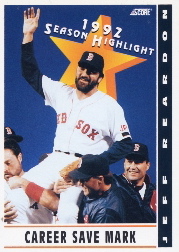
In 1992, Reardon put his name in the record books once again when he recorded his 342nd career save to pass Rollie Fingers into the top spot on the all-time saves list.  But Reardon struggled after breaking Fingers' record.  Over his next 25 games, Reardon posted a 6.33 ERA and blew seven save opportunities.  As a result, the Red Sox traded Reardon to Atlanta in late August, which seemed to rejuvenate the 36-year-old reliever.  In 14 late-season appearances with the the Braves, Reardon went 3-0 with three saves and a 1.15 ERA, helping Atlanta win their second consecutive NL West division title.  In the NLCS against the Pittsburgh Pirates, Reardon did not allow a run or a hit in three appearances and became the winning pitcher in Game 7 when Francisco Cabrera drove in Sid Bream with the pennant-winning run in the bottom of the ninth.  But the World Series was another story, as Reardon only got into two of the six games against the Toronto Blue Jays and was credited with the loss in Game 2 when he allowed two runs in the ninth inning.

With this slide by Sid Bream, Jeff Reardon became a winning pitcher in a Game 7.  How about that?

The 1992 World Series marked the beginning of the end for Reardon.  He signed with Cincinnati prior to the 1993 season and was used primarily as a middle reliever, going 4-6 with eight saves and a 4.09 ERA for the Reds.  He then signed as a free agent with the Yankees in 1994, but was horrible in 11 games for the Mets' crosstown rivals.  Reardon posted an 8.38 ERA and allowed 17 hits in 9⅔ innings before being released by the Yankees in early May.  The 38-year-old Reardon would never pitch again in the major leagues.

Jeff Reardon began his 16-year career in the big leagues as a late-inning pitcher for the Mets in 1979.  He pitched well in parts of three seasons as a Met, appearing in 97 games and going 10-9 with a 2.65 ERA.  But with Neil Allen entrenched in the closer's role, Reardon could only muster ten saves with the Mets.  However, with the team in need of offensive help (which was a common theme from the late '60s to the early '80s - isn't that right, Amos Otis and Nolan Ryan?), general manager Frank Cashen acquired Ellis Valentine in exchange for the bearded reliever.  Allen eventually gave up the closer's role to Jesse Orosco in 1983 (this time, Cashen got it right - he jettisoned Allen to St. Louis for Keith Hernandez), but by then, Reardon had become a star closer in Montreal.

In five and a half seasons with the Expos, Reardon saved 152 games and recorded a 2.84 ERA.  Although Reardon left Montreal following the 1986 season, he is still the Expos/Nationals all-time leader in saves and ranks second in ERA for pitchers who threw at least 500 innings for the club.  He also pitched the Expos into the postseason for the first and only time during the team's 36-year tenure in Montreal.

Upon bidding adieu to Montreal, Reardon then went to Minnesota, where he won a World Series ring in his first year there.  He also racked up 104 saves in three seasons (1987-1989) with the Twins.  In doing so, he became only the third pitcher to post 100 saves for multiple franchises, following Hall of Famers Rollie Fingers (A's, Padres) and Bruce Sutter (Cubs, Cardinals).

From 1990 to 1992, Reardon saved 88 games as a member of the Boston Red Sox, including his record-setting 342th career save.  Had he not been traded to Atlanta during the 1992 season, he might have become the charter member of the "100 saves with three teams" club.  Then again, had he not become a Brave, he wouldn't have had an opportunity to pitch in his second World Series.

How good was Reardon during the 12-year period from 1981-1992, a period that saw him save 344 games for the Expos, Twins and Red Sox?  In addition to being the Expos/Nationals all-time leader in saves, Reardon also ranks fifth on the Twins' all-time saves list and has the fifth-most saves in Boston's long and storied history as well.  The only other pitcher in baseball history who can make the same claim is Rollie Fingers.  (Fingers is No. 2 in Oakland, No.3 in San Diego and No. 3 in Milwaukee.)  And for the record, Reardon's ten saves with the Mets have him in a 23rd place tie with Turk Wendell, who was also never the team's closer.

Reardon showed he was durable and dependable throughout his career, recording 20 or more saves in 11 consecutive seasons (1982-1992).  In doing so, he became the first pitcher in major league history to accomplish the feat in more than nine straight years.  Since Reardon, only two other pitchers have posted at least ten consecutive seasons with 20+ saves.  Former all-time saves leader Lee Smith did it for 13 straight years from 1983 to 1995 and current saves leader Mariano Rivera pulled off 15 consecutive 20-save seasons from 1997 to 2011.  By comparison, only 16 pitchers have recorded 20 or more career saves for the Mets.  (Cal Koonce and Anthony Young are tied for 17th on the Mets' all-time saves list with 18 apiece.)  And of those 16 pitchers to record 20 career saves for the Mets, only John Franco (1994-1998) and Armando Benitez (1999-2003) reached the mark in as many as five consecutive seasons.

During a career that began in New York with the Mets in 1979 and ended across town with the Yankees in 1994, Reardon recorded 40-save seasons for three different teams.  He was also a four-time All-Star, finished in the top ten in the Cy Young vote twice, and even received MVP consideration three times (1985, 1987, 1988), a feat that is unheard of for a relief pitcher.  Reardon helped four teams make the playoffs and pitched in 18 postseason games for the Expos (1981), Twins (1987), Red Sox (1990) and Braves (1992).  He won two playoff games in his career, including a Game 7, and saved six others.

Reardon pitched in 880 games, with all of them coming in relief.  He finished his career with a 73-77 record, 367 saves (20 of which came against the Mets) and a 3.16 ERA.  Reardon was so dominant that he finished his career with more saves (367) than walks (358).  But as is the case with many other relief pitchers, Reardon did not receive much support when he became eligible for the Hall of Fame in 2000.  In his first year of eligibility, Reardon was named on 24 of the 499 ballots cast, falling one vote short of the 25 needed to receive the 5% of the votes required to remain on the Hall of Fame ballot.

Life after baseball hasn't been too kind to Reardon.  In 2004, his son died of a drug overdose, sending Reardon into a severe state of depression.  Reardon was taking anti-depressants and other medications prescribed to him when he was arrested in 2005 on charges of armed robbery.  However, he was acquitted of the crime when the judge found him not guilty by reason of insanity.  The judge's verdict was based on testimony by court-appointed psychiatrists who claimed that at the time of the alleged incident, Reardon was taking so many medications (12 in all) that he was in a "medication-induced delirium".  Although Reardon will never get over the pain of losing his son, he is now devoting his time to getting his own life back on track.

Jeff Reardon has experienced all the highs and lows life has to offer.  Although he never quite made it to the Hall of Fame, he will still go down as one of the best and most intimidating closers of all time.  In 1981, the Mets were looking for someone to spark their offense.  What they succeeded in doing was igniting the career of Jeff Reardon.  Whereas Ellis Valentine fizzled in New York, Jeff Reardon became one of the best closers in the history of the game.  A team can't win without good pitching.  It also can't win when it lets good pitching get away.


 (Jeff Reardon video shared on YouTube by Sebastien Lepage)


Note:  The Mets That Got Away is a thirteen-part weekly series that spotlights those Mets players who established themselves as major leaguers in New York, only to become stars after leaving town.  For previous installments, please click on the players' names below:

January 7, 2013: Nolan Ryan
January 14, 2013: Melvin Mora  
January 21, 2013: Kevin Mitchell 
January 28, 2013: Amos Otis