Saturday, September 14, 2013

An Unusual Stat Regarding Dave Kingman

Photo by Ed Leyro/Studious Metsimus (although technically it was taken by the security dude)

Back in July, I had the pleasure of meeting former Met first baseman/outfielder Dave Kingman.  Although Kingman was sometimes unapproachable as a player, I found him to be quite affable and a pleasure to talk to.  And after taking a few photos and having a short conversation about his two stints as a Met, I realized that I had rarely written anything on Kingman.  I had also rarely done any research on the player known as Sky King during his time with the Mets.  So today I'm going to kill two birds with one Kong blast.

I was looking at Kingman's career and found something very unusual about his 1982 season.  Besides hitting 37 home runs on a team in which there were no other hitters who managed more than 13 homers, Kingman also "slugged" only nine doubles.  That's 37 homers, nine doubles.

For someone known to hit the ball a long way, I found it odd that Kingman managed to hit so few doubles in 1982, especially when he played so many road games in the cavernous Busch Stadium and Astrodome.  I also wondered just how rare it was for someone to finish a season with 30 or more homers and fewer than 10 doubles.  The answer?  Let's just say Ike Davis has more stolen bases this year than there are players with that homer/double combo.

In 1955, Gus Zernial of the Kansas City Athletics became the first player in major league history to collect 30 homers in a season where he failed to hit 10 doubles.  Zernial hit 30 HR for the A's while managing to collect only nine two-base hits.  Forty-five years later, Mark McGwire joined Zernial on this list when he swatted 32 homers for the St. Louis Cardinals.  McGwire hit only eight doubles for the Cards in 2000.  McGwire came close to repeating the feat in 2001, but fell one homer short.  Big Mac hit 29 HR in his final season in the majors, while clubbing a mere four doubles.

In between Zernial and McGwire, there was Dave Kingman.  In 1982, the Mets' first baseman launched a then-franchise record 37 home runs, but only managed to hit nine doubles.  A flurry of two-baggers in September almost prevented Kingman from joining this exclusive club, as Kong collected four of his nine doubles in the season's final month.  From June 23 to August 28 - a span of over two months - Kingman played in 54 games and had 213 plate appearances.  He hit 14 homers in that time period but did not have a single double.  That's zero in the 2B column.

2B or not 2B.  That was the question with Dave Kingman in 1982, and more often than not, it was not 2B for Kingman in the doubles department.  Kingman is one of only three players in major league history to amass 30 or more home runs in a season he failed to reach 10 doubles.  Furthermore, Kingman's 37 HR are the most of any player on this short list, five more than the amount hit by Mark McGwire in 2000.

Dave Kingman truly had one of the most unusual offensive seasons in 1982, not just for the Mets, but for any hitter in baseball history.
 

There's A Dimensional Problem At Citi Field

Photo by Scott Cunningham/Getty Images

When Citi Field first opened in 2009, the baseball cognoscenti deemed it a pitchers' park.  With the high walls in left field and the deep power alleys (it was 415 feet to one spot just to the right of straightaway center field), fly ball pitchers would not have to worry about opposing hitters taking them deep as often as they would at various other ballparks around the league.

But after two seasons of the pitcher-friendly dimensions, it was decided by the Mets' brass that the heights of the walls should be lowered and those walls should also be moved closer to home plate.  The Mets had averaged 56 home runs per season in 2009 and 2010 and the team felt the more fair dimensions would help its players produce more long balls.  Since the walls were moved in, they've certainly seen more balls leave the yard.  They're just seeing them come off their opponents' bats.

Let's look at the home run production by the Mets and their opponents compiled over the last two seasons of Citi Field's old dimensions and compare that to the power production for the first two seasons of the new, more fair dimensions of the park.


Year
Mets HR (Citi Field)
Mets HR (Road)
Opponents HR (Citi Field)
Opponents HR (Road)
2010
63
65
47
88
2011
50
58
58
87
2012
67
72
88
73
2013
56
66
82
62


During the last two seasons of the old dimensions (2010 and 2011), both the Mets and their opponents hit more home runs away from Citi Field than they did in Flushing.  In fact, Mets pitchers allowed 70 more home on the road than they did at Citi Field in 2010 and 2011.  But once the fences were lowered and moved in, the opposition took full advantage of the change while Mets' hitters barely noticed the dimensional differences.

In 2010 and 2011, the Mets hit 12 more home runs on the road than they did at home.  In the two years since the dimensional switch at Citi Field, the difference in home runs on the road versus home runs at home has actually increased to 15, meaning the Mets' home run production has remained virtually unchanged since the walls were lowered and moved in.  That's not the case with the Mets' opponents.

After holding opponents to 105 home runs at Citi Field in 2010 and 2011, Mets' pitchers have allowed a whopping 170 homers in Flushing in 2012 and 2013.  Meanwhile, they've only given up 135 home runs on the road over the same time period.

Jonathon Niese, who has pitched at Citi Field under both dimensional conditions, allowed 15 home runs at Citi Field in 2010 and 2011.  He coughed up 19 gopher balls on the road during that time.  Since the fences were moved in, Niese has allowed 18 long balls at Citi Field and 14 on the road.

Dillon Gee allowed two more home runs on the road than he did at home in 2010 and 2011.  As soon as the dimensions were changed in 2012, he allowed ten homers at Citi Field compared to only two on the road.

Clearly, the change in dimensions was made to help the Mets score more runs via the long ball.  But all it has done so far is make opposing hitters salivate every time they come to the plate.  After allowing 70 more home runs on the road than at home in 2010 and 2011, Mets' pitchers have given up 35 fewer homers away from Citi Field than they have in their home ballpark.  That's an alarming difference.

The Mets need to improve their offense in 2014.  They also need their pitchers to stay healthy next season.  But perhaps they should also reconsider what they thought was a good plan going into the 2012 campaign.  The new dimensions have only been advantageous to hitters wearing road grays.
 

Thursday, September 12, 2013

Davey Johnson Should Be A Lock For The Hall of Fame


When Davey Johnson was hired to be the manager of the New York Mets prior to the 1984 season, no one expected much from the former major leaguer.  Although he had had some managerial success in the Mets' minor league system, he had never held a job as a skipper in the major leagues.  In fact, the only thing many Mets fans knew about him was that he made the final out of the 1969 World Series, lifting a long fly ball into that settled gently into the glove of a genuflecting Cleon Jones.

But Davey Johnson had a plan.  And his plan helped turn a moribund franchise around.  After a 1983 season in which the Mets finished with 68 wins under managers George Bamberger and Frank Howard, Johnson insisted on Wally Backman becoming his everyday second baseman.  He also convinced the front office that a raw, but über-talented 19-year-old pitcher was ready for the big show.  Johnson got his wish when Dwight Gooden became one of his five starters.

Behind the leadership skills of Johnson and the perfect combination of talented youth and grizzled veterans, the Mets won 90 games for only the second time in franchise history in 1984.  That number increased to 98 in 1985 and 108 in 1986, when the Mets won their first World Series title since Johnson flied out to Jones seventeen years earlier.

Eventually, the '80s ended and so did general manager Frank Cashen's patience with Johnson.  After the 42nd game of the 1990 season, Davey Johnson was relieved of his managerial duties, but not before leaving a legacy that has yet to be surpassed in Flushing.

Many people said that Johnson only did well as manager of the Mets because of the players he was given.  It's true that Keith Hernandez, Darryl Strawberry, Mookie Wilson, Ron Darling, Jesse Orosco and others were already wearing the orange and blue before Johnson managed them for the first time.  But it took a players' manager like Johnson to get them to become a team, something that hadn't been seen in New York since George Frazier was the Mets' manager in 1976.  The Mets were better because of Johnson.  And since he left New York, other teams have seen just how good a manager Johnson can be.

Following the exodus of Reds legend Tony Perez from the manager's seat nearly two months into the 1993 season, Johnson was hired to be the skipper in Cincinnati.  In his first full season as Reds manager in 1994, Johnson had the Reds in first place in the NL Central, but the players' strike wiped away any postseason dreams for the Queen City.  The following season, Johnson did lead the Reds into the playoffs, directing Cincinnati to its first postseason appearance since winning the World Series in 1990.  But alas, Johnson wore out his welcome once again and he was let go by Reds owner Marge Schott following the 1995 season.  The Reds would not return to the playoffs again for 15 seasons.

Although he was run out of two cities, Johnson did not have to wait long to find another managerial position in the major leagues.  Soon after his release from Cincinnati, he was scooped up by the Baltimore Orioles, who had not made the playoffs since 1983, when they won the World Series.  That all changed once Johnson arrived.  Baltimore made the playoffs in both seasons Johnson was at the helm, winning the wild card in 1996 and the AL East division title in 1997.  But once again, Johnson and ownership (in this case, Peter Angelos) did not see eye-to-eye on many fronts and Johnson resigned as Orioles manager following the 1997 season, a year in which he won the Manager of the Year Award, an honor never bestowed upon him prior to 1997 despite numerous postseason appearances.  Not coincidentally, the Orioles did not finish with a winning record for one and a half decades after Johnson's resignation.

After a year off in 1998, Johnson returned to a big league dugout in 1999, managing the Los Angeles Dodgers.  But for the first time in a full 162-game season, a Davey Johnson-led team finished with a losing record, going 77-85 in 1999.  The Dodgers did recover to win 86 games in 2000, but finished eight games behind the Mets for the National League wild card.  That was it for Davey Johnson as a major league manager, or so we thought.  It took him 11 years, but Johnson finally returned to the big leagues in 2011 as the manager the Washington Nationals.

His hair may be grayer, but his managing style isn't.  Davey Johnson has been a winner wherever he's managed.

The Nationals had never finished with a winning record since moving to Washington in 2005.  The Expos/Nationals franchise had also never finished a full 162-game season in first place in their first 43 seasons.  (The Expos made their sole playoff appearance in 1981, winning a split division title during the strike-shortened campaign.  They were also in first place in 1994, but a season-ending strike ended any chances of the Expos returning to the playoff stage.)  That all changed during Johnson's first full season in Washington, when he led the Nats to a franchise-record 98 victories and their first full-season division title.  It also gave Johnson his fifth division title as a manager and made Washington the fourth team Johnson had led to the playoffs.  For his efforts, Johnson won his second Manager of the Year Award.
 
Let's review.

The Mets had finished with seven consecutive losing seasons from 1977 to 1983.  Davey Johnson took over in 1984 and led them to six consecutive winning seasons, including two division titles and one World Series championship.  The Mets have not won a World Series since Johnson left town.

The Reds had made one playoff appearance since the end of the 1970s before Johnson took over during the 1994 season.  Their playoff drought ended in 1995, when Johnson led them to a division title.  It was one of only two postseason appearances the Reds made in a 30-year span.

The Orioles went 13 seasons without making the playoffs before Johnson came aboard.  They crashed the postseason party in each of Johnson's two seasons at the helm.  They didn't sniff October again until 2012.

The Expos/Nationals had never completed a 162-game schedule atop the NL East during their first four-plus decades of existence.  But they did last year.  And it was Davey Johnson who took them to those unprecedented heights.

Only 27 managers have won more games than the 1,363 won by Davey Johnson.  Furthermore, only 19 managers have a higher career winning percentage than Davey Johnson's .562 mark.

Ten managers have won 1,000 or more games and had a winning percentage of at least .560.  Nine of them are in the Hall of Fame.  The only one who isn't is Davey Johnson.  But the way things are going for the man who started his major league managerial career with the Mets, that should eventually change once he hangs up his uniform for good at the end of the 2013 season.

Davey Johnson has taken teams to places they've never been or places they hadn't been in years.  When Johnson leaves those teams, they tend to suffer in the standings.  That's not a coincidence.  That's a testament to his skill as a leader, motivator and manager.  Simply stated, Davey Johnson belongs in the Hall of Fame.  His ticket is as good as punched. 

Sunday, September 8, 2013

Joey's World Tour: Cleveland Rocked

Hi, everyone!  This is your fav'rit world-traveling Studious Metsimus baseball correspondent, Joey Beartran.  While you were waiting for the football season to start, I was visiting Cleveland, Ohio.  I saw the Mets play the Indians, visited the Rock and Roll Hall of Fame, and sampled some of Ohio's finest cuisine.

Although my camera crew and I were only in Cleveland for 24 hours, we had a great time in the city by Lake Erie.  The only "Erie" thing about the trip was how Scott Kazmir completely manhandled the Mets' lineup.  Where had THAT been all year?

Anyway, I should stop with my endless chatter and just show you some pictures of our trip.  I hope you enjoy them as much as I enjoyed bossing my cameraman around.


The day couldn't have been more beautiful for baseball.  The temperature was in the low-to-mid '70s with a light breeze coming off the lake.  Current Mets top prospect Zack Wheeler faced former Mets top prospect Scott Kazmir at Progressive Field.  It was the first time Kazmir faced the Mets since he was traded for Victor Zambrano in 2004.  And although he claimed he had nothing against his old team, he sure didn't pitch like it was any other game.

Kazmir pitched six innings, allowing no runs and striking out a dozen Mets without walking any of them.  It was the first time Kazmir had as many as 12 strikeouts in a game since August 25, 2007, when Kazmir had a 13-K, no-walk performance against the Oakland A's.

Wheeler, on the other hand, did not pitch well.  He allowed five hits and walked five batters in just five innings.  Perhaps it was Daisuke Matsuzaka sitting in the corner that spooked Wheeler into pitching the way he did.

Photo by Ed Leyro/Studious Metsimus

Although the game stayed close throughout, a late grand slam by the always annoying Nick Swisher turned the game into a blowout, causing my sister (Iggy Beartran) and I to drown our sorrows in hot dogs.

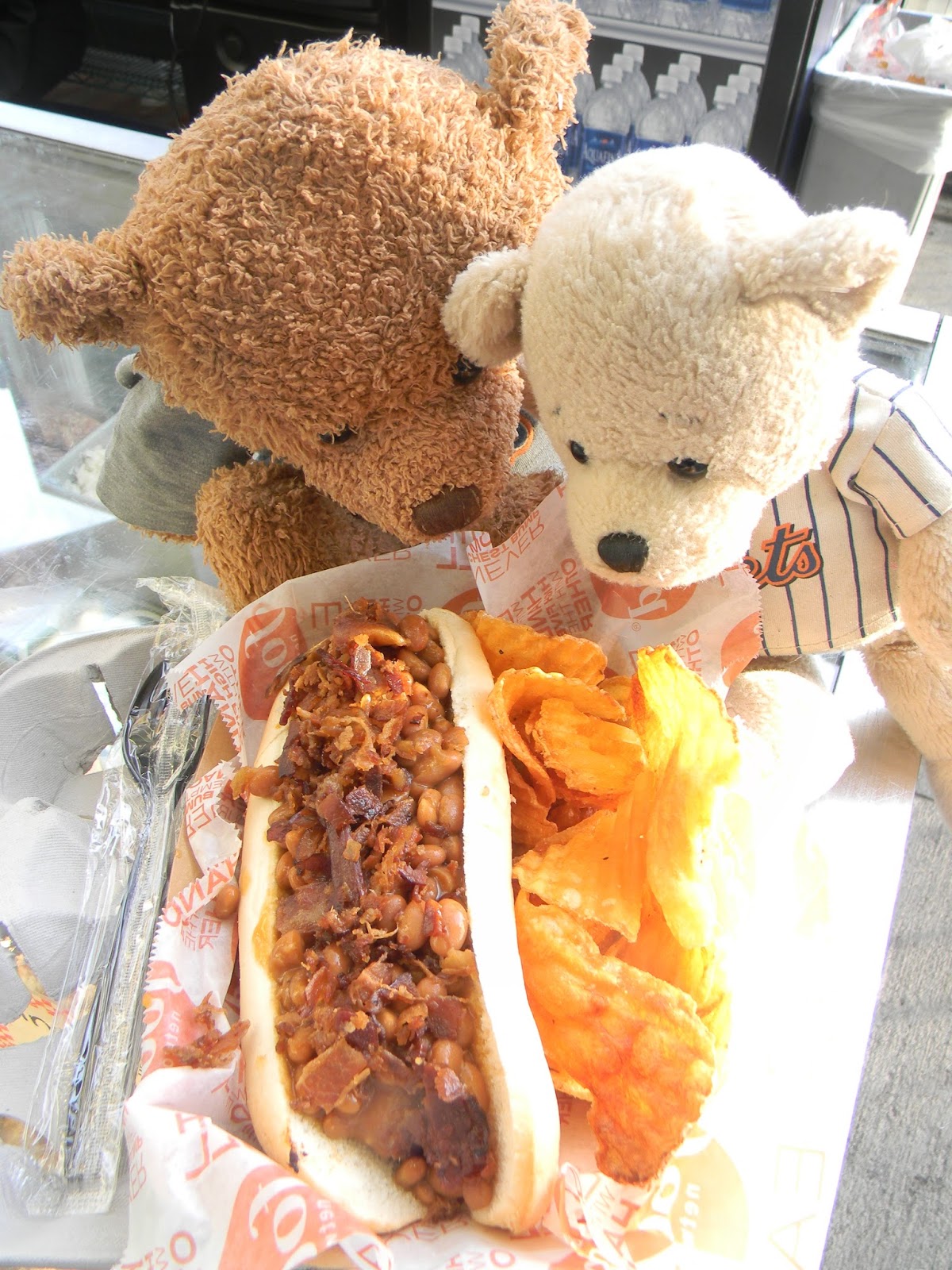
But what hot dogs they were!  We had our choice of $1 hot dogs (limit six per customer - six wouldn't have been enough to satisfy us after Swisher styled his way around the bases) or hot dogs with a choice of unique toppings, courtesy of the Food Network.  Since we're foodies ourselves, you can imagine which wiener was the winner for us.

Bacon, baked beans and bears.  Beautiful.

Our thick and juicy hot dog was loaded with baked beans and huge pieces of bacon.  The frankfurter also came with a large side of kettle chips.  It was quite delicious!

The Mets lost the game, 8-1, but at least we got to enjoy a gastronomical extravaganza.  We also got to see Heritage Park, which is located behind the center field area.  In the park are plaques devoted to Indians' Hall of Famers and the 100 greatest players in franchise history.  Those players included Bob Feller, Satchel Paige, Larry Doby, Gaylord Perry and some guy who played for the Mets.  You might remember him.


The only good thing about Carlos Baerga is that his failure allowed the Mets to trade for Robin Ventura, which in turn moved Edgardo Alfonzo from the hot corner to second base, where he became the greatest second baseman in franchise history.

Before I move on to the non-baseball portion of our trip, let me share some more pictures from Progressive Field, featuring several of my Studious Metsimus colleagues.


Besides the trip to Progressive Field, we also made two other stops in Cleveland.  One is quite popular with tourists (like David Wright) while the other is liked by only a very specific group of people (like Daisuke Matsuzaka).

First stop: the Rock and Roll Hall of Fame.

Any lover of music, not just rock music, would enjoy this museum.  It's located on the lakefront and has seven floors.  The top two and a half floors were devoted to the Rolling Stones, who were the featured artists in a special exhibit.  Other exhibits detailed the origins of rock n' roll, hip hop as a form of rock, as well as sections devoted to the Beatles, punk rock and heavy metal, and one floor dedicated to the Hall of Fame inductees.

Although flash photography wasn't allowed in a number of exhibits, my cameraman was able to snap off a few shots, which I am happy to share with you here.


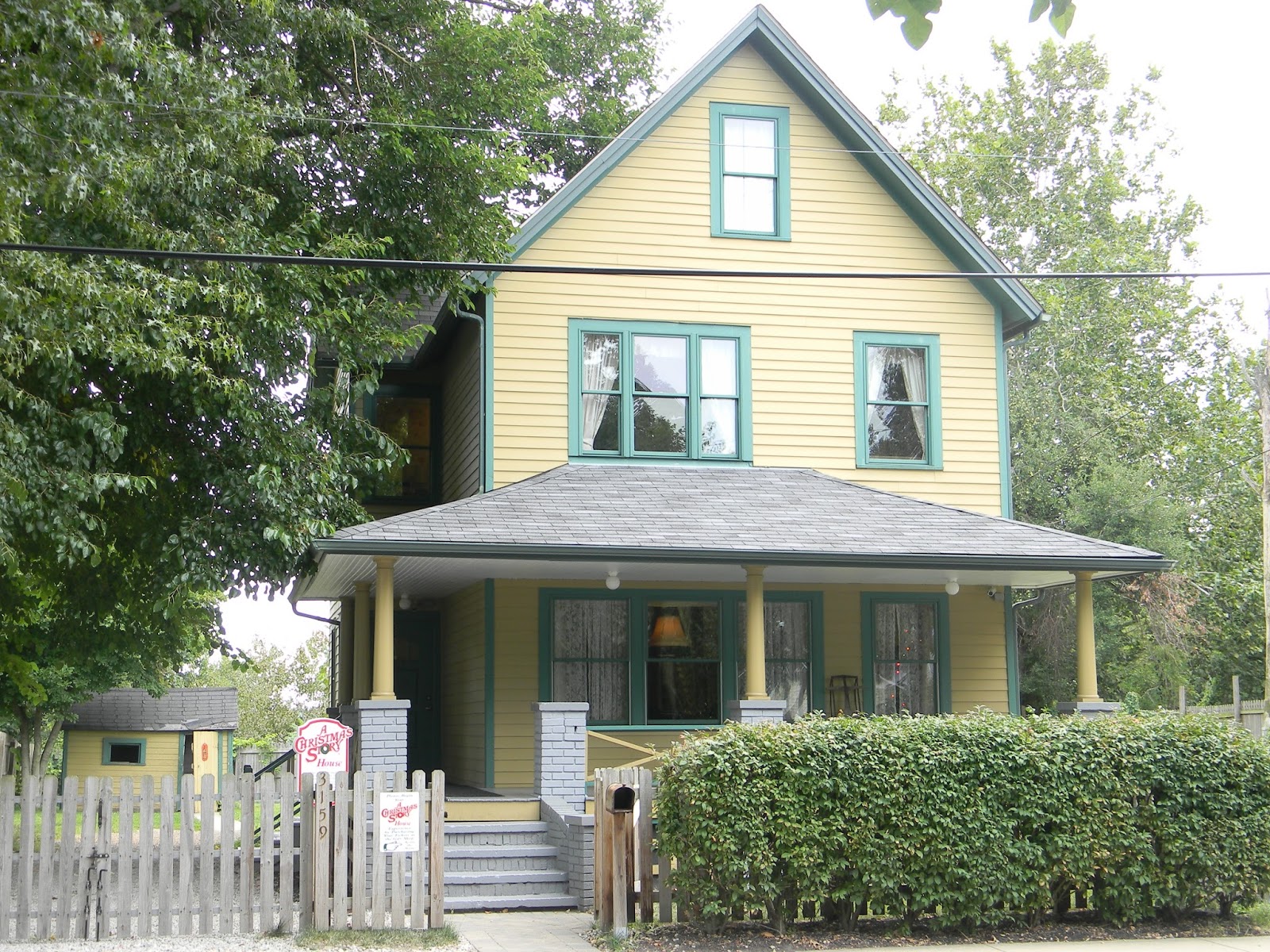
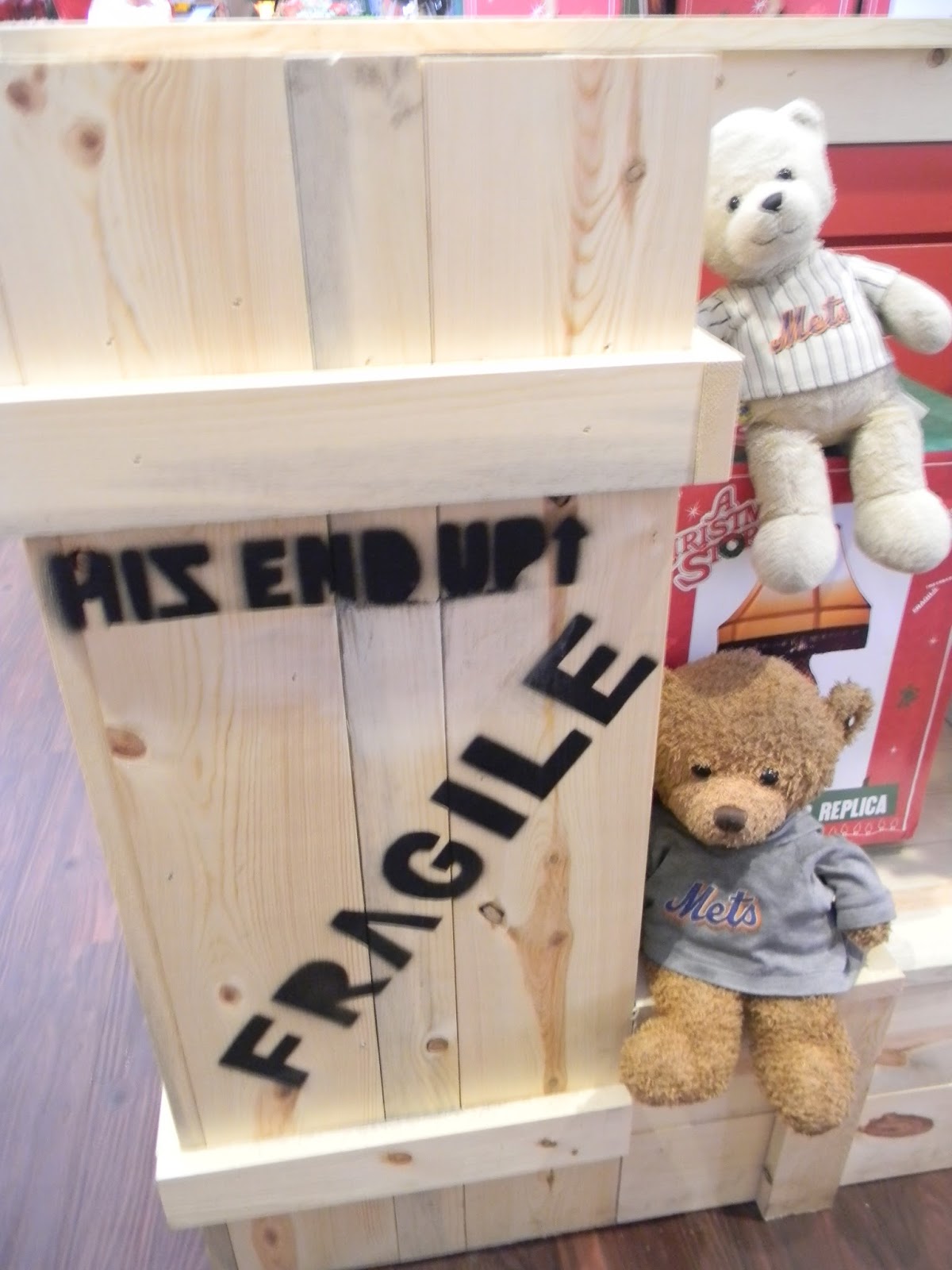
Just before heading back to the airport, we made another pit stop.  My Studious Metsimus colleagues have always been big fans of the film "A Christmas Story".  Although the film was set in Indiana, the house was actually in Cleveland.  That house has been preserved and has its own museum and gift shop.

Unfortunately, we arrived too late to go on an official tour of the house.  (We stopped at Cracker Barrel before going to the house - I like to take my time when I have my good ol' fashioned country breakfast.  Sorry about that.)  However, we did take plenty of photos of the house and visited its gift shop.  Here is the photographic evidence of our side trip.


So that does it for our tour of Cleveland.  To recap, Cleveland rocked.  It rocked at the Rock and Roll Hall of Fame.  It rocked with its Christmas Story house.  And it rocked with its delicious food.

Unfortunately, Cleveland also rocked in a different way, as Cleveland rocked the Mets in the game we attended.

In the past, we've attended games and gone on ballpark tours in Seattle, San Francisco, San Diego, Los Angeles, Milwaukee, Chicago and various cities all along the Eastern seaboard.  Now we can add Cleveland to our list.  It's just another stop on our never-ending world tour.  Where will we end up next?  I have no clue, but I do know that when we get there, you'll be able to read all about it right here on Studious Metsimus.


For more of Joey's World Tour, please click on the links below, where you will be entertained by Joey's wit, photos and love of ballpark cuisine:

World Tour Stop #1: Baltimore
World Tour Stop #2: Washington, DC
World Tour Stop #3: Pittsburgh
World Tour Stop #4: Texas
World Tour Stop #5: Los Angeles
World Tour Stop #6: San Diego
World Tour Stop #7: Toronto
World Tour Stop #8: Chicago
World Tour Stop #9: Milwaukee
World Tour Stop #10: Seattle

Monday, September 2, 2013

The Good, The Bad and The Murphy

Photo by Mike Stobe/Getty Images

Daniel Murphy made his major league debut on August 2, 2008, which makes him the second-longest tenured position player on the Mets behind David Wright.  Whereas David Wright is beloved by just about the entire Mets fan base, those same fans aren't as kind to Daniel Murphy.

Many fans (myself included) love the guy, and would have no problem with him becoming part of the team's main core for years to come.  Others, however, would love to see Murphy used as a trade chip, mentioning his lack of defensive skill and inconsistency at the plate as reasons for why they would not miss him in New York.

What's so good and what's so bad about Daniel Murphy that makes him so divisive to fans?  Allow me to answer that question for you.

The Good

Daniel Murphy can hit.  A lot.  His .289 career batting average is eighth all-time in Mets history behind only John Olerud (.315), David Wright (.301), Keith Hernandez (.297), Mike Piazza (.296), Edgardo Alfonzo (.292), Jose Reyes (.292) and Dave Magadan (.292).  Other than Magadan, the other six players are Mets legends.  Although Murphy is only 28, his name is right up there with those legends in the batting average category.

Daniel Murphy is a doubles machine.  His 146 doubles are the 15th-highest total in franchise history.  Murphy needs only 24 doubles to crack the top ten, something that should happen by early next season.  His 40 doubles in 2012 are the franchise-record for a left-handed hitter and his 137 doubles over his last four seasons are the third-most over a four-season span in club annals.  Only David Wright (166 doubles from 2005-08) and Carlos Beltran (145 doubles from 2005-08) had more.  Should Murphy leg out nine more doubles before the end of the season, he would pass Beltran, thereby producing the second-highest total of doubles of any Met in a four-season span.

Daniel Murphy is currently fifth in the National League in hits with 157, just six behind league leader Matt Carpenter.  The only Mets to lead the league in hits are Lance Johnson (227 hits in 1996) and Jose Reyes (204 hits in 2008).  Those are also the only 200-hit campaigns in team history.  Murphy needs 43 hits over the Mets' last 27 games to become the third Met to reach 200 hits, a number that seems unreachable but not impossible, especially when you consider that Murphy has 11 hits in his last four games.

Daniel Murphy has scored 80 runs this season, good for eighth-best in the NL.  With twenty more runs, Murphy would become only the 12th Met to reach triple digits in runs scored in a single season.  Other Mets who reached that mark include David Wright, Jose Reyes, Carlos Beltran, Mike Piazza, Edgardo Alfonzo, John Olerud, Howard Johnson, Darryl Strawberry and Tommie Agee - all of whom are considered franchise legends.

Finally, Daniel Murphy is leading all major league second basemen in runs scored and is the National League leader in stolen bases at the position with 18.  Among all major league second basemen, only Dustin Pedroia has more hits, singles and doubles than Murphy.  And among all National League second basemen, only Brandon Phillips has more RBI than Murphy.

Photo by Rich Schultz/Getty Images

The Bad

For as great a hitter as Daniel Murphy is, he is not adept at reaching base in ways that do not add to his hit total.  Murphy has never walked more than 38 times in a season and is currently the owner of a .313 on-base percentage, which would match the lowest of his career.  To put that into perspective, Ike Davis (he of the .205 batting average) has a higher OBP (.326) than Murphy.

Daniel Murphy has never been much of a power threat.  Although he led the team in homers in 2009, he did it by default, as he was the one position player who didn't succumb to injury.  His 12 homers in '09 still remain his career high.  Murphy's ten homers this season are lower than the output of sluggers Jedd Gyorko (16 HR), Yuniesky Betancourt (13 HR), Nick Franklin (12 HR) and Howie Kendrick (11 HR).  For the record, all four players listed above play second base for their respective teams.  And also for the record, the term "sluggers" was used sarcastically to describe their power.

Daniel Murphy has a 1.4 WAR in 2013.  Only once has he posted a WAR higher than 1.6.  By comparison, Ruben Tejada posted a 1.9 WAR in 2011 and a 2.0 WAR in 2012.  And let's not embarrass Murphy by mentioning his defensive WAR in 2013 is -0.9, which is slightly worse than the -0.8 dWAR he posted in 2012.  Oops.  Guess it's too late to save him from that embarrassment.

Speaking of defense, Murphy has committed 14 errors at second base in 2013, which is the second-highest total in the major leagues behind only Chase Utley, who has 15.  In 2012, Murphy made 15 errors at second base, which was also just one behind the league leader, Rickie Weeks, who committed 16 errors at the position.  Although Murphy has yet to lead the league in errors by a second baseman, his combined total of 29 errors over the last two seasons are the most in the majors, one more than the 28 miscues committed by Rangers' second baseman Ian Kinsler.

Photo by Harry How/Getty Images

By my count, that's five good points and four bad points, making Murphy just slightly valuable to the Mets.  With Wilmer Flores needing a position to play once David Wright returns from the disabled list, Murphy better check his rear view mirror or else he might be lapped by Flores on the second base depth chart.  Of course, Flores is also very Murphy-esque in that he is supposedly an outstanding hitter (.290 career batting average in the minors) who doesn't draw many walks (career-high 38 walks in 2012) and isn't the best fielder at any position.

Perhaps the Mets are looking to replace Murphy with Flores to save millions of dollars.  After all, Murphy is making $2.925 million this year and is second-year arbitration-eligible in 2014, meaning his salary will likely go up above $3 million and even higher in 2015 (Murphy will qualify for the big free agent bucks in 2016), while Flores can be paid near the major league minimum.  But let's look at Murphy's major league numbers and compare them to Flores' minor league numbers.  Please note that Flores had nearly 600 more at-bats in the minors than Murphy has had in the majors, so Flores' cumulative numbers should be slightly higher than Murphy's.

  • Murphy: .289/.332/.421, 197 XBH, 259 RBI, 275 runs, 37 SB, 140 BB, 299 K in 2,156 AB
  • Flores:  .290/.331/.430, 242 XBH, 404 RBI, 335 runs, 15 SB, 157 BB, 377 K in 2,755 AB

As you can see, offensively, Murphy and Flores are basically THE SAME PLAYER!  Flores is better at driving in runs, but that's because Murphy has been used mostly as a No. 2 hitter with the Mets, while Flores has hit further down in the order where RBI opportunities are more prevalent.  But Murphy is a far better base runner.  In fact, his 18 stolen bases this season are three more than Flores had in his six years in the minors.  In every other category, Murphy and Flores are quite similar, with Flores' edge in extra-base hits, runs scored, walks and strikeouts due to his extra 599 at-bats.

Daniel Murphy has some redeeming qualities.  He also has some negative points.  Because of that, Mets fans will always find something to argue about him.  But fans who want Wilmer Flores to get an everyday opportunity with the Mets might find themselves saying "hey, haven't we seen this before?" if Flores continues the career path he's taken.

The only difference between Daniel Murphy and Wilmer Flores is in the amount of money they're taking out of the Wilpons' piggy bank.  Daniel Murphy is very good at some things.  He's also quite bad at other things.  But his skills aren't that ugly.  And they're also not ugly enough that he should be replaced by the younger, less expensive Wilmer Flores, who might just be the next Daniel Murphy.

It will certainly be interesting to see what the Mets do with Daniel Murphy in the offseason.  The ultimate good/bad player will surely be a hot topic of conversation come winter time.  Then again, he's always been a hot topic for Mets fans regardless of the season.
 

Sunday, September 1, 2013

A Rock N' Roll Pitching Matchup In Cleveland

In 2004, general manager Jim Duquette thought the Mets were a playoff contender, as the team was just three games out of first place on July 22.  But one week later, the Mets were seven games off the pace and falling fast.  Not wanting to give up on the season, Duquette traded away the team's top pitching prospect, Scott Kazmir, to the Tampa Bay Devil Rays for pitcher Victor Zambrano.

The Mets finished the year with a 71-91 record, a full 25 games behind the division-winning Atlanta Braves.  Kazmir went on to become a two-time All-Star (2006, 2008), strikeout champion (2005) and helped lead the Rays to an unexpected American League pennant in 2008.  Duquette was replaced by Omar Minaya by the end of the 2004 campaign.

Fast forward seven years later.  The San Francisco Giants were the defending World Series champions and had a 4½-game lead in the NL West on July 20.  A week later, the lead was down to three games.  At the time, Pablo Sandoval was the only player on the team with more than nine homers.  The Giants were also last in the league in runs scored.  They needed an offensive upgrade, and they needed it fast, especially with the high-scoring Arizona Diamondbacks closing ground.  They thought they had that upgrade when general manager Brian Sabean acquired Carlos Beltran from the Mets on July 27.  To complete the trade, Sabean sent the Giants' top pitching prospect, Zack Wheeler, to New York.

Beltran performed well for the Giants, batting .323 with 20 extra-base hits in just 44 games, but his teammates did not.  San Francisco went 25-32 over the final two months of the season to finish eight games behind the Diamondbacks.

Both Jim Duquette and Brian Sabean parted ways with their best young hurlers, each of whom were former first-round draft picks, to acquire players they thought would help them in the short term.  Neither move worked.  But they did work for the teams who dealt for the minor leaguers.

Although Kazmir's wildness cost him a job in Tampa in 2009, he finally made it back to the majors this year with the Cleveland Indians.  Kazmir is 7-7 with his new team and is posting the lowest walk ratio (3.0 BB/9 IP) of his career.  He is also playing for a team that has remained in contention for a postseason berth all season.  Meanwhile, Wheeler is off to a fast start with the Mets, going 7-3 with a 3.36 ERA in his first 14 starts.  Wheeler has been particularly effective over his last five starts, striking out 31 batters and walking only six.  The Mets have won four of those five games.

On Friday night, the Mets will be traveling to Cleveland to take on the Indians in their final interleague series of the season.  Barring injury or bad weather, the pitching matchup for the series opener will be Scott Kazmir vs. Zack Wheeler.  Yeah.


Kazmir will be making his first start against the team that traded him before giving him a chance in the majors.  Wheeler will be taking his unblemished 5-0 road record (and 2.19 ERA) to Cleveland to face the Mets' former hotshot prospect.

Scott Kazmir was once traded away by the Mets to acquire a player who was supposed to help the team make a playoff run.  That move failed for the Mets.  Seven years later, the Mets fleeced the Giants by sending them a player who was supposed to help them defend their World Series title.  That moved failed for the Giants.

Friday night, both storylines will collide in Cleveland, when the phenom the Mets traded away in 2004 faces the phenom the Mets traded for in 2011.  Huey Lewis used to remind us in song form that "the heart of rock n' roll is in Cleveland".  Well, from what I see for Friday's pitching matchup, I believe him.

Scott Kazmir vs. Zack Wheeler.  It will truly be a rock n' roll pitching matchup Friday night at Progressive Field in Cleveland.