Showing posts with label Mike Cameron. Show all posts

Wednesday, August 31, 2016

Yoenis Céspedes vs. Other Mets in Their First 162 Games

Yoenis Cespedes's 162-game start gets a big thumbs up!  (Ed Leyro/Studious Metsimus)

Yoenis Céspedes has meant everything to the Mets since he was acquired at the trade deadline last July.  But because of nagging injuries and a trip to the disabled list earlier this season, Céspedes didn't get to play in his 162nd career game with the team until Wednesday, as he has missed 28 games during the 2016 campaign after resting for only two games with the Mets in 2015, both of which came after the team had clinched the division title.

Céspedes's numbers with the team in those 162 games are astounding, as he has produced 34 doubles, 44 homers, 112 RBI and has compiled a .583 slugging percentage and .941 OPS in a full season's worth of games.  Those five categories are traditionally recognized as categories in which sluggers generally excel, and Céspedes ranks favorably with the team's all-time greats in all five.

In doing research for hot starts by Mets players to see where Céspedes ranked, I found some interesting names that I did not expect to find among those franchise legends.  For every time Mike Piazza was in the top ten - he's the only player to be ranked in the top five in all five categories within his first 162 games with the team - there were a handful of "did they really have that type of start?" players.

Here are five lists, one each for doubles, home runs, runs batted in, slugging percentage and on-base plus slugging percentage, that show just how good Céspedes has been in his first 162 games with the Mets and how fortunate some other players were in their first full season's worth of contests with the club.


Doubles:

Bernard Gilkey
Mike Piazza - 46
Bernard Gilkey - 45
Paul Lo Duca - 44
David Wright - 41
Mike Cameron - 40
Rusty Staub - 39
Eddie Murray - 38
Robin Ventura - 38
Todd Zeile - 38
Ike Davis - 37


Home Runs:

Kevin McReynolds
Dave Kingman - 48
Yoenis Céspedes - 44
Carlos Delgado - 39
Mike Piazza - 38
Mike Cameron - 35
Gary Carter - 34
Frank Thomas - 34
Robin Ventura - 32
Cliff Floyd - 31
Bernard Gilkey - 31
Kevin McReynolds - 31
Darryl Strawberry - 31


Runs Batted In:

John Olerud
Carlos Delgado - 126
Bernard Gilkey - 124
Robin Ventura - 120
Mike Piazza - 119
Dave Kingman - 118
Gary Carter - 116
Yoenis Céspedes - 112
Donn Clendenon - 108
John Olerud - 107
Kevin McReynolds - 102


Slugging Percentage:
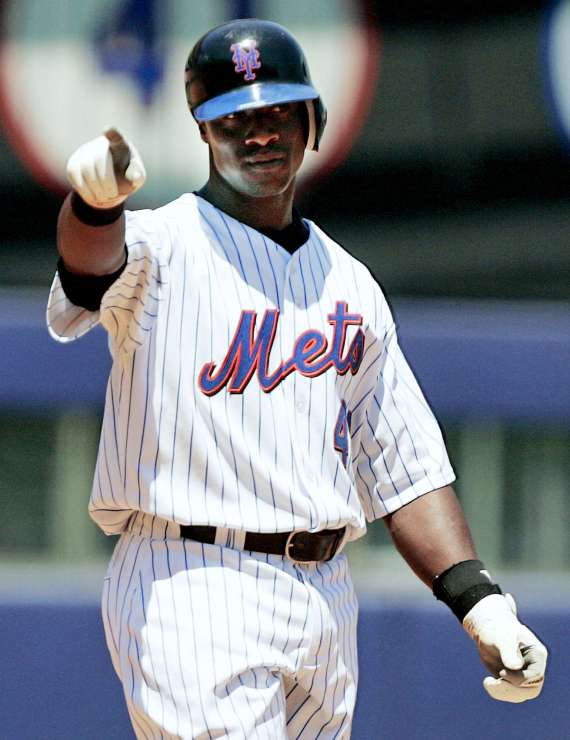
Mike Cameron
Mike Piazza - .604
Yoenis Céspedes - .583
Bernard Gilkey - .544
Rico Brogna - .529
Robin Ventura - .525
Cliff Floyd - .523
Carlos Delgado - .518
Donn Clendenon - .512
Dave Kingman - .511
Mike Cameron - .510


On-Base Plus Slugging Percentage:

Rico Brogna
Mike Piazza - 1.005
Yoenis Céspedes - .941
Bernard Gilkey - .930
Robin Ventura - .902
Cliff Floyd - .890
John Olerud - .889
Rico Brogna - .880
Carlos Delgado - .870
Benny Agbayani - .867
David Wright - .865


As you can see, there are several players whose names you would expect to see in multiple categories.  Power hitters such as Céspedes, Piazza, Carlos Delgado, Dave Kingman and others can be found in at least three of the five top-ten lists.  But did you really expect to see a guy like Rico Brogna appear on as many lists as David Wright?  What about Cliff Floyd and Mike Cameron showing up three times?  Or most surprisingly, what do you think of Bernard Gilkey and Robin Ventura joining Piazza as the only three players to rank in the top ten in all five categories?

Those unexpected players (Brogna, Floyd, Cameron, Gilkey, Ventura) all had sensational starts to their careers in Flushing, but they also suffered injuries (Brogna, Floyd and Cameron come to mind) or faded quickly (Gilkey and Ventura were both one-season wonders).

Meanwhile, a number of all-time team greats were absent from a number of these top-tens.  The late, great Gary Carter made it to the Hall of Fame and began a miraculous World Series rally that fueled the Mets to a championship.  But his excellent .490 slugging percentage and .861 OPS in his first 162 games with the team were both not high enough to appear on either category's respective top-ten list.  Darryl Strawberry may have won the National League Rookie of the Year award in 1983, but his only appearance on any of the above lists is a ninth-place tie in the homer department.  And Carlos Beltran may be the greatest free agent signing in Mets history, but a poor start to his career in New York kept him off every list.

It remains to be seen whether Céspedes will go down the road traveled by the great sluggers in Mets history or if the nagging injuries continue to increase and he will just be remembered for the incredible 162-game start to his Mets career, which included helping the team reach the 2015 World Series.

For now, Céspedes is one of only three Mets to have at least 30 doubles, 35 homers and 100 RBI in his first 162 games with the team, joining Carlos Delgado and Hall of Famer Mike Piazza.  Whether or not Céspedes joins Piazza in Cooperstown or even in the Mets Hall of Fame won't be known for years, but one thing's for certain.

Yoenis Céspedes has been gotten off to one of the best starts of any hitter in franchise history.  And there's nothing fluky about that.


Thursday, June 5, 2014

Curtis Granderson and the Not-So-Sweet Sixteen

Curtis Granderson looks spooked at the plate.  Could the ghost of Jason Bay be haunting him?

On Wednesday, Curtis Granderson delivered two hits in the Mets' 5-4 loss to the Chicago Cubs, giving him 1,201 for his career.  It was not the first time this season Granderson hit the 1,200 mark in a lifetime offensive category.  However, the other category wasn't exactly something to be proud of, as on May 6, Granderson struck out for the 1,200th time in his career.

Entering tonight's series finale against the Cubs, Granderson is the owner of 1,231 strikeouts and 1,201 hits.  How rare is it for a player to have more strikeouts than hits when he has that many of both?  Well, the first player to end his career with more strikeouts than hits when he had at least 1,200 of both didn't play his last game in the majors until 1986.  And since this player (a former Met) retired, just 16 other players - including Granderson - have joined him.

Here are a list of those players, which include Curtis Granderson and the other not-so-sweet sixteen.  This list includes a Hall of Famer, a few All-Stars and probably more current and former Mets than you would like.


Player
Final Year
Career Strikeouts
Career Hits
Career HR
Career RBI
Dave Kingman
1986
1,816
1,575
442
1,210
Reggie Jackson
1987
2,597
2,584
563
1,702
Jesse Barfield
1992
1,234
1,219
241
716
Cecil Fielder
1998
1,316
1,313
319
1,008
Jay Buhner
2001
1,406
1,273
310
965
Jose Canseco
2001
1,942
1,877
462
1,407
Dean Palmer
2003
1,332
1,229
275
849
Greg Vaughn
2003
1,513
1,475
355
1,072
Richie Sexson
2008
1,313
1,286
306
943
Troy Glaus
2010
1,377
1,375
320
950
Pat Burrell
2011
1,564
1,393
292
976
Mike Cameron
2011
1,901
1,700
278
968
Jim Thome
2012
2,548
2,328
612
1,699
Jason Bay
2013
1,216
1,200
222
754
Adam Dunn
Still Active
2,280
1,574
449
1,128
Ryan Howard
Still Active
1,474
1,226
322
1,003
Curtis Granderson
Still Active
1,231
1,201
223
633


Notice that just about everyone on the list was a middle-of-the-order power hitter.  But Granderson hit at the top of the order for much of his career and has surpassed 25 homers in a season just three times, hence his low RBI total.

Also notice that four of the 17 players (Kingman, Cameron, Bay, Granderson) called Shea Stadium and Citi Field home for parts of their careers.  It could have been seven out of 20, had Darryl Strawberry (1,352 strikeouts, 1,401 hits), Jeromy Burnitz (1,376 strikeouts, 1,447 hits) and Jose Valentin (1,294 strikeouts, 1,348 hits) struck out just a little more in their respective careers.  But just like the hitters who actually did make the list, Strawberry, Burnitz and Valentin were cleanup-type power hitters (Valentin had five straight years of 25+ homers from 2000 to 2004), something Granderson is not.

If Curtis Granderson were a prototypical power hitter, perhaps his high strikeout rate would be more acceptable.  Likewise, if Granderson had more seasons of elite home run totals, his low hit count could be forgiven.  But Granderson is not Dave Kingman, Reggie Jackson, Jose Canseco or Jim Thome.  He's not even Jesse Barfield or Pat Burrell, for that matter.  The closest player he resembles on the list above is - here's that name again - Jason Bay.

Although he tried his best to fulfill the lofty expectations that go with a lucrative four-year contract, Jason Bay fizzled quickly as a Met.  During his time in New York, Bay had more strikeouts (258) than hits (231), despite having fewer strikeouts (896) than hits (927) before coming to the Big Apple.  He also hit 26 or more homers in five of the six seasons before his first year in New York.  Then he hit a grand total of 26 homers in three years as a Met.  Because of his low home run totals and high strikeout rate, Bay found himself in the dreaded New York doghouse - the same place Granderson appears to be heading.

Curtis Granderson is a nice guy.  But being nice doesn't get you anything in New York if you're paid to hit home runs, then proceed to strike out ten times for every long ball you hit.  (Granderson has hit six home runs in 2014, while striking out 64 times.)  We saw it before with Jason Bay.  We don't need to see it again with Curtis Granderson.

There are 151 players in major league history who collected at least 1,200 hits and 1,200 strikeouts.  Of those players, only 17 had more strikeouts than hits.  Curtis Granderson is one of those players.  And if he doesn't want to go down the road taken by Jason Bay before him, he'll need to get himself off this list pronto.


Saturday, November 2, 2013

Was The Johan Santana Trade Worth It For The Mets?

"Who does this stupid blogger think he is, trying to say I wasn't worth the money?  I didn't see him pitch a no-hitter."

After a six-year relationship with the Mets, Johan Santana is no longer on the team's payroll, as the Mets paid the lefty $5.5 million to buy out his $25 million option for 2014.  With Santana no longer part of the team, the time has come to analyze whether or not the Mets did the right thing by trading for him in 2008.

At the time of the deal, which sent Carlos Gomez, Philip Humber, Kevin Mulvey and Deolis Guerra to the Minnesota Twins, the Mets were trying desperately to make amends with their fans after their epic collapse in 2007.  To complete the trade, the Mets signed Santana to a six-year, $137.5 million contract, which at the time was the most lucrative deal ever given to a pitcher.

Johan Santana was very good as a Met - when he was healthy.  In his first year in Flushing, Santana was 16-7 with 206 strikeouts and a league-leading 2.53 ERA.  Santana became the first left-handed pitcher in franchise history to lead the league in ERA in 2008, and the fourth Met overall to accomplish the feat, following right-handed starters Tom Seaver (1970, 1971, 1973), Craig Swan (1978) and Dwight Gooden (1985).  Santana's 206 strikeouts are also tops for a southpaw in club annals, surpassing Jon Matlack's record of 205 Ks, which he accomplished in 1973.

In his final start of the season, Santana gave one of the gutsiest performances by a pitcher in the team's history.  With the Mets needing to win to stay alive in the race for a postseason berth, Santana fired a three-hit shutout against the Florida Marlins on just three days rest.  And he did it with a torn meniscus in his left knee.  The Mets failed to make the playoffs in 2008 but succeeded in finally having a true ace atop their rotation.  Or so it seemed.

Santana's start on September 27, 2008 came in the first year of his six-year commitment to the Mets.  He would only make one more September start for the Mets over the last five years of his contract.  An assortment of injuries kept Santana on the disabled list for all of 2011 and 2013, and curtailed his 2009, 2010 and 2012 seasons.  But that 2012 campaign saw Santana do something no Mets fan ever thought he'd see.

On June 1, 2012, Johan Santana threw the first no-hitter in franchise history in the team's 8,020th regular season game.  Just like every Mets fan knows where he or she was on that unbelievable night, most Mets fans remember that he needed 134 pitches to complete his gem.  After he struck out David Freese to enter no-hit nirvana, Santana suffered through pitching purgatory.  An 8.27 ERA over his next ten starts left Terry Collins and Mets fans wondering if the inflated pitch count needed to secure his place in team history contributed to his post-no-hitter blues.  They continued to wonder for a year and a half, as Santana never pitched again for the Mets after August 17, 2012.

Johan Santana went 46-34 in 109 starts as a Met.  His 3.18 career ERA in New York is lower than the ERAs posted by all-time Met greats Ron Darling, Al Leiter and Rick Reed.  But for $137.5 million, we expected a little more.

For example, Santana's 46 victories fell short of the win total posted by relief pitchers John Franco (48), Jesse Orosco (47) and Tug McGraw (47).  Santana's 109 starts are also nine fewer than the number of starts made by Jonathon Niese, a pitcher who was still playing for AA-Binghamton when Santana made his first start for the Mets.

Great pitchers are supposed to produce great moments.  But other than the penultimate game of the 2008 season and the no-hitter, can anyone honestly remember another memorable pitching performance by Johan Santana?

Photo by Ed Leyro/Studious Metsimus

Mention Tom Seaver and you immediately think of the "imperfect game" or his ten-inning performance in Game 4 of the 1969 World Series (the Ron Swoboda game), or any of a number of dominant performances in 1973 when the rest of the team was floundering.  Similarly, say Doc Gooden's name and visions of back-to-back 16-strikeout games in 1984 and his 14-game winning streak in 1985 become crystal clear in your mind.

Johan Santana had two games that will forever be etched in the hearts and minds of Mets fans.  That's the same number of complete seasons he missed.

Don't get me wrong.  As a Mets fan who agonized over every late-inning first hit allowed by a starting pitcher, it was a dream come true to see someone like Johan Santana pitch the first no-hitter in team history.  Better him than someone like Oliver Perez.

But $137.5 million is just a tad too much for a no-hitter and a season-saving gritty performance - one that saved the season until it was lost the following day.  Carlos Gomez, the main piece in the deal that pried Santana away from the Twins, is now a Gold Glove-winning All-Star in Milwaukee.  His 24 homers and 40 stolen bases for the Brewers in 2013 would have led the Mets in both categories.  (Marlon Byrd's 21 homers and Eric Young's 38 steals led the team.)  Since 1989, only one Met has led the team in home runs and stolen bases in the same season.  That was Mike Cameron, who paced the 2004 Mets with 30 homers and 22 steals.

Carlos Gomez just completed the first year of a four-year, $28.3 million deal with the Brewers.  That's just barely more than the $25.5 million Johan Santana was paid in 2013 to not throw a single pitch for the Mets.

The no-hitter was great.  But I would have liked to see Santana win more games than Jesse Orosco.  A monkey's paw-like wish for a moment 8,020 games in the making doesn't seem to be worth what the Mets doled out for their smooth former All-Star.
 

Saturday, May 4, 2013

May The 4th Be With You: The Mets Who Powered Up In New York

Just because Bernard Gilkey witnessed different Star Wars in this photo, the force was still with him as a Met.

Today is May 4, otherwise known as Star Wars Day to those who believe in the force.  (May the 4th be with you - get it?)  In honor of the special day, I decided to do some research on the Mets players who hit with more power after they came to New York.

Shea Stadium and Citi Field have never been confused with smaller, bandbox parks.  As a result, home run hitters have never been plentiful in Flushing.  But some have come to New York and thrived as home run hitters in parks that were never conducive to such displays of power.

Let's look at the ten players who unexpectedly gave the home run apple a workout after they came to New York, comparing their home run output before they called Flushing home to what they produced after they became Mets.

 
Player
AB
pre-NY
HR
pre-NY
AB
in NY
HR
in NY
AB/HR
pre-NY
AB/HR
in NY
Diff.
 B. Gilkey
2133
52
1353
52
41.0
26.0
15.0
 D. Clendenon
3651
110
861
45
33.2
19.1
14.1
 K. Hernandez
4076
81
3164
80
50.3
39.6
10.7
 B. Bonilla
3294
116
1779
95
28.4
18.7
9.7
 H. Johnson
576
19
3968
192
30.3
20.7
9.6
 M. Cameron
3528
131
801
42
26.9
19.1
7.8
 R. Ventura
4542
171
1513
77
26.6
19.6
7.0
 T. Agee
1230
37
2416
82
33.2
29.4
3.8
 C. Floyd
3132
132
1643
81
23.7
20.3
3.4
 C. Beltran
3467
146
3133
149
23.7
21.0
2.7


As you can see, only three players had a difference of 10.0 of better.  What does that mean in regular English for those of you who don't speak stats?  It means that Bernard Gilkey, Donn Clendenon and Keith Hernandez needed 10 fewer at-bats to homer as Mets as they did when they were with their old teams.

Gilkey homered every 26 at-bats as a Met, while it took him 41 at-bats on average to homer as a Cardinal.  Clendenon collected over 30 at-bats for every homer he hit before calling Shea home, but once he came to New York, he circled the bases every 19.1 at-bats.  Even Keith Hernandez, who never had a 20-homer season in the majors, found New York to his liking when it came to hitting home runs.  Hernandez homered once every 50 at-bats in St. Louis, but it took him fewer than 40 at-bats on average to jack one out in New York.

Much has been made of the power outage suffered by Jason Bay after coming to New York.  Bay averaged 30 homers per season during his first six full seasons in the majors, but managed a total of 26 homers in his three years as a Met.  But not much has been said about the players who displayed more power after reporting for duty in Flushing.

The force was with players like Bernard Gilkey, Donn Clendenon and Keith Hernandez after they were acquired by the Mets.  And once they arrived in New York, they hit the ball with more force then they ever had for their previous teams.