It's Miller Time! But are the Nationals going to shut down the Brew Crew's party? (Ed Leyro/Studious Metsimus)
What's going on, everyone? This is your favorite fearless forecaster, Joey Beartran. And I don't know how effective I'll be picking other teams to win, especially since I'm still on a high from the Mets' season-ending walk-off victory.
Finishing ten games over .500 wasn't good enough to get the Mets into the playoffs, as they finished three games behind the Milwaukee Brewers for the second wild card. But at least they're not the 93-win Cleveland Indians, who became a fringe playoff team themselves when they allowed the small-market Tampa Bay Rays and Oakland Athletics to beat them to the postseason party.
Speaking of fringe teams, the Philadelphia Phillies paid $330 million to Bryce Harper, who led them to the promised land of a .500 record. That's over $100 million more than the Washington Nationals are offering Anthony Rendon, otherwise known as the player who was the real offensive leader of the Nats all these years. And the player who could possibly be one of just 25 who can say they helped Washington advance in the postseason for the first time ever.
But will Washington finally celebrate something other than a division title or wild card berth? Will Milwaukee continue to win one for the Yelich? How about the Rays, who are making their first playoff appearance with a skipper not named Joe Maddon? Or will the A's move on for the first time in five trips to the postseason under manager Bob Melvin?
I guess it's time for me to put on my thinking cap (or the hood from my Mets hoodie, since that's the only article of clothing I wear) and share my predictions for the American and National League Wild Card games. And of course, there's no chance those picks will be biased. Not at all.
National League Wild Card Game
Milwaukee Brewers vs. Washington Nationals
We all know the Nationals' history in the postseason. Four appearances, four quick exits. Meanwhile, every time the Brewers have qualified for the postseason since moving to the National League in 1998, they've won more playoff games than they did in their previous playoff appearance. Milwaukee won one postseason game in 2008, then followed that up with five playoff victories in 2011. Last year, the Brewers fell one win short of their second-ever trip to the World Series.
Both teams are hungry. Milwaukee is hungry for a pennant, while Washington is hungry for their first-ever October champagne celebration (which is weird because how can a team be hungry for a liquid?)
Let's look at the pitching matchup, because as we all know, pitching wins Wild Card Game championships.
The Nationals will trot out Max Scherzer, whose seven-year, $210 million contract has produced zero postseason wins in three starts and one relief appearance. Scherzer will also be pitching on six days rest, which usually helps a pitcher. However, this season Scherzer made four starts on six or more days rest. He won none of them, producing a 3.28 ERA in those well-rested appearances, which was nearly half a run higher than the 2.86 ERA he put up in his other 23 starts.
Milwaukee's starter will be Brandon Woodruff, who has a lifetime 1.46 ERA and 0.81 WHIP in four career postseason appearances. Those numbers look good on paper. You know what looks better on paper? His 0.96 ERA and 0.70 lifetime WHIP against the Nationals in four appearances. And I haven't even mentioned that he's struck out 23 Washingtonians while walking just two. (Okay, maybe I just did.)
The face of a philosopher. (Getty Images)
And the pièce de résistance? The next extra-base hit a Nationals player collects against Woodruff will be the first. You read that right. In his four appearances against Washington, Woodruff has faced 68 batters and has yet to allow an extra-base hit to any of them.
I believe it was the great former Mets shortstop Rafael Santana who once said, "Those who do not learn history are doomed to repeat it." (I also believe my Studious Metsimus colleague is passing me a note saying that it was actually George Santayana who said this. What does he know about famous quotes?) With or without Bryce Harper, the Nationals will always be doomed to repeat their postseason failures. Scherzer might be a future Hall of Famer, but 'Ol Blue Eye is not a future wild card game winner. At least not until he signs with another team.
Prediction: Milwaukee will advance to the NLDS.
American League Wild Card Game
Tampa Bay Rays vs. Oakland Athletics
So remember what I said about pitching winning championships? Well, we're going to get some pitching in this game. Unless things change, Oakland will be going with Sean Manaea, who made just five starts this season, but posted a 1.21 ERA and 0.78 WHIP in his September to remember. Tampa will be going with All-Star Charlie Morton, who went 16-6 and struck out 240 batters in just 194.2 IP. And if you recognize his name, it's probably because you recall how great he was for the Houston Astros in the 2017 World Series against the Los Angeles Dodgers, winning the seventh and deciding game to give Houston its first-ever championship. In other words, he's got what it takes to pitch in a win-or-go-home game.
Manaea was great in September, but his last four starts were against the Detroit Tigers, Texas Rangers (twice) and Seattle Mariners. Those three teams combined to finish 99 games under .500, meaning Jeurys Familia and Edwin Díaz could probably shut them down as well.
In addition, Tampa's lineup is as consistent as they come. Nine players had 300 or more plate appearances. Eight of those players had between 14 and 21 home runs. (The one who didn't, Austin Meadows, hit 33 taters.) No one on the Rays had as many as 90 RBI, but eight players drove in over 50 runs. No player hit .300, but eight of the nine regulars hit over .250, and the one who didn't (Kevin Kiermaier) led the team in stolen bases. How consistent were the Rays throughout the season? They had 11 players with a bWAR of at least 2.0, but none with a WAR above 5.0. And who is the one player worth exactly 5.0 WAR? Why, it's wild card game starting pitcher Charlie Morton.
The game is in Oakland, but Tampa had the second-best road record in the majors at 48-33. This team knows how to win on the road. And their starting pitcher knows how to pitch when the team's season is on the line.
Touch 'em all, Travis. (Scott Audette/AP)
Oh, and one more thing. Travis d'Arnaud is on the Rays and he just had that breakout campaign (16 HR, 67 RBI in 92 games with Tampa Bay) we were told he'd have one day as a member of the Mets. But in addition to his skills with the bat, d'Arnaud also made Charlie Morton better, as evidenced by the opponents' .202/.265/.361 slash line against Morton with d'Arnaud behind the plate.
The Coliseum hasn't seen a playoff victory in six years. That streak isn't ending this year. Right, Travis?
Remember, these are completely unbiased picks. So this photo of me at gorgeous Coors Field is just a total coincidence.
Hey, everyone! This is Joey Beartran, your furry fearless forecaster. And just like you, I'm only now starting to recover from the David Wright Kleenex Fest this past weekend at Citi Field. It's sad that the Captain's career is over, just like it's disappointing that the Mets are not in the postseason for a second consecutive campaign.
Because the Mets are emptying out their lockers instead of packing for an October road trip, that means we all have to watch teams in which we have no interest competing for a championship that has eluded our squad for nearly a third of a century.
Some of those non-Metsian teams were forced to play a 163rd game to determine who would get the chance to celebrate a division title and who would have to play in the same do-or-die game the Mets lost the last time they made the playoffs two seasons ago. The Cubs and Rockies both lost their 163rd and final regular season games, forcing them to play in a 164th and first postseason game against each other, with the loser not getting a chance to play in a 165th game. Meanwhile, the Yankees and A's already knew their wild card fate for some time, allowing them to prepare for the inevitable Yankee defeat. (Oops, I should've said "spoiler alert".)
As your prescient prognosticator, it's my duty to share my knowledge of what's going to happen in the American and National League Wild Card games. And hopefully, I won't spoil anything for you too soon like I did in the previous paragraph. (On an unrelated note, don't you just love the photo of me at the top of this post? Looks like the photo of a winning ballpark, doesn't it?)
National League Wild Card Game
Colorado Rockies vs. Chicago Cubs
Well, leave it to the Rockies to get so close to winning their first division title only to kiss it goodbye in their 163rd game. Then again, the Rockies are no strangers to making it to the playoffs as a second-place team. They've now qualified for the postseason five times in their quarter century of existence, with every appearance coming as the No. 2 team in the N.L. West. Meanwhile, the Cubs surrendered the N.L. Central crown in their 163rd game but still made the playoffs for a fourth consecutive season; the first time they've ever done that in their long history, which dates back to 1876, or the year Scott Atchison was born.
The Cubs won four more games than the Rockies did during the regular season and have far more playoff experience than Colorado does. Chicago manager Joe Maddon has taken his North Siders to the playoffs four times, immediately on the heels of taking his former team, the Tampa Bay Rays, to the postseason on four occasions. Maddon has also won more pennants (two) than his counterpart, Bud Black, has managed postseason games (one). And you can always expect the crowd at Wrigley Field to be raucous, especially in a do-or-die game.
Cole Hamels
Everything seems to suggest that the Cubs should easily dispose of the Rockies in the Wild Card game. Colorado has to overcome a playoff-tested opponent managed by a potential future Hall of Famer. They also have to play 4,683 feet closer to sea level than they're used to.
But the Rockies have one key advantage over the Cubs. Colorado doesn't have Cole Hamels on their payroll. Chicago does. And really, that's all that matters to me. Because no team that feels the need to fatten Hamels' wallet should ever be allowed to advance in the postseason.
Prediction: Colorado will advance to the NLDS.
American League Wild Card Game
Oakland A's vs. New York Yankees
The Yankees were expected to run roughshod over the rest of the American League this season. They didn't quite do that, finishing eight games behind the rival Red Sox in the A.L. East. Meanwhile, Oakland was expected to sell off their players at the trade deadline after a disappointing start. Instead, they added pitchers Edwin Jackson, Shawn Kelley, Mike Fiers, Fernando Rodney and some guy named Jeurys Familia and went 63-29 in their last 92 games to comfortably secure the second wild card spot.
A's versus Yankees usually doesn't end up well for the team from the left coast. The two teams have faced each other three times in the postseason (1981, 2000, 2001). New York emerged victorious on each occasion. (I have a selective memory, so I'm choosing to ignore what happened in
the World Series in 1973. If I ignore it, then it didn't happen.)
It's not just in baseball where New York takes care of Oakland in postseason affairs. On December 29, 1968, the New York Jets defeated the Oakland Raiders in the AFL Championship Game on their way to their first and only Super Bowl title.
If it seems like no one can remember the last time Oakland defeated New York in anything (remember, 1973 never happened in my mind), that's because no one was allowed to see it when it happened. I mean that literally, not figuratively.
Ever hear of "The Heidi Game"? On November 17, 1968, the Jets held a 32-29 lead over the Raiders with under a minute to play. The NBC television network was broadcasting the game, but because they were obligated to show the movie "Heidi" at 7:00pm, the game did not air to its conclusion and the football-loving audience instead saw the first few minutes of "Heidi" instead of two touchdowns by the Raiders, which turned an apparent New York victory into a bitter 43-32 defeat.
Sheldon, you're no Heidi.
The Heidi Game will be celebrating its 50th anniversary in less than seven weeks. I can't think of a better way to celebrate that special moment in sports history - one in which no one saw a team from Oakland defeating a club that calls New York home - than by having the A's ending the Yankees' season, hopefully without TBS switching off the game to show reruns of "The Big Bang Theory."
There have been many players to have long and distinguished careers in baseball who made brief pit stops as members of the Mets. Warren Spahn, Willie Mays and Roberto Alomar had already established themselves as future Hall of Famers before they reported for duty in Flushing. But by the time they joined the Mets, they were a shadow of their former selves and were out of baseball soon after their Mets debuts.
Very rarely has a player come to the Mets as a former All-Star, played well for the team, then left New York to become an All-Star again. One such example was a player who came to the team as a gifted 25-year-old athlete who had tremendous speed and solid pop in his bat. He exhibited both of those qualities during his brief tenure with the Mets, but once his 17-year stay in the majors was over, his time with the team was mostly met with "oh, he was once with the Mets?" comments from even the most die-hard fans.
He spent less than four months in a Mets uniform, but his mostly overlooked time with the team produced several magical moments, giving Mets fans credence that "The Magic is Back" was more than just a team slogan.
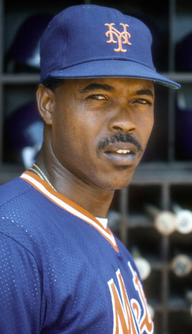
In 79 games as a Met, Claudell Washington had a full year's production compared to most of his teammates. (Topps Image)
Claudell Washington was a superstar at a very young age. Drafted as a 17-year-old amateur free agent by Oakland in 1972, Washington rocketed through the A's minor league system. After batting .361 with 11 homers and 33 stolen bases in just 74 games at the Double-A level in 1974, Washington was promoted to the majors eight weeks before his 20th birthday, winning a World Series ring with the A's just three and a half months after his call-up. In his first full season in the big leagues (1975), Washington made the American League All-Star team, collecting a hit and stealing a base in the Midsummer Classic, before getting picked off by Mets pitcher Jon Matlack, who earned the victory in the game. Washington ended the 1975 campaign with a .308 batting average, ten homers, 40 steals and placed 14th for the A.L. Most Valuable Player award.
But Washington had a disappointing 1976 campaign, showing very little power (5 HR) and having his batting average drop more than fifty points and his OPS tumble by more than one hundred points. At the same time, the A's were a team in transition. The advent of free agency caused team owner Charlie Finley to part ways with most of the players that helped the team win five consecutive division titles from 1971 to 1975. Free agent departures, trades and player releases resulted in four future Hall of Famers - Catfish Hunter, Reggie Jackson, Billy Williams and Rollie Fingers - leaving the team. Veteran players weren't the only casualties of Finley's fire sale, as 22-year-old Claudell Washington was dealt to the Texas Rangers just days before the start of the 1977 season for two minor league players and cash. It would not be the last time Washington changed uniforms.
Washington was traded five times and signed three free-agent deals with new teams over the course of his lengthy career. In 1980, he was traded from the Chicago White Sox (his third team) to the Mets. At the time of the deal, the Mets had recently undergone an ownership change and were desperately trying to attract fans to Shea Stadium. The team was the first in baseball to hire an advertising agency when they brought in Jerry Della Famina and his partners to come up with a slogan for the team. "The Magic Is Back" sought to foreshadow that good times were just around the corner at Shea. But by mid-May, the team was mired in the N.L. East cellar with a 9-18 record. A month-long burst of energy gave the Mets hope, as the team went 13-8 in their next 21 games. That was when new general manager Frank Cashen decided he had to bring in a big bat to help the team continue down the winning path, and he did so by trading for Washington.
The Mets had homered just 11 times in their first 48 games, with two of the homers coming in the season's third game. From April 16 to May 23, the team managed to hit just three homers in 30 games. Although Washington wasn't a classic slugger, he had an innate ability to drive the ball, as evidenced by his 33 doubles and 13 homers in 131 games for the White Sox in 1979. And given that Washington was only 25 years old when the Mets acquired him, he still had the potential to develop more power.
His first hit as a Met came during one of the most memorable innings in Mets history, as his RBI single with two outs in the ninth on June 14 brought Steve Henderson to the plate, who delivered a game-ending three-run homer off San Francisco Giants reliever Allen Ripley to complete the improbable five-run ninth-inning rally. Washington's single in the "Hendu Can Do" game was the only hit he produced in his first two weeks with the team. His next three hits traveled just a little farther than his first.
Image courtesy of Fleer
On June 22, the Mets played the finale of a three-game series at Dodger Stadium, hoping to escape with a victory after dropping the first two contests, which included a shutout loss to Jerry Reuss the day before. New York wasted no time putting runs up on the scoreboard, using Washington's first home run as a Met to take a 2-0, first-inning lead. Washington then homered again in the fifth, becoming the first player on the power-starved Mets to have a multi-homer game in 1980. Two innings later, he completed the trifecta, becoming the third player in franchise history - after Jim Hickman in 1965 and Dave Kingman in 1976 - to hit three home runs in one game. Washington had a chance to hit a fourth homer in the ninth inning, but singled instead. He then stole second base, becoming the first Met to have three homers and a stolen base in the same game. No Mets player matched Washington's feat until Yoenis Cespedes turned the trick in Colorado on August 21, 2015.
Washington's three-homer game was the first time since June 30, 1979 that the team had hit three home runs in one contest. It was also just the second time during the 1980 campaign that the club had homered more than once in a game. It didn't take long for the Mets to produce another three-homer game, doing so the next time they took the field two days later in Chicago, and once again Washington left the yard. With the Mets trailing by two runs in the fifth inning, Washington clubbed a three-run homer off Cubs starting pitcher Rick Reuschel, giving the Mets a 6-5 lead, which the bullpen was able to hold at windy Wrigley Field.
The four homers in two games for Washington proved to be contagious, especially once the calendar turned to July. After hitting just 15 homers in their first 62 games, the Mets hit 19 home runs in the first 19 games they played in July. Washington's prodigious power displays rubbed off on fellow outfielder Lee Mazzilli, who hit 11 of those 19 home runs. Washington played in 14 of the 19 games, putting together a streak where he drove in at least one run in 10 of 11 games. He also doubled once, legged out three triples, homered twice and stole six bases in the 14-game stretch.
New York reached the .500 mark during the Mazzilli and Washington-fueled hot streak, but then stumbled in August, going 9-20 from August 3 (when the team was just one game under .500 and six games out of first place) until the end of the month. The Mets scored just 98 runs in those 29 games, as the team's early summer magic went poof. But the one player who continued to wave a magic wand in August was Claudell Washington.
Washington played in 25 of the 29 games, batting .352 with a .545 slugging percentage. While his teammates were dormant at the plate, Washington contributed six doubles, a triple, three homers and 14 RBI in just 88 at-bats. When Washington finally cooled down, the team completely stopped winning. Literally. From August 31 to September 27, Washington played in 18 games, putting up a .169/.210/.220 slash line. The Mets lost all 18 games.
Once the 1980 season had come to its conclusion, with the advertised magic not being all the way back, Washington left the Mets as a free agent, signing a five-year, $3.5 million contract with the Atlanta Braves. The contract was ridiculed by most baseball pundits, and several baseball owners were stunned by the money Braves owner Ted Turner was throwing at Washington. Yankees owner George Steinbrenner called Turner "crazy", while Baltimore Orioles owner Edward Bennett Williams said the deal was "the most outrageous contract I have ever heard of" and went on to add other opinions on the signing, saying "it's absolutely crazy" and "a touch of madness". Mets general manager Frank Cashen, who engineered the trade for Washington just five months earlier, had just one word to say on the subject.
(Keith Torrie/NY Daily News)
"Stupefying."
Washington was reunited with his former Mets manager, Joe Torre, in Atlanta after Torre was relieved of his managerial duties in New York following the 1981 season. Torre's leadership and Washington's bat (he achieved a career high in home runs, RBI and runs scored, while adding 33 stolen bases) helped lead the Braves to a division title in 1982 - the team's first since losing to the Mets in the NLCS in 1969. Two years later, Washington made his second All-Star team and first as a National League player, entering the game as a defensive replacement for Mets superstar Darryl Strawberry. Ten years after he played his final game with the Mets, he retired from baseball, spending the final five seasons of his 17-year major league career with the California Angels and New York Yankees.
Claudell Washington's career with the Mets lasted all of 79 games. He started just 68 times, but still managed to be one of the team's top offensive stars. He produced a .275/.324/.465 slash line in 306 plate appearances and had 16 doubles, four triples, 10 homers, 42 RBI and 17 stolen bases. Despite playing in less than half of the team's games in 1980, Washington was second on the Mets in home runs, sixth in doubles, third in triples, sixth in RBI and fourth in steals. He also led the team in slugging percentage and his 121 OPS+ was second to Lee Mazzilli (126 OPS+).
In 1980, the Mets assured their fans that the magic of the team's past was on its way back to Shea Stadium. Although the team did not fulfill their end of the bargain for a few more years, the team did give its fans a reason to come out to the ballpark when the trade for Claudell Washington was made. Washington's performance at the plate and on the basepaths allowed him to leave for greener pastures after the season was over, but he still thrilled Mets fans during the brief time he called Flushing home.
Yes, it's true. Claudell Washington was actually a Met, even if it was only for four months out of his 17 years in the majors. If you blinked, you missed it. But if you were an opposing pitcher facing the Mets during the summer of 1980, then you had a front row seat to what Washington was capable of doing on a baseball diamond. It's no wonder Ted Turner broke the bank (and the minds of his peers) for a player like Washington.
Note: The Most With The Least is a
thirteen-part weekly series spotlighting those Mets players who
performed at a high level without receiving the accolades or playing
time their more established teammates got, due to injuries, executive
decisions or other factors.
For previous installments, please click on the players' names below: January 4, 2016: Benny Agbayani January 11, 2016: Donn Clendenon January 18, 2016: Tim Teufel January 25, 2016: Hisanori Takahashi February 1, 2016: Chris Jones
It was the tenth inning of Game Six of the 1986 World Series. The Mets and Red Sox were tied, 3-3. And Dave Henderson stepped up to the plate against Mets reliever Rick Aguilera. What happened next shocked Mets fans everywhere, as Henderson took Aguilera deep, running backwards to first base as the ball sailed over the left field fence to give the Red Sox a 4-3 lead.
One of the reasons why the Red Sox were in the World Series in the first place was because Henderson had supplied another dramatic home run in the American League Championship Series against the California Angels. With the Angels one strike away from winning the first pennant in team history, Henderson hit a two-run homer off closer Donnie Moore to give the Red Sox a one-run lead. Now Henderson had given Boston a one-run lead against the Mets in the World Series, with the Red Sox needing one scoreless inning from the bullpen to wrap up the team's first championship since 1918.
Well, we all know what happened next. And because of the Mets' improbable two-out rally in the bottom of the tenth and their 8-5 victory in Game Seven two nights later, Dave Henderson's home run heroics just became part of the story instead of the biggest moment in Red Sox history.
Incredibly, the home run by Henderson in Game Six was his third of the postseason - he also homered in Boston's Game Two victory over the Mets - after hitting just one home run in 36 games for the Red Sox during the 1986 regular season following his trade from the Seattle Mariners.
Henderson, who was the first player ever drafted by the Mariners in 1977, played 14 years in the big leagues, earning MVP votes in 1988 and 1991 as a member of the Oakland A's and making his only A.L. All-Star team in 1991. His teams made the postseason four times and he played in the World Series each time, losing the Fall Classic with the Red Sox in 1986 and the A's in 1988 and 1990. He was also a member of the 1989 World Series champion A's.
From 1988 to 1991, Jose Canseco, Mark McGwire and Rickey Henderson (who returned to Oakland in 1989) were the stars of the team. But had advanced metrics existed then, more people would have noticed the contributions of Dave Henderson, whose 20.7 WAR from 1988 to 1991 was higher than anyone on the team, including the aforementioned Canseco (20.1 WAR), Henderson (19.5 WAR) and McGwire (13.5 WAR).
Henderson was a key contributor to each pennant-winning team he played for, as evidenced by his .298/.376/.570 career slash line in the playoffs. Half of his 36 postseason hits went for extra bases (ten doubles, one triple, seven homers) and he drove in 20 runs in 121 postseason at-bats. And most importantly for Mets fans, he batted .400 (10-for-25) against New York in the 1986 World Series, making a case for World Series MVP (which NBC reported had gone to Bruce Hurst prior to the Mets' miracle comeback) had the Red Sox held on to win the title.
Dave Henderson may not have been a Hall of Fame player. He was barely an All-Star. But his contributions for all the teams he played for will never be forgotten, especially when those teams needed him the most. And had it not been for an improbable rally at Shea Stadium on October 25, 1986, Henderson's name would always remain in the minds of Mets fans who would still be hoping to see the team win its second championship.
Greetings, salutations and howdy, everyone! I'm Joey Beartran, your fav'rit Studious Metsimus prognosticator and masticator. For the first time in what seems like an eternity, the Yankees and Red Sox both failed to make the playoffs. In addition, the Phillies finished in the cellar for the first time since the Mets' last World Series appearance in 2000. (Unfortunately, the Mets finished below .500 for a sixth straight season, so not all of my prayers were answered.)
Ten teams qualified for the postseason, including five that haven't won a championship since the '80s (Orioles, Tigers, Royals, Dodgers and A's). One hundred percent of teams that call Missouri home made it (Royals, Cardinals) and eighty percent of California teams are still playing (sorry, Padres).
Twenty percent of those ten playoff teams will be going home by the time I have breakfast on Thursday. Will it be the Royals, who are in the playoffs for the first time since Buddy Biancalana led the team to a World Series title in 1985? Will it be the Pirates, who just completed their second winning season in a row after two decades of futility? Or will it be one of the Bay Area teams, who both have to go on the road for their wild card games?
Why am I asking so many questions? And what am I having for breakfast on Thursday after the playoff field is down to eight? Let's just got on with the wild card game predictions, shall we?
American League Wild Card Game
Oakland Athletics vs. Kansas City Royals
Since 1986, the A's have made a dozen trips to the playoffs and been to three World Series, which is 12 postseason appearances and three pennants more than the Royals have over the same time period. Experience usually prevails in these situations, right? Not so fast.
The starting pitchers for Oakland and Kansas City will be Jon Lester and James Shields, respectively. Lester and Shields have never faced each other in the playoffs, but their former teams have, as the Red Sox (Lester's team in 2008) and Rays (Shields' previous club) squared off in a classic seven-game American League Championship Series six years ago.
Lester won all three of his starts against the Royals in 2014, while Shields defeated the A's once and received a no-decision in his other appearance against Oakland, a game the Royals eventually won. But this game is in Kansas City, where the Royals took three of four from Oakland in August. And Oakland finished the year with a losing road record (40-41), which includes losses in 26 of their final 39 games away from home.
Shields isn't called "Big Game James" for nothing, and it's hard to overlook just how bad the A's have been outside of Oakland. And although Lester did go 3-0 versus Kansas City this year, two of those wins came before he was traded to Oakland from Boston.
Prediction: Kansas City will advance to the ALDS.
National League Wild Card Game
San Francisco Giants vs. Pittsburgh Pirates
The Giants have as many championships in the last four years as the Pirates have winning seasons in the last two-plus decades. Which means absolutely nothing in this win-or-go-home game. What does matter is the following.
Pittsburgh finished with a 51-30 record at PNC Park. That was tied for the best home mark in the National League. The Pirates also went 20-13 versus left-handed starters. Only Washington and Los Angeles (owners of the two best records in the league) fared better. Why are those facts important?
The wild card game will be played in Pittsburgh. And San Francisco starter Madison Bumgarner is a southpaw.
As good as Bumgarner was this year (18-10, 2.98 ERA), he had a very inconsistent season, allowing four runs or more in 12 of his 33 starts. Meanwhile, Pirates starter Edinson Volquez posted a career-best 3.04 ERA and finished strongly, going 9-1 with a 1.85 ERA over his last 17 starts.
It's hard to ignore how dominant Volquez has been since late June. It's also difficult to look past Pittsburgh's success at home and against left-handed pitchers.
In the late 1990s, Nike had a famous ad in which future Hall of Fame pitchers Greg Maddux and Tom Glavine wondered why they didn't get the attention afforded to slugger Mark McGwire. Upon realizing that McGwire's adulation arose from his propensity to hit prodigious home runs, the two decided to hit the gym, "bulking up" so they could hit long batting practice blasts as well. Actress Heather Locklear appeared to take notice at their newfound power, calling out Glavine's name and causing Maddux to utter the now-famous catch phrase, "chicks dig the long ball". But in reality, all Locklear wanted to know was if the pitchers had seen McGwire around the batting cage.
The commercial, although funny and unrealistic (Maddux and Glavine combined to hit six home runs in nearly 3,500 career plate appearances), did get one thing right. Baseball fans - including "chicks" - really do get excited about home run hitters, especially ones who hit titanic blasts. Mark McGwire hit 583 home runs. But he only had 1,043 hits that didn't leave the park, and he also struck out nearly 1,600 times in his 15-plus years in the big leagues. But fans flocked to catch a glimpse of the red-headed slugger despite the fact that he was purely a one-dimensional hitter.
When McGwire was called up the majors for the first time in 1986, he became teammates with another great power hitter - one who could hit balls a mile whenever he didn't swing and miss at them, and one who also had no desire to keep his hits within the confines of the ballpark. This slugger finished his career as McGwire's teammate in Oakland, but hit the plurality of his home runs as a member of the New York Mets. And when he came to bat for the Mets in the mid-'70s and early '80s, "chicks" - and everyone else - stopped what they were doing to see what he was about to do.
More powerful than a locomotive. It's a bird. It's a plane. It's Dave Kingman!
David Arthur Kingman was a huge man. Standing six-and-a-half feet tall, the hulking first baseman and outfielder was selected by the San Francisco Giants as the first overall pick in the 1970 June secondary draft. Kingman made his debut a year later, and made his first trip to the postseason as a member of the National League West champion Giants. But after hitting .278 in 41 games as a rookie in 1971, Kingman could only muster a .218 batting average from 1972 to 1974. However, he did manage to hit 71 home runs over the three seasons, giving him some value as a major league talent.
But according to Giants owner Horace Stoneham, Kingman was unhappy in San Francisco and wanted to be traded from the Bay Area team. The Mets, who had coveted the young slugger for years, had offered pitcher Jerry Koosman for Kingman in 1973, but could not come to an agreement with San Francisco because the Giants asked for former Rookie of the Year pitcher Jon Matlack instead. Two years after almost becoming a Met, Kingman finally switched coasts after the Mets purchased him from the Giants for $150,000.
When Kingman arrived in New York prior to the 1975 season, he did not have a position on the field to play. Kingman preferred playing first base, but John Milner was the incumbent at that position. Left field - another position Kingman could play - was also taken, as long-time Met Cleon Jones had manned the position for the better part of a decade. But Jones had injured his knee and would not be coming north with the team for the start of the season, giving Kingman the opportunity to play every day until Jones came back from his rehab assignment.
Unfortunately, two problems arose for Jones during his time in extended spring training. First, he was arrested for indecent exposure when police found him and a female companion sleeping nude in the back of a van. And second, Kingman got off to a powerful start, hitting home runs in three of his first four games and reaching double digits in homers by his 46th game. Jones, who finished the 1974 season as the team's all-time leader in home runs with 93, had hit 13 long balls for the Mets in '74. Kingman had surpassed that number by the All-Star Break. In fact, Kingman hit 13 homers in the month of July alone, setting a new franchise record for round trippers in a single month. Less than two weeks after the Midsummer Classic, Jones' career with the Mets came to an abrupt end, as he was given his unconditional release by the team.
Jones' release came after an 11-game stretch by Kingman in which he batted .348 with seven homers and 14 RBI. One month after Kingman's torrid stretch, he was finally moved to his preferred first base position to make room for rookie left fielder Mike Vail, who had embarked on a blistering streak of his own - a club-record 23-game hitting skein from August 25 to September 15. Although Kingman continued to hit with tremendous power at his new position (12 HR in his last 39 games), he didn't do much else with the bat, batting .199 with 58 strikeouts in 161 at-bats. Still, fans continued to watch in awe every time the Sky King stepped up to the plate, especially on September 18, when Kingman penned a new entry in the Mets' record book.
With the season winding down and the Mets barely hanging on to their division title hopes, the team welcomed the Chicago Cubs to Shea Stadium. Starting pitcher Hank Webb made the Cubs feel very welcome, allowing four runs without retiring a batter. In doing so, Webb became the ninth pitcher in Mets history to fail to record an out in a start, and just the second to accomplish the feat at Shea Stadium (Nolan Ryan was the first, turning the terrible trick in 1971). The Mets trailed 4-0 before they came to bat, but slowly chipped away at the Cubs' lead, scoring a run in the third and two runs in the sixth. After the Cubs tacked on an insurance run in the top of the eighth, the Mets tied it in their half of the inning - an inning that started on a double by Dave Kingman.
The game remained tied as the Mets came to bat in the bottom of the ninth, and extra innings loomed after Cubs' closer Darold Knowles retired the first two batters in the frame. But Knowles - who just two years earlier had stymied the Mets as a member of the Oakland A's in the World Series, pitching in all seven games and recording the final out in Game Seven - couldn't retire Rusty Staub, who laced a single off the lefty reliever. That brought up Kingman, who exorcised the Knowles demon from 1973 by exercising his right to walk off the field as a winner. Kingman's two-run, game-winning blast gave the Mets a thrilling, come-from-behind 7-5 victory and also gave him 35 homers on the season, breaking Frank Thomas' single-season club record.
Kingman would go on to hit another round tripper before the end of the season, finishing the year with 36 homers and 88 RBI. Although Kingman hit just .231 for the year, that figure still represented his highest batting average over a full season at the time. Kingman also set a career high with 22 doubles and led the Mets with seven stolen bases, making him just the third Met to lead the team in homers and steals in the same season after Tommie Agee (1970, 1971) and John Milner (1974). But with great power comes great strikeout totals, as Kingman fanned a career-high 153 times in 1975. He also rarely scored when he wasn't driving himself in, as he crossed the plate just 65 times despite hitting 36 homers. The 1975 Mets posted a winning record, albeit barely, ending the year with an 82-80 mark.
Despite his high strikeout totals and inability to round the bases without the ball leaving the yard, Kingman became an instant fan-favorite at Shea. A Dave Kingman at-bat was a celebrated event in Flushing, giving fans a good reason to come rushing back from the concession stands at the risk of dropping their hot dogs or spilling their beer. The peak of his popularity with Mets fans came in 1976, when he began the year on a sizzling pace.
After going 0-for-7 in his first two games, Kingman unleashed a barrage of booming blasts, belting seven homers over his next seven games and driving in 15 runs. By late-May, Kingman was leading the league with 17 homers and was hitting around .250, which was quite admirable for a man who was a .226 lifetime hitter coming into the season. Kingman's best game as a Met came in early June, when he and the team visited Dodger Stadium in Los Angeles.
The game on June 4 started out without pomp and circumstance for Kingman, as the right fielder (Kingman had been moved to right by new manager Joe Frazier to allow Ed Kranepool and Joe Torre to platoon at first base) popped out to first base in his first at-bat. But Kingman homered in each of his next three at-bats, victimizing starting pitcher Burt Hooton for a two-run homer in the fourth inning and a three-run blast in the fifth. Kingman then took reliever Al Downing deep in the seventh inning, launching his second three-run homer of the game. In all, Kingman drove in eight runs in the Mets' 11-0 whitewashing of the Dodgers, setting a new club record for RBI in a game. Kingman also became the second Met to produce a home run trifecta, joining Jim Hickman, who accomplished the feat in 1965.
By this time, Kingman had already established himself as the premier home run hitter in the league. His 30 home runs before the All-Star Break set a team record and his name was being mentioned in the same breath as Hack Wilson and Roger Maris, the National League and major league single-season home run leaders, respectively.
For his outstanding performance during the season's first half, Kingman was selected by the fans to start the All-Star Game for the National League in 1976, making him the seventh Met to receive that honor after Ron Hunt (1964), Jerry Grote (1968), Cleon Jones (1969), Tom Seaver (1970), Bud Harrelson (1971) and Willie Mays (1972). But less than a week after going 0-for-2 in the Midsummer Classic, Kingman's assault on the single-season home run record came to a crashing end, quite literally.
Dave Kingman always kept his eye on the ball. He should have done the same with his thumb.
In a game against the Atlanta Braves at Shea Stadium on July 19, pitcher Phil Niekro knuckled a fly ball to left field, where Kingman was making just his fifth start of the season after playing much of the year in right field. But the man known as Kong took a dive that resembled his namesake's fall from the Empire State Building rather than that of an All-Star outfielder. As a result, the only thing Kingman caught on the awkward attempt was his thumb under his glove, causing him to spend nearly six weeks on the disabled list with torn ligaments in his left thumb. Upon his return in late August, Kingman was a shell of his former self. Other than a two-homer, five-RBI performance against the Pittsburgh Pirates on September 19, Kingman managed to produce just three homers and nine RBI in his other 31 games following his DL stint.
A year after finishing two homers behind Mike Schmidt for the National League home run crown, Kingman settled for second place again, as his time on the disabled list allowed Schmidt to pass him for the title during the season's final week. Kingman did manage to break his own club record by hitting 37 homers in 1976, but he could have produced an all-time great season had he not been felled by his outfield play. The Mets, on the other hand, were not hampered by Kingman's injury, as the team went on post an 86-76 record in 1976, which represented the second-highest win total in franchise history. The team appeared to be headed in the right direction going into the 1977 campaign. But then everything came crashing down, with Kingman being caught in the rubble.
Going into the 1977 season, Mets chairman M. Donald Grant had made it clear that he did not want to pay his players much money nor did he want to go shopping in the free agent market. The team's off-the field problems caused by Grant's thriftiness (some would call it cheapness) started to affect their play on the field. The Mets began the year with a 9-9 record, then proceeded to lose 21 of their next 27 games. Kingman had spent most of the season complaining about the direction of the team, as well as the fact that no one was listening to his demands for a multi-million dollar contract.
"My only demands are in line with the dollar figures given to other players on other clubs. The Mets adhere to a policy of trying to remain in their own league on salaries," said Kingman, prior to the start of the 1977 campaign. "I look around and see the dollar figures of other players and I ask, why? Why should I play for the old figures the Mets are imposing?"
Clearly, with statements such as that one, Kingman's days as a Met were numbered. It also didn't help that after the Mets' 9-9 start in 1977, in which Kingman batted .290 with six homers and 18 RBI, he proceeded to bat just .169 with three homers and ten runs batted in over his next 40 games. Adding more fuel to Kingman's fire was an admission by general manager Joe McDonald, who used statistical data in an attempt to prove that Kingman's offensive production wasn't as valuable as it seemed.
"Dave hits home runs, but he also strikes out a lot. And we found that he does not rank very high in production," said McDonald in a press conference that was held in response to one of Kingman's own press conferences. "For example, in pressure situations late in games where you're three runs behind with men on base, Mike Schmidt of Philadelphia knocks in a run 42 percent of the time, Steve Garvey of Los Angeles 36 percent of the time, and Kingman only 18 percent."
As impressive as McDonald's knowledge of pre-sabermetrics was, there was just one little problem with his argument. It was completely untrue. Kingman and Schmidt were both .282 hitters in late inning pressure situations during the 1976 season, with Schmidt hitting just one more homer than Kingman. Garvey was a better hitter in those spots, batting .339, but he hit three fewer homers than Kingman and drove in just five more runs despite having 33 more at-bats in late inning pressure situations than Kingman.
Nothing Kingman said was going to get him a contract similar to the one Reggie Jackson was given by the New York Yankees (five years, $2.96 million), no matter how similar their power numbers were. It had now become a war of words between Kingman and the front office - a war which Kingman had no chance of winning. On June 15, 1977, as the midnight hour approached, Kingman was traded to the San Diego Padres for pitcher Paul Siebert and infielder Bobby Valentine. Siebert would go on to win two games as a Met and Valentine would hit two homers during his Mets tenure. Kingman would do so much more over the next three-plus seasons.
After bouncing around from the Padres to the Angels to the Yankees in 1977, Kingman joined the Chicago Cubs in 1978, where he became more than just a home run hitter, batting .266 with 28 homers and 79 RBI in just 395 at-bats. A year later, Kingman had his signature season in the major leagues - the one Mets fans thought they were going to get in 1976 before Kingman's thumb got in the way. Kingman led the National League with 48 homers in 1979, becoming just the eighth NL player to hit that many home runs in a season. Kingman also recorded career highs in RBI (115), runs scored (97), batting average (.288) and slugging percentage (.613), leading the league in the latter category. And of course, he obliterated Mets pitching in 1979, batting .364 with nine homers and 20 RBI. Six of his nine home runs came at Shea Stadium in just eight games played in his former home park.
How much did the Mets miss Kingman's home run power after they traded him? From 1977 to 1980, no Met hit more than 17 home runs in a season. Kingman had already hit 18 homers in 1979 before the season was two months old. Without question, the Mets needed a powerful hitter in their lineup like Kingman, and as long as M. Donald Grant was calling the shots in the front office, that wasn't going to happen. But once Grant lost his power and the team had new, forward-thinking owners in Nelson Doubleday and Fred Wilpon, the Mets would get the slugger they coveted, and it would come in the form of - you guessed it - Dave Kingman.
It's snow joke! After nearly four years away from the team, Dave Kingman was a Met again.
In 1981, the Mets brought back Kingman, as well as fellow mid-'70s slugger Rusty Staub back into the fold. But familiar faces did little to erase what had become a familiar sight at Shea Stadium - losses. The Mets got off to a 17-34 start in 1981, and another season appeared lost despite the new acquisitions. Kingman was doing his part, producing 14 homers and 32 RBI by June 11, which included home runs in a club-record four straight games in late May.
But June 11 was also the last game the Mets played until August, as the players' strike wiped out the entire midsection of the 1981 season. It also gave the Mets unexpected hope, as baseball decided it would give split division titles to teams that finished in first place before the strike. That meant the slate was wiped clean for teams like the Mets who struggled during the season's first half, allowing them the opportunity to play well in the second half to earn the second half division crown.
The Mets took full advantage of their opportunity in the second half, competing for a split division title until late September. As late as September 21, the Mets were only 2½ games behind the first-place Cardinals and one game in back of the second-place Expos with 12 games to play. One of the reasons for the Mets' second-half surge was Kingman, who came back from the strike on fire. In his first dozen games after the season resumed play, Kingman batted .319 with five homers and 14 RBI. And during the team's mid-September push, Kingman was very much an integral part of the Mets' four-game winning streak from the 18th through the 21st, reaching base six times and driving in four runs.
New York fell short of a unique postseason berth in 1981, losing eight of its final 12 games to fall out of the race for the second-half division title, but Kingman came up big, leading the team with 22 homers and 59 RBI while splitting time between left field and first base. However, Kingman was the only player on the team who hit for any power, as no one else on the club could muster more than six homers.
The Mets tried to give Kingman a power buddy in 1982, acquiring George Foster from the Cincinnati Reds. On paper, it looked like a great deal for the Mets, as the team now had a dangerous one-two punch in the middle of the order in Kingman and Foster. It also allowed Kingman to become the team's full-time first baseman, as Foster was a left fielder by trade. It's too bad Foster forgot to pack his power when he made the trip from the Queen City to Queens. From 1976 to 1981, Foster averaged 33 homers and 112 RBI per year, including a 22 HR, 90 RBI performance in the strike-shortened 1981 season. But Foster came nowhere near the numbers he put up in the abbreviated '81 campaign despite playing in 151 games for the Mets in '82. With 13 homers and 70 RBI, Foster was a colossal bust in his first year with the Mets, leaving Kingman to put the team on his back when it needed a power boost. At least Kingman came through on his end of the deal. By the end of May, the Mets were one of the most surprising teams in the league. New York was in second place in the NL East as they headed into June - the proud owners of a 27-21 record - with Kingman providing his usual power (14 HR, 38 RBI). His first home run in June proved to be quite memorable, as it was his 119th homer as a Met, breaking Ed Kranepool's franchise record.
(YouTube video courtesy of CourtsideTweets)
But Kingman, despite being known as a power hitter, was not producing extra-base hits other than home runs, as he had only been able to hit three doubles and no triples during the season's first two months. That odd trend would continue throughout the rest of the season so that when Kingman went through any period of time in which he wasn't hitting home runs, the team would be left with a bunch of singles hitters. They would also be left with a bunch of losses.
For example, after clubbing 14 home runs in April and May, Kingman managed just three homers in June. Not coincidentally, the Mets were 9-18 for the month. Likewise, from August 8 to September 3, the Mets lost 21 of 24 games, which included a 15-game losing streak. During that 24-game stretch of futility, Kingman left the yard three times. He also produced just one other extra-base hit in the 24 games - a double on August 29 against the Braves. In 1982, Kingman drove in runs in 58 of the 149 games he played. The Mets went 29-29 in those games. They were 28-63 when Kingman failed to drive in a run. Clearly, the Mets fared well when Kingman was hitting homers and driving in runs. But becoming the first home run champion in club history in 1982 (Kingman's 37 homers tied his own franchise mark) and setting the team mark for RBI by a right-handed batter (99) wasn't going to do a thing for the team's success if he had no help around him. The Mets vowed to get better in 1983, and they did in various respects. The only problem was that Dave Kingman got worse.
In 1983, George Foster produced a bounceback campaign, leading the team with 28 homers and 90 RBI. He was followed closely by National League rookie of the year Darryl Strawberry, who produced 26 homers and 74 RBI. But Kingman got off to an awful start in '83, batting .168 with six homers and 13 RBI in the team's first 37 games. Even after swatting four homers in four games in late May, Kingman couldn't continue to produce at the level expected of him, as he failed to hit a home run or drive in a run in each of his next 11 games. By mid-June, general manager Frank Cashen felt a change was needed at first base, and when the Gold Glove-winning, former MVP Keith Hernandez was offered to him by the St. Louis Cardinals, Cashen jumped at the opportunity.
On June 15, 1983, the Mets completed a trade with the Cardinals that netted them the league's top defensive first baseman, as well as a consistent .300 hitter who could hit the ball to all fields and over the wall, if need be. From 1977 to 1982, Hernandez averaged 37 doubles, six triples and 11 homers per season. He also batted .303 with a .392 on-base percentage during the six years before his trade to the Mets. In Kingman's six seasons with the Mets, he averaged 12 doubles, one triple and 26 homers a year, while batting .219 and reaching base at a .287 clip. As powerful as Kingman was, his .453 slugging percentage in six seasons with the Mets was actually lower than the .456 mark posted by Hernandez in the half-dozen years prior to his trade to New York. Needless to say, Kingman's days as a Met were all but over, and his production - or lack of it - showed his disappointment at being replaced.
After Hernandez became a Met, Kingman started just six games the rest of the season, appearing mostly as a pinch-hitter over the season's final three months. Kingman batted just .175 after June 15, with one homer and six RBI - or two homers and two RBI fewer than what he produced in his record-setting three-homer, eight-RBI game against the Dodgers on June 4, 1976. The Mets chose not to bring back Kingman at the conclusion of the 1983 season, allowing him to sign with the Oakland A's as a free agent. In Oakland, Kingman experienced a power renaissance, belting 100 homers over the next three seasons. Kingman also averaged 101 RBI per season as the Athletics' designated hitter and part-time first baseman, including a career-high 118 RBI in his first year with the team in 1984. But Oakland chose not to re-sign Kingman after the 1986 season, choosing to give his spot on the team to rookie Mark McGwire. McGwire went on to become the subject of Greg Maddux and Tom Glavine's ire in a television commercial, while Kingman had trouble finding a job after finishing second in the 1986 American League home run race. It was later revealed that collusion by team owners kept free agent signings at a historically low level from 1985 to 1987, causing veteran players like Kingman to remain unsigned. Kingman eventually signed a minor league contract in 1987 with his original team, the San Francisco Giants, but batted just .203 with two homers in 73 plate appearances before ending his comeback attempt. After nearly two decades in professional baseball, Kingman decided to call it a career. And what a unique career it was.
Kingman was a unique personality whose prime focus was on one thing - hitting the ball out of the park.
In 16 big league seasons, six of which were spent with the Mets, Kingman blasted 442 home runs and produced 1,210 RBI. The only players in those 16 seasons with more home runs than Kingman were Hall of Famers Mike Schmidt (495 HR) and Reggie Jackson (448 HR). But as great as his home run and RBI numbers were, Kingman struggled to produce lofty numbers in other offensive categories. Going into the 2014 campaign, there have been 51 players in major league history who have reached the 400-homer mark. Fifty of those players scored 1,000 or more runs in their careers. The lone exception is Dave Kingman, who crossed the plate 901 times. The player with the next fewest runs scored is Mike Piazza, who scored 1,048 times but played most of his career as a catcher, which limited the number of games he played each year. Kingman also finished his career with 1,575 hits, a number that will become the fewest number of hits collected by a member of the 400-HR club once Adam Dunn picks up his 39th hit in 2014. Kingman is already low man on the totem pole when it comes to doubles, as his 240 two-base hits have been surpassed by each of the other 50 players in the 400-HR club. (Mark McGwire is one rung above him with 252.) As a Met, Kingman became just the second man in big league history to hit 30 or more homers in a season where he failed to collect 10 doubles, joining Gus Zernial, who had 30 homers and nine doubles in 1955. (Mark McGwire became the third player to join this group in 2000 when he collected 32 homers and eight doubles.) But Kingman's 37 homers in 1982 are still the most for any player who couldn't reach double digits in two-baggers. Kingman finished his Mets career with 154 homers, which still ranks fifth in club history 30 years after Kong played his last game with the team. But he only cracked 70 doubles as a Met. There have been 143 players in team history who have hit ten or more homers during their time in New York. Kingman is the only one of those 143 players to finish his career with more than twice as many homers as he had doubles. Similarly, there have been 215 players who scored 30 or more runs in their Mets careers. Of those 215 players, the only one who drove himself in more than his teammates did (meaning more than half of his runs scored came on his own homers) was Kingman, whose 154 homers as a Met contributed to more than 50 percent of his 302 runs scored. With Dave Kingman, you were going to get one of two things. You were either going to see him hit the ball out of the park (442 HR) or you were going to witness a whiff (1,816 Ks). But you were definitely going to see something. After all, no one left his or her seat whenever the slugger stepped up to the plate, especially at Shea Stadium, where Kingman hit more home runs than he did at any other park.
Kingman's monster clouts got him the nickname Kong, and his high fly balls earned him the Sky King monicker. But other words that stuck to him were "surly", as well as "grouchy" and "malcontent". Kingman never had a favorable relationship with the media, as evidenced by the bucket of ice water he dumped on a media member's head while with the Cubs in 1980 and the live rat he sent to a female sportswriter during the 1986 season in Oakland. Each incident occurred during his final season with his respective teams. He also was never fond of the front office, as he regularly quarreled with his bosses over money, playing time and anything else that came to his mind. But chicks dig the long ball. And Kingman did plenty of that.
"I enjoyed the six years on the Mets. I'm very happy and very content. I can't imagine making a living any other way than hitting a baseball. When you take a good cut and pitcher and hitter alike know where it's going, that's the joy of being a power hitter."
--Dave Kingman, as told to the NY Daily News (Photo by Ed Leyro/Studious Metsimus) Dave Kingman may never be considered an all-time great. He also may never be able to shake his status as a surly slugger. But as a Met, no one made fans stay in their seats more than Kingman did. In three of his six seasons with the Mets, Kingman had more than twice the number of home runs hit by any of his teammates. Kingman finished the 1976 season with 37 homers. John Milner was second on the team with 15. Similarly, Kingman's 22 homers in 1981 were almost four times the amount hit by second-place finisher Lee Mazzilli, who hit a mere six homers for the '81 squad. A year later, Kingman's 37 homers were two dozen more than runner-up George Foster, who was the only other Met besides Kingman to hit more than eight home runs in 1982. Kingman played his first season in New York on a team that needed to win its final game to finish the year with a winning record. His second year as a Met, the team finished ten games above .500. But that was as good as it got for a Kingman-led team in New York. The Mets never came close to .500 in any of his other four seasons with the team.
Dave Kingman had his share of flaws, both on and off the field, but he was also the best power hitter on some of the most powerless Mets clubs. Unfortunately for the team, he was perhaps the only reason fans got excited to come to Shea Stadium during his time in New York. As Kingman once said, that's the joy of being a power hitter. That's also the sadness of playing for the Mets in the late 1970s and early 1980s.
Note: The Best On The Worst
is a
thirteen-part weekly series spotlighting the greatest Mets players who
just happened to play on some not-so-great Mets teams. For previous
installments, please click on the players' names below:
What's going on? Have you been enjoying the baseball playoffs yet? In case you don't know who I am, I'm Joey Beartran, your fav'rit Studious Metsimus prognosticator. And if I'm not your fav'rit, I should be. After all, who correctly predicted that Pittsburgh and Tampa Bay would win their respective wild card games, huh? Me, that's who!
So let's not waste any more time on idle chitchat and dive right into my picks for the four division series. Will I be right on all four? Does a bear poop in the woods? (Actually, I poop in the bathroom of a Citi Field luxury suite, as you can see here.) Here are my unbiased division series picks!
National League Division Series
Pittsburgh Pirates vs. St. Louis Cardinals
How great was it to see the Pirates win the wild card game in front of a packed house at PNC Park? And how sweet was it to have former Met Marlon Byrd get the action started with a home run? Word indeed!
Every few years, we see a team of destiny. The 1969 season had the Miracle Mets. Thirty-five years later, the Red Sox said goodbye to the Curse of the Bambino. And who can forget the Rockies and Rays making unlikely runs to the World Series in back-to-back seasons just a few years ago?
This year, the Pirates appear to be that team, swashbuckling their way through the NL's best teams. Despite hitting just .245 as a team, Pittsburgh showed great power (161 HR - 3rd in the league) and tremendous pitching. Six pitchers made at least a dozen starts. All of them had ERAs under 3.60. Six relievers appeared in 50 or more games. Only one of them had an ERA above 2.81, and it wasn't that much higher (Bryan Morris had a 3.46 ERA in 55 appearances). Top that with a league-leading 55 saves from the bullpen and you have a team that can beat you in all kinds of ways.
Yes, St. Louis has far more playoff experience. And yes, they also have home field advantage in the series. But despite St. Louis going 46-30 against the NL Central, Pittsburgh won the season series, 10-9, giving the Cardinals one-third of their losses within the division. The Pirates took one more game than St. Louis did in their head-to-head matchups during the regular season. They'll do the same in the postseason.
Prediction: Pirates in 5.
Los Angeles Dodgers vs. Atlanta Braves
After winning 14 consecutive division titles in the '90s and '00s, the Atlanta Braves did not win another division crown until this year, eight years after their last one. But the Braves won the NL East despite having two everyday players (Dan Uggla, B.J. Upton) fail to hit .200 for the season. They also had very little speed on the team, as only two players (Upton, Jordan Schafer) stole more than eight bases. And how about their hefty strikeout total, as five players struck out 116 or more times, contributing to their league-leading total of 1,384 whiffs.
Basically, a case can be made that Atlanta won the division because of their 13-2 start and their 14-game winning streak shortly after the All-Star Break. They went 69-64 in all other games. But they also won because they hit a lot of home runs (a league-leading 181 HR) and had an unreal bullpen (Craig Kimbrel, David Carpenter and Luis Avilan combined to go 13-4 with 50 saves, a 1.50 ERA and a 0.94 WHIP).
But the Dodgers have a few good pitchers of their own in Clayton Kershaw and Zack Greinke, who will add a few more strikeouts to the Braves' already-embarrassing totals. And Los Angeles can also hit. A lot. Even without Matt Kemp and a fully healthy Andre Ethier, the Dodgers still have a multidimensional lineup with speed (Carl Crawford, Hanley Ramirez, Yasiel Puig) and power (Ramirez, Puig, Adrian Gonzalez).
The Braves are too one-dimensional with their offense to expect to beat the Dodgers. If they can't hit the ball out of the park, they can't score. And if they can't score, their vaunted bullpen can't protect any leads. Los Angeles should have no problem handling Atlanta.
Prediction: Dodgers in 4.
American League Division Series
Tampa Bay Rays vs. Boston Red Sox
Can both teams win this series? Absolutely. And I wish both teams could. But since only one can, it will come down to which team has destiny on its side (see Pirates, Pittsburgh).
Boston had the best record in the American League. They also defeated Tampa in 12 of their 19 regular season meetings. But most of that came during the first half of the season, when Tampa was struggling to stay above .500 (Boston won nine of 12 meetings prior to the All-Star Break).
Tampa Bay is red hot right now. Including the wild card tiebreaker game against Texas and the wild card game versus Cleveland, the Rays have won 15 of their last 20 games. Meanwhile, Boston took it easy over the season's final three weeks, going 10-8 after September 7.
Take out Clay Buchholz (12-1, 1.74 ERA) and the rest of Boston's starting rotation is just slightly better than mediocre (48-37, 4.01 ERA). And Buchholz is only slated to start one game of the ALDS, as manager John Farrell is going to use Jon Lester and John Lackey in the first two games.
Meanwhile, Tampa has three aces in their starting rotation in Matt Moore (17-4, 3.29 ERA), David Price (10-8, 3.33 ERA) and Alex Cobb (11-3, 2.76 ERA and a scoreless outing against the Cleveland Indians in the wild card game. Pitching wins championships. But before you win a championship, you have to win a division series, and Tampa Bay will ride their starting pitchers into the ALCS.
Prediction: Rays in 4.
Detroit Tigers vs. Oakland A's
Last year, the Tigers won a hard-fought division series against the A's, going the distance before defeating Oakland in Game 5. This year, they'll have to put up a bigger fight if they want to return to the ALCS and World Series. But how much fight does a wounded team have?
Detroit's big bopper, Miguel Cabrera, has been battling aches and pains over the last month. And Justin Verlander, although seemingly healthy, has not looked like himself this year, going 13-12 with a 3.46 ERA. As a result of Cabrera's maladies and Verlander's inconsistencies, the Tigers went 16-16 over their final 32 games, barely holding off the Indians in the AL Central race.
Oakland, on the other hand, finished strongly, going 25-10 in their last 35 games. The A's might not have the sexy names in their starting rotation, but a staff comprised of 18-game winner Bartolo Colon, 14-game winner A.J. Griffin and 12-game winners Jarrod Parker and Tommy Milone can certainly get the job done.
The A's have power (seven players hit 12+ homers) and are willing to wait for their pitch, even if it means taking a walk (ten players walked 36 or more times). They also have a great bullpen, as the four-headed monster of Grant Balfour, Sean Doolittle, Ryan Cook and Jerry Blevins combined to post 17 wins, 42 saves and a 2.85 ERA, while holding opposing batters to a .219 batting average. That's something the Detroit Tigers just don't have. It cost them last year and it will cost them this year.