Showing posts with label One Season Wonders. Show all posts

Monday, March 26, 2012

One Season Wonders: The 2006 Mets

After their improbable run to the 2000 World Series, it seemed like the Mets were always one player away from taking it all.  By 2002, with deals made for Mo Vaughn, Roberto Alomar and Jeromy Burnitz, it seemed as though then-GM Steve Phillips was serious about making the Mets legitimate. By then, however, Mike Piazza had started to show signs of wear and tear for a catcher, and fan-favorite manager Bobby Valentine had shown signs of wearing out his welcome in New York.

The Mets needed a philosophy change, desperately.  Then came 2004 and the "Black Friday" deal of trading Scott Kazmir for Victor Zambrano, and it was decided that enough was enough.  Then-GM Jim Duquette and then-manager Art Howe were no longer lighting up the room, and something needed to be done.

Former Montreal Expos General Manager, Omar Teodoro Antonio Minaya y Sánchez, was hired to be the autonomous General Manager of the New York Metropolitan Baseball Club.  One of the first things he did was hire rookie manager Willie Randolph to head up his team, under the philosophy of "pitching, speed and defense."  With Minaya on board for his first full season, he made it clear that losing was not going to be an option in 2005.  And what better way to show fans he was being serious about it than by bringing in Pedro Martinez, perhaps the most sought after free-agent pitcher on the market and starter for the defending World Series champion Boston Red Sox.  Add Carlos Beltran to this mix of New Mets and the team improved from 71-91 in 2004 to 83-79 in 2005.  The seeds for success had been planted in 2005.  One year later, the team was ready to bloom.

Going into the 2006 season, the Mets still had some holes to fill.  After Mike Piazza hit a career-low .251 in 2005, it was clear that the Mets needed to go in a different direction behind the plate.  Enter Paul Lo Duca, who was an All-Star for the Florida Marlins in 2005.  At first base, the Mets turned to Carlos Delgado, the slugger who had spurned the Mets one year earlier for playing the Latino card in their attempt to sign him.  In right field, Xavier Nady was signed to replace Mike Cameron, whose 2005 season ended abruptly when the former centerfielder butted heads with the current centerfielder (literally) on the field in San Diego.

Finally, the team needed a dependable closer to replace Braden Looper, who was absolutely awful during the final two months of the 2005 season (0-3, 6-for-10 in save opportunities, 6.35 ERA, 1.65 WHIP over his final 18 appearances).  Enter Billy Wagner, the Sandman who gave opposing batters nightmares.

Once the Mets added a few role players who weren't expected to produce much for the team (Jose Valentin, Endy Chavez and Duaner Sanchez, to name a few), the team was ready for Opening Day.  After losing their first five games to start the 2005 season, the Mets needed to get off to a quick start in 2006.  They responded by getting off to one of the best starts in franchise history.

After splitting their first two games of the 2006 season, the Mets tallied seven consecutive victories, sweeping a pair of series against the Marlins and Nationals by a combined score of 35-11.  By April 17, the Mets were 10-2 and became the first team to lead its division by five games after the 12-game mark.  After a victory over the Atlanta Braves on April 29, the Mets' lead in the NL East had grown to seven games, but they had already suffered their first casualty on the mound.  It would become a recurring theme throughout the season.

Brian Bannister was drafted by the Mets in the seventh round of the 2003 amateur draft and made a quick ascent through the Mets' minor league system.  After a sensational 2005 campaign split between AA-Binghamton and AAA-Norfolk (13-5, 2.74 ERA), Bannister joined the major league squad out of spring training in 2006 and made his first start in the second game of the season.  In his first month in the major leagues, Bannister did not disappoint, going 2-0 with a sensational 2.89 ERA, never giving up more than three runs in any of his five April starts.

However, in his fifth start on April 26, Bannister injured his right hamstring while attempting to score on Kaz Matsui's double.  Although the rookie pitcher did score the run, it would be his final appearance until August, as he spent the next four months on the disabled list.

Bannister's injury would lead to the first start made by a pitcher who wasn't one of the original five starters.  On May 2, John Maine became the first pitcher other than Bannister, Pedro Martinez, Tom Glavine, Steve Trachsel and Victor Zambrano to make a start.  Other injuries would beset the team during the season and other starters were brought in to replace the injured starters in the rotation.  Some fared well in their unexpected roles (Maine, Orlando Hernandez), while others did not (Geremi Gonzalez, Jose Lima, Mike Pelfrey, Oliver Perez, Alay Soler and Dave Williams, all of whom made at least three starts for the 2006 Mets).

Only Maine and Glavine had a sub-4.00 ERA of the 13 pitchers who started at least one game for the Mets in 2006, while seven of the unlucky 13 had ERAs north of 5.00 (Steve Trachsel just missed becoming the eighth member of the mile-high ERA club, finishing the year with a 4.97 ERA despite winning 15 games).  The team's 4.14 ERA was its fifth-highest mark since the Gil Hodges era began in 1968.  Despite their makeshift, lackluster pitching staff, the 2006 Mets found a way to win 97 games.  Needless to say, it was the offense that carried the team to victory more often than not.

Newcomers Paul Lo Duca, Carlos Delgado and Xavier Nady all became major contributors in the Mets' offense.  Lo Duca finished seventh in the National League with his .318 batting average, picking up 163 hits and 39 doubles along the way.  Both of Lo Duca's totals in base hits and doubles represent franchise records for a catcher, breaking Mike Piazza's team records in both categories.

Carlos Delgado did not disappoint with his power production.  His subpar batting average (.265) was barely noticed after he rocketed 38 HR and drove in 114 runs for the Mets in 2006.  Only Darryl Strawberry (39 HR in 1987 and 1988) and Robin Ventura (120 RBI in 1999) had surpassed Delgado's totals in both categories for left-handed hitters in team history.

Xavier Nady was a quiet contributor on the 2006 Mets.  After making his major league debut with the San Diego Padres in 2000, Nady never became a constant presence in their lineup, collecting only 775 at-bats during his tenure in San Diego.  But given the everyday rightfielder's job in New York, Nady blossomed, hitting .310 with 14 extra-base hits (seven doubles, seven home runs) in his first 26 games as a Met.  By late July, Nady was quietly producing the best season of his career.  Then fellow newcomer Duaner Sanchez got the midnight munchies in Miami and Xavier Nady was no more.

By not getting a food plate delivered, Duaner Sanchez could not deliver to the plate after July 30.


Prior to the trade deadline, the Mets were not looking to make a deal for a set-up man.  After all, Duaner Sanchez had performed very well in that role, going 5-1 with a 2.60 ERA.  But when Sanchez was involved in a traffic accident while looking for late-night grub, the Mets needed to find a replacement fast.  As a result of Sanchez's taxicab collision, the Mets were forced to part ways with Xavier Nady in order to acquire set-up man Roberto Hernandez and throw-in Oliver Perez from the Pittsburgh Pirates.

With Nady no longer in right field, Lastings Milledge became the everyday rightfielder.  But Milledge was not ready to become a full-time player in the major leagues, hitting .189 with nine strikeouts in his first 12 starts after the trade.  Three weeks after becoming the everyday rightfielder, Milledge was back on the bench, with newly-acquired veteran Shawn Green replacing him.

Despite the Mets opening up a double-digit lead in the division (due mostly to an impressive 9-1 road trip in June), there was something missing from the team, and that was the team itself.  Due to injuries and poor performances by those enlisted to replace the injured players, the Mets had no consistency in their everyday lineup and starting rotation.

In addition to the 13 pitchers who made at least one start for the Mets in 2006, a total of 15 position players started at least 20 games at a position.  The fact that Paul Lo Duca (117 starts) and Ramon Castro (32 starts) were part of this list is not unexpected, as teams usually use their backup catchers often to give their No. 1 catcher at least one day off per week.  Also not unexpected were David Wright (153 starts at third base) and Jose Reyes (148 starts at shortstop) taking their positions almost every day.  But the other five positions on the field saw 11 different players make at least 20 starts.

Did anyone expect Julio Franco to start 20 games at first base in 2006, especially with Carlos Delgado having a monster year?  He did.  What about Chris Woodward making 33 starts at second base despite Kaz Matsui being the team's everyday second sacker to start the season and Jose Valentin ending the year there?  Woodward got to see more double play balls than he expected.  The oft-injured Cliff Floyd allowed Endy Chavez to start 22 games in left field.  But Chavez actually started more games in center (25 starts) and right (32 starts) than he did in left.

Clearly, there was no consistency to the team, especially in their starting lineup.  That lack of consistency would become more noticeable as the team entered the final month of the season.

The two Mets teams that followed the 2006 squad would be known for what they did over their final 17 games.  But the roots of those late-season collapses may have been traced back to 2006.  After 145 games, the 2006 Mets were proud owners of a 90-55 record and a 16-game lead in the division.  Their fourth 100-win season was within reach, as was their fifth division title.  But with the Mets needing one win against lowly Pittsburgh, the team's play became lackadaisical.  The Mets were swept in Pittsburgh and returned home to face the Florida Marlins.  The Mets did defeat the Marlins on September 18 to clinch their first National League East crown in 18 years, but it was one of their few victories over the final three weeks of the season.

Did Jose Reyes borrow those goggles from Duaner Sanchez?


After their 90-55 start, the Mets lost 10 of their next 13 games (with one of their three victories being the division clincher), before recovering to win their final four games of the regular season.  Although the team struggled to the finish line, they did finish a National League-best 97-65, with no other team in the league winning more than 88 games.  It was on to the NLDS against the wild card-winning Los Angeles Dodgers, but the Mets were going into that series missing a few key pieces.

Original Game 1 starter Pedro Martinez was scratched due to a pair of injuries in his shoulder and calf.  When word came down that Martinez's replacement, Orlando "The Dookie" Hernandez, was also unable to make the Game 1 start due to a calf injury, the Mets went with plan C, John Maine.  The first man to make a start for an injured player during the regular season was now being called upon to do the same in the postseason.  But just as the offense had picked up the beleaguered staff during the regular season, they came through again in the NLDS.

Carlos Delgado, who had never taken part in a playoff game prior to 2006, made quite a splash in his postseason debut, going 4-for-5 with a home run.  Also coming through with their bats were Cliff Floyd, who followed Delgado's blast with a homer of his own, and David Wright, who collected a pair of doubles and drove in three runs.  But the Mets might not have won the game had it not been for an odd play involving Paul Lo Duca at the plate.

With the game scoreless in the top of the second inning, the Dodgers had Jeff Kent at second base and J.D. Drew at first with no outs.  Russell Martin then drove a ball off the right field wall that should have scored at least one run.  However, Kent was slow getting around the bases and was thrown out at home.  Meanwhile, Drew, who never stopped running, was just a few feet behind Kent.  After an alert Lo Duca turned around to see Drew headed toward the plate, he made a quick tag of Drew to complete the unusual double play.  Almost forgotten in the aftermath of the play was that the Dodgers did eventually score a run in that inning to take a 1-0 lead, but it could have been much worse if not for the Dodgers' poor baserunning and the cat-like reflexes of Paul Lo Duca.  That play proved to be the difference in the Mets' 6-5 victory.

 Ernie Banks might have said "let's play two", but Paul Lo Duca said "let's tag two".


Compared to Game 1, the Mets had a relatively easy time with the Dodgers in Game 2, with Tom Glavine pitching beautifully in the team's 4-1 victory, but things got a little dicey in Game 3 with Steve Trachsel on the mound.

After the Mets spotted the longest-tenured Met with a four-run lead in Game 3, Trachsel gave it all back and then some.  By the time the Mets came to bat in the sixth inning, a 4-0 lead had turned into a 5-4 deficit.  But the Mets strung together four hits and a walk to score three runs in the sixth to retake the lead.  They added two insurance runs in the eighth inning before Billy Wagner came into the game in the ninth and got pinch-hitter Ramon Martinez to fly out to former Dodger Shawn Green to end the game, giving the Mets a 9-5 victory and a series sweep.  The Mets had advanced to the NLCS, with the 83-win St. Louis Cardinals standing in the way of their fifth National League pennant.  It looked as if the Mets were going to have an easy ride to the World Series.  But that did not end up being the case.

In a hard-fought Game 1 of the NLCS, the Mets defeated the Cardinals, 2-0, with all the runs scoring on a sixth inning home run by Carlos Beltran.  But in Game 2, the Mets failed to hold a late-inning lead, allowing the Cardinals to score two runs in the seventh to tie the game and three runs in the ninth to win it.  The big blow came off the bat of the light-hitting So Taguchi, who gave the Cards a 7-6 lead with a home run of Billy Wagner in the ninth.  St. Louis added two more runs off Wagner en route to a 9-6 series-tying victory.  The devastating Game 2 loss might still have been on the minds of the Mets as they traveled to St. Louis.  Either that or they lost their bats at the airport, as Jeff Suppan stymied the Mets' high-powered offense, holding them to three hits over eight innings.  Suppan also provided an unexpected blow, hitting a home run off Steve Trachsel to lead off the second inning.  Three batters later, Trachsel threw his final pitch as a Met.  The Mets lost Game 3, 5-0, and were now trailing the series, two games to one.

After feeling good about themselves following their Game 1 victory, the Mets were now one loss away from playing an elimination game.  The Mets had to win Game 4 to prevent that game from happening in front of the raucous Busch Stadium crowd and to guarantee a trip back to New York.  Oliver Perez, who had not pitched in two weeks and had only won one game in seven starts since being traded to the Mets at the trade deadline, was called upon to end the Mets' misfortunes in Missouri.  Needless to say, many people weren't very optimistic about the Mets' chances with Perez on the mound.  Perez didn't pitch very well, allowing five runs on nine hits in 5⅔ innings, but the offense bailed him out.  The Mets' 3 through 7 hitters combined to go 10-for-20 with two doubles and four homers (including two by Carlos Beltran).  They also drove in all of the runs in the Mets' 12-5 win.  With the Mets now assured of making a trip back to Shea Stadium, all they needed to do was win Game 5 in St. Louis and a pennant would be within reach.  That was easier said than done.

Similar to the Mets using Oliver Perez in Game 4, the Cardinals turned to a pitcher they had acquired in July who had underperformed in the regular season.  Jeff Weaver was awful for both the Angels and Cardinals, finishing the 2006 regular season with a combined 8-14 record and a 5.76 ERA.  But despite his poor season, the Cardinals gave him the ball in Game 5.  Weaver shocked the Mets by holding them to two runs in six innings of work, while his counterpart on the mound, Tom Glavine was knocked out of the game before he had recorded an out in the fifth inning.  The Cardinals went on to defeat the Mets, 4-2, to put them within one win of the World Series.  If the 1973 Mets could reach the World Series after only winning 82 regular season games, then the 2006 Cardinals figured they could do the same with 83 victories.  But the 1973 Mets also taught us that "ya gotta believe", and the 2006 version of the team was trying to do just that as they returned to Shea Stadium for Game 6.

With the Mets down three games to two, it was up to rookie John Maine to force a seventh game.  Maine was brilliant for the Mets, pitching into the sixth inning while keeping the Cardinals off the scoreboard, allowing only two hits along the way.  All the tension felt by the fans prior to the game was lifted after only one batter, when Jose Reyes led off the game with a home run.  The Mets added one run in the fourth and two runs off former Met Braden Looper in the seventh to take a 4-0 lead.  Despite another shaky outing by Billy Wagner in the ninth, giving up a two-run double to his NLCS nemesis, So Taguchi, the Mets escaped with a 4-2 victory and were on to their first Game 7 at Shea Stadium since the 1986 World Series.  But because of their lack of starting pitching depth, the Mets had to give the ball to Oliver Perez on only three days rest.  Perez would be facing Jeff Suppan, who had toyed with the Mets with his arm and his bat in Game 3.  One team was about to win the National League pennant, but it was two long fly balls that became the story of the game.

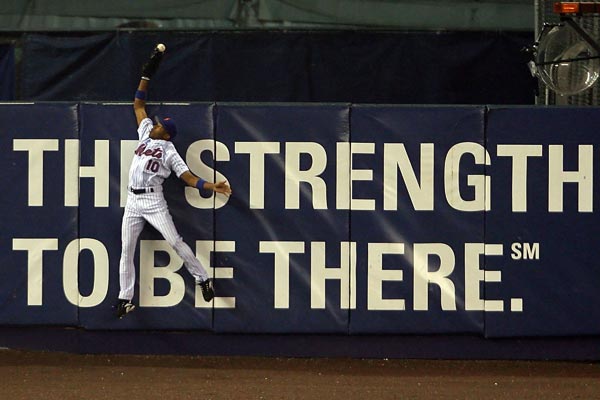
After not fooling the Cardinals in Game 4, Oliver Perez pitched very well in the biggest game of his life, allowing one run through the first five innings.  But after a one-out walk to Jim Edmonds in the sixth, Scott Rolen stepped up to the plate.  Rolen was a .450 career hitter (9-for-20) against Perez with five doubles.  However, he had never hit a home run off the Mets' lefty.  It looked as if that was about to change after only one pitch.  But Endy Chavez had something to say about that.  On Perez's first pitch to the Cardinals' third baseman, Rolen lifted a high fly ball that appeared to be headed for the Cards' bullpen.  But Chavez had the speed and the strength to be there, timing his leap perfectly to rob Rolen of a tiebreaking two-run homer.  After checking to see that the snowconed ball was in his glove, Chavez quickly threw the ball to second baseman Jose Valentin, who fired the ball to Carlos Delgado to double off Jim Edmonds for an inning-ending double play.  Shea Stadium was rocking like it had never rocked before with the Mets seemingly taking the momentum away from the Cardinals.  But they could not capitalize on Chavez's catch for the ages.

In the bottom of the sixth, the Mets loaded the bases with one out, with two participants in the previous half-inning's double play, Valentin and Chavez, coming up.  Cardinals' manager Tony La Russa could have taken starting pitcher Jeff Suppan out of the game at that moment, but chose to leave him in.  It was perhaps the most important managerial decision made in the series.  On a 1-2 pitch, Suppan struck out Jose Valentin, then got Endy Chavez to hit a routine fly ball to center to end the inning.  Neither team threatened in the seventh or eighth innings.  It was on to the ninth inning with the game still tied at one apiece.  Aaron Heilman, who had pitched the eighth inning for the Mets, was allowed to start the ninth.  Before long, his name would permanently become a part of Mets history, but not in the way he intended.

Billy Wagner had not fared very well in the ninth inning during the NLCS, giving up three runs in Game 2 and two more runs in Game 6.  Perhaps that factored into manager Willie Randolph's mind when he left Heilman in the game for the ninth inning.  The move appeared to be a good one after Heilman struck out Jim Edmonds to lead off the ninth.  But then Scott Rolen grounded a single to left to bring up Yadier Molina.  Doing his best Mike Scioscia impression, Molina lifted a long fly ball that carried out of the ballpark, far away from Endy Chavez's glove for a two-run homer.  The light-hitting Molina, who had only hit six home runs during the regular season brought back painful memories of Scioscia, another light-hitting catcher who in 1988 hit a two-run ninth-inning home run in the NLCS at Shea Stadium.  But Scioscia's home run came in Game 4 and only tied the game.  Molina's home run was in Game 7 and gave the Cardinals a two-run lead.

The Mets were now down 3-1 as they came to bat in the bottom of the ninth inning, three outs away from elimination.  Rookie closer Adam Wainwright was called upon to pitch the Cardinals into the World Series.  But he struggled early, allowing back-to-back singles to Jose Valentin and Endy Chavez to lead off the inning.  With the tying runs on base, Cliff Floyd was not called upon to bunt the runners over.  The move ended up being costly, as Floyd struck out on six pitches.  After Jose Reyes lined out to centerfielder Jim Edmonds, Paul Lo Duca, doing his best Gary Carter impersonation, refused to be the final out at Shea Stadium.  Lo Duca walked on five pitches to load the bases and bring up Carlos Beltran.  Wainwright threw two strikes to Beltran to go ahead in the count.  Then this happened...

Boo.

If you were to look at the big picture of the Mets in the last decade, 2006 was the blip on the radar, not the other way around.  Overall, 2006 was no different in how the Mets operated in years past, namely with injuries, bad contracts and reliance upon out-of-their-prime veterans and not-so-ready-for-prime-time rookies.  They were just more successful on paper than previous and post years.   

In fact, if you were to look at how the Mets started to slowly unravel at the end of the 2006 season, it was clear we all were just willing to overlook their shortcomings simply because of how good they did that year.  Most certainly Omar Minaya, Willie Randolph and Fred Wilpon did.  It is true, then, that winning makes you forget about these things.  Now that the Mets haven't won in a few years, we're able to look at 2006 more objectively, as being the one season wonder, the year that maybe shouldn't have been.  

Look at Steve Trachsel, who was an underrated and under-appreciated pitcher for the Mets in his years, winning 15 games that year but under the guise getting great run support.

Look at Jose Valentin and Chris Woodward, starting all those games at second base when they were supposed to be at best super utility players.  Who besides the Mets would give Julio Franco that much playing time, as a 48-year-old man?

Xavier Nady is seen to this day as a cult hero in Mets lore.  The fact that a middle reliever's injury caused so much of a domino effect on the dynamic of the team is a testament to not only how valuable Duaner Sanchez was to the bullpen, but conversely how that team was just one player short of imploding.  

Paul Lo Duca and Billy Wagner had great seasons in 2006, never to be replicated again in a Mets uniform.  

Carlos Beltran and Carlos Delgado fed off of each others production, and paved the way for future leaders of the team Jose Reyes and David Wright.  Now, Reyes is playing for the NL East rival Miami Marlins, and Wright has yet to take that leap to making the Mets his team. 

Lastly, trotting out 13 different starting pitchers, including Jose Lima, and they still won?  Chances are, this was not a formula for success but how lucky are you feeling, punk?   When your postseason hopes are foisted upon the likes of John Maine, Oliver Perez and Orlando "The Dookie" Hernandez, it's evident the 2006 Mets were just lucky to be there.

Prior to 2006, the Mets had made the playoffs six times.  Each of the six trips could be separated into pairs.  The 1969 and 1973 Mets were represented by many of the same players.  The 1986 and 1988 Mets could also be paired off, as the majority of the team in 1986 was still intact in 1988.  And of course, the 1999 and 2000 Mets were practically the same, save for John Olerud and Mike Hampton.  But the 2006 Mets have no postseason cousins.  They're simply a standalone team, a one season wonder on their own.


Studious Metsimus would like to thank Taryn "The Coop" Cooper for her contributions to this piece.  Not only was it her idea for the entire 2006 Mets team to receive the One Season Wonders spotlight, but she also wrote 10½ paragraphs for the piece.  You guess which ones.  For more examples of her writing on the Mets and on her other sports loves, please check out her site, A Gal For All Seasons.


Note: One Season Wonders was a thirteen-part weekly series spotlighting those Mets who had one and only one memorable season in New York. (And on occasion, it wasn't just an individual player that was a One Season Wonder.)  For previous installments, please click on the players' names below:
 
January 2, 2012: Bernard Gilkey
January 9, 2012: Terry Leach 
January 16, 2012: George Stone
January 23, 2012: Roger Cedeño
January 30, 2012: Frank Viola
February 6, 2012: Joe Christopher 
February 13, 2012: Dave Magadan 
February 20, 2012: Pedro Martinez
February 27, 2012: Bret Saberhagen 
March 5, 2012: Robin Ventura 
March 12, 2012: Willie Montañez
March 19, 2012: Lance Johnson 


Monday, March 19, 2012

One Season Wonders: Lance Johnson

The 1995 Mets were only two years removed from the team's first 100-loss season since 1967.  But they were one of the surprise teams in the National League, finishing in a second-place tie in the NL East with a 69-75 record in the strike-shortened season.  The future looked bright for the Mets, especially with Generation K, their highly touted trio of homegrown pitchers, about to make a splash.

However, one thing was missing for the Mets going into the 1996 season.  In 1995, the Mets traded their leadoff hitter, Brett Butler, to the Los Angeles Dodgers during the stretch run.  That left the Mets with a musical chairs situation in the leadoff spot, with Damon Buford, Joe Orsulak and Alex Ochoa trying to be the last person to sit on the leadoff seat.

Neither Buford, Orsulak or Ochoa figured to be the team's leadoff hitter in 1996, especially with general manager Joe McIlvane openly shopping for one.  Two months after the conclusion of the 1995 season, the Mets found their man in Chicago.  And he provided the team with the best season a leadoff hitter had ever produced to date.

"Leading off and playing center field, No. 1, Mook -- correction -- Lance Johnson!"


Kenneth Lance Johnson was not a young player when the Mets signed him.  At 32, he was entering a time in his life when speedsters tend to lose a step or two.  But the Mets decided to take a chance on Johnson after he had reached career highs in at-bats (607), hits (186), runs scored (98), home runs (10) and RBI (57), while batting .306 with 12 triples and 40 stolen bases in his final year with the White Sox.

Despite the fact that the Texas Rangers offered Johnson a three-year deal with a fourth-year option, guaranteeing him $8.35 million, the centerfielder chose to take his talents eastward, signing with the Mets for two years and $5.7 million.  Johnson settled on the Mets after talking to Bobby Bonilla, Daryl Boston and Mookie Wilson, all former Mets and good friends.

The Mets now had their leadoff hitter in place, but Johnson was a centerfielder.  Their Opening Day starter from the previous year, Brett Butler, had been the team's leftfielder.  That was also the position played by Damon Buford and Joe Orsulak.  One month after the Mets acquired Johnson, they orchestrated a trade for leftfielder Bernard Gilkey.

With the outfield set, the addition of a defensive wunderkind at short in Rey Ordoñez, and Generation K on the way, the Mets were ready to take the 1996 season by storm.  They didn't wait very long to make a positive impression on the fans, and Lance Johnson had a lot to do with it.

On April 1, before a packed house at Shea Stadium, the season opened ominously for the Mets, who fell behind early to the Cardinals by six runs.  But the Mets began to chip away at the lead and by the seventh inning, the Cardinals' lead had been halved.  After an exciting conclusion to the top of the seventh, where a perfect relay from Gilkey to Ordoñez helped nail Royce Clayton at the plate to keep the score 6-3, the Mets rallied for four runs in the bottom of the inning.  Smack dab in the middle of the rally was Lance Johnson.  The Mets' new centerfielder used his speed to generate a run, plating Ordoñez with an infield hit, then scored the go-ahead run on a sacrifice fly by Rico Brogna.  Johnson's run proved to be the difference in the 7-6 Mets' victory.

Although Johnson helped contribute to the Mets' Opening Day victory, he didn't start the season very well.  One month after the season opener, Johnson had a decent batting average (.272), but was only reaching base at a .286 clip, drawing three walks in the season's first month.  The Mets expected more from their leadoff hitter, and beginning with the second game of a doubleheader against the Montreal Expos on May 1, Johnson gave the Mets exactly what they wanted and more.

Photo by David G. Whitham
Over a six-game stretch from May 1 to May 7, Johnson batted .500 (14-for-28), scoring five runs and driving in another.  He also collected his seventh triple of the season, after hitting six in the season's first month.  The season was barely a month old and Johnson was already only three triples short of Mookie Wilson's single-season franchise record for three-base hits.  Before the season was half over, that record would be history.

On June 16, Johnson picked up his 11th triple of the season against the St. Louis Cardinals, breaking Mookie Wilson's club record that he set in 1984.  For Johnson, the moment was extra-special because it was the Cardinals who originally drafted him in 1984 before trading him to the White Sox just months after he played for St. Louis in the 1987 World Series.

By the All-Star Break, Johnson was already having an historic season for the Mets.  Through his first 87 games, One-Dog (as he was affectionately referred to by his teammates) was hitting .322 with 16 doubles, 13 triples and five home runs.  He also had 40 RBI out of the leadoff spot, which was an unusually high number for a No. 1 hitter.  What was not unusual for a leadoff hitter was his 65 runs scored and 28 stolen bases.

For his efforts, Johnson was selected to his first All-Star team, joining catcher Todd Hundley to become the first Mets' teammates in five years to represent the club in the Midsummer Classic.  Due to an injury to Padres' outfielder Tony Gwynn, Johnson started the All-Star Game and surprised everyone by playing the entire game, going 3-for-4 with two singles, a double, a run scored and a stolen base in the 6-0 National League victory.

Johnson continued to hit after the All-Star Break.  In his first 32 games after the break, Johnson had 12 multi-hit games and stole 14 bases.  However, the team, who had remained within a few games of the .500 mark for most of the season, was starting to feel the dog days of August, especially the young pitching staff.  Generation K had become Generation K.O., as Jason Isringhausen's ERA was climbing near 5.00 and Paul Wilson's ERA had already gone north of that mark.

By August 18, the Mets had fallen 20 games behind the first-place Braves.  One week later, manager Dallas Green was gone, replaced by Bobby Valentine.  Despite the poor play on the field and the upheaval in the clubhouse, Lance Johnson continued to shine.

Beginning with his 2-for-4 performance on August 14, Johnson hit .399 over the team's final 41 games.  In addition, the centerfielder scored 35 runs and drove in 20 more during the final quarter of the season.  Mostly everyone else wilted in the summer heat (save for Gilkey and Hundley), but Johnson just got better.  Despite not being a big on-base percentage player or a slugger, Johnson had an impressive 1.004 OPS over the last month and a half of the season, reaching base at a .426 clip and producing a .578 slugging percentage (13 doubles, six triples, two home runs in 173 at-bats).  The Mets finished the season with a disappointing 71-91 record, but Johnson's season was anything but disappointing.

For the season, Lance Johnson hit .333.  At the time, it was the second-highest batting average in team history (Cleon Jones hit .340 in 1969).  Johnson also became the second Met to play in 160 games (Felix Millan played 162 games in 1975) and the second to reach the 50-steal plateau (Mookie Wilson stole 58 bases in 1982 and 54 bases in 1983).  But there were a number of offensive categories in which Johnson was second to none.

In 1996, Johnson set the Mets' single-season record for at-bats (682), runs scored (117), hits (227), total bases (327), multi-hit games (75), singles (166) and triples (21).  He also had the rare distinction of having more stolen bases (50) than strikeouts (40).  To this day, Johnson still holds the single-season franchise records for hits, multi-hit games, singles and triples.

Following Johnson's record-setting campaign, the Mets rewarded him with a two-year contract extension worth $10 million, keeping him under the team's control until 1999.  But Johnson was also a year older, and a year closer to breaking down.  The 33-year-old Johnson started the 1997 season where he left off in 1996, hitting .309 with five stolen bases over the Mets' first 13 games.  But shin splints knocked Johnson out of the lineup on May 1 and he missed six weeks of action, returning to the Mets just in time to see Dave Mlicki shut out the Yankees in the first regular season Subway Series game on June 16.

By early August, Johnson was still hitting above .300, but he was hitting mostly singles.  His 17 extra-base hits (ten doubles, six triples, one home run) were a far cry from his 1996 production, when he finished the year with 61 extra-base hits.  Johnson also wasn't running as much, stealing 15 bases in 25 attempts.  His 60% success rate was well below his 77% career rate.  Despite Johnson's regression, the Mets were overachieving and competing in the National League wild card race.  However, the team was leading the league in blown saves and needed to improve their bullpen if they wanted to have a realistic shot at making the playoffs.

On August 8, the Mets made a deal to improve their bullpen, but the cost was steep, as they had to part ways with Lance Johnson.  In a six-player deal with the Chicago Cubs, the Mets sent Johnson, starting pitcher Mark Clark and backup shortstop Manny Alexander to the Windy City for centerfielder Brian McRae, closer Mel Rojas and set-up man Turk Wendell.  Although McRae went on to record a 20-20 season with the Mets in 1998 (21 HR, 20 SB), he never quite replaced Lance Johnson in center.  Meanwhile, Mel Rojas went on to become one of the most hated relievers in Mets' history.  However, Turk Wendell became one of the most successful middle relievers in team history, and was a key player in the Mets' postseason runs in 1999 and 2000.

The injuries that sidelined Johnson during the 1997 season continued to keep him off the field for extended periods of time over the next three years.  As a member of the Cubs in 1998 and 1999, Johnson missed a total of 145 games.  He then played 18 games for the Yankees in 2000 before being released on June 6, just four months before he would have gotten the chance to play against the Mets in the World Series.  Although Johnson was only 36 years old, he would never play in the major leagues again.

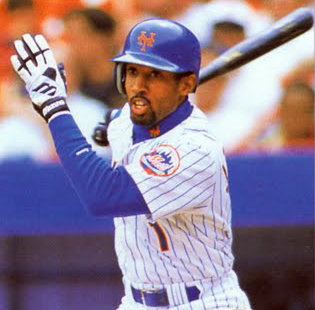
Although his career was cut short by injuries, Lance Johnson still had plenty to smile about.


Lance Johnson became an everyday player in 1990 as a member of the Chicago White Sox.  Over the next six seasons, he was one of the best leadoff hitters in the game not named Rickey Henderson, batting .289 and averaging 12 triples and 34 stolen bases per year from 1990 to 1995.  Then he became a Met in 1996 and obliterated his six-year averages.  But injuries and a subsequent trade in 1997 curtailed his career, ending it at a relatively young age.

The Mets did not play well as a team in 1996, finishing 20 games below .500.  But Lance Johnson did all he could to make the season a memorable one for Mets fans.  Mookie Wilson captured the fans' hearts with his speed and smile in the 1980s.  Two decades later, Jose Reyes did the same.  The Mets did not have many players like that in the 1990s, but for one season, they did.

Lance Johnson was Mookie Wilson after the fan-favorite retired and he was Jose Reyes before anyone knew who Reyes was.  But without his one magnificent season in 1996, perhaps no Mets fan would have known who Lance Johnson was.  It's amazin' what one wonderful season can do to a player.


Note: One Season Wonders is a thirteen-part weekly series spotlighting those Mets who had one and only one memorable season in New York.  For previous installments, please click on the players' names below:
 
January 2, 2012: Bernard Gilkey
January 9, 2012: Terry Leach 
January 16, 2012: George Stone
January 23, 2012: Roger Cedeño
January 30, 2012: Frank Viola
February 6, 2012: Joe Christopher 
February 13, 2012: Dave Magadan 
February 20, 2012: Pedro Martinez
February 27, 2012: Bret Saberhagen 
March 5, 2012: Robin Ventura 
March 12, 2012: Willie Montañez

Monday, March 12, 2012

One Season Wonders: Willie Montañez

In 1977, the Mets were in the middle of dismantling the team that brought them much success in the first half of the 1970s.  They weren't just massacring the team at midnight, they were chopping the players up and spitting them out for other teams to enjoy.  The Mets traded away "The Franchise", their best power hitter (Dave Kingman) and their rock behind the plate (Jerry Grote) during the 1977 season.  But they weren't done yet.

After the season was over, the Mets were involved in a complicated four-team trade with the Atlanta Braves, Texas Rangers and Pittsburgh Pirates.  On December 8, 1977, former Rookie of the Year Jon Matlack was shipped off to Texas and slugging first baseman/leftfielder John Milner packed his bags for Pittsburgh.  In return, the Mets received outfielders Tom Grieve and Ken Henderson from the Rangers.  Neither player performed very well for the Mets.  In fact, both of them were rarely seen on the field in a Mets uniform, with Grieve's career in New York lasting 54 games (.208, 2 HR, 8 RBI) and Henderson (.227, 1 HR, 4 RBI) playing in only seven games.

The Mets received one other player in the deal that sent Matlack and Milner away.  Unfortunately, it was not future Hall of Famer Bert Blyleven, who was also involved in the trade; he went from Texas to Pittsburgh.  No, the third player sent to the Mets came via the Atlanta Braves.  It was a player who was no stranger to trades, as he had already been a part of five organizations (St. Louis Cardinals, California Angels, Philadelphia Phillies, San Francisco Giants, Atlanta Braves) before becoming a Met.  He was also no stranger to trades involving All-Stars and future Hall of Famers.

In 1970, he was the player sent to the Philadelphia Phillies from the St. Louis Cardinals when Curt Flood refused to report to his new team, paving the way for the birth of free agency.  In 1975, he was traded to San Francisco for the Secretary of Defense, Garry Maddox.  This is the same Garry Maddox who went on to win eight Gold Glove Awards and was immortalized by Ralph Kiner when the Mets' legendary broadcaster proclaimed that "two-thirds of the Earth is covered by water, the other third is covered by Garry Maddox".  In 1976, he was traded to Atlanta for Darrell Evans, who went on to hit 414 HR in his major league career.  Then came the trade in 1977 that sent him to the Mets.  Willie Montañez didn't play for very long in New York, but he did have one phenomenal season as a Met.

The Mets were entering the dark ages in 1978, but they did have a bright star in Willie Montañez.


Guillermo Montañez Naranjo was a well-traveled player before coming to the Mets.  Although he was only 29 at the time of the trade to New York, he had already completed a number of great seasons with multiple teams.  His 1971 campaign for the last-place Phillies (.255, 30 HR, 99 RBI) almost won him the National League Rookie of the Year Award, as he placed second in the voting to Atlanta's Earl Williams.  In 1975, he recorded his first 100-RBI campaign, although he split the season between the Phillies and the San Francisco Giants.  In 1976, he recorded career-highs in batting average (.317), hits (206) and games played (163).  But once again, he split the season between two teams, beginning the year in San Francisco and ending it as a member of the Atlanta Braves.

When he joined the Mets in 1978, it was Montañez's sixth professional organization.  (He was in the St. Louis Cardinals organization twice although he never played for them at the major league level, and he recorded two at-bats as a California Angel in 1966, five years before his "rookie" season for the Phillies in 1971.)  As a Brave in 1977, Montañez was a first-time All-Star, finishing the year with a .287 batting average, 31 doubles, 20 HR and 68 RBI.  The 1977 Mets, on the other hand, had no player with more than 25 doubles, 12 HR or 65 RBI.  It goes without saying that Willie Montañez was expected to carry the bulk of the offensive load for the Mets in 1978.  The team may not have produced on the field, but Willie Montañez gave the Mets solid production with his bat.

The season did not start off so well for Montañez and the Mets.  The Mets and the Braves were playing a game of musical chairs in the National League basement.  At the same time, Willie Montañez was struggling with his new team, batting .206 with two home runs and 12 RBI through the team's first 36 games.  He also had more strikeouts (29) than hits (28), which was disconcerting for a player who was only two years removed from a season in which he recorded 206 hits while striking out only 47 times.  But with one visit from his former Braves teammates at Shea Stadium, Montañez turned his season around in a big way.

On May 18, 1978, in the final game of a three-game series against Atlanta, Montañez went 3-for-3 and drove in four runs.  In the first inning, Montañez gave the Mets a short-lived 1-0 lead with a sacrifice fly, but the Braves scored four runs in the top of the second to take a three-run advantage.  In each of his next two at-bats, Montañez cut the Braves' lead to a single run.  His RBI single in the third cut the lead to 4-3, while his run-scoring double in the fifth made it a 6-5 game.  The Mets finally tied the Braves in the bottom of the seventh, with Montañez providing the game-tying RBI double, and went on to win the game in the tenth inning, when Steve Henderson drove in Lee Mazzilli from second base with a single.  The first person to greet Mazzilli at home plate was Willie Montañez, who was on deck at the time.  As great as his 3-for-3, 4 RBI effort was against the Braves, he came up even bigger the following night against the Phillies.

Following the comeback victory against the Braves, the Mets once again fell behind by three runs.  In the bottom of the eighth, the Phillies led the Mets, 3-0, when Willie Montañez came up to bat.  Although he grounded into a fielder's choice, he did drive in the Mets' first run of the game.  Three batters later, Montañez scored on Lee Mazzilli's two-run single off former Met hero Tug McGraw.  The game was tied at 3, and the Mets now had the opportunity for their second consecutive walk-off victory.  In the bottom of the ninth, the Mets loaded the bases with one out for (you guessed it) Willie Montañez, who delivered the game-winning single off McGraw.  It was Montañez's second consecutive three-hit game and gave him a total of six RBI over the two games.  It also served as the impetus for a tremendous hot streak.

Beginning with the series finale against the Braves in mid-May, Montañez went on a tear, hitting .396 through the end of the month.  In 14 games, the Mets' first baseman lashed four doubles, five home runs and drove in a whopping 21 runs.  By the All-Star Break, Montañez's numbers (.267, 12 HR, 54 RBI) made Mets fans forget his slow start.  But the team went into a free fall following the All-Star Break, losing 21 of 28 games from July 27 to August 29 to fall into last place in the NL East.  As the team slumped, so did Montañez, as he hit .238 with three home runs and 26 RBI from the break to late August.  The Mets weren't able to recover from their slump, but Montañez had one final good month in September.

Over a two-week stretch in the season's final month, Montañez returned to his pre-Midsummer Classic form.  In 12 games from September 7 to September 20, Montañez batted .298 with five extra-base hits (four doubles, one homer) and 10 RBI.  One game in particular stood out for Montañez on a personal level, as he drove in all three runs in a 3-2 victory over the Pittsburgh Pirates on September 8.  Montañez produced run-scoring singles in the first and third innings, then delivered the game-winner with an RBI double in the eighth.  All three run-scoring hits were hit off the same pitcher, Bert Blyleven, who was one of the players involved in the trade that brought Montañez to New York.  Although the Mets were just playing out the schedule by that point, they did win eight of the 12 games during Montañez's final hot streak.

For the year, Willie Montañez batted .256.  However, he did lead the team with 32 doubles, 17 HR and 96 RBI.  At the time, the only two Mets who had registered more doubles in a season than Montañez were Rusty Staub (36 doubles in 1973) and Felix Millan (37 doubles in 1975).  Montañez's RBI total was also only surpassed by two Mets - Donn Clendenon (97 RBI in 1970) and Rusty Staub (105 RBI in 1975).  The Mets finished 1978 with a 66-96 record, but they entered the 1979 campaign knowing they had a bona fide slugger in their lineup.  Unfortunately, the key word in that last sentence was "had".

The 1979 Mets had a horrendous start to their season and by the end of May, they were already 13 games out of first place.  Unlike the previous campaign, when Willie Montañez did all he could to keep the Mets fairly relevant over the first few months of the season, in 1979, he was one of the main reasons why they got off to a 16-28 start.  Through May 9, Montañez's numbers (.150, 1 HR, 4 RBI) looked more like a pitcher's offensive figures than a slugging first baseman's stats.  Although he did raise his average to a more respectable .234 by mid-August, he did it mostly with singles.  (In June and July, Montañez managed just seven extra-base hits in 213 plate appearances.)  As a result, by August 11, Montañez had only produced five home runs and 47 RBI for the season.

By then, the Mets had been all but mathematically eliminated in the NL East race, and decided to trade away their veteran first baseman to the Texas Rangers for Ed Lynch and Mike Jorgensen.  After his trade from the Mets, Montañez returned to his peripatetic ways, playing for the Rangers, Padres, Expos, Pirates and Phillies over his final three-plus seasons in the majors before retiring after the 1982 season.

Willie Montañez was known as a hot dog throughout his days in the major leagues, drawing the ire of opposing players and managers throughout his long major league career.  But despite his antics, he was still a very productive player.  For one season in New York, he was as productive a hitter as the Mets had ever seen.  Then his production fell off the table and his Mets career soon followed.  The Mets might not have had many good players or teams to root for from 1977 to 1983, but in 1978, Willie Montañez was one of the few bright spots in an otherwise dark period of Mets history.  It was only one season, but for the era in which it occurred, it was a welcome sight to have a one-season wonder like Willie Montañez take the field for the Mets.


Note: One Season Wonders is a thirteen-part weekly series spotlighting those Mets who had one and only one memorable season in New York.  For previous installments, please click on the players' names below:
 
January 2, 2012: Bernard Gilkey
January 9, 2012: Terry Leach 
January 16, 2012: George Stone
January 23, 2012: Roger Cedeño
January 30, 2012: Frank Viola
February 6, 2012: Joe Christopher 
February 13, 2012: Dave Magadan 
February 20, 2012: Pedro Martinez
February 27, 2012: Bret Saberhagen 
March 5, 2012: Robin Ventura

Monday, March 5, 2012

One Season Wonders: Robin Ventura

In 1997, the Chicago White Sox were standing only 3½ games behind the first place Cleveland Indians on the morning of July 31.  However, with a 52-53 record, owner Jerry Reinsdorf felt they should be sellers instead of buyers at the trade deadline.  Throwing up the proverbial white flag, the White Sox shocked the baseball world by dealing their top starting pitcher (Wilson Alvarez), their closer (Roberto Hernandez) and a veteran pitcher (Danny Darwin) to the San Francisco Giants for a bevy of minor leaguers.

The South Siders were also attempting to trade their starting third baseman, but no team was interested in acquiring a player who had suffered a gruesome leg injury in spring training that had kept him out of the lineup for the majority of the '97 season.  As a result, the White Sox kept their third baseman until his contract expired following the 1998 season, allowing him to leave the team as a free agent.

Meanwhile, the Mets, who already had a third baseman in Edgardo Alfonzo, were interested in adding a little power to the hot corner.  With the White Sox showing no interest in bringing back their long-time third baseman, the Mets jumped at the opportunity to sign him, moving Fonzie back to second base to accommodate their newest infielder.  It took a four-year, $32 million contract to do it, but the Mets had finally wrangled themselves a power-hitting third baseman in Robin Ventura.


In 1999, Robin Ventura's sweet swing connected with baseballs and Mets' fandom alike.


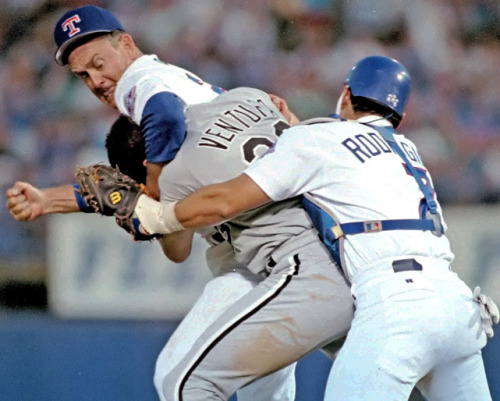
Before coming to the media capital of the world, Robin Mark Ventura had already been in the media spotlight on a number of occasions.  Sometimes the attention was positive (Ventura set an NCAA record at Oklahoma State University with his 58-game hitting streak in 1987) and sometimes he was getting a noogie from future Hall of Famer Nolan Ryan.

But one thing was for certain.  Robin Ventura was a complete player.  In ten years with the White Sox, Ventura had six seasons of 90 or more RBIs, surpassed 20 homers five times and hit over .280 in five different campaigns.  He was also an outstanding defensive player, winning five Gold Gloves as a member of the White Sox.  Although Edgardo Alfonzo was a good player at the time, he had never hit as many as 20 HR or collected as many as 80 RBIs.  He had also never been rewarded with a Gold Glove Award in four years with the Mets.  Robin Ventura had accomplished all of those feats prior to becoming a Met.  And in 1999, he was on a mission to accomplish the trifecta again.

In his first year in New York, Robin Ventura wasted no time getting acquainted with National League pitching.  The Mets' new third baseman hit .375 with five extra-base hits (three doubles, two homers) and 11 RBIs over his first ten games.  His torrid start put him among the league leaders in RBIs and made him one of the few players in Mets' history to reach 20 RBIs in a season before the end of April.  (In 1994, Jeff Kent set the franchise record for RBIs in April with 26.)

But once April turned into May, Ventura suffered his first slump as a Met and the team soon followed.  After defeating the Astros on May 3, the Mets' record stood at 17-9.  The team then went on to lose 19 of their next 28 games to fall below the .500 mark at 27-28.  During the month-long meltdown, Ventura batted only .240, dropping his season average to .268.  Although he still managed to hit eight doubles and five home runs during the 29-game stretch, he began to strike out more often, whiffing 27 times in 100 at-bats.

It was during this otherwise poor stretch that Ventura became the first player in major league history to hit grand slams in both ends of a doubleheader, as he accomplished the previously unprecedented feat against the Milwaukee Brewers at Shea Stadium on May 20.  However, this display of clutch hitting was rare for the Mets in May, and for Ventura in particular.  During the team's month-long slumber, Ventura only managed an additional three home runs and 13 RBIs on days when he wasn't hitting multiple grand slams.  The end result of the team-wide slump was the firing of pitching coach Bob Apodaca, hitting coach Tom Robson and bullpen coach Randy Niemann in early June, which coincided with a season-long eight-game losing streak.

After the dismissal of Apodaca, Robson and Niemann, Valentine famously stated that if the team didn't do well over the next 55 games, then he should also be relieved of his managerial duties.  Wanting to save his manager and the team's season, Robin Ventura went on a hitting tear, beginning with the Mets' 7-2 victory in the Subway Series finale against Roger Clemens and the Yankees.  In that game, Ventura collected two hits and scored two runs off Clemens, as the Mets handed him his first regular season loss in over a year.

The victory over the Yankees put the Mets back on track, as they went on to go 40-15 over their next 55 games, saving Valentine his job.  There were very few players in the National League as hot as Robin Ventura was over the two-month stretch.  From June 6 to August 6, Ventura batted .337 with 11 doubles, 16 HR and 48 RBI.  He also had a .405 on-base percentage and cut down on his strikeouts dramatically, fanning only 29 times in 223 plate appearances.

The Mets were finally cooled down with a loss to the Dodgers on August 7 (a game the Mets' third baseman didn't start), but Ventura's bat continued to smoke.  From August 8 to September 6, Ventura batted .366, lashed 13 extra-base hits (eight doubles, five homers) and drove in 22 runs.  On September 19, the Mets defeated the Philadelphia Phillies, 8-6, with Ventura driving in the game-tying run in the fifth inning.  The win upped the Mets' record to 92-58 and left them one game behind the Atlanta Braves for the NL East lead.  It also gave them a four-game lead over the Cincinnati Reds for the wild card, who had lost that day to the Pittsburgh Pirates.  With 12 games to go in the regular season, the Mets weren't thinking of the wild card.  They wanted to dethrone the Atlanta Braves, who had won eight consecutive division titles.  But things have a tendency to change quickly in baseball, and over the final two weeks of the season, the Mets found out just how true that adage was.

The Mets had a seemingly comfortable lead in the wild card race with 12 games to go.  But then the Mets embarked on a seven-game losing streak.  At the same time, the Reds won seven out of eight games.  With three games left in the regular season, the Braves had already clinched the division title and the Mets were now chasing the Reds and the Astros in the wild card race, as both teams were tied atop the National League Central division with identical 95-64 records.  At 93-66, the Mets were two games out with three games to go.  Their season was in jeopardy of ending prematurely for the second straight year.  But with one swing of Robin Ventura's bat, the team began to believe in themselves again.

On October 1, the Mets began a three-game series against the Pittsburgh Pirates, basically needing to sweep the Bucs and hope for outside help to have any chance of winning the wild card.  The Mets took an early 1-0 lead on Robin Ventura's 32nd homer.  But the Pirates came back and tied the game, sending it into extra innings.  After reliever Pat Mahomes escaped a two-on, one-out jam in the 10th inning, he retired the Bucs in order in the 11th.  In the bottom of the 11th, the Mets put a runner on second base with one out.  After an intentional walk to Edgardo Alfonzo and a groundout by John Olerud, the Pirates decided to walk Mike Piazza to load the bases for Ventura, hoping that southpaw reliever Scott Sauerbeck would retire the lefty-swinging Ventura to end the inning.  The inning did end, but not the way the Pirates wanted, as Ventura lined Sauerbeck's second pitch to right-center for a game-winning single.  As an added bonus, the Astros and Reds both lost to the Dodgers and Brewers, respectively.  The Mets were now one game behind Houston and Cincinnati for the wild card, and Shea Stadium was ready for an epic final weekend.

Going into the season's penultimate game, the Mets already knew that the Astros had won and the Reds had lost.  Houston was now leading the National League Central by a game over Cincinnati.  The Reds' loss meant that the Mets were one win away from tying them for the wild card lead.  Rick Reed was tabbed to start the game on October 2 and pitched the game of his life, striking out 12 Pirates and allowing no runs.  However, Bucs' starter Francisco Cordova was matching Reed zero for zero throughout the first five innings.  All that changed when the Mets came to bat in the sixth inning.  The Mets needed some mojo risin' and they needed it fast.  Up come Robin Ventura to provide the Mets with all the mojo they would need.

With two men on base, Ventura ripped a double down the right field line, plating the Mets' first run of the game.  The Mets scored another run in the inning and added five insurance runs in the eighth inning en route to a 7-0 victory over the Pirates.  The season had come down to Game No. 162, with the Mets and Reds tied for the wild card lead.  Ventura went 1-for-4 in the series finale against the Pirates and was on deck when Mike Piazza watched Brad Clontz's wild pitch bounce over the backstop in the ninth inning, scoring Melvin Mora from third base with the winning run and setting off a wild celebration at home plate in front of the Shea faithful.  Despite the thrilling ending, the Mets could not pop the champagne at home, as the Reds defeated the Brewers that night after a long rain delay, setting up a one-game playoff at Cinergy Field the following night.

Needing one victory to secure their first playoff berth in 11 years, the Mets got off to an early lead, compliments of Edgardo Alfonzo's two-run homer off Reds' starting pitcher Steve Parris.  In the third inning, Robin Ventura collected his 120th RBI of the season, drawing a bases-loaded walk from reliever Denny Neagle to give the Mets a 3-0 lead.  Ventura would reach base two more times in the game, but by then, Mets' starting pitcher Al Leiter had deflated the Reds' bubble, as the Mets went on to win the game and the National League wild card berth, advancing to the NLDS to play the NL West champion Arizona Diamondbacks.

Although Ventura hit only .214 against the Diamondbacks in the series, he found other ways to contribute.  In Game 1, it was Ventura who led off the ninth inning with a single off Randy Johnson.  What made the hit so incredible was the fact that Johnson had allowed a mere nine hits to left-handed batters over the entire 1999 regular season.  Five batters later, Edgardo Alfonzo hit the go-ahead grand slam off reliever Bobby Chouinard to give the Mets an 8-4 lead, a lead that held up in the bottom of the ninth when Diamondbacks' shortstop Hanley Frias popped out to (you guessed it) Robin Ventura to end the game.  The Mets split the next two games before winning Game 4 at home to take the series, with Ventura contributing a double and a walk in the deciding game.  Despite his low batting average in the NLDS, Ventura reached base seven times (four walks, three hits) for a .389 on-base percentage.

In the NLCS, Ventura struggled at the plate, taking oh-fers in each of the first four games.  Ventura didn't get off the schneid until the 11th inning of Game 5, when he singled for his first hit in 17 NLCS at-bats.  Although that hit has long been forgotten, his next hit in the NLCS will always be remembered.  Four innings after his 11th inning single, Ventura lashed another single, although this one carried over the right field wall.  The famous Grand Slam Single gave the Mets a 4-3 victory and sent the team back to Georgia for a Game 6 showdown against the Braves.

Ain't life grand?


Unfortunately, the Mets could not force a seventh and deciding game in Atlanta, but Robin Ventura tried his best to get the Mets to Game 7.  With the Mets down 5-0 in the sixth inning, Ventura was on deck when Mike Piazza hit a sacrifice fly to plate the Mets' first run.  Ventura then doubled to right field off Braves' starter Kevin Millwood and scored on Darryl Hamilton's two-run single.  The Mets had cut the Braves' lead to 5-3 and eventually sent the game into extra innings.  But the magical run ended in the bottom of the 11th inning, when Kenny Rogers walked Andruw Jones with the bases loaded.

Despite hitting a combined .154 (6-for-39) during the Mets' ten-game postseason run in 1999, Robin Ventura provided some of the timeliest hits for the Mets against Arizona and Atlanta.  Ventura was nothing but clutch for the Mets in 1999.  For the season, he set career-highs in batting average (.301), slugging percentage (.529), on-base plus slugging (.908), hits (177), doubles (38) and RBIs (120).  The Mets' third baseman also added 32 homers, scored 88 runs and won his sixth Gold Glove Award.  (He also was prominently featured as part of Sports Illustrated "Best Infield Ever?" story.)  For his efforts, Ventura finished sixth in the National League MVP vote, finishing just ahead of teammates Mike Piazza (7th) and Edgardo Alfonzo (8th).

The 2000 Mets were expected to build upon their success from 1999, with Robin Ventura being one of the key contributors.  Although the team did well in 2000, winning their fourth National League pennant, Ventura did not perform as expected in his second season in New York.  Ventura played in 85 of the team's first 87 games, but only batted .235 with 17 doubles, 16 HR and 53 RBIs.  He was then placed on the disabled list with a bruised right rotator cuff and missed the next 14 games.  Upon returning, he did even worse, batting .227 with six doubles, eight HR and 31 RBIs over his final 56 games.  His final numbers in 2000 (.232, 23 doubles, 24 HR, 84 RBI, 61 runs scored in 141 games) were a far cry from what he produced in 1999. (In fact, Ventura's only positive contribution to the 2000 Mets might have been his one-man performance in Rain Delay Theatre at Yankee Stadium.)  In the postseason, Ventura's batting average continued to suffer, as he hit .167 in 14 postseason games for the Mets in 2000.  He also failed to reach base in any of his last nine plate appearances against the Yankees in the World Series.

Ventura's 2001 campaign was more of the same.  Although his batting average went up slightly to .237 (still nowhere near the .301 average he produced in 1999), Ventura's power and run production continued to suffer.  In 142 games, Ventura hit 20 doubles and 21 HR, but only collected 61 RBIs.  He also struck out 101 times, which was only slightly lower than his hit total (108).  The 108 hits represented a career-low for Ventura over a season in which he played at least 100 games.  Unlike the 2000 season, in which the Mets made the playoffs despite Ventura's subpar campaign, the Mets barely finished above .500 in 2001.  As a result, the Mets decided that they needed to shed their third baseman's high salary and move in a different direction.  They did just that when they dealt Ventura to the Yankees for David Justice, who was then traded a week later to Oakland for pitchers Mark Guthrie and Tyler Yates.

Robin Ventura wasn't all about his bat.  He may have been better with his glove.


Despite only having one outstanding season with the Mets, Robin Ventura is still a beloved figure in New York.  He was an outstanding defensive third baseman during his three years in Flushing and provided many memorable moments for the team, although most of them came during their magical 1999 campaign.  Ventura is now managing the Chicago White Sox, the team for which he played the majority of his professional career.  But no matter what he does in Chicago, Ventura will always have 1999, a season that started out so innocently, but ended with a new Mets legend being born.

From his doubleheader grand salamis in May to his torrid two-month stretch in the summer of '99 to "The Best Infield Ever" to the Grand Slam Single, Robin Ventura was in the middle of many great moments during one of the most memorable seasons in Mets history.  He may not have had the best Mets career, but for one season, he was in the center of it all.  It's no wonder that that one season turned him into the Mets legend that he now is.


Note: One Season Wonders is a thirteen-part weekly series spotlighting those Mets who had one and only one memorable season in New York.  For previous installments, please click on the players' names below:
 
January 2, 2012: Bernard Gilkey
January 9, 2012: Terry Leach 
January 16, 2012: George Stone
January 23, 2012: Roger Cedeño
January 30, 2012: Frank Viola
February 6, 2012: Joe Christopher 
February 13, 2012: Dave Magadan 
February 20, 2012: Pedro Martinez
February 27, 2012: Bret Saberhagen

Monday, February 27, 2012

One Season Wonders: Bret Saberhagen

In 1991, the Mets went into the season with a manager other than Davey Johnson for the first time since 1983. Perhaps not coincidentally, the 1991 season ended with the Mets registering their first losing record since the aforementioned '83 campaign.

During the Mets' seven-year string of excellence from 1984-1990, the team prided itself on having a strong starting rotation.  Pitchers like Dwight Gooden, Ron Darling, Sid Fernandez, Bobby Ojeda, David Cone and Frank Viola had all contributed excellent seasons for the Mets during that period.  But a lot was changing as a result of the 1991 season.

Ron Darling was traded to Montreal at the 1991 trade deadline. Also gone were Bobby Ojeda, who was traded to Los Angeles prior to the 1991 season, and Frank Viola, who signed as a free agent with the Boston Red Sox after losing 10 of his last 12 decisions with the Mets in 1991.

Of the pitchers still on the Mets,  Sid Fernandez was coming off an injury-plagued season in which he only made eight starts, winning one of them.  David Cone lost a career-high 14 games in 1991, despite leading the league with 241 strikeouts.  And Dwight Gooden, the long-time ace of the staff, had undergone rotator-cuff surgery in September and was not a lock to be ready for the start of the 1992 season.

The Mets needed a quality starting pitcher and they needed one fast.  They also wanted a young pitcher who was a proven winner and could give them plenty of innings.  Five years after acquiring David Cone from Kansas City, they went back to the Royals and found themselves the ace they wanted in 27-year-old Bret Saberhagen.

The Mets hoped Bret Saberhagen would be the apple of their eye when they traded for him in 1991.


Bret William Saberhagen had done it all in the major leagues before his 28th birthday.  He was a two-time All-Star (1987, 1990), a Gold Glove Award winner (1989), a two-time Cy Young Award winner (1985, 1989), had pitched a no-hitter (1991) and was a World Series MVP, pitching the Kansas City Royals to their first and only title in 1985.  One thing he hadn't done was pitch in a large market city, as Kansas City wasn't exactly the media capital of the world, or even Missouri for that matter.

But with the Mets in need of a quality arm to anchor their depleted staff, Saberhagen seemed like the perfect fit.  So on December 11, 1991, the Mets traded Kevin McReynolds, Gregg Jefferies and Keith Miller to the Royals for Saberhagen and Bill Pecota.  The cost to acquire the front-line starter they coveted was steep, as McReynolds, Jefferies and Miller were all regulars on the 1991 Mets, but the Mets were desperate for an ace, and Saberhagen fit the bill.

As good as Saberhagen was during his eight-year stay with the Royals, he did suffer from the even-year, odd-year syndrome.  Saberhagen finished with a losing record in every even-numbered year, going a combined 36-48 with a 3.70 ERA and 1.23 WHIP in 1984, 1986, 1988 and 1990.  However, in odd-numbered years, Saberhagen was an elite pitcher.  In 1985, 1987, 1989 and 1991, Sabes combined to go 74-30 with a 2.85 ERA and 1.06 WHIP.  His first year with the Mets was going to be an even-numbered year.  You can imagine what happened next.

Bret Saberhagen was one of a number of new faces brought in by general manager Al Harazin prior to the 1992 season.  With Eddie Murray, Bobby Bonilla and manager Jeff Torborg on board, Saberhagen was supposed to be the crown jewel of the offseason haul.  Instead, he turned out to be the cubic zirconia version of his former self.

Injuries prevented Saberhagen from performing at the level the Mets expected of him, and as a result, he was only able to make 15 starts, going 3-5 with a 3.50 ERA.  The next year, everyone expected a bounceback season from Saberhagen, especially since it was an odd-numbered year.  The only problem was that it was only Saberhagen who everyone expected to bounce back.  The rest of the team was another story.

In 1993, the Mets produced their worst record in twenty-six years.  Not since the days before Gil Hodges' arrival as manager had the Mets been so awful.  The '93 squad finished the year with a 59-103 record, and it could have been much worse had it not been for a season-ending six-game winning streak.  The Mets were so bad in 1993 that even the expansion Florida Marlins finished ahead of them in the seven-team National League East.  Needless to say, Bret Saberhagen did not win a lot of ballgames in '93.  However, he wasn't that bad compared to his teammates.

Although injuries curtailed Saberhagen's season for the second consecutive year, he was the only starter to not finish the season with a losing record.  In addition to his 7-7 record in 19 starts, Saberhagen had a respectable 3.29 ERA and an outstanding 1.06 WHIP.  The low WHIP was a direct result of Saberhagen's excellent control, as he walked a mere 17 batters in his 19 starts.

After two injury-plagued seasons in 1992 and 1993, the Mets still had not gotten what they expected from their ace.  However, when Saberhagen was healthy in 1993, he showed he could be one of the stingiest pitchers in baseball.  All he needed was one season of good health, just one, to prove that he could still be one of the best pitchers in the game.  That wish became a reality in 1994.

After their horrific 1993 season, the Mets weren't expected to do much in 1994.  But they surprised most experts over the first month and a half of the season, jumping out to a quick start.  The Mets weren't doing it with their hitting (they finished next-to-last in the NL in batting average in 1994) or their baserunning skills.  (Jose Vizcaino went 1-for-12 in stolen base attempts and John Cangelosi led the team in thefts with five - that's one, two, three, four, FIVE STEALS!)  But the one thing they had in 1994 that they didn't have in 1993 was a healthy Bret Saberhagen.  And his health was instrumental in getting the Mets off to their quick start.  In the team's first 32 games, Saberhagen was 4-1 with a 3.09 ERA.  As a result, through May 10, the Mets were in second place with an 18-14 record, just 2½ games behind the first place Atlanta Braves.

Saberhagen split his next four decisions as the Mets slipped below .500.  But beginning with his start on June 13 against the defending National League champion Phillies, Saberhagen went on a roll that lasted until the end of the season.  On that fateful night, Saberhagen pitched beautifully, allowing two runs (one earned) in seven innings, needing only 94 pitches to stifle the high-powered Phillies' offense.  It was a far cry from his previous outing against Philadelphia, a four-inning, seven-run debacle on May 21.  The confidence he gained by beating the Phillies in mid-June lasted for the rest of the season, as Saberhagen was pretty much unhittable after that game.


Beginning with his final start in June, Saberhagen had one of the finest extended stretches in club history.  From June 30 to his last start of the season, Sabes went 7-0 with a 1.51 ERA and 0.85 WHIP.  Even more impressive was his strikeout-to-walk ratio, as Saberhagen struck out 62 batters over his final nine starts while walking only five.  That's one, two, three, four, FIVE WALKS, as in the same number of steals John Cangelosi had all season.


During this second-half surge, Saberhagen pitched what was perhaps his best game as a Met against the San Diego Padres on July 15.  In the second game of a twi-night doubleheader against the Padres, Saberhagen pitched ten scoreless innings, allowing five hits (all singles) while striking out 11 and walking none.  Unfortunately, Padres' starter Andy Benes matched Saberhagen zero-for-zero, striking out 14 Mets batters in eight innings of work.  Saberhagen's valiant effort went for naught, as the Mets lost the game, 2-1 in 14 innings, when Mike Maddux allowed back-to-back home runs to Tony Gwynn (the best hitter in Padres' history) and Phil Plantier (the current hitting coach for the Padres).


After Saberhagen defeated the Phillies again on August 10 to improve his record to 14-4, the Mets stood only two games under .500 with a 55-57 record.  It was Saberhagen's seventh consecutive victory, a streak that began on June 30 when the Mets entered the day in last place with a 33-43 record.  Since then, the Mets had gone 22-14 and had climbed into third place in the NL East.  The Mets lost their next game in 15 innings and then lost the season soon after, as the baseball strike put an end to the 1994 season.  Who knows what Bret Saberhagen would have accomplished had the season not been cut short?

Despite the premature ending to the 1994 season, it still went down in history as the year in which Bret Saberhagen produced one of the best pitching performances in club annals.  For the year, Saberhagen went 14-4, but that didn't tell the whole story.  His 2.74 ERA and 1.03 WHIP were both second in the National League to Atlanta's Greg Maddux.  Saberhagen also finished in the top ten in wins (14, 3rd), winning percentage (.778, 2nd), innings pitched (177
⅓, 3rd), strikeouts (143, 4th) and complete games (4, 4th).  He also had the dubious distinction of finishing the year with more wins (14) than walks (13).  In addition, by recording 143 strikeouts against only 13 bases on balls, Saberhagen finished the year with an unheard of 11:1 K/BB ratio.  How unheard of was it?  To this day, it's still a major league record.

After two injury-plagued seasons in 1992 and 1993, Saberhagen finally produced the season the Mets expected from him during his third year in New York, making the All-Star team and finishing third in the Cy Young Award vote.  His 1994 campaign came on the heels of his infamous bleach-spraying incident, a matter that earned him a four-game suspension to start the '94 season and caused him to be discussed in trade talks with the Cleveland Indians, a trade that would have brought shortstop Felix Fermin and young right-handed starter Albie Lopez to the Mets.  Fortunately for the Mets, that deal was never consummated, as Fermin went on to hit .190 in 1995 and 1996 (after a .317 campaign in 1994) and Lopez posted a career ERA just under 5.00 in a decade-long major league career.

The 1995 season didn't begin as scheduled, as the strike knocked out the first three weeks of the regular season.  The season finally did get underway in late April, but Bret Saberhagen left his best stuff behind.  Although Saberhagen was decent in 16 starts for the Mets in 1995, he only won five games.  His 3.35 ERA and 1.14 WHIP, although both good, were nowhere near his numbers from his record-setting 1994 campaign.  Also, his strikeout-to-walk ratio decreased dramatically in 1995, as Saberhagen struck out 71 batters while walking 20 in his 16 starts.  The 3.55 K/BB ratio was a far cry from his major league record 11.00 K/BB mark in 1994.


As a result, Saberhagen was traded to the Colorado Rockies in July for minor league pitchers Arnold Gooch and Juan Acevedo.  Although the move was widely speculated to be payroll-related, Mets' co-owner Fred Wilpon said it was due to Saberhagen's injury history and lack of overall productivity during his 3½-year stay in New York.  Wilpon had decided that Mets needed to get younger to get better, and Saberhagen was not part of that equation.  Besides, Generation K was about to take Flushing by storm.  Until it didn't.

One thing Fred Wilpon was right about was that Bret Saberhagen wasn't very durable.  In fact, Saberhagen only had one more injury-free season left in him, going 15-8 in 31 starts for the 1998 Red Sox.  Although Saberhagen did pitch in the majors until 2001, he was never able to stay healthy once he left the Mets, save for that 1998 season.  A career that once looked so promising fizzled out earlier than expected, as Saberhagen appeared in only three games after his 36th birthday.

If not for injuries and Bleach-gate, Bret Saberhagen's career as a Met could have been truly special.


From 1992 to 1995, Bret Saberhagen was never as bad as people made him out to be.  Although he won only 29 games as a Met (the same total won by Oliver Perez, a pitcher who really was as bad as people made him out to be), he posted a 3.16 ERA and 1.08 WHIP in his nearly four-year career in orange and blue.  Let's put his Mets career in perspective. 

Only ten pitchers in Mets history had a lower ERA than Saberhagen's 3.16 mark.  Bret Saberhagen's winning percentage as a Met was .580.  The only pitchers in team history who topped that are Dwight Gooden (.649), Rick Reed (.621), Johan Santana (.615), Tom Seaver (.615), David Cone (.614), Ron Darling (.586), Al Leiter (.586) and Pedro Martinez (.582).  And about that WHIP.  The only Met with a better career WHIP than Bret Saberhagen is Tom Seaver, and you need to go to a third decimal point to determine that Seaver's 1.076 WHIP was only slightly better than Saberhagen's 1.079 WHIP.

For all the talk about how Bret Saberhagen underachieved, he really didn't.  Although he wasn't as healthy as he could have been, when he was on the mound, he was one of the best pitchers to ever put on a Mets uniform.  Unfortunately, his career on the field in New York was overshadowed by his mischief off the field.  But once you look past his off-field behavior, you'd see that Bret Saberhagen was really a special pitcher for the Mets.

To New York sports fans, 1994 was memorable because of the Rangers winning the Stanley Cup and the Knicks making it to the seventh game of the NBA Finals.  But for Mets fans, 1994 was the year Bret Saberhagen quietly put up one of the best seasons in team history, even if the season was cut short by the players' strike.  The Mets haven't had a player win more than 17 games in a season since Frank Viola and Dwight Gooden accomplished the feat in 1990.  Just imagine what Bret Saberhagen could have done had it not been for the strike.

Although he was technically a one-season wonder in New York, Bret Saberhagen's career as a Met was not too shabby.  But because his tenure in New York coincided with some of the worst seasons in recent history, his accomplishments on the field have been largely forgotten.  They shouldn't be.  Bret Saberhagen was pretty darn good.  No amount of bleach will ever erase that.


Note: One Season Wonders is a thirteen-part weekly series spotlighting those Mets who had one and only one memorable season in New York.  For previous installments, please click on the players' names below:
 
January 2, 2012: Bernard Gilkey
January 9, 2012: Terry Leach 
January 16, 2012: George Stone
January 23, 2012: Roger Cedeño
January 30, 2012: Frank Viola
February 6, 2012: Joe Christopher 
February 13, 2012: Dave Magadan 
February 20, 2012: Pedro Martinez