Showing posts with label 1996 Mets. Show all posts

Tuesday, May 11, 2021

25 Years Ago: When Mark Grace Punched Me in the Face

Twenty-five years ago today, I decided to take in a Saturday matinee at Shea Stadium to see the Mets take on the Chicago Cubs.  Although the 1996 squad had three offensive forces in center fielder Lance Johnson, left fielder Bernard Gilkey and catcher Todd Hundley, my favorite player on the team was first baseman Rico Brogna.

Brogna was only a Met for parts of three seasons and never played for a winning Mets team, but in his short time with the club, he became a beloved figure with the fans.  One of Brogna's many big moments with the team came on that particular Saturday - May 11, 1996 - when he delivered a walk-off home run to defeat the Chicago Cubs, 7-6, at Shea Stadium.

But the story of the game wasn't the Brogna blast that erased a four-run Cubs rally.  It was the bench-clearing brawl in the fifth inning that started when Mets starting pitcher Pete Harnisch and Cubs catcher (and good friend) Scott Servais got into a heated argument at the plate.  And before the 15-minute donnybrook was done, Mark Grace had punched me in the face.  Here's the story - 25 years later - of how a great contact hitter made some unwanted contact with my left cheek.

http://mlb.mlb.com/assets/images/3/5/8/42598358/cuts/markgrace640_1qjnv3kf_ovzjm02b.jpg
Is this what Mark Grace looked like before his fist came in the direction of my face?


The Mets were celebrating John Franco Day at Shea Stadium on May 11, 1996, to commemorate the reliever's 300th career save.  But Franco was not around to notch a save in this game, thanks to the fisticuffs that took place in the fifth inning of the Mets' 7-6 victory.

The seeds to the battle royale were planted in the first inning, when Mets catcher Todd Hundley had to duck out the way of a errant pitch by Cubs starter Kevin Foster.  When Foster came to bat for the first time in the second inning, Harnisch drilled him with his first pitch.  No warnings were issued at the time by home plate umpire Greg Bonin.

Harnisch expected retaliation by Foster when he came to bat, but fortunately for him, the Mets had two runners on base when he came up to the plate in the second inning and the bases loaded for his next at-bat in the third.  Neither Foster nor relief pitcher Rodney Myers (who came in for Foster in the third) could hit Harnisch with a pitch because doing so would damage the Cubs' chances at a scoreless inning.  Harnisch batted again in the fifth inning, but this time there were two outs and no one on base.  Terry Adams was now on the mound for the Cubs.  It didn't take long for the fracas to begin.

Adams threw his first pitch low and behind Harnisch.  Cubs catcher Scott Servais then started jawing at Harnisch, which caused the Mets pitcher to throw a punch at Servais.  Both benches and bullpens emptied and a violent brawl ensued.  The fight then moved in the direction of the Cubs dugout.  Guess where my seat was that day?

Now, you should know that I have always enjoyed taking photos at Mets games.  And in 1996, the Mets had a promotion where they gave fans in attendance a disposable Kodak camera.  It was a camera that had no zoom and could only be used for 24 photos before it had to be discarded.  It was as primitive as you could get for a wannabe photographer.  The Mets didn't draw well in 1996, so I was able to get a ticket three rows behind and slightly to the home plate side of the Cubs dugout.  Because I was so close to the field, I figured I'd use the disposable camera since I wouldn't need a zoom feature from that distance.

Of course, as soon as I saw the mountains of men pushing, shoving and trying to decapitate each other near the Cubs dugout, I ran down to the front row and tried to take a super close-up photo of the action.  That's when Cubs first baseman Mark Grace stepped in.  And my face and my camera checked out.


Video courtesy of MetsRewind


In his effort to try to separate Mets players from his teammates, Grace accidentally (or at least I think it was unintentional) took a swipe in my direction, landing his fist on my face between my left cheek and left eye.  I dropped the camera in shock, and of course, it broke upon impact with the field level concrete.  The area between my cheek and eye ended up slightly swollen, and it had the appearance of a piece of skin that had just been ripped off with a piece of tape.  Grace had as mean a left hook as he had a sweet lefty swing.  I just had a mean bruise on my face and a broken camera.

After the pugilists were sent back to their respective corners, nine players and coaches had been ejected, including the man who was celebrating his special day at Shea Stadium: John Franco.

The Mets, who at one point had a 6-2 lead in the game, saw their lead whittled down to two runs in the ninth.  With Franco stewing in the showers - he claimed he was unjustly ejected, saying "I'm too old to be doing that kind of stuff" - the Mets used three pitchers in a failed attempt to protect a 6-4 lead in the ninth.  A two-out, two-run single by Jose Hernandez off Doug Henry tied the game at six and put Rico Brogna in position to win it in the bottom of the ninth.

With one out and no one on, Brogna delivered a high fly ball deep down the right field line.  Right fielder Sammy Sosa climbed the fence right near the foul pole, but Brogna's blast just cleared the wall over Sosa's glove.  With Sosa still dangling on the wall, Brogna ran gingerly around the bases, having injured himself during the fifth-inning fracas.  It gave Brogna a four-hit, two-homer, four-RBI day and capped a thrilling 7-6 victory for the Mets.

Of course, I have no photographic evidence of this home run because my camera was in pieces thanks to Mark Grace, but I'll always have clear memories of that free-for-all, Rico Brogna's amazing day at the plate, and the shape of Grace's left fist - all of which happened 25 years ago today on a Saturday afternoon at Shea.

I guess I should be thankful Grace didn't sock me a few inches higher.  My memories might not have been so clear then.

************************

Big thanks to MetsRewind for the video of the fight.  I was standing near the dugout at the 0:49 mark of the video, but might have been bending over at the time picking up my damaged camera.  At least I had a ringside seat.

Please check out metsrewind.com for podcasts, blogs and much more amazin' Mets content.  You can also find MetsRewind on Facebook, Instagram and Twitter (@metsrewind, naturally).


Wednesday, May 11, 2016

20 Years Ago: When Mark Grace Punched Me in the Face

Twenty years ago today, I decided to take in a Saturday matinee at Shea Stadium to see the Mets take on the Chicago Cubs.  Although the 1996 squad had three offensive forces in center fielder Lance Johnson, left fielder Bernard Gilkey and catcher Todd Hundley, my favorite player on the team was first baseman Rico Brogna.

Brogna was only a Met for parts of three seasons and never played for a winning Mets team, but in his short time with the club, he became a beloved figure with the fans.  One of Brogna's many big moments with the team came on that particular Saturday - May 11, 1996 - when he delivered a walk-off home run to defeat the Chicago Cubs, 7-6, at Shea Stadium.

But the story of the game wasn't the Brogna blast that erased a four-run Cubs rally.  It was the bench-clearing brawl in the fifth inning that started when Mets starting pitcher Pete Harnisch and Cubs catcher (and good friend) Scott Servais got into a heated argument at the plate.  And before the 15-minute donnybrook was done, Mark Grace had punched me in the face.  Here's the story - 20 years later - of how a great contact hitter made some not-so-great contact with my left cheek.

http://mlb.mlb.com/assets/images/3/5/8/42598358/cuts/markgrace640_1qjnv3kf_ovzjm02b.jpg
Is this what Mark Grace looked like before his fist came in the direction of my face?

The Mets were celebrating John Franco Day at Shea Stadium on May 11, 1996, to commemorate the reliever's 300th career save.  But Franco was not around to notch a save in this game, thanks to the fisticuffs that took place in the fifth inning of the Mets' 7-6 victory.

The seeds to the battle royale were planted in the first inning, when Mets catcher Todd Hundley had to duck out the way of a errant pitch by Cubs starter Kevin Foster.  When Foster came to bat for the first time in the second inning, Harnisch drilled him with his first pitch.  No warnings were issued at the time by home plate umpire Greg Bonin.

Harnisch expected retaliation by Foster when he came to bat, but fortunately for him, the Mets had two runners on base when he came up to the plate in the second inning and the bases loaded for his next at-bat in the third.  Neither Foster nor relief pitcher Rodney Myers (who came in for Foster in the third) could hit Harnisch with a pitch because doing so would damage the Cubs' chances at a scoreless inning.  Harnisch batted again in the fifth inning, but this time there were two outs and no one on base.  Terry Adams was now on the mound for the Cubs.  It didn't take long for the fracas to begin.

Adams threw his first pitch low and behind Harnisch.  Cubs catcher Scott Servais then started jawing at Harnisch, which caused the Mets pitcher to throw a punch at Servais.  Both benches and bullpens emptied and a violent brawl ensued.  The fight then moved in the direction of the Cubs dugout.  Guess where my seat was that day?

I have always enjoyed taking photos at Mets games.  In 1996, the Mets had a promotion where they gave fans in attendance a disposable Kodak camera.  It was a camera that had no zoom and could only be used for 24 photos before it had to be discarded.  It was as primitive as you could get for a wannabe photographer.  Because the Mets didn't draw well in 1996, I was able to get a ticket three rows behind and slightly to the home plate side of the Cubs dugout.  Because I was so close to the field, I figured I'd use the disposable camera since I wouldn't need a zoom feature from that distance.

Of course, as soon as I saw the mountains of men pushing, shoving and trying to decapitate each other near the Cubs dugout, I ran down to the front row and tried to take a super close-up photo of the action.  That's when Cubs first baseman Mark Grace stepped in.  And my face and my camera checked out.

In his effort to try to separate Mets players from his teammates, Grace accidentally (or at least I think it was unintentional) took a swipe in my direction, landing his fist on my face between my left cheek and left eye.  I dropped the camera in shock, and of course, it broke upon impact with the field level concrete.  The area between my cheek and eye ended up slightly swollen, and it had the appearance of a piece of skin that had just been ripped off with a piece of tape.  Grace had as mean a left hook as he had a sweet lefty swing.  I just had a mean bruise on my face and a broken camera.

After the pugilists were sent back to their respective corners, nine players and coaches had been ejected, including the man who was celebrating his special day at Shea Stadium - John Franco.

The Mets, who at one point had a 6-2 lead in the game, saw their lead whittled down to two runs in the ninth.  With Franco stewing in the showers (he claimed he was unjustly ejected, saying "I'm too old to be doing that kind of stuff"), the Mets needed three pitchers in a failed attempt to protect a 6-4 lead in the ninth.  A two-out, two-run single by Jose Hernandez off Doug Henry tied the game at six, and put Rico Brogna in position to win it in the bottom of the ninth.

With one out and no one on, Brogna delivered a high fly ball deep down the right field line.  Right fielder Sammy Sosa climbed the fence right near the foul pole, but Brogna's blast just cleared the wall over Sosa's glove.  With Sosa still dangling on the wall, Brogna ran gingerly around the bases, having injured himself during the fifth-inning fracas.  It gave Brogna a four-hit, two-homer, four-RBI day and capped a thrilling 7-6 victory for the Mets.

Of course, I have no photographic evidence of this home run because my camera was in pieces thanks to Mark Grace, but I'll always have clear memories of that free-for-all, Rico Brogna's amazing day at the plate, and the shape of Grace's left fist - all of which happened 20 years ago today on a Saturday afternoon at Shea.

I guess I should be thankful Grace didn't sock me a few inches higher.  My memories might not have been so clear then.
 

Monday, February 1, 2016

The Most With The Least: Chris Jones (1995-96)

Pinch-hitting is a thankless job.  It's also one of the most difficult things to do in baseball with any kind of consistency.  Take, for example, former Met Lenny Harris.  No one had more pinch hits in the history of the game than Harris, who finished his 18-year career with 212 safeties as a pinch-hitter.  From 1995 - the first season in which Harris had 50 at-bats as a pinch-hitter - through 2005, Harris batted .300 or higher in a pinch-hitting role in five of those 11 seasons.  However, he batted .220 or lower in four of the other six campaigns.

Another former Met who struggled mightily and succeeded wildly as a pinch-hitter was Ed Kranepool.  From 1966 to 1970, Eddie was not steady in the role, collecting just ten hits in 71 at-bats for a putrid .141 batting average.  But as easy as it was to retire Kranepool as a pinch-hitter when he was in his 20s, it became nearly impossible to keep him off base when he came up as a pinch-hitter in his 30s.  From 1974 to 1978, Kranepool batted .396 (57-for-144) in a pinch, racking up 11 doubles, one triple and five homers as a substitute hitter.

Kranepool and Harris are just two examples of how frustrating it can be for a hitter to come off the bench at a moment's notice.  But Kranepool and Harris weren't always on the bench.  In fact, Kranepool averaged nearly 500 plate appearances per year from 1964 to 1969, making the National League All-Star team as a 22-year-old first baseman in 1965, while Harris was a super utility player in the 1990s, playing every position on the field except catcher.

Meanwhile, one former Met was practically stuck to the bench during his two years in New York, starting just 62 games in his pair of seasons with the team.  When his name was in the starting lineup, he performed rather poorly.  But coming off the bench, he was a completely different player.  In fact, unlike most other pinch-hitters, this player was incredibly consistent as a sub during his time in New York, to the point where he eventually found himself walking off into the team's pinch-hitting record books.

Look!  Up in the sky!  It's a bird!  It's a plane!  It's another Chris Jones walk-off homer!  (Jim Commentucci/Post-Standard)

In 1970, the Beatles took "The Long and Winding Road" all the way No. 1.  For the Fab Four from Liverpool, it was their final time at the top of the charts.  Fourteen years later, Christopher Carlos Jones began his long and winding trek from Liverpool (New York, not the U.K.) to the top of the professional baseball world, although his rise to the majors took a little longer than he would have liked.

Jones was drafted by the Cincinnati Reds in 1984 and didn't make his major league debut until 1991.  From 1991 to 1994, Jones was an outfielder for the Reds, Houston Astros and Colorado Rockies, but averaged just 100 at-bats per season for the three teams.  It wasn't until he became a member of the Mets that Jones finally played a full season in the majors, even if he never realized his dream of becoming an everyday player.

During the strike-shortened 1995 campaign, Jones started 40 games for the Mets.  He was mostly unproductive as a starting player, batting .247 with a .288 on-base percentage and .373 slugging percentage in 161 plate appearances.  But it was as a pinch-hitter that Jones found otherworldly success.

In just his fourth pinch-hitting appearance for the Mets, Jones took Giants starter Mark Portugal deep, giving New York its only run in a 5-1 loss to San Francisco.  Three days later, Jones came into the game as a pinch-hitter against future Hall of Fame closer Trevor Hoffman of the San Diego Padres, who was trying to protect a one-run lead in the tenth inning.  Hoffman had allowed back-to-back singles to Jeff Kent and Joe Orsulak before Jones stepped up to the plate.  Trying to get Jones to ground into a game-ending double play, Hoffman worked the count to two balls and two strikes before Jones unloaded on Hoffman's fifth offering, launching the ball deep down the left field line for a game-ending three-run homer.  Jones's blast was the first walk-off home run ever surrendered by Hoffman and the first game-ending four-bagger by a Met in two seasons (Bobby Bonilla was the last to turn the trick in 1993).

Two months after his teammates celebrated with him at home, Jones invited his fellow Mets to another post-game party at the plate.  On July 29, in a game against the Pittsburgh Pirates, Mets manager Dallas Green removed first baseman Rico Brogna - who was one of the team's best hitters - for pinch-hitter Jones in the bottom of the tenth inning.  Bucs skipper Jim Leyland had brought in southpaw reliever Ross Powell to face the lefty-swinging Brogna, which forced Green to bring in the right-handed hitting Jones.  The move paid off immediately, as Jones delivered a home run to deep left-center off Powell, giving the Mets an instant 2-1 victory over the Pirates.

Chris Jones in 1995.
Less than four weeks later, Jones was kept in the park in a pinch-hitting role, but the end result didn't change.  Once again, a game-ending hit by Jones pinned a loss on Trevor Hoffman, as the Padres closer allowed three hits, a walk and a wild pitch before being removed for reliever Doug Bochtler.  Bochtler struck out the first batter he faced before surrendering the game-ending single to Jones.  For Jones, the walk-off hit was all the more satisfying because it came just one day after he was denied a game-tying, ninth-inning homer because of a blown call by an umpire.  In that game against the Giants on August 23, Jones hit an opposite-field fly ball off San Francisco starter Terry Mulholland that grazed off the right field foul pole with two outs in the ninth.  However, first base umpire Gary Darling didn't see it that way, calling the ball foul and bringing Jones back to the plate, where he struck out to end the game on the very next pitch.

For the year, Jones posted an incredible .400/.469/.840 slash line in 32 pinch-hitting appearances, a far cry from the .247/.288/.373 figure he put up when his name was in the starting lineup.  In addition, Jones became just the third Met to produce three walk-off hits in the same season, joining Jerry Buchek (1967) and George Foster (1983).

The 1995 Mets didn't have a single outfielder who started more than 88 games at any one outfield position.  Manager Green was constantly tinkering with his starting lineups, especially when it came to the outfield.  He penciled in Brett Butler as the team's starting center fielder 88 times before Butler was traded to the Dodgers in mid-August.  Other than Butler, no player started more than half of the season's 144 games at one outfield position.  Six players started ten or more games in left field, while four players made at least 18 starts in right.  Included in that mix was Chris Jones, who made 17 starts in left and 18 starts as the team's right fielder.  But the team wanted more stability in the outfield for the 1996 campaign, and did so by signing free agent Lance Johnson to play center field and trading for left fielder Bernard Gilkey.  Both players made over 150 starts at their respective positions for the Mets in 1996, leaving Butch Huskey, Alex Ochoa and Carl Everett as a three-headed monster that combined to start 139 games in right field.  As a result, Jones's playing time was significantly reduced in 1996, as Green allowed him to start just 22 of the team's 162 games.  But the Mets' crowded outfield situation allowed Jones to continue to serve as the team's top pinch-hitter, and he did just that in his second year in New York, wasting no time to continue thrilling fans with his late-inning heroics.

On Opening Day, the Mets spotted St. Louis an early six-run cushion, but then chipped away at the Cardinals' lead.  By the time the seventh inning rolled around, the lead had been cut in half.  At the end of the seventh frame, the comeback was complete.  New York scored four runs in the inning to take a 7-6 lead, with the first run of the inning scoring on a single by Jones, who was pinch-hitting for pitcher Jerry DiPoto.  Three weeks later, Jones entered a game against the Cincinnati Reds in the eighth inning as part of a double switch.  The game eventually went into extra innings and ended when Jones took reliever Jeff Shaw - who ended his career with 203 saves and two All-Star selections - out of the yard for his third walk-off homer in less than 12 months, causing his manager to rave about Jones's uncanny ability to contribute in clutch situations.

"Chris Jones is one of my favorite guys, he works very hard to stay ready," said Green.  "I haven't been able to use him as much [as a starter], but whenever I call on him he makes a contribution.  He really hit that one."

Jones continued to serve as the team's top player off the bench, with occasional starts here and there in the congested outfield, but was mostly used in double switches and as a pinch-hitter.  In late July, he came into a game against the Pirates after Carl Everett injured his right leg in the fourth inning.  On the mound for Pittsburgh was left-hander Denny Neagle, who struck out a career-high 12 batters in the game.  But Neagle surrendered a game-tying home run to Bernard Gilkey in the ninth, sending the game into extra innings.  The Pirates scored a run in the top of the tenth to regain the lead and brought in three-time All-Star closer Dan Plesac to try to finish off the Mets in the bottom of the frame.  An error by shortstop Jay Bell allowed Alvaro Espinoza to reach base to lead off the inning.  Two batters later, Jones introduced Plesac to the deepest part of Shea Stadium.


YouTube video courtesy of CourtsideTweets

Jones's fourth walk-off home run (and fifth game-ending hit) in two seasons sparked the Mets to their season-high fifth consecutive victory and prompted his manager to once again lament that he couldn't get Jones into more games.

"He wants to play desperately but I can't put him in the outfield with the guys I've got," said Green, who was perhaps better served to keep Jones as a late-inning contributor rather than as a player who accumulated most of his at-bats as a starter.

All told, Jones played in 168 games during his two-year stint with the Mets, starting 62 of the 168 contests.  He compiled just 331 at-bats between the two seasons, but still managed to produce 12 home runs and 49 RBI.  However, one-third of his dozen homers were of the walk-off variety, which puts him in exclusive company.  Through the 2015 season, only four players in franchise history have hit as many as four game-ending home runs for the Mets.  Three of them are Cleon Jones, Kevin McReynolds and Mike Piazza - players who combined to hit 435 homers during their time in New York.  All three players currently rank in the team's all-time top twenty in lifetime home runs.  The unlikely member of the walk-off dinger quartet is Chris Jones, whose 12 career homers as a Met tie him for 125th place on the team's home run list with players such as David Segui, Brian Schneider, Jordany Valdespin and fellow walk-off homer hero Tim Harkness.

Incredibly, Jones delivered a go-ahead RBI ten times in his limited appearances for the Mets - a phenomenal accomplishment for a player who did not have 50 RBI in his career with the team.  In addition, eight of his 12 home runs either tied the game or gave the Mets the lead, including a go-ahead blast against future Hall of Famer John Smoltz in 1996 during his Cy Young Award-winning campaign.

Whereas some of the all-time great pinch-hitters like Lenny Harris and Ed Kranepool had outstanding years as super subs to go along with some stinkers, Chris Jones always had success in the role during his two seasons with the Mets.  A year after batting .400 as a pinch-hitter in 1995, Jones put together another solid season, batting .318 in 25 appearances.  For the two years, Jones put up a .362/.439/.617 slash line as pinch-hitter, which dwarfed his numbers as a starting player over the same time period (.243/.290/.370).  In addition, Jones produced half of his dozen home runs with the Mets in games he didn't start.  He also had 21 of his 49 RBI when he came into the game as a late-inning defensive replacement, as a part of a double switch, or as a pinch-hitter.  Jones did this despite having far more at-bats as a starting player (235) than he did as a substitute (96).

The Mets did not have much to celebrate in 1995 and 1996, as those seasons came during a dark six-year period in which the team employed five managers and failed to finish above .500 in any of the six seasons.  But Chris Jones's late-inning contributions made it worthwhile for Mets fans to maintain interest in games until the very last out was recorded.  No lead was safe as long as Jones was still on the bench, waiting for his name to be called.  He was very quietly one of the best late-inning clutch performers in team history despite having a relatively short career with the Mets.

Chris Jones waited seven years to make his major league debut after he was originally drafted in 1984.  He waited another four years before he made a name for himself as a member of the New York Mets.  And very few Mets players, past or present, have been able to duplicate what Jones was able to accomplish in the toughest of situations.  Jones is a true example of what it means to make the most of the few opportunities he was afforded.


"I don't leave anything on the table.  You're in the majors a short period of time and you have to give 100 percent."

--Chris Jones (after yet another walk-off homer)


Note:  The Most With The Least is a thirteen-part weekly series spotlighting those Mets players who performed at a high level without receiving the accolades or playing time their more established teammates got, due to injuries, executive decisions or other factors.  For previous installments, please click on the players' names below:

January 4, 2016: Benny Agbayani
January 11, 2016: Donn Clendenon
January 18, 2016: Tim Teufel
January 25, 2016: Hisanori Takahashi

Saturday, February 8, 2014

A "Best On The Worst" Side Story: When Mark Grace Punched Me In The Face

Earlier this week, I shared the story of Rico Brogna, who played with the Mets from 1994 to 1996.  Brogna never played for a winning Mets team, but in his short time with the club, he became a beloved figure with the fans.  One of his many big moments with the team came on Saturday, May 11, 1996, when Brogna delivered a walk-off home run to defeat the Chicago Cubs, 7-6, at Shea Stadium.

But the story of the game wasn't the Brogna blast that erased a four-run Cubs rally.  It was the bench-clearing brawl in the fifth inning that started when Mets starting pitcher Pete Harnisch and Cubs catcher (and good friend) Scott Servais got into a heated argument at the plate.  And before the 15-minute donnybrook was done, Mark Grace had punched me in the face.  Here's the story of how a great contact hitter made some not-so-great contact with my left cheek.

http://mlb.mlb.com/assets/images/3/5/8/42598358/cuts/markgrace640_1qjnv3kf_ovzjm02b.jpg
Is this what Mark Grace looked like before his fist came in the direction of my face?

The Mets were celebrating John Franco Day at Shea Stadium on May 11, 1996, to commemorate the reliever's 300th career save.  But Franco was not around to notch a save in this game, thanks to the fisticuffs that took place in the fifth inning of the Mets' 7-6 victory.

The seeds to the battle royale were planted in the first inning, when Mets catcher Todd Hundley had to duck out the way of a errant pitch by Cubs starter Kevin Foster.  When Foster came to bat for the first time in the second inning, Harnisch drilled him with his first pitch.  No warnings were issued at the time by home plate umpire Greg Bonin.

Harnisch expected retaliation by Foster when he came to bat, but fortunately for him, the Mets had two runners on base when he came up to the plate in the second inning and the bases loaded for his next at-bat in the third.  Neither Foster nor relief pitcher Rodney Myers (who came in for Foster in the third) could hit Harnisch with a pitch because doing so would damage the Cubs' chances at a scoreless inning.  Harnisch batted again in the fifth inning, but this time there were two outs and no one on base.  Terry Adams was now on the mound for the Cubs.  It didn't take long for the fracas to begin.

Adams threw his first pitch low and behind Harnisch.  Cubs catcher Scott Servais then started jawing at Harnisch, which caused the Mets pitcher to throw a punch at Servais.  Both benches and bullpens emptied and a violent brawl ensued.  The fight then moved in the direction of the Cubs dugout.  Guess where my seat was that day?

I have always enjoyed taking photos at Mets games.  In 1996, the Mets had a promotion where they gave fans in attendance a disposable Kodak camera.  It was a camera that had no zoom and could only be used for 24 photos before it had to be discarded.  It was as primitive as you could get for a wannabe photographer.  Because the Mets didn't draw well in 1996, I was able to get a ticket three rows behind and slightly to the home plate side of the Cubs dugout.  Because I was so close to the field, I figured I'd use the disposable camera since I wouldn't need a zoom feature from that distance.

Of course, as soon as I saw the mountains of men pushing, shoving and trying to decapitate each other near the Cubs dugout, I ran down to the front row and tried to take a super close-up photo of the action.  That's when Cubs first baseman Mark Grace stepped in.  And my face and my camera checked out.

In his effort to try to separate Mets players from his teammates, Grace accidentally (or at least I think it was unintentional) took a swipe in my direction, landing his fist on my face between my left cheek and left eye.  I dropped the camera in shock, and of course, it broke upon impact with the field level concrete.  The area between my cheek and eye ended up slightly swollen, and it had the appearance of a piece of skin that had just been ripped off with a piece of tape.  Grace had as mean a left hook as he had a sweet lefty swing.  I just had a mean bruise on my face and a broken camera.

After the pugilists were sent back to their respective corners, nine players and coaches had been ejected, including the man who was celebrating his special day at Shea Stadium - John Franco.

The Mets, who at one point had a 6-2 lead in the game, saw their lead whittled down to two runs in the ninth.  With Franco stewing in the showers (he claimed he was unjustly ejected, saying "I'm too old to be doing that kind of stuff"), the Mets needed three pitchers in a failed attempt to protect a 6-4 lead in the ninth.  A two-out, two-run single by Jose Hernandez off Doug Henry tied the game at six, and put Rico Brogna in position to win it in the bottom of the ninth.

With one out and no one on, Brogna delivered a high fly ball deep down the right field line.  Right fielder Sammy Sosa climbed the fence right near the foul pole, but Brogna's blast just cleared the wall over Sosa's glove.  With Sosa still dangling on the wall, Brogna ran gingerly around the bases, having injured himself during the fifth-inning fracas.  It gave Brogna a four-hit, two-homer, four-RBI day and capped a thrilling 7-6 victory for the Mets.

Of course, I have no photographic evidence of this home run because my camera was in pieces thanks to Mark Grace, but I'll always have clear memories of that free-for-all, Rico Brogna's amazing day at the plate, and the shape of Mark Grace's left fist.  It's a good thing he didn't sock me a few inches higher.  My memories might not have been so clear then.
 

Monday, March 19, 2012

One Season Wonders: Lance Johnson

The 1995 Mets were only two years removed from the team's first 100-loss season since 1967.  But they were one of the surprise teams in the National League, finishing in a second-place tie in the NL East with a 69-75 record in the strike-shortened season.  The future looked bright for the Mets, especially with Generation K, their highly touted trio of homegrown pitchers, about to make a splash.

However, one thing was missing for the Mets going into the 1996 season.  In 1995, the Mets traded their leadoff hitter, Brett Butler, to the Los Angeles Dodgers during the stretch run.  That left the Mets with a musical chairs situation in the leadoff spot, with Damon Buford, Joe Orsulak and Alex Ochoa trying to be the last person to sit on the leadoff seat.

Neither Buford, Orsulak or Ochoa figured to be the team's leadoff hitter in 1996, especially with general manager Joe McIlvane openly shopping for one.  Two months after the conclusion of the 1995 season, the Mets found their man in Chicago.  And he provided the team with the best season a leadoff hitter had ever produced to date.

"Leading off and playing center field, No. 1, Mook -- correction -- Lance Johnson!"


Kenneth Lance Johnson was not a young player when the Mets signed him.  At 32, he was entering a time in his life when speedsters tend to lose a step or two.  But the Mets decided to take a chance on Johnson after he had reached career highs in at-bats (607), hits (186), runs scored (98), home runs (10) and RBI (57), while batting .306 with 12 triples and 40 stolen bases in his final year with the White Sox.

Despite the fact that the Texas Rangers offered Johnson a three-year deal with a fourth-year option, guaranteeing him $8.35 million, the centerfielder chose to take his talents eastward, signing with the Mets for two years and $5.7 million.  Johnson settled on the Mets after talking to Bobby Bonilla, Daryl Boston and Mookie Wilson, all former Mets and good friends.

The Mets now had their leadoff hitter in place, but Johnson was a centerfielder.  Their Opening Day starter from the previous year, Brett Butler, had been the team's leftfielder.  That was also the position played by Damon Buford and Joe Orsulak.  One month after the Mets acquired Johnson, they orchestrated a trade for leftfielder Bernard Gilkey.

With the outfield set, the addition of a defensive wunderkind at short in Rey Ordoñez, and Generation K on the way, the Mets were ready to take the 1996 season by storm.  They didn't wait very long to make a positive impression on the fans, and Lance Johnson had a lot to do with it.

On April 1, before a packed house at Shea Stadium, the season opened ominously for the Mets, who fell behind early to the Cardinals by six runs.  But the Mets began to chip away at the lead and by the seventh inning, the Cardinals' lead had been halved.  After an exciting conclusion to the top of the seventh, where a perfect relay from Gilkey to Ordoñez helped nail Royce Clayton at the plate to keep the score 6-3, the Mets rallied for four runs in the bottom of the inning.  Smack dab in the middle of the rally was Lance Johnson.  The Mets' new centerfielder used his speed to generate a run, plating Ordoñez with an infield hit, then scored the go-ahead run on a sacrifice fly by Rico Brogna.  Johnson's run proved to be the difference in the 7-6 Mets' victory.

Although Johnson helped contribute to the Mets' Opening Day victory, he didn't start the season very well.  One month after the season opener, Johnson had a decent batting average (.272), but was only reaching base at a .286 clip, drawing three walks in the season's first month.  The Mets expected more from their leadoff hitter, and beginning with the second game of a doubleheader against the Montreal Expos on May 1, Johnson gave the Mets exactly what they wanted and more.

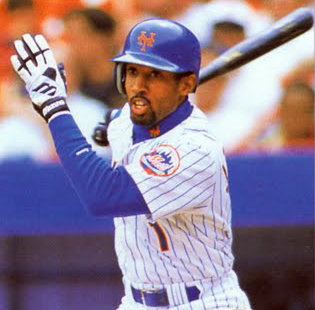
Photo by David G. Whitham
Over a six-game stretch from May 1 to May 7, Johnson batted .500 (14-for-28), scoring five runs and driving in another.  He also collected his seventh triple of the season, after hitting six in the season's first month.  The season was barely a month old and Johnson was already only three triples short of Mookie Wilson's single-season franchise record for three-base hits.  Before the season was half over, that record would be history.

On June 16, Johnson picked up his 11th triple of the season against the St. Louis Cardinals, breaking Mookie Wilson's club record that he set in 1984.  For Johnson, the moment was extra-special because it was the Cardinals who originally drafted him in 1984 before trading him to the White Sox just months after he played for St. Louis in the 1987 World Series.

By the All-Star Break, Johnson was already having an historic season for the Mets.  Through his first 87 games, One-Dog (as he was affectionately referred to by his teammates) was hitting .322 with 16 doubles, 13 triples and five home runs.  He also had 40 RBI out of the leadoff spot, which was an unusually high number for a No. 1 hitter.  What was not unusual for a leadoff hitter was his 65 runs scored and 28 stolen bases.

For his efforts, Johnson was selected to his first All-Star team, joining catcher Todd Hundley to become the first Mets' teammates in five years to represent the club in the Midsummer Classic.  Due to an injury to Padres' outfielder Tony Gwynn, Johnson started the All-Star Game and surprised everyone by playing the entire game, going 3-for-4 with two singles, a double, a run scored and a stolen base in the 6-0 National League victory.

Johnson continued to hit after the All-Star Break.  In his first 32 games after the break, Johnson had 12 multi-hit games and stole 14 bases.  However, the team, who had remained within a few games of the .500 mark for most of the season, was starting to feel the dog days of August, especially the young pitching staff.  Generation K had become Generation K.O., as Jason Isringhausen's ERA was climbing near 5.00 and Paul Wilson's ERA had already gone north of that mark.

By August 18, the Mets had fallen 20 games behind the first-place Braves.  One week later, manager Dallas Green was gone, replaced by Bobby Valentine.  Despite the poor play on the field and the upheaval in the clubhouse, Lance Johnson continued to shine.

Beginning with his 2-for-4 performance on August 14, Johnson hit .399 over the team's final 41 games.  In addition, the centerfielder scored 35 runs and drove in 20 more during the final quarter of the season.  Mostly everyone else wilted in the summer heat (save for Gilkey and Hundley), but Johnson just got better.  Despite not being a big on-base percentage player or a slugger, Johnson had an impressive 1.004 OPS over the last month and a half of the season, reaching base at a .426 clip and producing a .578 slugging percentage (13 doubles, six triples, two home runs in 173 at-bats).  The Mets finished the season with a disappointing 71-91 record, but Johnson's season was anything but disappointing.

For the season, Lance Johnson hit .333.  At the time, it was the second-highest batting average in team history (Cleon Jones hit .340 in 1969).  Johnson also became the second Met to play in 160 games (Felix Millan played 162 games in 1975) and the second to reach the 50-steal plateau (Mookie Wilson stole 58 bases in 1982 and 54 bases in 1983).  But there were a number of offensive categories in which Johnson was second to none.

In 1996, Johnson set the Mets' single-season record for at-bats (682), runs scored (117), hits (227), total bases (327), multi-hit games (75), singles (166) and triples (21).  He also had the rare distinction of having more stolen bases (50) than strikeouts (40).  To this day, Johnson still holds the single-season franchise records for hits, multi-hit games, singles and triples.

Following Johnson's record-setting campaign, the Mets rewarded him with a two-year contract extension worth $10 million, keeping him under the team's control until 1999.  But Johnson was also a year older, and a year closer to breaking down.  The 33-year-old Johnson started the 1997 season where he left off in 1996, hitting .309 with five stolen bases over the Mets' first 13 games.  But shin splints knocked Johnson out of the lineup on May 1 and he missed six weeks of action, returning to the Mets just in time to see Dave Mlicki shut out the Yankees in the first regular season Subway Series game on June 16.

By early August, Johnson was still hitting above .300, but he was hitting mostly singles.  His 17 extra-base hits (ten doubles, six triples, one home run) were a far cry from his 1996 production, when he finished the year with 61 extra-base hits.  Johnson also wasn't running as much, stealing 15 bases in 25 attempts.  His 60% success rate was well below his 77% career rate.  Despite Johnson's regression, the Mets were overachieving and competing in the National League wild card race.  However, the team was leading the league in blown saves and needed to improve their bullpen if they wanted to have a realistic shot at making the playoffs.

On August 8, the Mets made a deal to improve their bullpen, but the cost was steep, as they had to part ways with Lance Johnson.  In a six-player deal with the Chicago Cubs, the Mets sent Johnson, starting pitcher Mark Clark and backup shortstop Manny Alexander to the Windy City for centerfielder Brian McRae, closer Mel Rojas and set-up man Turk Wendell.  Although McRae went on to record a 20-20 season with the Mets in 1998 (21 HR, 20 SB), he never quite replaced Lance Johnson in center.  Meanwhile, Mel Rojas went on to become one of the most hated relievers in Mets' history.  However, Turk Wendell became one of the most successful middle relievers in team history, and was a key player in the Mets' postseason runs in 1999 and 2000.

The injuries that sidelined Johnson during the 1997 season continued to keep him off the field for extended periods of time over the next three years.  As a member of the Cubs in 1998 and 1999, Johnson missed a total of 145 games.  He then played 18 games for the Yankees in 2000 before being released on June 6, just four months before he would have gotten the chance to play against the Mets in the World Series.  Although Johnson was only 36 years old, he would never play in the major leagues again.

Although his career was cut short by injuries, Lance Johnson still had plenty to smile about.


Lance Johnson became an everyday player in 1990 as a member of the Chicago White Sox.  Over the next six seasons, he was one of the best leadoff hitters in the game not named Rickey Henderson, batting .289 and averaging 12 triples and 34 stolen bases per year from 1990 to 1995.  Then he became a Met in 1996 and obliterated his six-year averages.  But injuries and a subsequent trade in 1997 curtailed his career, ending it at a relatively young age.

The Mets did not play well as a team in 1996, finishing 20 games below .500.  But Lance Johnson did all he could to make the season a memorable one for Mets fans.  Mookie Wilson captured the fans' hearts with his speed and smile in the 1980s.  Two decades later, Jose Reyes did the same.  The Mets did not have many players like that in the 1990s, but for one season, they did.

Lance Johnson was Mookie Wilson after the fan-favorite retired and he was Jose Reyes before anyone knew who Reyes was.  But without his one magnificent season in 1996, perhaps no Mets fan would have known who Lance Johnson was.  It's amazin' what one wonderful season can do to a player.


Note: One Season Wonders is a thirteen-part weekly series spotlighting those Mets who had one and only one memorable season in New York.  For previous installments, please click on the players' names below:
 
January 2, 2012: Bernard Gilkey
January 9, 2012: Terry Leach 
January 16, 2012: George Stone
January 23, 2012: Roger Cedeño
January 30, 2012: Frank Viola
February 6, 2012: Joe Christopher 
February 13, 2012: Dave Magadan 
February 20, 2012: Pedro Martinez
February 27, 2012: Bret Saberhagen 
March 5, 2012: Robin Ventura 
March 12, 2012: Willie Montañez

Monday, January 2, 2012

One Season Wonders: Bernard Gilkey

In the music business, many artists have recorded one big hit and then never went on to score another.  When In Rome spent more than a day near the top of the charts in 1988 with "The Promise" but made no promises about creating another hit.  One year earlier, T'Pau gave us a little bit of "Heart and Soul" but never gave us another hit.  Recording a hit song doesn't guarantee success with future recordings. (Isn't that right, Biz Markie?)  Similarly, having a breakout season in the major leagues doesn't mean a player is headed for the Hall of Fame.  In fact, for some Mets, one good season was all they had in them.

For the next thirteen weeks, we'll be focusing the spotlight on some of the biggest one season wonders in Mets history.  These players had some of the greatest seasons in club annals, but don't look for them on the career leaderboard.  All they had was 162 games of fame with the Mets, which I guess is more than the 15 minutes of fame some players had (I'm talking to you, Richard Hidalgo).

So sit back and enjoy the first part of One Season Wonders, as we take a look at a Met who had one of the most complete offensive seasons in franchise history, but never came close to replicating his magical season.  It's time to party like it's 1996 and the host of this party is Bernard Gilkey.

One season wonder Bernard Gilkey sporting the snow white cap that itself was a one season wonder.


Otis Bernard Gilkey was a man of many firsts.  He was the first player in Mets history to go by the name Bernard (or Otis for that matter - Amos Otis doesn't count since that was his last name).  He was also the first Met to be bopped in the head by a fly ball while an alien spaceship flew over Shea Stadium.  (He can thank Will Smith and Tommy Lee Jones for that fielding error.)  Despite all that, it was his first season as a Met that really opened eyes in Flushing.

Prior to the 1996 season, the Mets were desperately seeking a cleanup hitter.  With most available power-hitting free agents already off the table, GM Joe McIlvane traded for the best available player who wouldn't cost him too much talent.  The Cardinals had just signed outfielder Ron Gant to a five-year contract and were looking to cut payroll to have the finances to acquire 41-year-old closer Dennis Eckersley.  Gilkey became the odd man out in St. Louis despite having a solid year for the Cardinals in 1995 (.298, 33 doubles, 17 HR, 69 RBI in 121 games).

On January 22, 1996, the Mets got their man, trading minor league prospects Erik Hiljus, Eric Ludwick and Yudith Orozio to St. Louis for Bernard Gilkey.  Hiljus never pitched for the Cardinals and only logged 124 innings over parts of four seasons in the major leagues.  Ludwick pitched even less over his four-year major league career (74.2 innings), but at least 16.2 of those innings came in a Cardinals uniform.  Orozio never made it to the majors and was out of professional baseball by 1998, at the tender age of 23.  By that time, Gilkey had already given the Mets more than they ever could have expected from him.

The 1996 Mets went into the season with high expectations following a surprising second-place finish in the strike-shortened 1995 campaign.  The outfield of Gilkey in left, the newly-acquired Lance Johnson in center and the Butch Huskey/Carl Everett platoon in right was loaded with raw talent and athleticism.  The only question was how they'd play together as neither of the four had ever played in the same outfield with the others prior to 1996.

Although Joe McIlvane was seeking a cleanup hitter when he traded for Gilkey, manager Dallas Green inserted the new leftfielder into the two-hole on Opening Day 1996.  It didn't take long for Gilkey to hit his way into the middle of the lineup.  Beginning with his Opening Day performance, in which he helped erase a six-run deficit to the Cardinals with a sixth-inning home run and a game-tying RBI single one inning later, Gilkey scorched opposing pitchers.

Over his first 11 games, all as the Mets' No. 2 hitter, Gilkey hit .375.  But Gilkey wasn't just slapping singles around the ballpark in compiling that high average.  In those 11 games, he lashed four doubles and blasted four home runs, giving him an impressive .708 slugging percentage.  He also drove in 13 runs over the first two weeks of the season, while not hitting in a traditional RBI spot in the batting order.  It was clear early on that Gilkey had to be moved down in the batting order, and Dallas Green did just that on April 16, when Gilkey batted third for the first time.  It would be the spot from which he would primarily bat for the rest of the season while assaulting the Mets' single-season record book.

Now firmly entrenched in the No. 3 spot in the Mets' batting order, Gilkey continued to pound out the extra-base hits in May.  During the season's second month, Bernard ripped 13 extra-base hits (seven doubles, six home runs) and collected 24 RBIs.  Gilkey "only" hit .295 in May, but it was the only month during the 1996 season in which he failed to hit .300.

In June, Gilkey went on his most prolonged slump of the season, going hitless in 15 at-bats against his former team when the Mets traveled to St. Louis.  How did Gilkey respond to this mini-slump?  Very well, thank you very much.  Over the next nine games following his oh-fer at Busch Stadium, Gilkey reached base an astonishing 20 times (17 hits, three walks).  He slugged at an .800 clip in those nine games, mostly on the strength of seven more extra-base hits (five doubles, two homers).

Despite an amazing first half of the season in which he hit .302 with 21 doubles, 16 HR, 62 RBI and 10 stolen bases, Gilkey was snubbed for the National League All-Star team.  Any frustration Gilkey might have felt for the obvious oversight was taken out on National League pitching after the break.  And boy, did he ever take out those frustrations.

From July 11 (the first game following the All-Star Break) through August 25, a span of 43 games, Gilkey gave new meaning to the term "raking the ball".  During those six weeks, Bernard hit .356 with 15 doubles, two triples and 12 home runs.  He also scored and drove in almost a run per game, crossing the plate 40 times and driving in 40 as well.

Whereas the 1995 Mets closed out the season on a 34-18 tear, the 1996 squad took the other fork in the road and ended their season poorly, losing 35 of their final 54 games and their manager (Dallas Green was replaced by Bobby Valentine in late August).  Despite the poor finish by the team, Bernard Gilkey just kept on chuggin'.

Beginning with the Mets' final game in August, Gilkey batted .329 and reached base at a .440 clip over his final 22 games.  Of course, the extra-base hits kept on coming as well, as Gilkey hit seven more doubles, one triple and two home runs over the final three weeks of the season.

Bernard Gilkey's 1996 season was one of the most complete seasons by a non-pitcher in Mets history.  For the year, Gilkey hit .317 with 44 doubles, three triples, 30 HR, 117 RBI, 108 runs scored and 17 stolen bases.  In addition, he finished with a .393 on-base percentage, a .562 slugging percentage and was deadly with runners in scoring position, batting .406 (63-for-155) in those situations.  But Gilkey was not just an offensive threat on the field, as evidenced by his National League-leading 18 outfield assists in 1996.

At the time, Gilkey's .317 batting average was the fifth highest single-season mark in Mets history for players who qualified for the batting title.  Only Cleon Jones (.340 in 1969 and .319 in 1971), Dave Magadan (.328 in 1990) and Lance Johnson (.333 in 1996) had ever posted a single-season batting average higher than Gilkey's .317.  Furthermore, Gilkey's .562 slugging percentage in 1996 was the second-highest single-season mark in the franchise's first 35 years, surpassed only by Darryl Strawberry's .583 slugging percentage in 1987.

With his 44 doubles in 1996, Gilkey broke Howard Johnson's franchise record of 41 two-baggers in a season, a record that still stands.  Gilkey also became the second Met to record 40 doubles and 30 homers in the same season, following Johnson's 41 HR/36 double campaign in 1989.  In addition, Gilkey tied Johnson's club record with his 117 RBIs, a record that would eventually be surpassed by Mike Piazza, Robin Ventura and David Wright.  Finally, Gilkey became the third Met to reach triple digits in runs scored and RBIs in the same season, joining Darryl Strawberry (1987, 1988) and Howard Johnson (1989, 1991) as the only Mets to accomplish this feat during the team's first 35 seasons.

Unfortunately, Gilkey's breakthrough season in 1996 did not carry over into the 1997 campaign.  Although the Mets did far better in the standings in '97, finishing 88-74 and competing for the National League wild card berth until the final week of the season, Gilkey's performance left a lot to be desired.  The leftfielder saw his batting average drop to .249 and he didn't hit for as much power (18 HR) or drive in nearly as many runs (78 RBI) as he did during his stellar '96 season.

 Was Gilkey's close encounter with aliens over Shea the reason for his dropoff in 1997?


Given one final chance by Bobby Valentine to regain his 1996 form, Gilkey was moved back into the two-hole after the Mets acquired Mike Piazza from the Florida Marlins in late May 1998.  Despite having excellent protection by having Piazza and John Olerud hitting behind him, Gilkey floundered in the No. 2 spot.  In June and July, Gilkey hit a mere .168 and his power disappeared, as he hit only five doubles and two home runs in 45 games.

The Mets were in contention for the wild card, but having Gilkey in the lineup every day was hurting them more than it was helping them, so a day before the trade deadline, Gilkey was sent to Arizona for pitcher Willie Blair and catcher Jorge Fabregas.  Neither Blair nor Fabregas contributed much to the Mets, and the team fell one game short of ending their decade-long playoff drought, a skein that ended in 1999 when the Mets defeated Gilkey's new team, the Arizona Diamondbacks in the NLDS.  Gilkey literally did nothing against the Mets in the NLDS, going 0-for-6 against his former team in two games.

When the Mets acquired Bernard Gilkey prior to the 1996 season, the team was looking for a veteran player with some pop in his bat who could bat cleanup.  They didn't get a cleanup hitter, but they did get one of the finest offensive seasons ever recorded by a Mets player.  Alas, it was the only great season by Gilkey in a Mets uniform, making him one of the biggest one season wonders in team history.