Monday, January 14, 2013

The Mets That Got Away: Melvin Mora

Some players aren't pegged to be stars by the teams that employ them, even as they're coming up through their minor league system.  Edgardo Alfonzo was never expected to become the player he turned into as a member of the Mets.  He's now considered to be one of the most underrated and beloved Mets of all-time, as evidenced by his selection as the greatest second baseman in the history of the franchise.

It took Alfonzo a few years to become an All-Star caliber player in the major leagues, but at least the Mets gave him a chance to become that player.  The Mets gave the kid from Venezuela his first shot at the big league level four years after they drafted him in 1991.  One of Alfonzo's fellow countrymen waited a bit longer to make his big league debut with the Mets after toiling in the minor leagues for the better part of a decade.  He was never considered to be a top prospect at any minor league level, but gradually moved up the minor league chain until he made his debut with the Mets in 1999.  One year later, he was gone.

Trying to find a short-term solution, general manager Steve Phillips created a long-term problem when he traded away Melvin Mora to the Baltimore Orioles for fill-in shortstop Mike Bordick.  Although the Mets didn't know it at the time, they were letting go of a player whose offensive numbers would rival and eventually surpass those put up by fellow Venezuelan and former teammate Edgardo Alfonzo.  The trade marked the unofficial beginning of the downfall of Phillips as the team's GM, which was followed soon after by the regression of the team in the NL East standings.

Melvin Mora, before he was a Met that got away.

Melvin Mora was originally drafted as a 19-year-old by the Houston Astros in 1991.  Mora made his professional debut with the Gulf Coast League Astros in 1992, hitting .222 with only three extra-base hits in 144 at-bats.  Mora did not have much power as a young minor leaguer, managing only 23 home runs in six seasons with various Astros' farm teams.  He did, however, possess good speed, stealing 83 bases in 126 attempts from 1992 to 1995.  But in 1996, Mora only stole seven bases in 19 attempts between the Double-A and Triple-A level.  One year later, he once again managed only seven stolen bases, but saw his batting average drop from .284 to .257.  He also saw a drop in what little power he had picked up over the years, falling from eight homers in 1996 to two homers in 1997.

After six years in the Astros' organization (and a stint in the Chinese Professional Baseball League), Mora was granted free agency.  Halfway through the 1998 season, Mora contacted Edgardo Alfonzo's brother, Edgar, who was a coach with the Mets' Class A affiliate in St. Lucie.  Not wanting to go back to Taiwan, Mora accepted a job as a utility player and spent the rest of the year in St. Lucie and AAA-Norfolk.  In 28 games, Mora's numbers resembled the ones he put up during his first professional season in 1992, as he batted .241 with only one extra-base hit in 96 plate appearances.  Once again, Mora was granted free agency, but after receiving no offers from other teams, Mora re-signed with the Mets in February 1999.

Eight years after signing his first professional contract with the Astros, Mora was invited to spring training with the Mets, hoping to make the team.  He responded by putting up fantastic Grapefruit League numbers, batting nearly .400 and providing extra-base hit after extra-base hit.  He also showed off the versatility he acquired at St. Lucie by playing six different defensive positions.  Mora didn't make the team out of spring training, as the final roster spot was given to Mike Kinkade.  Upon hearing the news, a clearly disappointed Mora was quoted as saying "I feel like I want to go to a bridge and jump off."

Mora was sent back to Norfolk, where he performed brilliantly.  While Mora was flourishing at Triple-A, Kinkade was languishing in his role as one of the Mets' top utility players.  Through May 20, Kinkade could only manage a .196 batting average.  He also had three times as many strikeouts as walks and was downright dreadful as a sub, batting .125 in 19 games.  Kinkade's failures as a Met led to his demotion to Norfolk and finally gave Mora the long-awaited break he needed to reach the majors for the first time.

On May 30, 1999, Mora played in his first game with the Mets, starting at shortstop against the Arizona Diamondbacks.  However, he was given the unenviable task of facing perennial All-Star Randy Johnson, who was in the middle of a Cy Young Award-winning campaign.  Naturally, Mora went 0-for-3 against Johnson, but was not one of the Big Unit's ten strikeout victims in the Mets' 10-1 loss to the Diamondbacks.  The loss was the third in a row for the Mets, a skein that reached eight consecutive losses before Phillips cleaned house by firing most of the Mets' coaching staff.  The Mets' bench was now full of new coaches for Mora to learn from.  Mora would get plenty of opportunities to get that education as he didn't start another game for the Mets until July 17.

More spent the month of June and the first two weeks of July as a late-inning defensive replacement and pinch-hitter.  Through his first 19 games in the big leagues, Mora had only collected 13 at-bats and was still looking for his first big league hit.  On July 6, more than five weeks after playing in his first game with the Mets, Mora finally collected his first hit as a major leaguer.  With the Mets already blowing out the Montreal Expos, Mora pinch-hit for third baseman Robin Ventura, delivering a single off future Met pitcher Miguel Batista.

Mora would continue to play sparingly for the Mets after July 6.  Through August 1, Mora had played in 38 games for the Mets, but had only started three of them.  The extended stays on the bench caused Mora's bat to suffer, as he was hitting an anemic .083 (2-for-24) through the first of August.  Mora spent the next month of the season at AAA-Norfolk, where he once again began to pound the baseball.  Combined with the numbers he put up at Norfolk prior to his first call-up to the Mets, Mora hit .303 with 17 doubles, eight home runs and 18 stolen bases for the Tides in only 82 games.  He also reached base at a .393 clip and continued to play various positions while getting the regular playing time he was denied at the major league level.

When the rosters expanded on September 1, Mora was once again promoted to the parent squad to serve as a late-inning defensive replacement and pinch-hitter.  Mora only had six official at-bats from September 1 to October 2, collecting two hits during that stretch.  Mora had played in 64 of the team's first 161 games, collecting only four hits and scoring five runs as the forgotten man on the roster.  But when he collected his fifth hit and scored his sixth run, everyone knew who Melvin Mora was.

On October 3, 1999, the Mets went into their 162nd game of the season deadlocked with the Cincinnati Reds in the National League wild card race.  After finding themselves two games off the pace entering their season-ending three-game series with the Pittsburgh Pirates, the Mets took the first two games against the Bucs while the Reds dropped their first two games against the Milwaukee Brewers.  The Mets needed to win the series finale to guarantee themselves of at least one more game.  After a relatively easy 7-0 win over the Pirates in the middle game of the series, the Mets found themselves in a taut, tension-filled game in Game No. 162.  Future Met Kris Benson and former Met killer Orel Hershiser were locked up in a pitcher's duel at Shea Stadium, with each pitcher allowing one run.  The game remained tied as the Mets came up with a chance to win it in the bottom of the ninth.

Bobby Bonilla, who had been booed for much of his two stints with the Mets, was greeted with cheers when he was announced as a pinch-hitter for Shane Halter leading off the ninth.  Four pitches later, those rare cheers morphed back into the more customary boos, as Bonilla grounded out to first.

That brought up Melvin Mora, who had entered the game in the seventh inning as a pinch-runner for all-time stolen base king Rickey Henderson.  On a 1-0 pitch, Mora lined an opposite field single to right field off reliever Greg Hansell.  Mora then advanced to third base on a single to right by Edgardo Alfonzo.  After intentionally walking John Olerud to set up a force out at any base, Hansell was relieved by former Met Brad Clontz.  With Mike Piazza now standing at the plate and Mora standing 90 feet away from extending the Mets season, Clontz uncorked a wild pitch that bounced up into the netting behind home plate, allowing Mora to scamper home with the winning run and whipping the Shea Stadium crowd (myself included) into a joyous frenzy.

After defeating Cincinnati in a one-game playoff the following day (Cincinnati had defeated Milwaukee in their 162nd game to force Game No. 163), the Mets advanced to the postseason for the first time in 11 years.  Despite only having a .161 average in 31 big league at-bats, Mora had proven himself to be a valuable commodity to the Mets.  Six months after being the final man cut by the team after spring training, Mora did not find himself on the outside looking in when the postseason rosters were set.  He was joining his teammates in Arizona for their National League Division Series matchup against the Diamondbacks.

Just as he had done in his major league debut in May, Mora's first postseason at-bat came against Randy Johnson.  Mora had been inserted into the lineup via a double switch in the sixth inning by manager Bobby Valentine and came up to the plate to face Johnson in a tie game in the seventh.  Mora did not contribute to a potential go-ahead rally in that at-bat, grounding out to third.  But he was a major contributor to a go-ahead rally the next time he faced Johnson.

The game was still tied at 4 when the Mets came up to bat against Johnson in the top of the ninth.  Robin Ventura led off the inning with only the tenth hit by a left-handed batter off Johnson all year.  Roger Cedeño tried to sacrifice Ventura to second but popped out to Johnson for the first out.  Light-hitting shortstop Rey Ordoñez then pulled a single to left, advancing Ventura to second base.

Up stepped Melvin Mora, who had never struck out against Johnson in four previous at-bats, but had also never reached base against him.  A double play could have gotten Johnson out of the inning.  Instead, Mora drew a walk off the tiring southpaw, loading the bases and sending Johnson to the showers and Bobby Chouinard into the game to face Rickey Henderson.  After Henderson hit into a force play, with Ventura being thrown out at home, Edgardo Alfonzo launched a grand slam down the left field line, scoring Ordoñez, Mora and Henderson to give the Mets an 8-4 lead, a lead they would hold on to for a Game 1 victory.

Mora would not collect an official at-bat for the rest of the series, coming into Games 3 and 4 as a late-inning defensive replacement, but his walk off Randy Johnson in Game 1 helped set up what might have been the turning point of the series.  By winning Game 1, as well as taking Games 3 and 4 at Shea Stadium, the Mets did not have to face Randy Johnson in the series again.  Once Todd Pratt blasted a series-ending home run off closer Matt Mantei, the Mets advanced to face the division rival Atlanta Braves in the National League Championship Series.  The Mets fell short in their quest to reach the World Series, but Melvin Mora did everything he could to get them as close as possible to the pennant.

Edgardo Alfonzo's grand slam might not have been possible without Melvin Mora's key walk against Randy Johnson.

After playing in three of the four division series games, but collecting only one official at-bat, Mora was given an increased role in the NLCS against the Braves.  But he needed the removal of Rickey Henderson in Game 2 to prove that he could be productive in a role other than designated double switch player.

After Henderson ran gingerly to first base on a groundout in the second inning, he was replaced in the lineup by Mora, who promptly blasted a home run - his first in the majors - in his first at-bat following Henderson's removal.  Mora's homer extended the Mets' lead to 2-0, a lead they held until Kenny Rogers allowed a game-tying two-run homer to Brian Jordan and a go-ahead two-run homer to Eddie Perez in the bottom of the sixth.  Mora did his best to start a rally for the Mets in the eighth inning, reaching base on an error and scoring all the way from first on a double by Edgardo Alfonzo.  Mora's 270-foot-dash cut Atlanta's lead to a single run, but the Mets failed to produce the tying run after Alfonzo's two-bagger and went down in order in the ninth.  The Mets lost the game, 4-3, to fall behind the Braves in the NLCS, two games to none.

Mora got his first postseason start in Game 3 at Shea Stadium and got into the action quickly, although this time it wasn't with his bat.  In the top of the first, the Braves pushed across an unearned run against Mets starter Al Leiter.  After a leadoff walk to Gerald Williams, Leiter allowed Bret Boone to reach on an error.  A second error, this time on a throw by catcher Mike Piazza on an attempted double steal, allowed Williams to score and Boone to move to third base.  But with the Braves threatening to score more, Melvin Mora caught a fly ball by Brian Jordan and threw Boone out at the plate, keeping the score 1-0.

At the plate, Mora also contributed, collecting hits in each of his first two at-bats against Braves starter Tom Glavine.  But Mora's first career multi-hit game was not enough, as Glavine devastated the Mets with seven shutout innings.  The bullpen did the rest, as the lone run scored by the Braves in the first held up.  Atlanta won the game, 1-0, to put the Mets one game away from elimination.  But Mora would not let the Mets go down without a fight.

Rick Reed started Game 4 for the Mets and was absolutely brilliant through seven innings, facing the minimum 21 batters through seven innings.  The only baserunner he allowed - Bret Boone, who singled in the fourth inning - was erased on a failed stolen base attempt.  The Mets had taken a 1-0 lead on a solo homer by John Olerud and were six outs away from ending the Braves' chances of a sweep.  But before you could say Chief Noc-A-Homa, Brian Jordan and Ryan Klesko blasted back-to-back home runs off Reed, quickly turning one of the greatest pitching performances by a Met into a 2-1 deficit.  Melvin Mora got a good view of both home runs, as he had just been inserted into the game as a defensive replacement for Rickey Henderson.  The Braves didn't score again in the inning, but were now in position to close out the series.  All they needed were six outs.

Roger Cedeño led off the bottom of the eighth with a single, but was still standing on first after Rey Ordoñez popped up a bunt attempt and Benny Agbayani struck out.  Up stepped Melvin Mora, who needed to get on base to continue the rally.  After a stolen base by Cedeño, Mora worked out a walk to bring up John Olerud.  Braves manager Bobby Cox replaced reliever Mike Remlinger with Public Enemy No. 1, John Rocker, who watched helplessly as Cedeño and Mora pulled off a daring double steal.  Olerud followed the timely steals with a two-run single, plating Cedeño and Mora to give the Mets a 3-2 lead.

Roger Cedeño and Melvin Mora celebrate at the plate, allowing John Rocker to ponder what time the next 7 train arrives.

The Mets held on to the lead in the ninth and avoided the sweep, needing to win one more game to send the series back to Atlanta.  They would get that win in Game 5, and once again, Melvin Mora was an unlikely contributor.

Game 5 of the 1999 National League Championship Series was an all-time classic.  Both teams scored early, with Olerud providing a two-run homer off Greg Maddux to give the Mets a first inning lead, only to have Masato Yoshii give it back in the fourth on an RBI double by Chipper Jones and a run-scoring single by Brian Jordan.  The game was still tied, 2-2, when the Braves came up to bat in the top of the thirteenth inning.

After using eight pitchers through the first twelve innings, the Mets were down to their final relief pitcher to start the 13th.  Rookie Octavio Dotel was the only non-starter left for the Mets and was sent to the mound to face the Braves.  Dotel had made only one appearance for the Mets in the postseason and fared miserably in Game 2 of the NLDS, allowing a double, two walks and a hit batsman in one-third of an inning against Arizona.  Now he was being called upon to save the Mets season after not having pitched in 11 days.  He might not have been able to do so without the help of Melvin Mora.

Dotel retired the first two batters he faced in the 13th inning, striking out pinch-hitter Jorge Fabregas and retiring Gerald Williams on a grounder to short.  If he could retire Keith Lockhart, he would avoid facing eventual league MVP Chipper Jones with the go-ahead run on base.  But Dotel couldn't retire the side in order, allowing Lockhart to reach him for a single.  Up stepped the man who was constantly reminded of his given first name by Mets fans at Shea Stadium.  But this time, the name on everyone's mind would be Melvin Mora.  Jones laced a double down the right field line, which was picked up by a hustling Mora near the right field corner.  Mora threw the ball to cut-off man Edgardo Alfonzo, who fired a quick throw to catcher Mike Piazza, nailing Lockhart at the plate by about 20 feet.  Mora's defensive effort took Dotel off the hook and sent the game on into the rain-soaked night.


The Mets did not score in their half of the 13th and neither team scored in the 14th inning.  Dotel was still on the hill in the 15th, facing the light-hitting part of the Braves' lineup.  But Walt Weiss led off the inning with a single and then surprised everyone by stealing second.  (Weiss stole only seven bases during the regular season and was never a big base-stealer during his 14-year major league career.)  Weiss was still on second base when Dotel retired Gerald Williams on a fly ball to left.  But Keith Lockhart, who was denied the opportunity to score the go-ahead run two innings earlier, delivered an RBI triple, scoring Weiss to give the Braves a 4-3 lead.

In the bottom of the 15th, the Mets refused to give in to exhaustion.  They rallied against Kevin McGlinchy, tying the game on a single and stolen base by Shawon Dunston, a walk to Matt Franco, a sacrifice by Edgardo Alfonzo, an intentional walk to John Olerud and an unintentional walk to Todd Pratt.  With Melvin Mora waiting on deck and pinch-runner Roger Cedeño standing 90 feet away from a hard-fought Mets victory, Robin Ventura delivered the now-famous Grand Slam Single, giving the Mets their second consecutive victory in their final turn at bat.

Although Mora went 1-for-6 in the 15-inning thriller, his defensive play in the 13th inning kept the season alive for the Mets and allowed Ventura to come through with his titanic blast two innings later.  The series moved on to Atlanta for Game 6.  Mora did not start the game, but provided a spark off the bench, and it almost led to another thrilling Mets victory.

The Mets fell behind early to the Braves as Al Leiter allowed five runs in the first inning without retiring a single batter.  Despite the quick punch to the gut, the Mets did not stop fighting.  First, they cut the Braves' lead to 5-3.  Then, after the Braves added two insurance runs in the sixth, the Mets tied the game at 7-7 in the seventh, using a home run by Mike Piazza to knot the score.  One inning later, Benny Agbayani led off with a single off reliever Mike Remlinger.  After Agbayani advanced to second on a sacrfice bunt by Rey Ordoñez, Melvin Mora was called upon to pinch-hit for pitcher Orel Hershiser.  Just three games earlier, Mora drew a crucial walk off Remlinger in the eighth inning to set up the go-ahead run.  This time, Mora took it upon himself to supply the go-ahead run in the eighth off Remlinger, delivering an RBI single to give the Mets an 8-7 lead.  Unfortunately, that lead was short-lived, as John Franco allowed the Braves to tie the game in the bottom of the eighth.  The game went on to extra innings, where once again Mora was in the middle of a run-scoring rally.

With John Rocker entering his second inning of work after a 1-2-3 ninth, the Mets pounced on the reliever.  Benny Agbayani drew a leadoff walk to get things started in the tenth.  Two batters later, Rocker attempted to pick off Agbayani and would have been successful had it not been for a miscue by first baseman Brian Hunter.  (Ironically, it was Hunter who had tied the game two innings earlier with an RBI single off John Franco.)  With the Mets getting unexpected help on Hunter's error, Mora came up and delivered a single that moved Agbayani to third.  Agbayani came around to score on Todd Pratt's sacrifice fly to give the Mets a 9-8 lead.  Mora then stole third, but was stranded there when Edgardo Alfonzo went down on a rare strikeout.  Mora's insurance run would have been the difference had he scored, especially after the Braves tied the game on an RBI single by Ozzie Guillen in the bottom of the tenth.  Unfortunately, Mora never got a chance to play postseason hero again, as the Mets walked off a loser when Kenny Rogers threw ball four to Andruw Jones in the 11th.

Although the Mets lost the NLCS to the Braves in six games, Melvin Mora did everything he could to extend the series.  After collecting just five hits in 66 regular season games, Mora picked up six hits in the NLCS, batting .429 with a home run, two runs batted in, three runs scored and two stolen bases.  He reached base in half of his 16 plate appearances and also began two plays in the outfield that resulted in runners being thrown out at the plate.  Despite the sad ending to the 1999 campaign, the future looked bright for Mora and the Mets.  But little did Mora know how short that Mets future would be.

Melvin Mora glided his way into Mets fans hearts in 1999, but he was skating on thin ice in the summer of 2000.

For the first time since signing his first professional contract in 1991, Melvin Mora began a season on a major league roster, accompanying the Mets on their season-opening trip to Tokyo to face the Chicago Cubs.  Mora still didn't have a regular defensive position, but was getting more at-bats than he did in 1999.  Mora played in 31 of the team's first 37 games, starting ten of them.  But he was only batting .245 with four extra-base hits in those 31 games, although one of those extra-base hits was a walk-off home run off Milwaukee's Curt Leskanic on April 20 - the first regular season home run of Mora's career.  After a 1-for-3 performance against the Marlins on May 12, Mora was sent back to AAA-Norfolk to get some regular at-bats.  Less than three weeks later, he would be getting regular at-bats at the major league level, but at the expense of a key member of the team.

On May 29, three-time Gold Glove winner Rey Ordoñez fractured his left forearm while attempting to tag the Dodgers' F.P. Santangelo.  Ordoñez would be lost for the season.  The Mets immediately recalled Mora from Norfolk and inserted him into the lineup the next day.  Mora reached base four times against the Dodgers on May 30, scoring three times and driving in a run.  Over the next month, Mora was unstoppable at the plate, batting .338 with seven doubles, three homers, 12 RBIs, 20 runs scored and five stolen bases.

By late June, Mora had taken over the everyday job at shortstop, even though general manager Steve Phillips was still looking for a veteran with better defensive skills to play the position.  Phillips was considering Rich Aurilia and Mike Bordick in a potential trade, as well as perennial All-Star and former NL MVP Barry Larkin.  But with Mora hitting and the Mets winning, it appeared as if Mora would be able to keep the job in Ordoñez's absence.  But everything changed once the Mets stopped winning.

After defeating the Braves on July 1, the Mets were tied with the Braves in the loss column.  But the Mets then lost 12 of their next 19 games, and after dropping two out of three in Atlanta from July 21-23, found themselves six games out of first.  Part of the problem was Melvin Mora, who hit .194 over the 19-game stretch and reached base at a .243 clip.  Mora would go on to play two more games with the Mets before Phillips had seen enough.  The slump in the win column, as well as Mora's slump at the plate, caused Phillips to pull the trigger on a deal with the Orioles, sending Mora to Baltimore for All-Star shortstop Mike Bordick.  (The Mets also sent Pat Gorman, Leslie Brea and Mike Kinkade to Baltimore in the deal - the same Mike Kinkade who almost caused Mora to jump off a bridge in 1999 after he made the team out of spring training and Mora didn't.)

Things were looking up for the Mets after the Mike Bordick trade.  No, wait.  That was just Mike Bordick looking up.  My bad.

At the time of the trade, Bordick was three weeks removed from playing in his first All-Star Game.  He had also already established a career high with 16 HR and was on his way to a career high in RBIs.   Mora, on the other hand, was hitting .260 with six HR and 30 RBI in 215 at-bats with the Mets.  On paper, it appeared to be a good deal.  After one at-bat, it looked even better, as Bordick hit a home run to endear himself to the fans for all of one game.  Bordick went 2-for-3 in his Mets debut and continued to do fairly well over the next three weeks, batting .311 with four homers.  But over his final 37 games, Bordick turned into Rey Ordoñez but without the flashy defense.  From August 18 till season's end, Bordick hit .229 with no homers and 12 RBIs.  The Mets would have loved to receive that production in the playoffs.

Bordick hit .167 (2-for-12) in the four-game NLDS against the Giants, then hit .077 (1-for-13) in the NLCS against the Cardinals, a series in which five of the other seven regulars hit over .300.  Bordick continued his cold hitting in the World Series against the Yankees, batting .125 (2-for-16) over the first four games before being benched so that Kurt Abbott could start at shortstop in Game 5.  In 14 postseason games, Bordick combined to hit .121 (4-for-33) with no extra-base hits and eight strikeouts.  For his efforts, or lack of them, Bordick was not offered a contract to play for the Mets in 2001, instead choosing to return to Baltimore as a free agent.

As fate would have it, Bordick would only play 58 games for the Orioles in 2001, suffering a season-ending injury against the Mets on June 13.  He played one more year in Baltimore in 2002, before finishing his career as a member of the Blue Jays in 2003.  While Bordick's career was coming to a close, Mora's career was just taking off.

Mora's first full season in Baltimore had plenty of ups and downs.  Mora finished the season with a .250 average, 28 doubles, 7 HR, 48 RBI, 11 SB and 5 NB (newborn babies), as his wife, Gisel, gave birth to quintuplets on July 28, 2001.  He celebrated in 2002 by starting more games than he ever had in the past (145), albeit at five different positions.  Mora started 63 games in left field, 36 games at shortstop, 31 games in center field, nine games at second base and three games in right field.  He also started three games as Baltimore's designated hitter.  Mora only hit .233 in 2002, but set career highs in hits (130), doubles (30), home runs (19), RBI (64), runs scored (86) and stolen bases (16).

Although Mora was limited to 96 games in 2003, he showed great improvement at the plate and was rewarded for his efforts by being selected to his first All-Star team.  In his third full season as an Oriole, Mora hit .317 and reached base at a .418 clip, a figure that would have ranked third in the AL had he compiled enough at-bats.  Compiling the necessary number of at-bats was not a problem for Mora in 2004.

Photo by Brad Mangin
In 2004, Mora took his game to a level no one could ever have expected.  Mora finally had a position he could call his own, taking over as the Orioles' full-time third baseman after Tony Batista - an All-Star at the position for Baltimore in 2002 - left the Orioles to sign a free agent contract with the Montreal Expos.  In 140 games as the team's new third baseman, Mora batted .340, finishing second to Ichiro Suzuki in the batting race (Ichiro set a major league record with 262 base hits in 2004).  Mora did lead the league with his .419 on-base percentage and finished among the league leaders in hits (187), doubles (41), home runs (27), runs scored (111), RBI (104) and slugging percentage (.562).  Mora's spectacular season earned him his first Silver Slugger Award and MVP consideration.

To put Mora's 2004 campaign into perspective, consider this.  The Orioles franchise has been around since 1901, when they were playing as the Milwaukee Brewers.  After one season in Milwaukee, they moved to St. Louis to become the Browns, where they played for 52 seasons.  Since 1954, they have called Baltimore home.  In over a century of existence, no player had ever had a season for the Orioles in which he hit at least .320, with 40 doubles, 25 HR, 100 RBI and 100 runs scored.  Not Frank Robinson.  Not Eddie Murray.  Not even Cal Ripken.  The only player to accomplish all of those numbers in the same season is Melvin Mora, the same man Steve Phillips traded away because he wanted to rent Mike Bordick for half a season.  You're welcome, Baltimore.

Mora followed up his record-breaking season with another fine year in 2005, batting .283 with 30 doubles, 27 HR and 88 RBI.  Although the numbers were a slight dropoff from his 2004 form, he still managed to secure his second All-Star selection in 2005, after being snubbed for the team during his historic 2004 campaign.  Mora had two similar seasons in 2006 (.274, 25 doubles, 16 HR, 83 RBI, 96 runs scored, 11 SB) and 2007 (.274, 23 doubles, 14 HR, 58 RBI, 67 runs, 9 SB) before rebounding to give the Orioles one more great season in 2008 (.285, 29 doubles, 23 HR, 104 RBI, 77 runs scored) despite missing 27 games.

For the first time in nearly a decade with the Orioles, Mora had a subpar season in 2009, batting .260 with only eight home runs and 48 RBI in 125 games.  Mora was granted free agency following the 2009 season, finishing out his career in 2010 with the Colorado Rockies and 2011 with the Arizona Diamondbacks.  But before saying his final goodbyes to the big leagues, he gave the Mets one final reminder of what might have been on August 11, 2010, hitting a grand slam off Manny Acosta at Citi Field to turn a one-run Mets lead into a three-run deficit in the eighth inning.

"Oh, snap!  Did I just give up a grand slam to Melvin Mora?"

Although no one would ever confuse Melvin Mora with the great hitters in Orioles history, Mora compares favorably with those greats on the team's all-time leaderboard.  Since the team moved to Baltimore in 1954, Mora ranks in the team's top ten in games played (1,256; 10th in Orioles history), runs scored (709; 9th), hits (1,323; 10th), doubles (252; 8th), home runs (158; 9th), RBIs (662; 8th), walks (465; 10th) and total bases (2,073; 8th).  Had Mora compiled those numbers as a Met, he'd be fourth in games played, third in runs scored, third in hits, second in doubles, fifth in home runs, third in RBIs, seventh in walks and second in total bases.  In other words, he'd be one of the best Mets hitters of all-time.

In 1971, the Mets needed help in the infield and traded a player that was incomplete in their minds, along with three other players, for an All-Star shortstop.  That incomplete player was Nolan Ryan and the All-Star shortstop was Jim Fregosi.  Ryan went on to become a Hall of Famer and Fregosi went on to become the answer to a trivia question that Mets fans would rather not answer.  Almost three decades later, the Mets once again needed help in the infield and traded away a player that had not performed well, along with three other players, for an All-Star shortstop.  This time, it was Melvin Mora who became an All-Star on his new team, while the player the Mets got in return (Mike Bordick) did almost nothing before going back to his old team the following season.

Melvin Mora has no business being mentioned in the same sentence as Nolan Ryan.  But like Ryan three decades before him, Mora is one of those Mets who never should have gotten away, but did.  The Mets thought they were helping their team by trading away these raw, but talented players.  They were wrong both times.  And the record books for several other teams serve as a constant reminder of what the Mets could have had.


Note:  The Mets That Got Away is a thirteen-part weekly series that spotlights those Mets players who established themselves as major leaguers in New York, only to become stars after leaving town.  For previous installments, please click on the players' names below:

January 7, 2013: Nolan Ryan

Sunday, January 13, 2013

#BlameNoOne

In 2006, Carlos Beltran came up to bat in the ninth inning of the National League Championship Series.  After hitting a franchise record-tying 41 HR during the season, all he needed was to hit a ball in the gap to score the three runners on base and give the Mets the National League pennant.  He was facing rookie pitcher Adam Wainwright.  The crowd was on its feet, screaming, praying, rally capping - doing whatever they needed to do to help Beltran and the Mets.  Wainwright threw two strikes to Beltran.  The crowd got louder.  Then came a Lord Charles straight out of the Dwight Gooden playbook.  Beltran got a good look at it.  So did the home plate umpire.  Strike three.

For the rest of his Mets career, Beltran was unfairly blamed for anything that went wrong with the team, even if it was kinda sorta tongue-in-cheek.


Second and third, less than two out, rally-killing pop-up?  #BlameBeltran
Relief pitcher giving up another walk-off homer?  #BlameBeltran
Finish the toilet paper and don't have an insurance roll at your disposal?  #BlameBeltran


It was very easy to pin the Mets troubles on Beltran.  After all, prior to this year's re-signing of David Wright, no everyday player had ever earned as much money than Carlos Beltran did as a Met.  Plus, everything was going right for the Mets prior to Strike Three.  Nothing has gone right for the team since then.  Although Beltran was a great player during his time with the Mets, he came up short once in a big spot.  But that "once" unfairly became his legacy.

That brings me to the Seattle Seahawks.

Mets jersey?  Check.  Mets cap?  Check.  Seahawks shirt and carpet logo?  Check, check.

As many of you may know, I have been a Seahawks fan almost as long as I've been a Mets fan.  I've been a fan long enough to have watched their previous road playoff victory (December 31, 1983) prior to last week's win at Washington.

The Seahawks lost today to the Atlanta Falcons in heartbreaking fashion.  Down by 20 points entering the fourth quarter, the Seahawks scored three unanswered touchdowns in the final 15 minutes, taking the lead on a 2-yard touchdown run by Marshawn Lynch with 31 seconds remaining.  Unfortunately, that lead did not stand, as the Falcons completed two passes to set up the game-winning 49-yard field goal.

In the second quarter, the Seahawks were at the Falcons' 11-yard line and went for it on 4th-and-1 when they could have attempted a short field goal.  They were stopped short.  At the end of the first half, the Seahawks were once again in field goal range when Russell Wilson was sacked.  Without a time out at their disposal to stop the clock, they did not get their next snap off in time.  No field goal attempt.  No touchdown pass.  No points.

But wait, there's more.

After Lynch scored his go-ahead touchdown and the Falcons drove down the field, Pete Carroll called a time out to "ice" Atlanta's field goal kicker.  Matt Bryant ended up missing the field goal wide right.  But because the play was blown dead because of the time out, Bryant got another chance to be the hero.  This time, he kicked it right down the middle to give the Falcons a 30-28 lead.  Seattle tried one final Hail Mary, but their prayers were left unanswered.

I could place the blame on the play-calling during the two deep second quarter drives into Falcons territory that resulted in no points.  I could blame the rule that allows an opposing team to call a time out a split second before a last-second kick is attempted (a rule I've always disliked).  I could blame Pete Carroll for taking advantage of that rule.

But I'm not.  Instead, I #BlameNoOne.

The Mets were supposed to be the dominant team in 2006.  They steamrolled their way to the NL East title.  They won 97 games when no one else in the National League won more than 88.  They had a lineup that could overcome any deficit the so-so starting rotation gave them.  They had a pretty good closer in Billy Wagner.  But they lost.  And we were left to blame Beltran.

But this year's Seahawks weren't supposed to be much of a factor.  They were coming off four consecutive losing seasons (even if one did produce an unlikely division title) and were trusting their offense to a rookie quarterback - one that was overlooked by every team in the NFL before being drafted by the Seahawks in the third round.

The San Francisco 49ers were the class of the division.  The Green Bay Packers were the perennial favorite to come out of the NFC.  The Seattle Seahawks?  They had pretty-looking new uniforms.  And not much else.

But after a 4-4 start, Russell Wilson played with the poise of a veteran and the heart of a champion.  The rest of the team, especially their frighteningly good Legion of Boom secondary, would not let the team lose.  Seattle finished the season with an 11-5 record, the third-best record in team history.

The Seahawks, much maligned for their inability to win games on the road, won three consecutive road games against the Bears, Bills and Redskins.  Two of those three teams went 10-6 in the regular season (Chicago, Washington).  One of those games came in the playoffs (Washington).  And they came within a last-minute drive and a last-second Hail Mary of winning their fourth straight road game to send them to the NFC Championship Game.

Many things could have been done differently in this game.  Just one of those things could have given Seattle the victory.  But there is no one to blame for this loss.  Not even Carlos Beltran.

The future is bright in Seattle.  And before long, it will be opposing teams that will be finding people to blame after every loss to the Seahawks.  It's a good time to be a 12.


Wednesday, January 9, 2013

Broken News: And Then There Were None (The Hall of Fame Edition)

Welcome to the latest edition of Broken News, where someone else breaks a news story, then we break it some more.  In today's special edition, we're going to look at the Hall of Fame vote, which surprisingly enough yielded no new Hall of Famers.

Seven ex-Mets were on the Hall of Fame ballot.  Roberto Hernandez (no votes), Mike Stanton (no votes), Jeff Conine (no votes), Aaron Sele (one vote - not a typo), Shawn Green (two votes) and Omar Minaya's bosom buddy, Julio Franco (six votes) did not generate enough support to remain on the ballot in 2014.  The seventh former Met who received votes should have received a lot more support than he did, as Mike Piazza was named on 329 ballots (57.8% of the 569 ballots cast), which was 98 votes short of the 427 needed for election into the Hall of Fame.  Clearly, those 240 members of the Baseball Writers Association of America (BBWAA) who chose not to scribble Piazza's name on their ballot either:

a) remembered Piazza's back acne story and proceeded to have wicked flashbacks to when they were pimply kids who were beat up regularly by the jocks in high school.
2) were afraid his Hall of Fame plaque would have him wearing a Marlins cap and wanted to spare the baseball-loving world of that potential atrocity, or
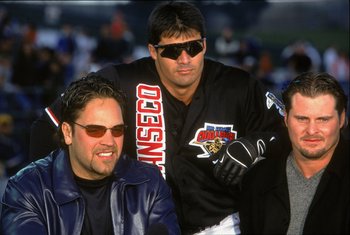
iii) saw the following picture of Piazza & Pals and naturally assumed that steroids can be passed from person to person through the air like the flu.

Oh, Mike.  Why did you allow yourself to be photographed with Jose Canseco and Jason Giambi?

Whatever their reason was to not include Piazza on their ballots, he has officially (and more than likely undeservedly) been lumped into the group of players that include Barry Bonds, Roger Clemens, Mark McGwire, Sammy Sosa and Rafael Palmeiro.

Bonds and Clemens faced criminal charges because of their alleged links to steroid use.  McGwire didn't want to hop into his andro-fueled DeLorean to revisit the past.  Sammy Sosa left his English For Dummies book at home next to his cork collection.  And Rafael Palmeiro was caught with his finger in the steroid jar ... period.

Now Piazza, who is widely considered to be the best-hitting catcher of all-time, has been kept out of the Hall of Fame in his first year of eligibility.

Another former Mets catcher, Gary Carter, received 42.3% of the Hall of Fame votes in his first year of eligibility, dropped to 33.8% in his second year (being on the ballot with first-timers Nolan Ryan, George Brett and Robin Yount will tend to get you overlooked), then climbed steadily year after year before he was finally inducted in his sixth year of eligibility in 2003.

Carter was an 11-time All-Star, three-time Gold Glove winner and five-time Silver Slugger recipient.  He also hit only .262 over his 19-year career, failed to score 100 runs in any of those seasons and never hit more than 32 home runs or drove in more than 106 runs.  Piazza, meanwhile, was a 12-time All-Star and 10-time Silver Slugger recipient (no Gold Gloves - nobody's perfect).  Piazza hit .308 over his 16-year career, crossed the plate 100+ runs twice and reached or surpassed Carter's career-high in homers nine times while steamrolling past the Kid's career-high RBI total five times (and had another season in which he drove in 105 runs).

Gary Carter's numbers might have been dwarfed by Piazza, but Carter did have Piazza beat in one shiny category.

Suffice it to say, as good as Carter was, he would've been Piazza's backup had they been teammates.  But that wasn't good enough for Piazza to be inducted into the Hall of Fame in 2013.  And it may not be good enough for him to go in next year as well.

Whatever reason the writers had for keeping the best-hitting catcher of all-time out of Cooperstown this year won't be acceptable to me.  Mike Piazza deserved to enter the hallowed Hall that is reserved for the all-time greats of the sport in his first year of eligibility.

The BBWAA might have been afraid a few blemishes on Piazza's back.  But in my opinion, keeping him out of the Hall of Fame in 2013 was a far greater blemish.     


Tuesday, January 8, 2013

If Studious Metsimus Had A 2013 Hall of Fame Vote...

On Wednesday, the National Baseball Hall of Fame will release the names of its newest inductees.  It will most certainly be the most scrutinized class of all time, considering all the new nominees that have been linked to steroids.  Players like Barry Bonds, Roger Clemens and Sammy Sosa have all had their names liked with performance-enhancing drugs.  Although their numbers scream out for inclusion in Cooperstown, how they achieved those numbers is up for discussion.

In addition to Bonds, Clemens and Sosa, other first-time nominees include former Mets Mike Piazza, Julio Franco and Shawn Green.  Also nominated for the first time are Curt Schilling, Kenny Lofton, Craig Biggio, David Wells, Steve Finley, Reggie Sanders, Jeff Cirillo, Woody Williams, Rondell White and Ryan Klesko.

Players who received at least five percent of the vote in previous years are allowed to reappear on this year's ballot.  Those players include Jack Morris, Jeff Bagwell, Lee Smith, Tim Raines, Alan Trammell, Edgar Martinez, Fred McGriff, Larry Walker, Mark McGwire, Don Mattingly, Dale Murphy, Rafael Palmeiro and Bernie Williams.  For Dale Murphy, it will be his 15th and final time on the ballot.  Should he not be elected to the Hall of Fame, he would be removed from next year's ballot.

This is the third consecutive year that Studious Metsimus was not allowed to formally cast a vote for players we deemed worthy of Hall of Fame enshrinement, but we ain't mad at'cha.  In fact, if it pleases the BBWAA, we'd like to send them a gift to let them know that there are no hard feelings because of our omission from their swanky club.  Please let us know when you receive the 1979 Mets highlight video (on Beta, of course), which is autographed by the one and only Richie Hebner.

Now, on to our votes!


Mike Piazza

Well, duh.  Who didn't see this pick coming?  There's no doubt Piazza belongs in the Hall of Fame as the best hitting catcher of all time.  But those who have a predisposed aversion to back acne would beg to differ.

Piazza spent the majority of his career with the Los Angeles Dodgers and New York Mets.  He also had a one-week tour of duty with the Florida Marlins and rode off into the sunset after one-year stints with the San Diego Padres and Oakland Athletics.  In 16 seasons in the major leagues, Piazza was a 12-time All-Star and 10-time recipient of the Silver Slugger Award.  Since the inception of the award in 1980, no other catcher has won it more than seven times and only Barry Bonds won more (12) at any position.  In addition, no catcher hit more home runs than Piazza (396 HR as a catcher, 427 HR overall) and no backstop has a higher career slugging percentage than Piazza (.545).

But power wasn't all Piazza was known for at the plate.  He was also an outstanding contact hitter.  In an era where striking out 150 times in a season is commonplace, Piazza never struck out more than 100 times in a season.  In fact, Piazza had almost twice as many hits (2,127) as strikeouts (1,113) in almost 7,000 career at-bats.

Piazza led his teams to the postseason five times.  He reached the playoffs as a Dodger in 1995 and 1996, as a Met in 1999 and 2000, and as a Padre in 2006.  In 2000, when Piazza reached his only World Series, he had an outstanding post-season, hitting .302 with six doubles, four homers and eight RBI in 14 games for the Mets.  Piazza also walked nine times in the 14 games to register a .403 on-base percentage.  His ten extra-base hits gave him a spectacular .642 slugging percentage.

Mike Piazza will reach the Hall of Fame.  His numbers say he should be a first ballot Hall of Famer.  The writers might say otherwise.


Craig Biggio

In the past, 3,000 hits was a surefire way to make it to the Hall of Fame.  Of course, in this questionable era of inflated offensive statistics, that may no longer be the case.  But Craig Biggio should not be bunched in with the Bondses and Palmeiros of this era.  Biggio belongs in the Hall of Fame.

Craig Biggio scored 1,844 runs in his 20-year career.  That's good for 12th in MLB history.  He reached the 100-run plateau eight times in his career and led the league twice.  He also collected 668 doubles, a number surpassed by only four players (Tris Speaker, Pete Rose, Stan Musial, Ty Cobb).  Of the top 13 players on the all-time doubles chart, 11 are already in the Hall of Fame.  The other two are Pete Rose (who is not eligible for enshrinement) and Craig Biggio.  Biggio led the NL in doubles three times and had seven 40-double seasons.

Biggio began his career as a catcher before moving to second base and center field.  He won five Silver Slugger Awards, earning his first as a catcher in 1989.  His other four came as a second baseman for the Astros in 1990s.  Second base was also where Biggio won all four of his Gold Glove Awards.

Biggio was also an outstanding base stealer, swiping 414 bags over his career, including a league-leading 39 steals in the strike-shortened 1994 season.  In 1998, at the age of 33, Biggio stole a career-high 50 bases, just one year after stealing 47.

Finally, Biggio finished his career with 1,014 extra-base hits, hitting 291 homers and 55 triples in addition to his 668 doubles.  He is one of only 34 players to reach 1,000 extra-base hits.  Of those 34 players, 21 are in the Hall of Fame.  12 of the other 13 are either still active, not yet eligible or wagging their fingers at Congress (even Redd Foxx thinks Rafael Palmeiro was a big dummy).  The other is Craig Biggio.

One more thing.  He also had 3,060 hits.  He's good enough for me.  He should be good enough for the Hall of Fame voters.  And if anyone thinks he used PEDs to help his power rise from a single-digit home run hitter in four of his first five seasons to a player who hit 20+ HR in eight of last 15 seasons, just look at Hall of Famer Carl Yastrzemski's home run numbers, especially what he did during the seventh to tenth seasons of his career.  Those same people probably wouldn't have voted him in either.


Holdovers Jeff Bagwell and Larry Walker

I could go on and on about why I feel they should be getting themselves plane tickets for Cooperstown in late July, but I'll just direct you to what I wrote about them last year when I felt they had a strong case for candidacy.

Jeff Bagwell, despite many people's beliefs concerning his connection to PEDs, received a nearly 15% increase in votes from his first time on the ballot in 2011 (41.7%) to his 2012 level (56.0%).  Meanwhile, Larry Walker had a more modest increase from his first time (20.3% in 2011) to his second (22.9% in 2012) and will probably use up much of the 15-year eligibility period if he is ever to make it to Cooperstown.  Bagwell will make it to the Hall someday, if not this year.  Walker might need to sway the voters with some of his patented Canadian charm, a big ol' helping of poutine and his slogan "at least I'm not Jason Bay, eh?"

This is how a Hall of Famer should always hit.

Just like every other year, several players will fall short of enshrinement.  Jack Morris, who was on two-thirds of the voter's ballots last year, might fall short again this year.  However, because the writers will intentionally leave off those players who are allegedly linked to steroids, Morris might get an extra vote or twelve.

The same thing applies to Lee Smith, Tim Raines, Edgar Martinez and Alan Trammell.  All four were among the greatest players at their positions in the era in which they played.  But none of the four are all-time greats in my opinion (except maybe Martinez, although he might always be overlooked because he was primarily a designated hitter).

In Trammell's case, his longevity contributed to his overall offensive numbers.  Yes, he was a six-time All-Star who won four Gold Gloves and three Silver Sluggers, but it took him until his 20th season to record his 1,000th RBI and he never quite made it to 200 HR, finishing with 185.  In two decades, Trammell only reached 70 RBI in a season three times.  Meanwhile, his double play partner in Detroit, Lou Whitaker, had six 70-RBI campaigns in 19 seasons, was a five-time All-Star, won three Gold Gloves and four Silver Sluggers.  It should also be noted that Whitaker was off the Hall of Fame ballot after his first year of eligibility, receiving only 2.9% of the vote.

The players listed above might make it someday, if not this year, as might most of the players suspected of using PEDs.  But I think only Mike Piazza and Craig Biggio will be elected this year, with Jeff Bagwell and Larry Walker deserving spots but perhaps having to wait longer.  Jack Morris was an all-time '80s great and terrific post-season pitcher, but might be shut out until his 15th and final year on the ballot in 2014.

Regardless of who gets in, it will be an historic Hall of Fame class, to say the least.


Monday, January 7, 2013

The Mets That Got Away: Nolan Ryan

Everyone has regrets in life.  Sometimes regret comes in the form of leaving a job right before you would have been offered a promotion and raise.  Other times it manifests itself as a significant other who goes on to a happy relationship with someone else while you remain single and wonder what might have been.  Life wouldn't be life if we didn't regret things sometimes.  But life would sure be a heck of a lot better if we didn't make those mistakes that caused those feelings of regret.

Over the years, the Mets have gone on to make several moves they have since regretted.  In 1966, the Mets drafted catcher Steve Chilcott with the first overall pick in the June amateur draft.  With the second pick, the Kansas City A's drafted Reggie Jackson.  Jackson went on to have a Hall of Fame career that saw his teams win 11 division titles and five World Series championships.  Chilcott went on to do absolutely nothing, never advancing past the Triple-A level.  The Mets have regretted that oversight ever since.

But the passing over of Jackson for Chilcott in 1966 was about players who had never played a game in the major leagues at the time of the regretful move.  What about those players who actually played for the Mets, then left the team to become stars elsewhere?  Those are the true Mets who got away.

Over the next three months, we will discuss thirteen players who either began their major league careers as Mets or became established as big league ballplayers in the orange and blue, then went on to achieve greater success elsewhere.  We will cover players from every decade and every position.  One week you might see a pitcher from the '60s while another week we might cover a 21st century infielder.  The Mets have allowed many future All-Stars to get away from them, but when considering all the ones who got away, one player seems to resonate far more than the others.

Photo by Louis Requena/MLB Photos via Getty Images

Lynn Nolan Ryan, Jr. was a lanky pitcher at Alvin High School in Alvin, Texas.  At 6'2" and 140 lbs., Ryan was passed over by many scouts despite his obvious potential and blazing fastball.  But Red Murff, a Mets scout and fellow Texan, saw something special in Ryan and took a chance with him, despite his slight build and inability to control where his 100 MPH fastballs would end up.  Murff's faith in Ryan led the Mets to draft the pitcher in the 12th round of the inaugural June amateur draft in 1965.

A total of 294 players were selected before Ryan in the draft, including 127 pitchers.  Five of those 127 pitchers were drafted by the Mets, including three hurlers who never threw a pitch in the big leagues and one (Les Rohr) who won two games in the majors despite being the second overall pick in the draft.  Jim McAndrew had some success with the Mets after being taken with their 11th round pick in 1965, but he only had a 36-49 record as a Met despite pitching for teams that had winning records in five of his six seasons in New York.  Nolan Ryan, however, had quite a career.

Ryan was a late-season call-up in 1966, after going 17-4 with a 2.36 ERA for Single-A Greenville and Double-A Williamsport.  The 19-year-old fared well in his first appearance in the big leagues, a two-inning relief stint against the Atlanta Braves.  He retired the first four batters he faced, including future Hall of Famers Eddie Mathews (strikeout) and Hank Aaron (groundout).  He did surrender a home run to Joe Torre and a walk to Rico Carty in his second inning of work, but those were the only blips in an otherwise successful major league debut.  His next appearance one week later was quite the opposite.

On September 18, Ryan made his first major league start, taking the mound against the Houston Astros.  Just 16 months before, Ryan was pitching for his high school team 30 miles south of the Astrodome.  Now he was facing major league hitters in front of his family and friends.  It would be a memorable start, but not in the way Ryan had hoped.  In a portent of things to come, Ryan struck out the side in the first inning, but also allowed four hits, two walks and threw a wild pitch.  Meanwhile, Astros' starter Bob Bruce, who was 2-13 at the time, pitched a complete game, striking out ten Mets in the 9-2 victory for Houston.  Ryan, on the other hand, was knocked out after his one inning of work.  It took Ryan 16 months to advance from his high school mound to the major leagues.  It would be another 19 months before Ryan made his return to the majors.

MLB/Getty Images
Ryan barely pitched in 1967, missing time because of an arm injury.  He also was required to fulfill his obligation with the U.S. Army Reserve.  As a result, he was only able to pitch 11 innings in the minors that year, starting one game at Winter Haven in the Florida State League and making three relief appearances for Triple-A Jacksonville.  That off-season, the Mets acquired Gil Hodges from the Washington Senators to be their manager.  In his first spring training as Mets skipper, Hodges was so impressed with Ryan's arm, he insisted on bringing him up north to be part of the starting rotation.  Ryan never pitched in the minor leagues again.

As the 1968 season began, Hodges pegged Ryan as the team's No. 4 starter behind Tom Seaver, Jerry Koosman and Don Cardwell.  As a result, Ryan was given the ball to start the Mets' fourth game of the season, once again against the Astros in Houston.  Ryan was practically unhittable in his first start since his one-inning debacle two seasons earlier.  He struck out five of the first six batters he faced and did not allow a hit until the sixth inning.  Ryan shut out the Astros before being lifted with two outs in the seventh inning.  The Mets won the game, 4-0, with Ryan earning his first major league victory.  He allowed three hits and two walks while striking out eight.

In his first 13 starts, Ryan was as dominant as any pitcher in the league.  In 93⅔ innings, Ryan allowed 63 hits and struck out 103 batters.  He had a stellar 2.21 ERA and was holding the opposition to a .193 batting average.  Ryan did walk 49 batters over that stretch, but it was still a far cry from his minor league numbers (200 BB in 291 IP).  But Ryan crumbled in the second half, going 0-4 with a 5.13 ERA in eight appearances (five starts).  He also walked 26 batters and only struck out 30 in 40⅓ innings.  These inconsistencies from appearance to appearance would continue to plague Ryan throughout his tenure in New York.

The 1969 season began with Ryan in the bullpen, as rookie Gary Gentry took over the No. 4 spot in the rotation after a strong season at Jacksonville.  Ryan was used as the long man in the bullpen who made an occasional spot start.  But because the starting rotation of Seaver, Koosman, Cardwell and Gentry was so good, Ryan only appeared in ten of the team's first 66 games.  In two starts and eight relief appearances, Ryan was brilliant (3-0, one save, 1.86 ERA, .202 batting average against).  However, those two good months were followed by one horrible month, with Ryan not being able to find the strike zone.  Although he allowed only 12 hits over his next 16 innings, he allowed 15 runs (14 earned) to score.  The main reason for his 7.88 ERA over that month was his inability to prevent the umpire from saying "ball four", as Ryan issued 14 bases on balls.

Ryan settled down over his final 11 appearances (five starts), walking only 23 batters in 44⅓ innings, while going 3-2 with a 3.05 ERA.  He became even more unhittable over those final two months, holding opposing hitters to a .176 batting average.  His most memorable outing during that stretch came in a complete-game victory over the Montreal Expos in the second game of a doubleheader on September 10.  In that game, Ryan allowed one run on three hits while striking out 11.  His stellar performance helped give the Mets sole possession of first place in the National League East.  It was a lead they would never relinquish.

Ryan's strong finish earned him a spot on the Mets' postseason roster.  In Game 3 of the first-ever National League Championship Series, Gary Gentry took the hill trying to pitch the Mets into the World Series after the team had taken the first two games in the best-of-five series.  Gentry was hit hard by the Braves, allowing two singles, two doubles and a home run in two-plus innings of work.  With the Mets already trailing the Braves by two runs with runners on second and third and no outs, manager Gil Hodges replaced Gentry with Ryan.  Ironically, only six months earlier, it was Gentry who took over for Ryan in the starting rotation.  Now it was up to Ryan to stop the bleeding and propel the Mets into their first World Series.

Knowing that the Braves could blow the game wide open with a timely hit, Ryan proceeded to strike out Rico Carty for the first out.  After issuing an intentional walk to the power-hitting Orlando Cepeda, Ryan fanned Clete Boyer before retiring light-hitting rookie catcher Bob Didier on a fly ball to left.  With the rally squelched, the Mets began to chip away at the Braves' lead.  A solo homer by Tommie Agee in the third cut the Mets' deficit in half and a two-run homer by Ken Boswell (who was drafted by the Mets eight rounds ahead of Ryan in 1965) gave the Mets their first lead of the game.  The Braves retook the lead in the fifth on a two-run homer by Cepeda, but that lead was short-lived, with Ryan himself starting the Mets' game-changing rally.

With the Mets now trailing 4-3, Hodges could have gone to a pinch-hitter for Ryan, who was leading off the bottom of the fifth for the Mets.  But Hodges left Ryan in to bat for himself and was rewarded immediately.  Ryan led off the inning with a single and came all the way around to score two batters later on a home run by Wayne Garrett.  The Mets would go on to score another run in the inning to take a 6-4 lead.  This time, Ryan made sure to hold the lead.

After Cepeda's fifth inning homer, Ryan retired 13 of the final 15 batters he faced, allowing two singles over the final 4⅓ innings.  For the game, Ryan pitched seven solid innings of relief, allowing three hits and two walks while striking out seven.  The Mets went on to win the game, 7-4, and advanced to the World Series to face the heavily favored Baltimore Orioles.  Just like the NLCS, Ryan was used only once in the World Series.  Again it was in Game 3 and again it was in relief of Gentry.  Only this time, the Mets needed him to come through to change the complexion of the series.  And once again, Ryan delivered.

With the series tied at one game apiece, Gentry was matched up against the Orioles' Jim Palmer.  Palmer was uncharacteristically erratic, allowing five hits and four walks in six innings.  Gentry, on the other hand, was on top of his game, shutting out Baltimore through the first six innings.  But Gentry tired in the seventh, allowing three consecutive walks after retiring the first two batters.  The next batter was Paul Blair, who hit a career-high 26 HR in 1969 and led the Orioles with six RBI in their three-game sweep of the Minnesota Twins in the ALCS.  In what was perhaps the most critical moment in the World Series, Hodges once again turned to Ryan to bail out Gentry.  Ryan responded by getting Blair to line out to Tommie Agee, who made a spectacular sprawling catch to end Baltimore's threat.

After retiring Blair to end the seventh, Ryan pitched a 1-2-3 inning in the eighth, then set down the first two batters he faced in the ninth before allowing two walks and a hit to load the bases.  With the Mets holding on to a 5-0 lead, the tying run was now in the on-deck circle in the form of future Hall of Famer Frank Robinson, who was hoping to get a chance to bring his team all the way back.  For him to do so, the batter at the plate would have to reach base.  That batter was Paul Blair.  Just like he did in the NLCS, Hodges did not pull Ryan from the game when he could have, instead allowing him to work out of the jam he created.  Ryan retired Blair in a key spot in his previous at-bat.  Hodges was entrusting him to do the same in this at-bat.  With the game and perhaps the series on the line, Ryan struck out Blair to end the threat and the game, giving the Mets a 2-1 series lead.  The Mets would go on to win the World Series two games later.

The Mets went into the 1970 campaign with high expectations after surpassing everyone's expectations the previous year.  Gil Hodges also expected more from Nolan Ryan in 1970, inserting him into the starting rotation to replace Don Cardwell, who made 21 starts for the Mets in 1969.  At age 34, Cardwell was the oldest pitcher on the Mets staff, and Hodges decided he would serve the team better coming out of the bullpen.  The switch from Cardwell to Ryan in the starting rotation wasn't the only significant move made by the Mets prior to the start of the 1970 season.  In January, general manager Johnny Murphy passed away after suffering his second heart attack in a two-week span.  To replace him, the Mets chose Bob Scheffing, who had been in baseball for nearly 30 years as a player, coach, manager and scout.  Scheffing would be connected to Ryan for a different reason less than two years later.

In his first start of the season on April 18, Ryan thanked Hodges for having faith in his ability to start by producing one of the greatest pitching performances in franchise history.  Ryan pitched a complete-game one-hit shutout, allowing a leadoff single to the Phillies' Denny Doyle before recording the next 27 outs without allowing another hit.  In the process, Ryan tied a franchise record with 15 strikeouts (Tom Seaver shattered the record four days later by striking out 19 Padres).  Ironically, Ryan defeated Jim Bunning, who just six years earlier had also recorded 27 outs without allowing a hit in a Father's Day matchup against the Mets.  However, unlike Ryan, Bunning did not allow anyone to reach base in his perfect game.  In addition to Doyle's leadoff single, Ryan walked six batters.

Ryan finished the month of April with two wins and a 0.69 ERA.  Although he was virtually unhittable, allowing six hits over his first 26 innings, he was constantly pitching out of jams he created by not being able to find the strike zone.  Once he started giving up more hits, his ERA started to creep up.  From May 5 to June 10, Ryan made six starts, pitching 38⅓ innings.  In those six starts, he allowed 32 hits and walked 25 batters.  In the process, his ERA rose from 0.69 to 3.78.

For the rest of season, Ryan continued to prove that the only thing consistent about him was his inconsistency.  From July 19 to September 9, Ryan made eight starts.  He allowed four hits or less in half of them and reached double digits in strikeouts three times.  But he also walked five or more batters in five of those starts.  Just like Ryan, the Mets were also inconsistent in 1970.  The Mets were in the hunt for the division title all season, but never took charge in the NL East.  They spent 25 days in first place and were tied for the division lead as late as September 14.  When the season ended, the Mets had finished six games behind the division-winning Pirates.  It was their largest deficit of the year.  By that time, Ryan had already been banished to the bullpen, making five consecutive appearances in relief between September 13 and September 27 before being given one final start on September 30 after the Mets had been eliminated from playoff contention.  Naturally, he allowed three hits but walked eight batters in that start, a loss that gave him a 7-11 record on the season.

It was more of the same for Ryan and the Mets in 1971.  For the second straight year, Ryan finished four games under .500 (this time with a 10-14 record) while the Mets repeated their 83-79 record from the previous season.  The only difference this time around was that the Mets were already out of division contention by the All-Star Break, as the Pirates held a commanding ten-game lead at the break over the Mets.  Although Ryan set career highs in starts (26), innings pitched (152) and strikeouts (137), he also established new career marks in walks (116 - which remains a Mets record to this day) and hit batsmen (15 - a team record not surpassed until Pedro Astracio plunked 16 batters in 2002).

The 1971 team scored 588 runs, a dropoff of over 100 runs from the previous season's total of 695.  One of the reasons the team had trouble scoring was its inability to find an offensive-minded third baseman.  The Mets had auditioned dozens of men at the hot corner throughout their first decade of existence, but none of them was able to play well enough to keep the job.  Four players started at least one game at third base for the Mets in 1971, but the two main handlers at the position were former Brooklyn Dodger Bob Aspromonte and young Wayne Garrett.

Aspromonte started 97 games at third base for the Mets but was abysmal at the plate, hitting .225 with five homers and 33 RBI.  But he was Ron Santo compared to Wayne Garrett.  In 1970, Garrett showed much promise at the position, slugging 12 homers and finishing second on the team in runs scored (74) and walks (81), despite playing in only 114 games.  But Garrett regressed in 1971, hitting .213 with two doubles, one homer and 11 RBI in 202 at-bats.  How bad was Garrett in '71?  His offensive numbers compared favorably to those of Tom Seaver, who batted .196 with three doubles, one homer and 7 RBI, all of which was accomplished in only 96 at-bats.  Needless to say, the Mets were in desperate need of upgrading their offense for the 1972 season, especially at the hot corner.

According to an article by Leonard Koppett in the New York Times, the Cubs would have discussed trading Ron Santo to the Mets, but they first had to address their managerial situation.  (Manager Leo Durocher was expected to be replaced by Whitey Lockman, but Durocher remained Cubs manager in 1972 until he was fired midway through the season, when he was then replaced by Lockman.)  Rico Petrocelli was also considered by the Mets, but they thought Boston's asking price was too steep.  The article went on to say that Gary Gentry - not Nolan Ryan - was the pitcher who was coveted by potential trade partners.

But Ryan was not pleased with the way the staff was being handled.  With Seaver and Koosman on the team, Ryan was always a back of the rotation starter.  Therefore, his turn was skipped more often than not and he'd be required to pitch out of the bullpen more often than he would have liked.  In addition, his wife, Ruth, did not like living in New York, causing Ryan to fear for her safety whenever the Mets were on the road.  As a result, Ryan asked to be traded from the Mets, a request that was finally granted on December 10, 1971 by general manager Bob Scheffing.  The California Angels, who originally wanted Gary Gentry in a trade, settled for Ryan, sending former Gold Glove winner and six-time All-Star Jim Fregosi to the Mets for the disgruntled pitcher.  (Scheffing also threw in Frank Estrada, Don Rose and Leroy Stanton for good measure.)  The Mets have regretted that decision ever since.

This is Bob Scheffing, the man who traded Nolan Ryan for Jim Fregosi.  Insert colorful expletives here.

Fregosi had played very well for the Angels since his first call-up to the team during their inaugural 1961 campaign.  In 11 seasons, Fregosi was a .268 hitter who hit for power (404 extra-base hits as an Angel), which was exactly what the Mets were seeking in a third baseman.  There was only one problem.  Fregosi had never played a single inning at third base.

As the Angels shortstop, Fregosi had a career year in 1970, achieving personal bests in doubles (33), home runs (22), RBI (82) and runs scored (95).  However, his 1971 campaign produced numbers almost identical to what Bob Aspromonte put up for the Mets.  Both players produced five homers and 33 RBI, although Fregosi had a slight edge in batting average (.233 to Aspromonte's .225).  Still, the Mets thought they'd be getting the vintage 1970 Fregosi model when they sent Ryan out west.  Instead, they got a clunker in return.

Fregosi collected five home runs and 43 RBI, while playing 156 games in 1972 and 1973.  Those were his total numbers as a Met, not what he produced per season.  Fregosi's performance, or lack thereof, almost made fans long for the return of Bob Aspromonte.  But what they really longed for was Nolan Ryan, who became a superstar for the Angels.

In his first year in California, Ryan finally realized his potential as a starter, going 19-16 with a 2.28 ERA.  He also struck out a whopping 329 batters in 284 innings and was selected to represent the American League in the All-Star Game.  But this was nothing compared to what he accomplished in 1973.

In his second year with the Angels, Ryan became a 20-game winner for the first time, going 21-16 with a 2.87 ERA.  He also threw two no-hitters and set a major league record by striking out 383 batters in 326 innings.  Ryan struck out ten or more batters in 23 of his 39 starts.  He also walked 202 batters, becoming only the second pitcher since 1900 to surpass 200 walks in a season.  However, the other pitcher to accomplish the feat was Hall of Famer Bob Feller, who walked 208 batters as a 19-year-old for the Cleveland Indians in 1938.

In 1974, Ryan "only" struck out 367 batters, but set career highs with 22 wins and an eye-popping 332⅔ innings pitched.  No American League pitcher has thrown that many innings in a season since Ryan.  The only National League hurler to surpass that total was knuckleballer Phil Niekro, who did so with the Atlanta Braves in 1978 and 1979.  Of course, Nolan Ryan threw a little bit harder than Niekro did.

From 1972 to 1979, Ryan averaged 302 strikeouts per season with the Angels.  He also was the author of four no-hitters in California and left the team as its all-time leader in games started (288), wins (138), innings pitched (2,181⅓), strikeouts (2,416), complete games (156) and shutouts (40).  He also helped lead the Angels to their first-ever postseason appearance in 1979.  In what became his final start as an Angel, Ryan started Game 1 of the ALCS against the Baltimore Orioles, allowing three runs (one earned) on four hits in seven innings.  He struck out eight and walked three.  Ryan never got a chance to pitch the Angels to their first World Series appearance, as Baltimore took the best-of-five series in four games, with Ryan waiting to take the mound in a fifth game that never happened.

That off-season, Ryan returned to his Texas roots, signing as a free agent with the Houston Astros.  One year after helping the Angels reach the playoffs for the first time, he did the same with the Astros.  Ryan went 11-10 for the NL West champion Astros, reaching the 200-strikeout plateau for the eighth time in nine seasons.  But for the first time in his career, he came up short in the playoffs.

After pitching spectacularly for the Mets and Angels in two previous postseason runs, Ryan pitched okay in his first playoff game with the Astros (two runs on eight hits in 6⅓ IP) before being lit up in the do-or-die Game 5 against the Phillies, allowing six runs in seven innings to the eventual World Series champions.  The following season, Ryan led the Astros to the playoffs once again, following a brilliant campaign in which he pitched his fifth career no-hitter and went 11-5 with a league-leading 1.69 ERA.  But for the second straight year, the Astros lost a do-or-die playoff game to the eventual World Series champions, with Ryan taking the loss in Houston's 4-0 loss to the Dodgers in Game 5 of the first-ever NLDS.

Ryan would have to wait five more years before returning to the playoffs.  Although Ryan and the Astros didn't reach the postseason from 1982 to 1985, Ryan finally learned how to control his pitches, over a decade after not being able to do so with the Mets.  After leading the league with 109 walks in 1982, followed by 101 bases on balls in 1983, Ryan walked only 69 batters in 1984.  It marked the end of a stretch in which Ryan walked 100 or more batters in 11 of 13 seasons.  Ryan never walked 100 batters in a season again after 1983, despite pitching ten more years and making 291 additional starts.

Fifteen years after he was traded from the Mets, Ryan finally got a chance to face them in the postseason.  Ryan had fared extremely well against the Mets prior to 1986, going 6-3 with a sparkling 1.68 ERA in 13 starts versus his former team, but 1986 was a different story.  Ryan did not record a single victory against New York in 1986, going 0-3 with a 5.16 ERA in four starts.  The Mets' dominance over Ryan continued in the post-season, as they scored five runs in five innings off the 39-year-old fireballer in Game 2 of the NLCS.  In his next start five days later, Ryan took the hill against Doc Gooden in a much-anticipated matchup between two of the best strikeout pitchers of their time.  They did not let the crowd down.

In one of the most tightly contested pitchers duels of all-time, Ryan and Gooden matched each other pitch-for-pitch.  The game was scoreless until the fifth inning, when the Astros scored a run on a fielder's choice.  Ryan had been dominant, retiring the first 13 batters he faced until Darryl Strawberry hit a line drive home run that barely cleared the 338-foot sign in the right field corner.  The game remained tied through nine innings, with both Ryan and Gooden going the distance.  Ryan was removed for a pinch-hitter as the game went into extra innings, after allowing only two hits and striking out 12.  Gooden was more economical with his pitches, striking out four batters, but the low pitch count allowed him to pitch ten innings.  Neither pitcher factored in the decision, as the Mets eventually won the game on a Gary Carter RBI single in the 12th inning.  But Ryan let the Mets know that Mike Scott wasn't the only pitcher who could handcuff them at the plate.  Unfortunately for the Astros, neither Ryan nor Scott pitched again in the series, as the Mets defeated the Astros in a classic Game 6 to win the pennant and deny Ryan another opportunity to pitch in the Fall Classic.

Both Gooden and Ryan won rings with the Mets at a young age.  But Ryan accomplished just a tad more over his career.

The lack of run support in Game 5 of the 1986 NLCS served as a precursor to what Ryan would experience in 1987.  For the first time in his career, Ryan won two-thirds of the pitching Triple Crown, leading the league with a 2.76 ERA and 270 strikeouts.  However, his won-loss record for the year was a confounding 8-16.  Ryan won half as many games as teammate Mike Scott (16-13, 3.23 ERA) despite allowing 24 fewer earned runs.  But the Astros only gave Ryan an average of 3.3 runs per start, making wins hard to come by for the Ryan Express.  Houston scored two runs or less in 16 of Ryan's 34 starts, losing 15 of the 16.  Ryan also had 25 quality starts in 1987, but the Astros managed go 11-14 in those games.

In 1988, just two years removed from a division title, the Astros dropped to fifth place in the NL West.  Although Nolan Ryan won 12 games for the '88 Astros, he wasn't playing for a young team.  The Astros used 39 players in 1988, of which 21 had already celebrated their 30th birthday.  The average age of the 15 pitchers used by Houston that year was 33.  The Astros had qualified for the postseason three times in Ryan's nine-year tenure with the team, but it was time for the Ryan Express to move on.  It didn't have to go far before reaching the next station.

After nine years in Houston, Ryan went north up I-45 toward Arlington, home of the Texas Rangers.  Although he had not faced American League hitters since 1979, the 42-year-old Ryan pitched as though he had never left.  Ryan finished his first season in Texas with a 16-10 record and a 3.20 ERA, numbers that were already impressive for someone of Ryan's age.  But what made his season more astonishing was his league-leading 301 strikeouts.  Ryan struck out ten or more batters in 18 of his 32 starts, including 13 in his final start of the season, a complete-game three-hit shutout against the California Angels on September 30, 1989.  For the record, Ryan did not walk a batter in that game.  It was the third time that season in which Ryan reached double digits in strikeouts without walking a batter, something he never accomplished in 288 starts as an Angel and 74 starts as a Met.

Ryan proved that 1989 wasn't a fluke by pitching his sixth and seventh no-hitters in 1990 and 1991, respectively.  Ryan was 13-9 with a 3.44 ERA in 1990, winning his final strikeout title with 232 Ks.  In 1991, Ryan finished the year with a 12-6 record and a 2.91 ERA.  His earned run average placed him fifth in the American League, barely behind the 2.62 ERA posted by league leader and fellow Texan flamethrower Roger Clemens.  Ryan also recorded the final 200-strikeout season of his career in 1991, finishing third in the league with 203 Ks.  (Clemens once again topped the league in that category with 241 Ks.)

In 1992, age finally caught up to the Ryan Express, as the 45-year-old only won five games in 27 starts.  His 157⅓ innings pitched were his lowest total in a non-strike-shortened season since his final year with the Mets in 1971, as were his 157 strikeouts.  One year later, Ryan called it a career after making 13 starts for the Rangers and posting a 4.88 ERA.  It ended a streak of 25 consecutive seasons in which Ryan maintained an ERA under 4.00.  But before hanging up his cleats for good, Ryan gave us one final example of his toughness and why he was considered a power pitcher.


For a major league record 27 seasons, Nolan Ryan constantly overcame the odds.  When teams passed over the scrawny, 140-pound pitcher from Alvin, Tex. in the 1965 amateur draft, Mets scout Red Murff made sure the Mets gave him a chance.  After not being able to master his craft in New York, the California Angels took Ryan over Gary Gentry and turned him into a star.  When Ryan went home to Houston, he finally learned how to control his blazing fastball and helped the Astros reach heights they had never reached in their first two decades of existence.  Finally, when he closed out his career with the Rangers, he accomplished things no pitcher of his age had ever accomplished before, pitching at an elite level well into his 40s.

Consider this.  After Ryan turned 40 prior to the 1987 season, he won 71 games, had a 3.33 ERA and struck out 1,437 batters.  Only nine pitchers in Mets history have won more than 71 games.  And only four pitchers (Tom Seaver, Dwight Gooden, Jerry Koosman Sid Fernandez) struck out more batters as members of the Mets than Ryan did after hitting the big four-oh.

After his Mets career ended in the ill-fated trade for Jim Fregosi, Ryan became an eight-time All-Star who, although never winning the Cy Young Award, finished in the top ten in the voting for the award eight times.  He also won 295 games, completed 209 starts, threw 59 shutouts, authored seven no-hitters and struck out 5,221 batters after leaving New York.  Take away his time with the Mets and Ryan would still be the all-time leader in strikeouts by 346 Ks over No. 2 strikeout king Randy Johnson, who also pitched in the majors until he was in his mid-40s.

Overall, Ryan won 324 games, posted a 3.19 ERA and recorded an untouchable 5,714 strikeouts.  To put his strikeout record in perspective, former Mets pitcher R.A. Dickey paced the NL with 230 strikeouts in 2012.  Twenty consecutive seasons of 230 strikeouts would still fall over 1,000 strikeouts short of Ryan's record total.  

Without question, when beginning a discussion of those Mets players who got away, Nolan Ryan has to top the list.  His trade to the Angels was one of a series of poor moves made by the franchise during the 1970s, and even after he was gone, he indirectly contributed to the departure of Tom Seaver.  (Daily News columnist Dick Young claimed that Seaver's wife, Nancy, was jealous that Ryan was being paid more money by the California Angels, thus causing Seaver to demand a trade.)

Ryan won his only World Series ring as a member of the Mets, but has his number retired by the other three teams for which he played.  One can only dream of what might have been had Ryan remained a Met.