Showing posts with label Mike Pelfrey. Show all posts

Monday, March 14, 2016

The Most With The Least: Jose Valentin (2006)

Before anyone had ever heard of Bernard Madoff and Ponzi schemes, the Mets were a free-spending team.  Under general manager Omar Minaya, the team gave Carlos Beltran a seven-year, $119 million contract, then topped that three years later when Johan Santana signed a six-year deal for $137.5 million to pitch for the Mets.

Along the way, Minaya doled out four-year contracts to a quartet of thirty-somethings when he recruited Pedro Martinez, Billy Wagner, Luis Castillo and Jason Bay to play for the team.  The foursome went on to spend as much time on the disabled list or in the doghouse as they did on the field.

Omar Minaya loved to make a splash with lucrative free agent signings, even if they ended up hurting the team in hindsight.  But one acquisition that cost the team less than $1 million ended up paying unexpected dividends for the Mets on the way to their sole postseason appearance in the Minaya era.  Minaya signed many former All-Stars near the end of their careers.  But this player never made an All-Star team, nor did he ever win a Gold Glove or Silver Slugger award in his 16-year career.  He did, however, play a key role in the Mets' push toward the playoffs, surprising everyone who thought he would be nothing more than a bench player.

Jose Valentin went from bench player to everyday middle infielder on a division-winning team.  (Al Pereira/Getty Images)

Jose Antonio Valentin was signed as an amateur free agent by the San Diego Padres on his 17th birthday in 1986.  Twenty years after signing his first professional contract, he became a member of the New York Mets, inking a one-year deal worth $912,500.  Valentin had just come off an injury-plagued season with the Los Angeles Dodgers in 2005, batting .170 with two home runs in 56 games.  But Minaya was confident in Valentin's versatility and ability to produce off the bench in the late innings, citing those attributes as reasons for the signing of the 14-year veteran.

"(Valentin) can play anywhere," said Minaya.  "He can hit the fastball at the end of the game.  He's got power."

Valentin did hit a career-high 30 home runs in 2004 as a member of the Chicago White Sox, which was also his fifth consecutive season of 25 or more homers.  (Valentin was one of 18 players to hit 25+ HR in each season from 2000 to 2004.)  However, the version of Valentin being acquired by the Mets was 36 years old, battling injuries and coming off the worst season of his career.  At best, he was expected to be the team's top pinch-hitter, occasionally getting a start in left field for the injury-prone Cliff Floyd or allowing one of the infielders to get a day off here and there.  And that's exactly what Valentin did during the first month and a half of the season, although he didn't do it very well.

Through May 12, Valentin appeared as a pinch-hitter in 23 of the team's first 35 games.  He also appeared in three other games as a left fielder and once as a first baseman.  Valentin batted a mere .167 in those 27 games with no extra-base hits and just two RBI.  But in a rare start against one of his former teams in Milwaukee (Valentin spent the first eight seasons of his major league career with the Brewers), Valentin produced a two-run single and a two-run homer to help the Mets to a wild, 9-8 victory.  The following afternoon, Valentin delivered four hits and drove in two more runs in the Mets' 6-5, extra-inning loss to the Brewers.  Four days later, manager Willie Randolph gave Valentin a start at second base for the first time as a Met.  Although Valentin had started just nine games at the position prior to 2006, Randolph's decision ended up being one of the most important choices he made all year.

Although the Mets lost on May 18 to the St. Louis Cardinals, Valentin homered and scored two runs in the 6-3 defeat.  He also played flawless defense at second base, handling seven chances (five assists, two putouts) without an error.  Even before Valentin's first start at the position, the Mets' incumbent second baseman, Kaz Matsui, had fallen out of favor with the team and its fans.  Matsui was struggling to keep his batting average above .200 and as a result, was being constantly booed at Shea Stadium.  Following Valentin's impressive debut at second, Matsui continued to start at the position.  However, Matsui put up a horrendous .129/.182/.161 slash line over the next eight games, causing Randolph to give Valentin another start at second base on May 28.  Valentin rewarded his manager by driving in two runs in the Mets' 7-3 victory over the Florida Marlins.

Jose Valentin points at all the Kaz Matsui haters.  That's a lot of people he's pointing at.  (NY Daily News/Getty Images)

Valentin's performance against the Marlins earned him another start at second base the following night against the Arizona Diamondbacks.  Trailing 1-0 in the second inning, Valentin delivered a two-run single to give the Mets an early lead.  Four innings later, Valentin homered to give the Mets a much-needed insurance run in a game eventually won by New York, 8-7.

After the game, Randolph insisted that Valentin had not supplanted Matsui as the team's everyday second baseman, despite Valentin's resurgence at the plate after his slow start.

"I have a feeling (Matsui will) be making more starts," said Randolph.  "He's not totally out of the picture.  Everyone thinks he's lost his job, but that's not the case.  He's struggling a little bit, and we want to get him going again."

One day after Randolph claimed Matsui hadn't lost his job, Valentin homered again as the team's starting second baseman.  Ten days after that, the Mets sent Matsui - and $4.5 million in cash - to the Colorado Rockies for utility player Eli Marrero.  Second base now belonged to Jose Valentin for the remainder of the season, and Valentin made sure that no one would take the position from him.

From May 28 to June 21, Valentin batted .364 with a 1.060 OPS, producing 14 extra-base hits and 13 RBI in 19 starts to raise his batting average for the season above .300 for the first time.  Six of Valentin's 14 extra-base hits came during the Mets' season-changing ten-game road trip in Los Angeles, Arizona and Philadelphia.  New York began the long trip with a 4½-game lead over Philadelphia and a six-game advantage over Atlanta.  After winning nine of ten games away from Shea, including a three-game sweep in the city of Brotherly Love, the Mets' first-place lead had ballooned to 9½ games over the Phillies and a whopping 13 games over the Braves.

By the time July rolled around, the Mets' lead in the division had grown to a dozen games and top pitching prospect Mike Pelfrey had been called up to temporarily fill a spot in the rotation.  Pelfrey won his major league debut against the Marlins at Shea Stadium on July 8, but much of the credit for the victory belonged to Jose Valentin, who hit a grand slam in the first inning and nearly hit another one in the second, settling for a three-run triple off the base of the right field wall.  Valentin became just the second player in Mets history to drive in seven runs in the first two innings of a game, joining Gary Carter, who accomplished the feat on July 11, 1986.  


Video courtesy of MLB.com's YouTube channel


Less than two weeks after Valentin cleared the bases twice against the Marlins, he continued to mash in bases-loaded situations when the Mets took on the Houston Astros on July 21, as he broke a scoreless tie with a grand slam against Astros starter Taylor Buchholz.  This time, Valentin's blast helped John Maine earn his first win as a Met, as Maine completed a four-hit shutout in the 7-0 victory over the Astros.  Five days later, Valentin played the hero once again, delivering a walk-off single against Cubs reliever (and former Met) Glendon Rusch with two outs in the tenth inning to plate the game's only run.

Valentin continued to produce in August and September, coming through in a memorable way on September 18.  Valentin homered in his first two at-bats, leading the Mets to a 4-0 victory over the Marlins that clinched the National League East division title for New York - the team's first division crown since 1988.  Although Valentin had only 384 at-bats in his first season in Flushing, he still produced 24 doubles, three triples, 18 homers and 62 RBI.  Valentin also had an impressive .490 slugging percentage and .820 OPS.  And on a team filled with All-Stars, his 3.6 WAR ranked fourth behind Carlos Beltran (8.2), Jose Reyes (5.8) and David Wright (4.1).

Prior to his comeback campaign in 2006, the only second basemen in Mets history to hit more home runs than Valentin in a single season were Jeff Kent (1993, 1995) and Edgardo Alfonzo (1999, 2000).  In addition, the only second sacker in club annals to boast a higher slugging percentage than Valentin's .490 mark in 2006 was Alfonzo.

After the Mets swept the Los Angeles Dodgers in the division series (Valentin took an oh-fer in the three games), Valentin finished second on the team in RBI in the National League Championship Series against the St. Louis Cardinals.  The second baseman drove in five runs in the series, which was only surpassed by Carlos Delgado's nine runs batted in.  But much like Carlos Beltran was unjustly vilified for striking out with the bases loaded in the ninth inning to end the series, Valentin is remembered negatively by some fans for fanning with the bases loaded in the sixth inning, just minutes after Endy Chavez's leaping catch had apparently shifted the momentum of the game in the Mets' favor.  However, it was Valentin who started the failed ninth inning rally against Cardinals closer Adam Wainwright by delivering a single on a 3-2 pitch.

Just three weeks after Beltran took strike three from Wainwright, the Mets re-signed Valentin for one year and $3.8 million - approximately four times as much money as he earned in 2006.  Unfortunately, the injury bug that stayed away from Valentin during his first season with the Mets found him repeatedly in his second.  In spring training, Valentin missed some time because of a sleeping injury; he claimed to have slept incorrectly on the team bus.  Valentin then missed the entire month of May with a knee injury. 

Valentin's season came to an end shortly after the All-Star Break in a bizarre series of events.  First, he punched a wall in Puerto Rico out of frustration during the mid-season hiatus following an argument that took place while he was attempting to sell the local baseball team he owned.  A week later, a foul ball broke his leg, causing his season to come to an abrupt end.  Valentin re-signed with the Mets in 2008, but never played for the team and was released in June.  The team then gave him one last shot in 2009, signing the 39-year-old Valentin to a minor league contract, but released him before the end of spring training.  Valentin then retired to become a baseball instructor in his native Puerto Rico.  He returned to the majors as a first base coach for the Padres in 2014 and 2015, but he still holds out hope for a managerial position in the near future.
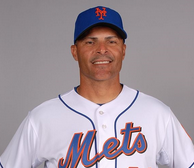
Photo by Doug DuKane/Getty Images

"I think I can be a good manager.  I would like to take my chances and see if I can be one of those Puerto Ricans that are managing in the big leagues.  Or a coach.  I would do it; start in the minor leagues.  I'd do it as a coach or as an instructor.  That's my goal - to make it to the big leagues again."


Jose Valentin had a solid 16-year career in the major leagues.  Although he hit over 300 doubles and nearly 250 homers, he never made an All-Star team or played in a World Series.  The closest he ever got to the Fall Classic was in 2006, when he had his final hurrah as a productive big league ballplayer - a last go-round that might never had happened had Omar Minaya not signed him for under a million dollars.

Valentin had one of the finest offensive seasons ever produced by a second baseman in Mets history and did all he could to help the Mets win the pennant, including leading off the ninth inning of Game Seven with a base hit.  But in the end, all he could do was watch the Cardinals celebrating their National League crown from third base, where he was left stranded along with the dreams of his teammates and the club's fans.

The 2006 season is bittersweet for anyone associated with the Mets, as the team had one of the most successful regular seasons in franchise history, only to be followed up by a disappointing postseason.  But for Jose Valentin, the 2006 campaign marked his final moment in the sun.  And no one will ever be able to take that season away from him.


Note:  The Most With The Least is a thirteen-part weekly series spotlighting those Mets players who performed at a high level without receiving the accolades or playing time their more established teammates got, due to injuries, executive decisions or other factors.  For previous installments, please click on the players' names below:

January 4, 2016: Benny Agbayani
January 11, 2016: Donn Clendenon
January 18, 2016: Tim Teufel
January 25, 2016: Hisanori Takahashi
February 1, 2016: Chris Jones
February 8, 2016: Claudell Washington
February 15, 2016: Moises Alou
February 22, 2016: Pat Zachry
February 29, 2016: Art Shamsky
March 7, 2016: Mark Carreon 


Friday, June 27, 2014

Cutch and Go (Big Pelf)

Andrew McCutchen would've looked good in orange and blue, right?  It could've happened...

When the Mets lose in heartbreaking fashion, as they did Friday night in Pittsburgh, I tend to think of what might have been.  Did Daniel Murphy's caught stealing prevent the Mets from a potential big inning?  Could a Terry Collins ejection in the 10th provide the spark for an extra-inning rally?  Tonight I'm not thinking of those questions.  Instead, I'm going back a decade to see what might have been had the Mets not gotten swept by the Pirates in a doubleheader in late September.  Confused?  You won't be after reading this.

On September 19, 2004, the Mets and Pirates were both finishing out the season knowing that they were all going to playing golf in October rather than baseball.  New York and Pittsburgh were both near the bottom of their respective divisions entering the Sunday doubleheader at PNC Park.  Aaron Heilman and Ricky Bottalico combined to pitch a two-hitter against Pittsburgh in the first game.  The Mets lost, 1-0.  In the second game, New York's Kris Benson (the Bucs' first overall pick in 1996) got rocked for six runs against his former team.  The Mets lost both games to the Pirates, and ended the season with a 71-91 record.  Pittsburgh ended up with one more win than the Mets, finishing the year at 72-89 (they did not make up an earlier rainout).

The Mets earned the ninth overall draft pick by finishing 20 games under .500, while the Bucs got to select 11th in the 2005 June amateur draft.  New York drafted Mike Pelfrey.  Two picks later, Pittsburgh chose Andrew McCutchen.  Yeah.

So had the Mets split that late-season doubleheader with the Pirates in 2004, they would have finished the year with a 72-90 record, while the Bucs would have posted a 71-90 mark.  New York would have picked after Pittsburgh, rather than before them.

Would the Mets have drafted McCutchen had Pelfrey been taken off the board?  Would the Pirates have gone with Big Pelf had they been presented with that opportunity?  No one will ever know.  But it sure is interesting to consider how different these teams could have been had they flip-flopped their draft choices in 2005.  And that could have happened had the Mets played better in just one of two "meaningless" games against the Pirates at the tail end of the 2004 campaign.

We should all hope McCutchen doesn't continue to haunt the Mets the way he did Friday night at PNC Park.  And more importantly, we should all hope the Mets don't have any more heartbreaking losses that make me come up with crazy "what might have been" scenarios such as the one presented here.

Let's go Mets.  And go Big Pelf...

Wow, someone actually bought that shirt?

Friday, March 22, 2013

Can Jon Niese Succeed Where Mike Pelfrey Didn't?

Jonathon Niese has worked hard to get to where he is now.
(Photo by Ed Leyro/Studious Metsimus)

On Thursday, the Mets announced that Jonathon Niese will be taking the ball on Opening Day, making his first season-opening start for the only team he's known in the major leagues.  Niese will get the start because Johan Santana has not been able to throw off a mound since early March and might begin the season on the disabled list.

Niese had a breakthrough season for the Mets in 2012, going 13-9 with a 3.40 ERA, 1.17 WHIP and 155 strikeouts - all career-bests.  But getting the Opening Day nod means facing lots of aces during the season's first month and perhaps beyond.  If a pitcher isn't up to the task of facing the best moundsmen in the league on a regular basis, then a breakthrough season can quickly be negated by a disappointing year.  Just ask Mike Pelfrey.

Just three years ago, Pelfrey was pitching in his fifth year with the Mets.  After years of showing abbreviated flashes of greatness, Pelfrey took off in 2010.  The right-hander won ten of his first 12 decisions, finishing the year with a 15-9 record and a 3.66 ERA.  With Johan Santana out for the opener in 2011, new manager Terry Collins gave Pelfrey the ball in Game No. 1, hoping he could build upon his success from the previous year.  To say Pelfrey struggled in the role as the team's new "ace" would be a tremendous understatement.

One year after winning a career-high 15 games as the team's No. 4 starter, Pelfrey regressed in 2011, going 7-13 with a 4.74 ERA.  Pelfrey struggled during the entire first half, allowing four runs or more in nine of his first 17 starts.  In many of his starts, Pelfrey faced some of the best pitchers in baseball.  He squared off against Josh Johnson (twice), Cole Hamels, Justin Verlander, Matt Cain and Roy Halladay, to name a few.  He failed to defeat any of them.

In 2012, Jonathon Niese was the team's No. 3 starter after Johan Santana and R.A. Dickey.  As a result, he got to face the likes of Vance Worley (twice), Mike Minor, Jake Westbrook, Jacob Turner and Mike Fiers.  Niese defeated all of them.

This year, Niese won't have as many fortunate matchups pitching out of the No. 1 slot in the rotation.  He'll be going up against All-Stars and Cy Young candidates just as Mike Pelfrey did in 2011.  If Niese has truly grown as a pitcher, he will succeed where Pelfrey failed.  But if he can't rise to the occasion, his career stands to take a downward turn for the first time since his initial call-up to the big leagues in 2008.

Mike Pelfrey never fully realized his potential in New York.  But even though he is now in Minnesota, he can still help the Mets.  Pelfrey's 2011 season can serve as a lesson to Jonathon Niese - a lesson on how not to pitch when thrust into a new situation.

Jonathon Niese is signed through the 2016 season.  It's up to him to prove to the Mets that they made the right decision.


Tuesday, February 5, 2013

How The Mets Just Made The 2013 Season Shorter

Most of the time, when the Mets make a move I disagree with, I tend to write long-winded diatribes filled with bitter sarcasm and scathing remarks generally aimed at the person or persons responsible for the unfortunate transaction.  However, today I'm pressed for time so there will no 1,000+ word rant.  Instead, I'll just be giving you the long and short of today's Mets news, which as you're about to read, couldn't be more appropriate.

Watch that hand, Terry.  You might end up smacking Rauch on the back of his knee instead of his ass.

Jon Rauch was one of the few dependable arms in the Mets bullpen last year.  But in 2013, his 6'11" inch frame will be casting shadows on the mound at Marlins Park.

Various sources have reported that Rauch has signed a one-year, $1 million contract to pitch for the stripped-down version of the Miami Marlins.  He will more than likely pitch in Miami for a few months, get a few tattoos, then get shipped off to a pennant contender for a bunch of prospects at the trade deadline.

Rauch's departure, coupled with the non-signing of 6'10" Chris Young and the non-tendering of 6'7" Mike Pelfrey will make the Mets a much shorter team in 2013.  In fact, as of this scribbling, no player on the Mets' 40-man roster is taller than 6'4".

It's possible the Mets just thought the 34-year-old Rauch was getting up there in years.  Perhaps they believed Chris Young was about to break like an outfield wall in front of Rodney McCray.  Or maybe they expected Mike Pelfrey to eventually bite off his tongue while throwing a pitch.  For all we know, perhaps the Mets just found a new way to cut costs by spending less money on fabric for the tall players' jerseys.

But one thing's for certain.  The light stanchions at Citi Field will be the only things casting shadows on the mound now that Rauch, Young and Pelfrey have all cautiously lowered their heads under the home bullpen gate for the last time. 

Jon Rauch will be soaking rays in Florida in 2013.  Mike Pelfrey will be dodging snowballs and line drives in Minnesota.  Chris Young will be trying not to get hurt wherever he winds up.  None of these behemoths will be pitching for the Mets in 2013.   It looks like a long season just got a little shorter for the Mets.

Friday, December 21, 2012

Joey's Letter To Sandy Claus (2012)


Dear Sandy Claus,

Do you remember me?  I'm Joey Beartran.  I sent you a letter last year asking for various things, such as Johan Santana pitching an entire season, Jason Bay regaining his power stroke, and R.A. Dickey getting some run support so he could get some more wins.  That was not my entire list, but you get the idea.

Well, Johan Santana didn't pitch the entire season, but he did toss the first no-hitter in team history.  Jason Bay didn't regain his power stroke, but he did give Mets fan strokes with every strikeout, pop-up, or double play he grounded into with runners in scoring position.  ("But he hustles!!")  R.A. Dickey figured he wouldn't wait for you to grant me my Christmas wish for more run support, so he just went out and won himself the first Cy Young Award ever given to a knuckleball pitcher.  Then you traded him.

So it looks like I got some of the things I asked for in last year's letter, just not exactly in the way I wanted them.  I guess this year I'll have to be more specific with you.  I mean, I can imagine what it's like for you, doing double duty as the Mets general manager by day and gift-giver to all good girls and boys by night.  I do double duty here myself as the Studious Metsimus roving reporter and culinary expert, so I know that sometimes a detail or two might be overlooked.  Just don't do it with this year's letter, okay?  I mean it this time.

Anyway, here goes.  Pay close attention this time, will ya?

Hope I don't forget anything on my list this year.

I would like a brand-spanking new bullpen in 2013.  No, I'm not talking about the actual bullpen in right-center field where relievers warm up their arms (told you I was going to be more specific).  I'm referring to new relief pitchers who will be summoned from said bullpen.  We should not have to be subjected to the likes of Manny Acosta, Miguel Batista and Ramon Ramirez.  Were they being used because Mel Rojas wasn't available?  We need dependable relievers who can put fires out instead of the ones we employed last year, who came running in from the bullpen with their glove in one hand and a full gasoline can in the other.

I would also like a set outfield by Opening Day.  In fact I would just like one outfielder by the time pitchers (sans Dickey) and catchers (sans Thole and Nickeas) report to spring training on Bobby Valentine's Day.  Casey Stengel once said that the Mets had to draft Hobie Landrith first in the expansion draft because without a catcher, there would be plenty of passed balls.  Well, without an outfield, there will be a ton of inside-the-park homers hit against the Mets.  At least with one outfielder, the Mets will be able to keep the opposition to mostly triples.

Speaking of outfielders, I'd like you to re-sign Scott Hairston.  If it's a multi-year deal he wants, then it's a multi-year deal he should get.  Hairston was one of the team's most dependable power sources last season, hitting 20 homers in limited action.  That's an amazing number considering that no Met reached the 20-homer plateau in two of Citi Field's first three seasons.  When Daniel Murphy (Doubles Machine) leads the team in homers one year and Carlos Beltran leads the Mets in bombs another year - despite playing the final two months for another team - that should be a clear sign that the team needs a little more power in their lineup.  Scott Hairston can be paid with the money you wouldn't give to R.A. Dickey, and you'd still have some spare change left over to get yourself a Shake Shack burger or two.  Just don't touch mine.  I'm kinda attached to it.

You can have your cookies and milk, Sandy Claus.  I'll stick to my Shake Shack burger and fries.

I'd like Johan Santana to remember that this could be his final season in a Mets uniform.  Therefore, I expect him to make more than 21 starts, especially if he wants to get paid in 2014.  Santana will only be 34 on Opening Day, so he should still have plenty left in his tank.  Then again, Fred Wilpon's high school sweetheart (Sandy Koufax) was out of baseball by age 30, so you never know.  Regardless, if Santana is going to be on the active roster for all 162 games, he should not be pushed past his limit (which should be well before his 134th pitch) in any start.  With no R.A. Dickey in the rotation, Santana will once again be counted on to be the team's ace.  Aces make more than 21 starts.  Make a note of that.

As of right now, the starting rotation consists of Santana, Jonathon Niese, Matt Harvey and Dillon Gee.  You don't need Dee Dee Ramone to let you know that adds up to 1-2-3-4 pitchers.  Since these are the 2013 Mets and not the 1971 Baltimore Orioles, I'm going to need a fifth starter in the rotation.  Mike Pelfrey is now a Minnesota Twin.  Unfortunately, he does not have a twin of his own that the Mets can slide into their rotation.  Speaking of former Mets, Scott Kazmir just signed with the Cleveland Indians, so he's unavailable.  And now the Mets are talking to the Dodgers about bringing back Chris Capuano.  At least they're not thinking of signing former Yankee Carl Pavano.  (Oh, wait.  Never mind.)  In 2009, the Mets needed a fifth starter and signed everyone they could.  Freddy Garcia Tim Redding and Livan Hernandez all competed for the job in spring training.  None of them fared very well.  All I'm asking for is a dependable fifth starter and not a game of musical chairs where the last one standing gets the job.  And if the last one standing is Carl Pavano, then he cheated and should be removed from consideration.

Finally, I'd like the Mets to continue to be patient with their minor league talent.  The team was right to keep Matt Harvey in the minor leagues for as long as they did.  When he was finally called up to the big leagues, he proved he was ready, striking out 70 batters in 59 innings and posting a 2.73 ERA and 1.15 WHIP.  The team should do the same with Zack Wheeler and the recently acquired Noah Syndergaard.  Similarly, Travis d'Arnaud should not automatically be on the Opening Day roster just because he was the big prize in the R.A. Dickey sweepstakes.  That's what the Mets got John Buck for.  In 1979, the Mets suggested to their fanbase to "bring your kids to see our kids".  A third of a century later, it's time for that slogan to make a comeback.  But there's no rush.  The kids will be here ... eventually.  And so will I.

If only Sandy Claus checked Twitter more often, I wouldn't have to send him snail mail.

So, Sandy Claus, did you get all that?  Let's review.

I need a new bullpen.  I need Mel Rojas to be perpetually unavailable.  I would like three outfielders, but I'd especially like one of them to be Scott Hairston.  I'd like a Shake Shack burger if you're going to get one for yourself.  I'd like Johan Santana to stay healthy and pitch like an ace.  I'd also like to know what Fred Wilpon is getting Sandy Koufax for Valentine's Day.  I'd like a fifth starter, and if one of them has the DNA of one of the members of the 1971 Orioles, I wouldn't object.  I would like you to get a restraining order on Carl Pavano so he's not allowed to go anywhere near Citi Field.  And I'd like you to take it easy with your kids in the minors so that when this kid goes to Citi Field next season, they'll be ready to perform like the dependable major leaguers I expect them to be.

That's not too much, is it?  And I was very specific with my requests, unlike last year when you kinda sorta gave me what I asked for.  I'm not falling for your trickery again this year!

Thanks so much, Sandy Claus!  I was a good bear this year.  Don't you forget it!

Love and best wishes for the 2013 season,
Joey Beartran

P.S. In case you don't give me Scott Hairston as one of my outfielders, can you at least get him to come over to my house?  I really enjoyed playing with him the last time we got together on the field.

Photo by Sharon Chapman.  "O"-Face by Scott Hairston.


Saturday, July 14, 2012

Chipper Jones Welcomes Josh Edgin To The Mets

On Friday, Josh Edgin became the 934th player in Mets history to play for the team.  He also became the 442nd player to take the mound for the Mets when he came into the game in the fifth inning to clean up the mess Miguel Batista left for him.  Edgin struck out both batters he faced to escape the bases loaded, one-out jam.  However, he didn't become a true Met until the following inning.  What happened to earn him this dubious honor?

Chipper Jones took him deep.

If chicks dig the longball, chicks must really dig Chipper Jones when he bats against the Mets.


Josh Edgin started the sixth inning trying to keep the Mets within one run of the Braves.  But he didn't check the playlist on Chipper Jones' Farewell Tour before the Braves' third baseman walked up to the plate to face him.  You see, Chipper Jones always has a second set when he faces the Mets.  It's a set that includes taking a new pitcher deep every time he sees him.  And Josh Edgin found out about that set one pitch too late.

In allowing Jones' 49th career HR against the Mets, Josh Edgin became the 35th different Mets pitcher to watch his meatball leave the yard.  27 of those 35 pitchers gave up exactly one home run to Jones.  Those pitchers are:

  • Josias Manzanillo (1995)
  • Pete Harnisch (1995)
  • Pete Walker (1995)
  • Mark Clark (1996)
  • Jason Isringhausen (1997)
  • Masato Yoshii (1999)
  • Pat Mahomes (1999)
  • Dennis Cook (1999)
  • John Franco (2000)
  • Glendon Rusch (2001)
  • Satoru Komiyama (2002)
  • Pedro Astacio (2002)
  • Tom Glavine (2003)
  • Jae Weong Seo (2003)
  • Edwin Almonte (2003)
  • Pedro Martinez (2006)
  • Darren Oliver (2006)
  • John Maine (2007)
  • J.J. Putz (2009)
  • Pedro Feliciano (2009)
  • Pat Misch (2009)
  • Johan Santana (2010)
  • D.J. Carrasco (2011)
  • Jonathon Niese (2011)
  • R.A. Dickey (2011)
  • Chris Schwinden (2011)
  • Josh Edgin (2012)


Jones has also victimized eight different Mets pitchers on multiple occasions.  Those pitchers are listed below, along with the number of home runs they gave up to him and the years in which those home runs were hit:

  • Bobby Jones: 4 HR (1996, 1997 [twice], 1998) 
  • Steve Trachsel: 4 HR (2002, 2003, 2004, 2005)
  • Rick Reed: 3 HR (1999, 2001 [twice])
  • Mike Pelfrey: 3 HR (2007, 2008, 2010)
  • Orel Hershiser: 2 HR (1999 [twice])
  • Aaron Heilman: 2 HR (2003, 2005)
  • Dave Mlicki: 2 HR (1995, 1997)
  • Al Leiter: 2 HR (1999, 2000)


Here are some additional tidbits of home run information, courtesy of Chipper Jones' bat and the good folks at baseball-reference.com.

Although Chipper Jones has five multi-HR games against the Mets, Bobby Jones is the only pitcher in Mets history to allow two home runs to Chipper in the same game, doing so on June 25, 1997.  Chipper's non-relative allowed a solo shot in the fourth inning followed by a grand slam in the fifth.  In each of Chipper Jones' other four multi-HR games against the Mets, he took multiple pitchers deep.

Since the Mets left Shea Stadium for Citi Field in 2009, Jones has hit ten home runs against them.  Those ten homers were hit off ten different pitchers, with Jones doing the 120-yard trot against (in order) J.J. Putz, Pedro Feliciano, Pat Misch, Johan Santana, Mike Pelfrey, D.J. Carrasco, Jonathon Niese, R.A. Dickey, Chris Schwinden and Josh Edgin.  (Here's a tip for Mets pitchers.  If you don't want to give up a home run to Chipper Jones, go by your given first name, not by your initials.  Got that, Putz, Carrasco and Dickey?)

The home run allowed by Edgin on Friday was the first given up by a Met to Jones in 2012.  If no other Met serves up a homer to the Braves' soon-to-be retiree (which is about as likely as Lucas Duda winning a Gold Glove this year), this would mark the fourth season in which Jones hit only one home run against the Mets.  In 1998, 2004 and 2008, Jones hit only one home run against the Mets, taking Bobby Jones deep in 1998, Steve Trachsel in 2004, and Mike Pelfrey in 2008.  Not by coincidence, those are the three Mets pitchers who allowed the most home runs to Jones during their time in Flushing.  (Pelfrey is tied with Rick Reed for third-most home runs allowed.)

Finally, Josh Edgin is not alone in allowing a home run to Chipper Jones during his major league debut.  Two other Mets pitchers received their "welcome to the majors" present from Chipper Jones in the form of a home run as well.

At Shea, at Citi, or at Turner Field, no Met pitcher is safe from Chipper Jones.


On July 7, 2003, Edwin Almonte made his major league debut for the Mets, pitching in relief of Jae Weong Seo, who had already given up a home run to Jones earlier in the game.  Almonte must not have been watching from the bullpen, as he allowed another home run to Jones in the eighth inning.  Almonte went on to pitch 11 more games in relief for the Mets in 2003, never recording a decision for the team, but finishing his abbreviated career with a whopping 11.12 ERA, the highest ERA for any Mets pitcher who appeared in at least 10 games.

Just last year, during the first game of a doubleheader on September 8, 2011, Chris Schwinden was rocked by a Chipper Jones home run in the third inning of his major league debut.  Like Almonte before him, Schwinden has not won a game in the major leagues, despite making six additional appearances (five starts) since his debut.  Fortunately, his 6.98 ERA as a Met is not the highest of any pitcher in Mets history who has made at least six starts.  That honor goes to Calvin Schiraldi, who was a Met before he lost Games 6 and 7 of the 1986 World Series to his former team.  Schiraldi had a 7.63 ERA as a Met in 15 appearances (seven starts) with the team in 1984 and 1985.  Fortunately for him, he was out of baseball by 1991, so he was not able to be taken deep by Chipper Jones.

Chipper Jones has not just welcomed Mets pitchers to the big leagues.  He has also given a goodbye present to one unfortunate soul.  On September 11, 2002, during the first game of a doubleheader, Jones hit a home run off Mets reliever Satoru Komiyama.  It was the last hit allowed by Komiyama in the major leagues, as he never pitched again after that game.  And just for the record, Komiyama finished his one-year career in the big leagues with an 0-3 record.  No wins.  Just like Almonte.  Just like Schwinden.  Just like Edgin (as of now).

Chipper Jones has always been one of the biggest thorns in the Mets' side.  Josh Edgin has now been pricked by that thorn.  Welcome to the big leagues, Josh.  You're a true Met now.

Thursday, June 7, 2012

R.A. Dickey And The Quest For A 20-Win Season


Not since Frank Viola in 1990 have the Mets produced a 20-game winner.  In fact, the only Met to win as many as 17 games in a season since then was Al Leiter, who went 17-6 in 1998.  But that might change in 2012, and the man who might make it happen is R.A. Dickey.

R.A. Dickey, who just extended his personal scoreless streak to 24⅔ innings (just seven innings shy of Jerry Koosman's franchise record), is the proud owner of a 9-1 record with a 2.44 ERA through his first 12 starts.  With a full month left to the season's midpoint, Dickey is only one win shy of seeing himself halfway to win No. 20.

Will he finally end the Mets' 22-year drought of not producing a 20-game winner?  Let's look at all of the past 20-game winners in Mets history to see where they were after the first 12 starts of their 20-win campaigns.

  • Tom Seaver (1969): 8-3, 2.51 ERA through 12 starts (13 gm); finished 25-7, 2.21 ERA
  • Tom Seaver (1971): 7-2, 2.01 ERA through 12 starts (13 gm); finished 20-10, 1.76 ERA
  • Tom Seaver (1972): 8-3, 3.09 ERA through 12 starts; finished 21-12, 2.92 ERA
  • Tom Seaver (1975): 8-4, 2.16 ERA through 12 starts; finished 22-9, 2.38 ERA
  • Jerry Koosman (1976): 6-5, 4.03 ERA through 12 starts (13 gm); finished 21-10, 2.69 ERA
  • Dwight Gooden (1985): 8-3, 1.72 ERA through 12 starts; finished 24-4, 1.53 ERA
  • David Cone (1988): 9-2, 2.35 ERA through 12 starts (19 gm); finished 20-3, 2.22 ERA
  • Frank Viola (1990): 9-2, 2.04 ERA through 12 starts; finished 20-12, 2.67 ERA


Of the five pitchers who have produced 20-win seasons for the Mets, none had more than nine wins after his first 12 starts.  With today's win, Dickey has matched David Cone and Frank Viola with nine victories over their first 12 starts, although two of Cone's nine wins came in relief.

It appears that Dickey is on track to become the sixth member of the 20-win club, but there have been other pitchers in the past who got off to a quick start for the Mets, then failed to win 20 games.

In 1997, Bobby Jones had a spectacular first two months, going 10-2 with a 2.22 ERA through his first 12 starts to earn his first and only trip to the All-Star Game.  But after his quick start, he struggled the rest of the way, going 5-7 with a 4.85 ERA over his final 18 starts of the season.

Just two years ago, Mike Pelfrey got off to the best start of his career, going 8-1 with a 2.23 ERA over his first 12 starts.  But in addition to being snubbed for the All-Star team, he also failed to continue his hot start after June.  Over his final 21 starts in 2010, Pelfrey went 7-8 with a 4.60 ERA.  Both Jones and Pelfrey had to settle for 15-win campaigns in 1997 and 2010, respectively.

Johan Santana recently ended the Mets' long no-hitter drought.  Now it's up to R.A. Dickey to end another drought that no Mets pitcher has come close to ending over the past two-plus decades.  Can he become the first 20-game winner since the end of the Davey Johnson era?  Nothing is certain, but if Dickey can maintain his torrid pace, there's no reason why he can't join Seaver, Koosman, Gooden, Cone and Viola as Mets' 20-game winners.

Monday, May 28, 2012

Is R.A. Dickey An All-Star?

Photo by Ed Leyro/Studious Metsimus (Yeah, that's right.  I took it.  Not bad, huh?)

On Sunday, R.A. Dickey pitched 7 innings of shutout ball against the Padres, allowing three hits, walking one and striking out ten batters.  The 10-K performance gave Dickey 29 strikeouts over his last three starts (20 IP).  It also helped in lowering his ERA to 3.06, a number Dickey had not seen since his sole bad start of the year in rain-soaked Atlanta on April 18.  On that day, a day in which Dickey admitted the weather conditions made it seem like he was throwing "a wet water balloon", the knuckleballer allowed eight runs in 4⅓ innings, ending his streak of consecutive quality starts at 14.

Since his damp debacle against the Braves, Dickey has been magnificent.  He has made seven consecutive quality starts, giving him 21 in his last 22 starts.  In those seven quality starts, he has a 2.09 ERA, 0.89 WHIP, and opponents are batting a measly .193 against him.  The most important number in Dickey's line is the big fat zero in the loss column since April 18.  Over the past six weeks, Dickey is 5-0, helping the Mets improve to a season-high six games over .500.

For the season, Dickey is 7-1 with a 3.06 ERA and 61 strikeouts in 64⅔ innings.  His seven wins tie him with Gio Gonzalez, Cole Hamels, Lance Lynn and former Met teammate Chris Capuano for first place in the National League, as does his .875 winning percentage.  Dickey is also ninth in the NL in innings pitched and eighth in strikeouts.  He is also an excellent fielder, as evidenced by his 16 assists in ten starts.  This is nothing new, as Dickey led the league in assists by a pitcher in 2011 and was second in 2010.  He is currently third in the National League in assists by a pitcher, picking up his 16th assist on Sunday after making a beautiful diving stop to his right on a ground ball by Chase Headley.

Given all this data, the question must be asked.  Should R.A. Dickey represent the National League in the 2012 All-Star Game?

Every team must be represented by at least one player, but David Wright's scalding start has pretty much made him a lock for the All-Star team.  Therefore, Dickey would probably not be chosen because he "has to be" chosen as the Mets' sole representative.  He would have to earn his spot on the roster.

Looking at his numbers, you would think that he already has earned a spot on the roster.  Seven wins, 61 strikeouts, low ERA, low WHIP.  That just screams All-Star, right?  Not so fast.

Two years ago, Mike Pelfrey pitched seven shutout innings against the Phillies on May 27 (the same date Dickey pitched 7⅓ shutout innings against the Padres this year).  After Pelfrey's masterpiece, his record improved to (you guessed it) 7-1, the same record Dickey has on the same date Pelfrey had it in 2010.

But Pelfrey didn't fall off the face of the Earth after improving to 7-1.  In fact, on June 25, 2010, he defeated the Minnesota Twins in an interleague matchup to improve to 10-2.  He was also the proud owner of a spiffy 2.71 ERA.  Please note that June 25 was only two weeks before pitchers were to be selected for the All-Star Game by players, coaches and managers (fans do not participate in the pitcher selection process).  Pelfrey did not make the All-Star team in 2010, despite his outstanding first-half performance.

Pelfrey isn't alone in recent All-Star snubbery.  (Yes, I just made up that word.  What are you going to do, kick me off the All-Star team?)  In 2007, John Maine won his first five decisions and was 10-4 with a 2.71 ERA on July 5.  Just like Pelfrey, he also did not make the National League All-Star team.

So where does that leave Dickey?  If I had a vote, I'd give it to the Mets' resident knuckleballer.  But I don't have a vote.  And the people who do have a plethora of choices amongst pitchers.

There are currently ten pitchers in the National League with an ERA of 2.50 or less.  Dickey is still above 3.00.  Seven pitchers in the National League have a WHIP of 1.00 or less.  Dickey is just barely below 1.10 (1.098, to be exact).  And some players, such as Houston's Brett Myers (12 saves, 1.59 ERA, 0.82 WHIP), might "have to be" chosen before a player like Dickey is.  No other Astro hitter or pitcher is having an All-Star caliber season, so Myers might force his way onto the team as the sole Astros' representative, taking a roster spot away from another deserving candidate, someone like R.A. Dickey.

If R.A. Dickey is going to become a first-time All-Star in 2012, he's going to have to keep pitching the way he has since his one poor outing in Atlanta.  He'll need to get his ERA below 3.00.  He'll need to continue striking out batters.  He'll need to keep piling on the wins.  Then again, as recent history shows with Met pitchers, that doesn't guarantee anything when it comes to making the All-Star team.  To me, R.A. Dickey is an All-Star in 2012.  Let's hope the players, managers and coaches feel the same way.

Saturday, May 26, 2012

David Wright Is Not The Only Met Approaching Team Milestones


Recently, David Wright passed Jose Reyes to move into second place on the Mets' all-time hits list.  As of this writing, Wright has 1,308 hits, leaving him 110 hits short of franchise leader Ed Kranepool.  With 116 games left in the season, Wright stands a good chance to surpass Kranepool before the season ends on October 3.

Wright is already the team leader in doubles, extra-base hits, total bases, times on base, and runs batted in.  He also is set to pass Jose Reyes in runs scored shortly, as he is currently only six runs behind his former infield mate.

Assuming Wright signs a contract extension with the Mets, he will probably lead the Mets in most offensive categories by the time he plays his final game for the team, making him a true Mr. Met.  But David Wright isn't the only player on the Mets right now who is moving up the team's all-time leader board.  In honor of the team's 50th anniversary season, let's take a look at current Mets players who rank in the club's all-time top 50 in various hitting and pitching categories.  I'm sure some of these players might surprise you.

  • Batting average (min. 1,000 AB): Daniel Murphy (.293, 5th all-time)
  • Doubles: Daniel Murphy (88, 37th all-time)
  • Triples: Daniel Murphy (9, T-44th all-time)
  • ERA (min. 500 IP): Johan Santana (2.88, 3rd all-time)
  • WHIP: Johan Santana (1.178, 6th all-time)
  • Games pitched: Bobby Parnell (197, 23rd all-time)
  • Games started: Mike Pelfrey (149, 13th all-time)
  • Wins: Mike Pelfrey (50, 15th all-time), Johan Santana (41, T-20th all-time), Jonathon Niese (25, T-36th all-time), R.A. Dickey (25, T-36th all-time)
  • Saves: Frank Francisco (12, 20th all-time)
  • Innings pitched: Mike Pelfrey (896.1, 15th all-time), Johan Santana (650.0, 24th all-time)
  • Strikeouts: Johan Santana (549, 17th all-time), Mike Pelfrey (506, T-19th all-time), Jonathon Niese (359, 37th all-time), R.A. Dickey (289, 42nd all-time)

As you can see, the only hitter currently in the top 50 in any other batting categories other than David Wright is Daniel Murphy.  But virtually the entire starting staff, including the injured Mike Pelfrey finds themselves all over the team's all-time leader board in various pitching categories.

Also, for a team that has boasted a number of quality relief pitchers, like Tug McGraw, Jesse Orosco, Roger McDowell, John Franco, Armando Benitez (don't laugh) and Billy Wagner, it's kind of surprising that in less than two months, Frank Francisco has already cracked the top 20 in saves.

The Mets might not have the history of the Yankees, Red Sox, Dodgers or Giants, but they do have a history.  And as you can see, many of the players on the 2012 team are in the process of making some history of their own.

Friday, May 11, 2012

Around The World In 8,000 Games


Friday night's game against the Miami Marlins was already going to be special for the Mets because it was to be their first game in the Marlins' new ballpark.  But Mets historians such as myself will remember the game for another reason, as it was the 8,000th regular season game in franchise history.

In their first 8,000 games, the Mets have emerged victorious 3,829 times, while falling short on 4,163 occasions.  They have also played eight games to a tie.  In addition, the Mets have finished with a winning record in 23 of their 50 campaigns, making the playoffs seven times (five division titles, two wild cards).  All that you know.  But what if I broke down the 8,000 games into eight 1,000-game periods?  What would the Mets' record be in each period?  Which team did they defeat the most?  Which team gave them the most trouble?  Which pitcher was the most successful?  Who hit the most home runs?

Ladies and gentle-Mets, without further ado, I invite you to join me as we go around the Mets' world in 8,000 games (1,000 games at a time) to answer all these questions and perhaps find a nugget or two we weren't expecting to find.


Games 1 - 1,000: April 11, 1962 - May 12, 1968 (1st game of DH)

Record: 332 wins, 664 losses, 4 ties
Easiest victim: Chicago Cubs (47 wins, 67 losses, 1 tie)
Toughest opponent: Los Angeles Dodgers (27 wins, 87 losses, 1 tie)
Winningest pitcher: Al Jackson (40 wins, 74 losses)
Saves leader: Jack Hamilton (14 saves)
Top home run hitter: Jim Hickman (60 HR)
RBI leader: Ed Kranepool (223 RBI)


Games 1,001 - 2,000: May 12, 1968 (2nd game of DH) - June 17, 1974

Record: 517 wins, 482 losses, 1 tie
Easiest victim: Philadelphia Phillies (67 wins, 42 losses)
Toughest opponent: Cincinnati Reds (30 wins, 51 losses)
Winningest pitcher: Tom Seaver (121 wins, 66 losses)
Saves leader: Tug McGraw (83 saves)
Top home run hitter: Tommie Agee (81 HR)
RBI leader: Cleon Jones (379 RBI)


Games 2,001 - 3,000: June 18, 1974 - July 18, 1980

Record: 451 wins, 548 losses, 1 tie
Easiest victim: Chicago Cubs (63 wins, 52 losses), Atlanta Braves (46 wins, 32 losses)
Toughest opponent: Philadelphia Phillies (40 wins, 73 losses)
Winningest pitcher: Jerry Koosman (55 wins, 65 losses)
Saves leader: Skip Lockwood (65 saves)
Top home run hitter: Dave Kingman (82 HR)
RBI leader: Lee Mazzilli (233 RBI)


Games 3,001 - 4,000: July 19, 1980 - April 19, 1987

Record: 500 wins, 498 losses, 2 ties
Easiest victim: Pittsburgh Pirates (66 wins, 44 losses, 1 tie)
Toughest opponent: St. Louis Cardinals (49 wins, 64 losses)
Winningest pitcher: Dwight Gooden (58 wins, 19 losses)
Saves leader: Jesse Orosco (94 saves)
Top home run hitter: Darryl Strawberry (113 HR)
RBI leader: Darryl Strawberry (358 RBI)


Games 4,001 - 5,000: April 20, 1987 - May 24, 1993

Record: 527 wins, 473 losses
Easiest victim: St. Louis Cardinals (62 wins, 46 losses)
Toughest opponent: Chicago Cubs (50 wins, 57 losses)
Winningest pitcher: Dwight Gooden (89 wins, 51 losses)
Saves leader: John Franco (79 saves)
Top home run hitter: Howard Johnson (166 HR)
RBI leader: Howard Johnson (527 RBI)


Games 5,001 - 6,000: May 25, 1993 - September 5, 1999

Record: 499 wins, 501 losses
Easiest victim: St. Louis Cardinals (38 wins, 27 losses)
Toughest opponent: Houston Astros (27 wins, 41 losses)
Winningest pitcher: Bobby Jones (63 wins, 50 losses)
Saves leader: John Franco (189 saves)
Top home run hitter: Todd Hundley (112 HR)
RBI leader: Todd Hundley (338 RBI)


Games 6,001 - 7,000: September 6, 1999 - April 7, 2006

Record: 488 wins, 512 losses
Easiest victim: Colorado Rockies (28 wins, 17 losses)
Toughest opponent: Atlanta Braves (44 wins, 70 losses), St. Louis Cardinals (14 wins, 26 losses)
Winningest pitcher: Al Leiter (67 wins, 52 losses)
Saves leader: Armando Benitez (143 saves)
Top home run hitter: Mike Piazza (165 HR)
RBI leader: Mike Piazza (477 RBI)


Games 7,001 - 8,000: April 9, 2006 - May 11, 2012

Record: 515 wins, 485 losses
Easiest victim: Pittsburgh Pirates (27 wins, 17 losses)
Toughest opponent: Atlanta Braves (52 wins, 62 losses)
Winningest pitcher: Mike Pelfrey (50 wins, 54 losses)
Saves leader: Billy Wagner (100 saves)
Top home run hitter: David Wright (143 HR)
RBI leader: David Wright (595 RBI)

Wednesday, April 25, 2012

Lifetime Mets, We've Had A Few (But Just Enough To Mention)

With apologies to Frank Sinatra, the Mets have had very few players who spent their entire professional careers with the team.  I'm talking about players who originally signed with the Mets, came up through their minor league system and spent their entire major league careers wearing the orange and blue.

So many players spent a decade or more with the Mets, but all of them managed to play at least one game for another team.  Players such as Tom Seaver, Jerry Koosman and Buddy Harrelson all came up through the Mets' minor league system and were teammates for most of their careers, but none of them retired as Mets.

Tom Seaver played for the Reds, White Sox and Red Sox after leaving New York (twice).  Jerry Koosman pitched for the Twins, Phillies and White Sox after playing his final game for the Mets.  And Bud Harrelson stuck around for a few years, toiling for the Phillies and Rangers once his days in New York were through.

There have also been a handful of players who most people don't remember as playing for an organization other than the Mets.  Do you remember Cleon Jones as a member of the White Sox?  No?  He was indeed a member of the Pale Hose, albeit for only 12 games in 1976 after playing a dozen years in New York.  How about Craig Swan?  The former ERA champion who led the Mets in wins during the Dark Ages of 1977-1983 finished his career with a two-game stint as a California Angel.  John Stearns played in a total of 809 games during his ten years in New York.  But the Bad Dude made his major league debut in 1974 for the Philadelphia Phillies, spending less time in Philly (two at-bats) than a cheesesteak spends in Rusty Staub's hands.

So which players can be considered true lifetime Mets?  Only three players who played at least seven years with the team fall into this category.  Let's take a look at that loyal trio.


Ed Kranepool

Of course the list has to begin with Steady Eddie.  Kranepool is the franchise's all-time leader in many categories due to his longevity with the team.  After the Mets drafted him in 1962 out of James Monroe High School in the Bronx, Kranepool made his major league debut as a 17-year-old on September 22, replacing Gil Hodges at first base in a blowout loss to the Cubs just days before the end of the team's inaugural season.  Seventeen years and eight days later, Kranepool played his final game for the Mets, collecting a double as a pinch-hitter for starting pitcher John Pacella.

In an interesting piece of symmetry, Kranepool began his career by replacing a Brooklyn legend and ended it by pinch-hitting for a kid from Brooklyn.  (Pacella was born in Brooklyn in 1956, 11 months after Hodges won is only championship in the borough.)

Ed Kranepool played 18 seasons in the big leagues, all with the Mets, before being granted free agency after the 1979 season.  When no other team offered him a contract, Kranepool chose to retire at the age of 35.


Ron Hodges

Look up the term backup catcher in a baseball dictionary and Ron Hodges' picture will more than likely accompany the definition.  Although Hodges played 12 years with the Mets, beginning in 1973 with the "Ya Gotta Believe" Mets and ending in 1984, the first year of Davey and Doc, he was rarely the No. 1 option behind the plate.

Stuck behind Jerry Grote for the first four years of his career, Hodges continued to be the Mets' backup catcher when John Stearns took over for Grote in 1977.  Stearns went on to become the first non-pitcher to represent the Mets as a National League All-Star four times.  Hodges went on to familiarize himself with the Shea Stadium bench.  However, with Stearns suffering from an assortment of injuries in the early '80s, Hodges began to receive more playing time.

In 1982, his tenth season with the Mets, Hodges collected 200 at-bats in a season for the first time.  The following year, Hodges surpassed the 100-game mark for the only time in his career.  In 1984, Hodges went back to being a backup, this time to Mike Fitzgerald, before being released after the season at the age of 35.


David Wright

When Mike Hampton decided to leave the bright lights of New York to get a Rocky Mountain high for himself, his wife and his school-age children, the Mets were rewarded with a "sandwich pick" in the 2001 amateur draft.   With that pick, the team selected third baseman David Wright, a Mets fan who grew up watching the team's future stars in Tidewater and Norfolk.  Since then, Wright has become one of the team's biggest stars.

Wright made his way up the minor league ladder quickly, making his major league debut on July 21, 2004, batting seventh and playing third base against the Montreal Expos.  He's been a fixture at the hot corner ever since.

Now entering his ninth year with the Mets, Wright is the team's all-time leader in doubles, extra-base hits, total bases and RBI.  By year's end, Wright could potentially also be the team leader in runs scored, base hits and walks.  And just think, before Wright made his major league debut, the Mets used to go through third basemen like Davey Johnson went through bottles of Rolaids.


Of all the players who played more than seven seasons in Flushing, Ed Kranepool, Ron Hodges and David Wright are the only three to be drafted and signed by the Mets, played their way through their minor league system and suited up for no other team but the Mets.  Out of all the pitchers in team history, only Jeff Innis (1987-93) and Mike Pelfrey (2006-12) were Mets for as many as seven seasons, without having ever known another organization since the day they were drafted.

Chipper Jones is about to end an 18-year career in the major leagues, all with the Atlanta Braves.  Mariano Rivera is expected to do the same for the Yankees.  This comes a year after his long-time teammate, Jorge Posada, called it a career after 17 years in pinstripes.  And I'm not even going to mention Derek Jeter (even though I just did).  All of these players have had long, successful careers with the only organization they've ever known.  But the Mets have only produced three such players who played for the team for just half the time of Jones, Rivera, Posada and Jeter.

The Mets have had very few "lifetime" players, and even fewer who played at least a decade for the team.  It's something that they will hopefully correct with David Wright leading the way, followed by the abundance of young homegrown players currently on the team.

Sunday, April 22, 2012

Did Terry Collins Say What I Think He Said?


In Saturday's 5-4 victory over the San Francisco Giants, the Mets blew a three-run lead in the ninth inning, costing Mike Pelfrey a chance to get his first win of the season.  Pelfrey pitched eight strong innings, allowing one run on six hits while throwing 102 pitches.  Despite stifling the Giants' bats all day, manager Terry Collins decided to pull Pelfrey from the game and go with Frank Francisco in the ninth inning, less than 24 hours after the Mets' closer was defeated by the Giants in the team's 4-3, 10-inning loss.

Maybe Mike Pelfrey couldn't go much more than 100 pitches so early in the season.  Maybe Frank Francisco was brought into the game to get on the right track after his poor performance the previous night.  Maybe Fred Wilpon needed to sell more hot dogs so he called the dugout to get Collins to slow the game down as much as possible.

But no.  Those weren't the reasons why Pelfrey was removed from the game.  According to Zach Berman in the New York Times, Collins would have sent Pelfrey to the mound in the ninth inning had there not been a save situation intact for Francisco.  But with a three-run lead, Collins made up his mind to send his starter to the showers and his closer to get rained upon.

Francisco faced four batters, retiring one of them.  He allowed a walk and two hits, with the second hit driving in a run.  That was all for Francisco, who wasn't in the dugout to watch the misplayed fly ball by Kirk Nieuwenhuis, which caused his ERA to balloon to 8.53.  Although the Mets did rally to win the game in the bottom of the ninth, Terry Collins' words still resonated many hours later.  Let me repeat them.

He didn't allow Pelfrey, a pitcher who had dominated the Giants all day, to pitch a complete game because the rulebook said it was a save situation.  Therefore, he chose to send in his erratic closer, who was great in the season-opening sweep of Atlanta, but has since been quite hittable.

Over his last three appearances, Francisco has faced 16 batters, allowing nine of them to reach base.  He also has an astronomical 23.14 ERA over those three appearances, earning a loss and a near-loss in the process.

In 2011, Terry Collins said that he didn't care about Francisco Rodriguez's 55-games-finished clause in his contract; he was going to use him every time a save could be had.  Apparently, the same goes for Frank Francisco, even if his starter would be a much more viable option.  Can you imagine what he'd do if a starting pitcher was one inning away from throwing the team's first no-hitter, but had already surpassed 100 pitches and was in a one-run game?  Wait, you don't have to imagine that, as Collins was already quoted as saying he would have pulled Jonathon Niese from a game earlier this season in which Niese took a no-hitter into the seventh inning.

There is such a thing as "going by the book".  But there is also such a thing as "going with your gut".  Terry Collins should have gone with his gut on Saturday.  Instead, his decision-making almost cost the team a victory that seemed inevitable after Pelfrey came back to the dugout in the eighth inning.  Collins will have to return that book that he keeps going by before it becomes overdue, because once it does, both he and the team might be suffering the consequences of a long, lost season.