Showing posts with label Mo Vaughn. Show all posts

Saturday, August 13, 2016

The Dog Days of Summer Seem to Only Affect the Mets


If you've been living in the New York metropolitan area the last few weeks, you know it's been a hot summer, especially recently when temperatures have been in the 90s with heat indices soaring into triple digits.  In between breaths of hot and sticky air, you've probably heard someone mention that we're in the dog days of summer.  But what exactly are those canine 24-hour periods?

The dictionary definition of dog days is as follows:

  • The sultry part of the summer, supposed to occur during the period that Sirius, the Dog Star, rises at the same time as the sun: now often reckoned from July 3 to August 11.
  • A period marked by lethargy, inactivity or indolence.

Clearly, the second definition was created with the 2016 New York Mets in mind.

Just a few days after the astrological beginning of the dog days of summer, the Mets' record stood at 47-38 and they held a firm grip on the National League's top wild card spot.  Since then, the Mets have gone 10-20 and their players have developed those dreaded summer allergies - the ones that make them allergic to winning streaks longer than one game.

Since July 7, when the Mets were three games ahead of the Cardinals and Marlins, New York has the worst record in baseball.  Don't believe me?  Here, see for yourself.  Can't find the Mets?  Just look all the way down in the lower right hand corner - the spot usually reserved for last place teams.


The dog days have affected other competitive teams as well, as the Marlins and Cardinals have only been one game above .500 since July 7.  The Pittsburgh Pirates, who had the eighth-best record in the National League on July 7, are also just one game over the break-even point since that date.  But even that's been good enough to put them ahead of the Mets on the morning of August 13.  It should be noted that the Mets had the fourth-best record in the Senior Circuit five weeks ago, which means the Pirates only needed to be barely better than mediocre to leapfrog over four teams on their way to passing the defending National League champions in the wild card race.

The Mets have done nothing but fall apart since Sirius started to rise at the same time as the sun.  I mean that figuratively and literally, as Matt Harvey, Yoenis Cespedes, Jose Reyes, Asdrubal Cabrera and probably some other players you never realized were on the team (Justin Ruggiano, anyone?) have all been felled by the injury bug.  Still, even with the plethora of boo-boos, no one could have expected that this team would ever be the worst out of 30 teams for a period of just over a month.

Summer doldrums have affected the Mets in the past as well.  Just six years ago, the Mets' record stood at 45-35 on the morning of July 3, the date in which the dog days of summer begin in the astrological sense.  The team had the wild card lead and was only two games behind the first-place Braves in the N.L. East and three games ahead of the eventual division champion Phillies.  Five weeks later, they were below .500, behind the Phillies, and on the outside of the playoff race looking in.

Do you remember the 2002 season, when general manager Steve Phillips brought in a bunch of former All-Stars in Mo Vaughn, Jeromy Burnitz and Roberto Alomar to help the team go for its sixth straight winning season and third playoff trip in four years?  That team was 53-49 in late July and within striking distance of the wild card-leading Dodgers.  Then ... KABOOM!  That's the sound a Flushing Free Fall makes when the team proceeds to go 8-25 in its next 33 games, which included a 12-game losing streak in mid-August and the loss of every home game in the entire month.  For all you kids out there, that's an 0-13 record in August.

And what about the 1992 Mets, also known as "The Worst Team Money Could Buy"?  That team was actually just four games out of first place on July 24 and appearing to be worth every penny invested in it.  But less than a month later, the team was 15 games off the pace in the division after losing 19 of 24 games.

The dog days of summer affect every major league team.  Players get tired over a long season and especially when the weather is hot and humid.  But over the years, those days have been particularly rough on the Mets.  This season has been no exception.

Last night's loss to the Padres was the Mets' 20th defeat in their last 30 games.  If you believe in astrological definitions, the dog days of summer ended two days ago.  Perhaps someone should tell the Mets that the Dog Star is no longer rising with the sun and hope that this information can help the team rise in the wild card standings.  The Mets could certainly use all the help they can get.


Friday, September 20, 2013

Gettin' Iggy With It: Mets Kick Ass In Philly


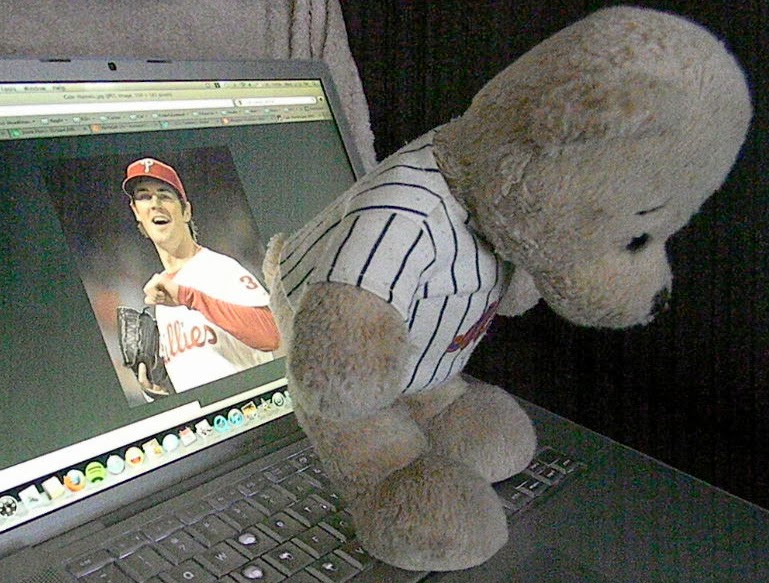
Hi!  This is Iggy Beartran, your expert on all things Cole Hamels.  On Friday, the Mets traveled to Philadelphia to face the richest ass in the world.  Naturally, they were on like Donkey Kong, scoring six runs on ten hits off the smarmy southpaw.  But that's nothing new for the Mets, who can be seen beating up on Hamels almost as often as Mo Vaughn can be seen at the head of the line at an all-you-can-eat buffet.  (Almost.)

Cole Hamels, who was gunning for his 100th career victory on Friday, has lost 13 of 20 decisions to the Mets in his career.  His 13 losses are the second-most defeats by a Phillies pitcher against the Mets.  Meanwhile, sixteen Phillies pitchers have defeated the Mets more often than that smiling ass has.

But wait, there's more.

  • Including Friday's game, Hamels has been touched for ten hits or more in eight of his 243 career starts, meaning that he allows double-digit hits approximately once every 30 starts.  But of those eight games with ten-plus hits allowed, four of them have come against the Mets.
  • Since the beginning of the 2011 season, Hamels has allowed six or more runs in a game half a dozen times.  Three of those six games came against the Mets.
  • David Wright is one of three players with 40 or more career at-bats versus Hamels to have a batting average over .340 against him.  (In 63 at-bats, Wright is hitting .349 against Hamels.)  The other two are Wright's former Mets teammates, Scott Hairston (.395) and Jose Reyes (.393).
  • Cole Hamels has never allowed more than five homers to any one batter.  He has also never allowed any hitter to collect more than 15 RBI off him.  What has Wright done against him in those categories?  Five home runs, 15 RBI.

The Mets have not performed particularly well over the past five seasons.  But that's just because they haven't been able to face Cole Hamels 162 times a year.  Because of his comments about the Mets being choke artists following the 2008 campaign, Hamels has been viewed as a gigantic ass by Mets fans.  But the Mets have done nothing but knock him around for loss after loss since then.  In essence, they have been quite literally kicking ass every time they face him.

It's enough to make even his identical twin brother smile.


Saturday, March 30, 2013

Milestones And The Mets Who Can Reach Them

As is common before the beginning of each season, many bloggers and reporters write about those Mets players who are approaching statistical milestones in their careers.  At Studious Metsimus, we enjoy our stats - sometimes a little too much - just like everyone else.  Therefore, we'd also like to contribute our list of players and personnel who are approaching career milestones.

But of course, this is Studious Metsimus, so why should you expect the typical milestones you can find anywhere else?  And why stop at just Mets players reaching milestones, when the entire Mets team is approaching a few milestones as well?

So sit back and enjoy.  And when one of the players (or the entire team) reaches a milestone, feel free to tweet about it before anyone else and watch as your dozens, hundreds or thousands of followers retweet you left and right or ask you if you got this from Studious Metsimus.  Claim ignorance if it's the latter.  That's what yours truly would do.


Individual Milestones Within Reach

David Wright won't wear a "C", but he does wear an "M" for Milestones.

David Wright:
  • Needs 74 hits for 1,500 (or half of the magic 3,000 plateau)
  • Needs 16 homers for 220 (would tie Mike Piazza for 2nd most in Mets history)
  • An All-Star Game selection would be his 7th (would tie Darryl Strawberry and Piazza for 2nd most in club annals)
  • Needs 1 sacrifice fly to knock Ed Kranepool off another perch (Wright and Kranepool are currently tied for the team lead with 58 sacrifice flies - tip of the Mets cap to Mark Simon for pointing this out, even if Kranepool himself would probably want this to stay on the down low)


Daniel Murphy:
  • Needs 33 hits for 500 (nowhere near the magic 3,000 plateau)
  • Needs 31 games for 500 (would become 41st Met to reach that mark)


Ike Davis:
  • Needs 33 doubles for 100 (clearly he's still early in his career)
  • Needs 42 homers for 100 (would also break the team's single-season HR record)


Ruben Tejada:
  • Needs 1 homer for 3 (tying Rick Aguilera, Juan Samuel and Kelvin Chapman - and breaking a tie with Mike Nickeas)


Lucas Duda:
  • Needs 8 runs for 100 (a total reached 19 times by a Met in a single season; this is Duda's fourth season in New York)
  • Needs 1 strikeout for 200 (and a congratulatory boo from the Citi Field crowd)
  • Needs 1 furniture mover to avoid another embarrassing off-season injury (duh!)


Terry Collins:
  • Needs 24 wins to tie Casey Stengel for 9th most wins in team history
  • Needs 53 wins to tie Jerry Manuel for 8th most wins in team history
  • Needs 78 wins to tie Dallas Green for 7th most wins in team history
  • Needs 109 wins and a World Series title to shut Greg Pomes up
  • Needs 3 inches between his number and his his belt to stop dressing like Steve Urkel

Terry Collins prepares for "Family Matters Night" at Citi Field.


Bobby Parnell:
  • Needs 44 saves to enter the Mets' all-time top ten in saves (and break Armando Benitez's single-season team record)
  • Needs 5 saves to pass Anthony Young for most saves by a homegrown Met since 1990


Jonathon Niese:
  • Needs 202 strikeouts to enter the Mets' all-time top ten in Ks
  • Needs 23 strikeouts to match Nolan Ryan's totals as a Met (sigh...)
  • Needs 16 starts and 12 wins to have more than Johan Santana had as a Met (double sigh...)


Johan Santana:
  • Needs 1 start to make more starts than anyone expects him to make this year (triple sigh...)

"Oh, crap.  I'm missing another full season."

Team Milestones Within Reach

70,000 hits:
  • Through 51 seasons, the Mets have collected 69,041 hits.  With 959 more hits, the Mets will reach the 70,000 mark.  The only years the Mets failed to reach 959 hits were in 1981 and 1994, both strike-shortened seasons.  As long as the Mets don't bring back Jason Bay, this milestone should be reached in late August or early September.  Plan your trip to Citi Field accordingly.

5,000 stolen bases:
  • The Mets should have reached this milestone last year, but stole only 79 bases in 2012 - their lowest full-season total since 2003.  How much of a station-to-station team were the Mets in 2012?  They stole one more base than Jose Reyes stole by himself in 2007.  The Mets' non-pilfering tendencies caused the team to finish the 2012 season with 4,998 steals, leaving the team two thefts short of the magic 5,000 plateau.  They could reach that figure on Opening Day or it could take them an entire month.

50,000 strikeouts:
  • If only this was 50,000 strikeouts by Mets pitchers.  But since the Mets traded all-time strikeout king Nolan Ryan before he became the Ryan Express, this 50,000 figure refers to the number of times Mets hitters have whiffed.  When the team strikes out for the 549th time this year (which should happen sometime in late June), they can thank several of their human windmills for helping this nightmare come true.  Without the likes of Dave Kingman, Jeromy Burnitz, Mo Vaughn and other futile flailers, this milestone would not have been possible by 2013.

The more Mo Vaughn struck out, the faster he could partake of the post-game spread.

Monday, March 18, 2013

The Mets That Got Away: Jeromy Burnitz

The Mets have made their fair share of questionable trades over the years.  On occasion, some of those traded players found their way back to New York.  Players like Rusty Staub, Dave Kingman, Tom Seaver and David Cone went on to accomplish great things in between their first and second stints with the Mets.

Staub was an RBI machine in Detroit.  Kingman nearly had a 50-homer season with the Cubs.  Seaver pitched a no-hitter in Cincinnati.  Cone did the same in the Bronx, although his game was perfect and he also added World Series rings for each finger on his pitching hand.

All four returned to New York hoping to recapture their past glory.   But Staub spent most of his time as a pinch-hitter (albeit a great one) before retiring in 1985.  Kingman made Mario Mendoza look like a batting champion before he was released.  Seaver had his worst season as a Met, then was left unprotected in the free agent compensation draft.  And Cone made only four starts before calling it a career.

Staub, Kingman, Seaver and Cone aren't the only former Mets who were traded away before eventually returning to the team.  In fact, one former Met has the dubious distinction of being jettisoned by the team twice, only to see his performance on the field improve exponentially both times he was dealt.

Jeromy Burnitz, in a baseball card photo taken before he was a two-time former Met.

Jeromy Neal Burnitz was the Mets' first round pick in the 1990 June amateur draft.  Burnitz was selected 17th overall, three picks ahead of 270-game winner Mike Mussina.  After splitting time between Pittsfield and St. Lucie in 1990, Burnitz had a stellar season at AA-Williamsport in 1991.  Burnitz's first full minor league campaign resulted in the Eastern League's first 30-30 season, as the outfielder hit 31 home runs and stole 31 bases for the Bills.  The Mets took notice of their young star's performance, honoring him with a Doubleday Award.

Burnitz was promoted to AAA-Tidewater in 1992, but saw a sharp decrease in his power numbers.  The outfielder managed to hit only eight home runs in 121 games for the Tides, just one year after slamming nearly four times that amount at the Double-A level.  In 1993, Burnitz found himself once again at Tidewater, hitting .227 with eight home runs in 65 games.  But the Mets were having a rough time settling on a regular centerfielder, as Ryan Thompson, Joe Orsulak, Dave Gallagher and Darrin Jackson had all started at least ten games at the position before spring turned to summer.  As a result, Burnitz was called up to the Mets on June 21.  Eight days later, he let the world know he had arrived.

On June 29, the Mets won an extra-inning slugfest against the Florida Marlins, coming from behind to win, 10-9.  Burnitz went 3-for-5 in the game with two doubles and a home run.  He tied the game in the third inning with his first big league home run.  Four innings later, Burnitz laced an RBI double to give the Mets a temporary two-run lead.  Finally, in the 12th, Burnitz led off the inning with a long double and scored the eventual winning run on a sacrifice fly.

After smoking the Marlins in late June, Burnitz continued to scorch the rest of the National League in the month of July.  In his first ten games in July, Burnitz hit .355 with three homers and 10 RBIs.  But as great as he was in July, Burnitz saved his best game for August.

In a game against the Montreal Expos on August 5, Burnitz became the first Mets rookie (and sixth Met overall) to drive in seven runs in a game.  Burnitz rapped an RBI single in the first and a grand slam in the fifth to give the Mets a seemingly insurmountable 9-1 lead.  By the end of the sixth, the lead had evaporated, as three Mets pitchers combined to allow eight runs.  The game remained tied until the 13th inning, when Joe Orsulak drove in the go-ahead run with a single and Burnitz added two insurance runs - his sixth and seventh RBIs of the game - with a double down the right field line.  The Mets went on to win the game, 12-9.  Burnitz's record-setting performance was accomplished off two of the best pitchers of the era, as his seven RBIs came against Dennis Martinez (245 career wins) and John Wetteland (330 lifetime saves).

Burnitz finished the season strongly, with a .260/.383/.506 slash line in September, collecting nine extra-base hits, scoring 15 runs and driving in ten.  Burnitz only had 263 at-bats for the Mets in 1993, but they were quite productive, as he picked up ten doubles, six triples and 13 homers.  He also scored 49 runs and had 38 RBIs, making it easy to overlook his .243 batting average.  For all the promise Burnitz showed in 1993, he failed miserably one year later.  And his disciplinarian manager was not amused.

Jeromy Burnitz was a hothead.  So was his manager, Dallas Green.  Something had to give, especially after Burnitz lost his temper during a poor spring training at-bat.  When Burnitz was hitting .192 after the season's first month, something finally did give.  Burnitz was sent back to the minors, less than a year after bursting onto the major league scene.

With Norfolk, Burnitz continued to hit with power (15 doubles, five triples, 14 homers) but maintained a low batting average (.239).  After over two months at Norfolk, Burnitz was finally recalled on July 22.  Three weeks later, Major League Baseball was shut down by a players' strike, but not before Burnitz got to play in 18 games.  He continued to be an enigma at the plate, hitting a more respectable .292, but did so without hitting a home run and striking out 19 times in 65 at-bats.

By November, Burnitz had finally found a way out of Dallas Green's doghouse, as the former first round pick was traded to the Cleveland Indians for pitchers Paul Byrd, Jerry DiPoto and Dave Mlicki.  Byrd and DiPoto were both ex-Mets by 1997, while Mlicki hung around until 1998 (one year after famously shutting out the Yankees in the first-ever regular season game between the two New York teams).  Meanwhile, Burnitz was just getting started.

Burnitz only had seven at-bats with the Indians in 1995, as he spent the majority of the year in the minors.  In 1996, Burnitz had trouble getting into the everyday lineup, collecting 128 at-bats for Cleveland.  Of course, anyone would have had trouble cracking a lineup that featured outfielders Albert Belle, Kenny Lofton and Many Ramirez.  Even the designated hitter position was occupied, as Cleveland was using Eddie Murray as their non-fielding batter.

With no definite position in Burnitz's immediate future, the Indians traded him to Milwaukee for six-time .300 hitter Kevin Seitzer.  Seitzer played in 86 games with Cleveland before retiring after the 1997 campaign.  Burnitz, on the other hand, went on to become one of the most feared power hitters in baseball.

After finishing out the 1996 season in Milwaukee, Burnitz had a true breakout year in 1997.  In his first season as an everyday player, Burnitz set career highs across the board, batting .281 with 37 doubles, eight triples, 27 homers, 85 RBIs, 85 runs scored and 20 stolen bases.  Burnitz became the second player in Brewers history to achieve to 20 HR/20 SB season, joining future Hall of Famer Robin Yount, who hit 23 homers and stole 20 bases for Milwaukee in 1980.  As great as Burnitz's season was in 1997, he improved upon it in 1998.

Burnitz was a one-man wrecking crew in his second full season in Milwaukee.  On a team in which no other player hit more than 16 homers or surpassed 68 RBIs, Burnitz had himself a 38 HR, 125 RBI campaign.  At the time, the 38 home runs represented the fourth-highest single-season total in Brewers' history and the 125 RBIs were one short of Cecil Cooper's team record of 126 RBIs, which he set in 1983.  Burnitz also became the eighth Brewer to amass 300 total bases in a single season, joining Robin Yount, Cecil Cooper, Ben Oglivie, Paul Molitor, George Scott, Tommy Harper and Gorman Thomas.  As great as his season was, perhaps nothing satisfied Burnitz more than when he homered off Dave Mlicki - one of the players for whom he was traded - in his first career at-bat against the Mets.

Dave Mlicki might have been able to shut out the Yankees, but he couldn't shut down Jeromy Burnitz.

In 1999, Burnitz finally got some much-needed help in the lineup, as three of his teammates (Dave Nilsson, Geoff Jenkins, Marquis Grissom) reached the 20-HR mark.  Burnitz finished the year with a .270 batting average, 33 doubles, 33 homers, 103 RBIs and 91 walks.  The better plate discipline - which he never had as a Met, much to Dallas Green's dismay - helped Burnitz achieve a .400 on-base percentage for the first time in his career.

It was more of the same for Burnitz over the next two seasons, as his 2000 campaign (29 doubles, 31 homers, 98 RBIs, 91 runs scored, 99 walks) and 2001 season (32 doubles, 34 homers, 100 RBIs, 104 runs scored, 80 walks) were virtual mirror images of each other.

But after hitting .271 over his first three full seasons in Milwaukee, Burnitz experienced a steep decline in his batting average, combining to hit .242 in 2000 and 2001.  The 2001 campaign would be Burnitz's last season in Milwaukee, as the Mets desperately needed to upgrade their offense and thought Burnitz would be part of the solution.  If only they had bothered to notice the downward trend in his batting average.

Following the 2001 season, a year in which the Mets failed to defend their National League crown and needed a strong September to finish the year above .500, general manager Steve Phillips decided the team needed to go shopping.  But with the Mets already trying to pare their lofty payroll, Phillips decided he would have to fix the team's deficiencies via the trade route rather than by signing free agents.

First, Phillips tried to pry John Smoltz away from the Braves to no avail.  When that didn't pan out, Phillips focused squarely on upgrading the team's offense.  By the time the calendar flipped to 2002, Roberto Alomar, Mo Vaughn and Roger Cedeño had been acquired by the Mets.  The Mets then set their focus on acquiring one more big bat, doing so when they traded for Jeromy Burnitz.  However, the cost for reacquiring the lefty slugger was steep, as the Mets lost Lenny Harris, Glendon Rusch, Benny Agbayani and Todd Zeile in the three-team deal.

The Mets were surprisingly competitive over the first four months of the 2002 season.  Heading into August, the team was in second place in the NL East with a 55-51 record, leaving them a reachable 4½ games behind the wild card-leading Dodgers.  The Mets were winning despite not having typical seasons by Alomar, Vaughn and Cedeño.  But the one new addition who really underachieved to the point of having an awful season was Jeromy Burnitz.

Second verse, same as the first.

After reaching the 30-HR mark in each of his previous four seasons, Burnitz failed to hit 20 home runs for the Mets.  His batting average, which had already begun to drop during his last two seasons in Milwaukee, plummeted in 2002.  Burnitz struggled to stay above .200 all year and was drawing fewer walks than he did as a Brewer.  During the Mets' season-changing 12-game losing streak in August, Burnitz managed only three hits and struck out in 40% of his at-bats.  The Mets fell to last place for the first time since 1993, with Burnitz finishing the year with a .215 batting average, 15 doubles, 19 homers and 54 RBIs.

The Mets began the 2003 season as poorly as they finished in 2002.  By May 13, New York was already ten games behind Atlanta and seven games behind Montreal for the wild card.  One month later, Steve Phillips was relieved of his duties, replaced by Jim Duquette.  By the end of June, it was clear that the Mets were not going to compete for a playoff spot, as the team was buried in the NL East cellar.  As a result, Duquette decided to restock the team's farm system by trading off its high-priced players.  One of the casualties was Jeromy Burnitz.

After an immensely disappointing season in 2002, Burnitz had actually earned some trade value during the first half of the 2003 campaign.  Burnitz missed a month of action due to a broken hand caused by an errant Billy Wagner fastball, but once he returned on May 23, he started to tear the cover off the ball.

In his first nine games after returning from the disabled list, Burnitz hit .412 with four homers and 13 RBIs.  By June 1, Burnitz had his batting average up to a season-high .324.  Burnitz had another hot streak shortly before the All-Star Break, driving in at least one run in seven consecutive games from July 2 to July 9.  One week later, Burnitz was gone, as Duquette jettisoned the outfielder to Los Angeles for three prospects, including Victor Diaz.

Burnitz's first-half totals with the Mets were excellent (.274, 18 doubles, 18 HR, 45 RBIs in only 65 games).  With the Dodgers, Burnitz regressed, batting .204 with only four doubles, 13 HR and 32 RBIs in 61 games.  Needless to say, the Dodgers let Burnitz leave as a free agent at the end of the 2003 season.

Now in his mid-thirties, Burnitz was hoping another team would give him a shot to prove that he could still play at a high level.  He did get that shot, and it came with a team that was used to playing at a high level.

Would this be called a "Mile-High Five"?

The Colorado Rockies took a chance on Burnitz, signing him to a one-year deal to play in the Mile High City in 2004.  Burnitz rewarded them immediately, batting .302 with 16 homers and 46 RBIs in his first 53 games.  Burnitz saved his best month for July, when he had an incredible .360/.424/.809 slash line.  During the month, Burnitz collected eight doubles, one triple, 10 homers and 27 RBIs despite starting only 22 games.  His renaissance season saw Burnitz finish the year with a career-high .283 batting average.  He also hit 30 doubles and 37 home runs, while driving in 110 runs and scoring 94 times.

Despite his phenomenal season, Colorado declined to pick up Burnitz's option for the 2005 campaign, allowing the slugger to become a free agent.  Burnitz almost signed with Colorado's division rival in Arizona, agreeing in principle to a two-year deal with the Diamondbacks.  But that deal was pulled from the table after Arizona completed a three-team trade with the Dodgers and Yankees that made Shawn Green their new rightfielder.  The deal also sent Randy Johnson to the Yankees, while the Yankees shipped Javier Vazquez to the Dodgers.

Although he was disappointed that he had just lost the security of a multi-year contract, Burnitz continued to look for a new team and finally found one when the Chicago Cubs signed him to a one-year, $4.5 million deal with a $7 million option for a second year.  But Burnitz was going into a pressure situation with the North Siders, as he was being asked to replace Cubs' icon Sammy Sosa in right field.

Burnitz had a solid season for the Cubs, batting .258 with 31 doubles, 24 homers, 87 RBIs and 84 runs scored while playing in a team-high 160 games.  But those numbers paled in comparison to Sosa, who averaged 48 HR and 123 RBIs from 1995 to 2004.  As a result, the Cubs decided to buy out Burnitz for $500,000 rather than pick up his option for 2006, leaving Burnitz to become a free agent for the third straight year.

Once again, Burnitz had a two-year deal on the table, this time with the Baltimore Orioles.  But because of language in the contract that would allow Baltimore to take their time making the deal official, Burnitz decided to sign a one-year contract with the Pittsburgh Pirates with a second year option that would pay him the same amount of money as Baltimore's two-year deal.  Ironically, the Orioles' executive who tried to negotiate the deal with Burnitz was Jim Duquette, who only two years earlier had traded Burnitz to the Dodgers while he was the Mets' general manager.

It's quite possible that one of the underlying reasons why Burnitz chose to pass on the deal with Baltimore was because of his relationship with the former Mets GM.  Burnitz showed no love for his time with the Mets when he mentioned New York fans in a statement he made to reporters after failing to run out a ground ball in Pittsburgh. 

"I apologize for that.  It seems like I'd hit 20 balls in a row like that, rollovers to first.  The fact is, I went and looked at it, and I had no chance.  He would have thrown me out.  But the effort that they expect - and they jumped on me for it - I apologize if I don't play hard enough. I have a reputation for playing hard.  I heard the boos.  And I've heard 'em before.  If I poke my head out of the dugout in New York, there would be 40,000 of them.  Loud, too."

If Burnitz didn't have love for New York, then he certainly couldn't have loved his time in Pittsburgh.  After getting off to a slow start (.234, 8 HR, 26 RBI, .289 OBP in the team's first 50 games) and saying that manager Jim Tracy was forced to keep him in the everyday lineup because he was "Joe High-Paid Free Agent", Tracy decided to put Burnitz in a platoon with some of the Pirates' younger players.

As a result, Burnitz played in just 111 games, his lowest full-season total since becoming an everyday player with the Brewers in 1997.  Burnitz finished the year with only 28 extra-base hits after averaging 29 doubles and 30 homers over the previous nine seasons.  He also hit .230 and had a career-worst .289 on-base percentage, a number that was even lower than his OBP during his forgetful 2002 campaign with the Mets.

At season's end, Pittsburgh declined to pick up Burnitz's option for the 2007 season.  This time, Burnitz was unable to find another suitor, causing him to retire from baseball at the age of 37.

Jeromy Burnitz was a five-tool player in the minor leagues who occasionally forgot to sharpen his fifth tool (batting average), while neglecting to use one of his other tools (speed).  He was a 30-30 player as a Mets' farmhand, but surpassed seven stolen bases in the majors only twice in 14 seasons.  The Mets never got the Burnitz they saw in the minor leagues and gave up on him two years into his major league career.  Nearly a decade later, they gave him a second chance and once again, they decided to send him packing.  Both times, Burnitz proved to the Mets that he was better off without them.

In 5½ years with Milwaukee, Burnitz became one of the Brewers' top power threats in franchise history.  From 1997 to 2001, Burnitz averaged 32 doubles, 33 homers and 102 RBIs per season.  His 125 RBIs in 1998 are more than any Met has ever achieved in 50-plus seasons (Mike Piazza and David Wright share the single-season franchise record with 124 RBIs).  In 1997 and 1998, Burnitz received National League MVP votes and he was selected to represent the Brewers in the All-Star Game in 1999.

On a team that has had great hitters over the years (Robin Yount, Paul Molitor, Prince Fielder and Ryan Braun come to mind), Burnitz was able to crack Milwaukee's all-time top ten list in various offensive categories.  He ranks among the team leaders in home runs (165; 9th in Brewers' history), walks (423; 8th), on-base percentage (.362; 7th), slugging percentage (.508; 4th) and OPS (.870; 4th).  Burnitz's 525 RBIs as a Brewer had him in the top ten until recently, when both Prince Fielder and Ryan Braun passed him.  Burnitz was also the first Brewer in team history to hit 30 or more home runs in four consecutive seasons, accomplishing the feat from 1998 to 2001.  All this from a player who never hit 20 home runs in a season for the Mets in parts of four years with the team.

Although Jeromy Burnitz accomplished many things as an individual (six 30-HR seasons, four 100-RBI campaigns), he always seemed to achieve them on teams that did not go on to great things.  The Brewers finished with a losing record in each of his nearly six seasons in Milwaukee.  All four Mets teams he played for (1993, 1994, 2002, 2003) finished below .500, as did the 2004 Rockies, 2005 Cubs and 2006 Pirates.

Burnitz never got to taste the postseason as a major league player and rarely got to experience a pennant race.  Still, he finished his career with 315 home runs, nearly 300 doubles and just under 1,000 RBIs.  It's not a career that he should be ashamed of.

The Mets gave up on Burnitz twice during his career.  The first time, it was because the manager didn't like him and he was underachieving.  The second time, it was because he had finally started to achieve but was now too expensive to keep around on a rebuilding team.  Both times, Burnitz blossomed after the Mets let him go.  And both times, the Mets became competitive within a few years of his departure.  But despite the team's successes soon after Burnitz's dual departures, the Mets have been missing one thing - a regular rightfielder.

Darryl Strawberry left the Mets as a free agent following the 1990 season.  Burnitz made his debut three years later, and spent parts of four seasons in New York during his two tours of duty with the team.  In those four seasons, Burnitz started 262 games in right field.  Believe it or not, that's more games than any Met has started in right field since the Straw Man's departure.  The only other Mets to start more than 200 games in right field since 1990 are Bobby Bonilla (226 starts) and Butch Huskey (202 starts).  Strawberry started 1,064 games in right field during his eight years as a Met.  That's just 48 more starts than Jeromy Burnitz had as a rightfielder for the other teams he played for during his career.

Perhaps the Mets shouldn't have let go of Burnitz's booming bat.  Perhaps he would have accomplished great things in New York.  And perhaps the Mets wouldn't have gone into a seemingly endless cycle of searching for a regular rightfielder.  But one thing is for certain.  Both Burnitz and the Mets accomplished great things when they weren't married to each other.  The double divorce, though not exactly amicable, was the best thing that could have happened to all the parties involved. 

Now if only the Mets could stop playing musical chairs with the right field position...


Judging by these quotes, Jeromy Burnitz wasn't exactly cut out to handle the New York media.  


Note:  The Mets That Got Away is a thirteen-part weekly series that spotlights those Mets players who established themselves as major leaguers in New York, only to become stars after leaving town.  For previous installments, please click on the players' names below:

January 7, 2013: Nolan Ryan
January 14, 2013: Melvin Mora  
January 21, 2013: Kevin Mitchell 
January 28, 2013: Amos Otis
February 4, 2013: Jeff Reardon
February 11, 2013: Lenny Dykstra
February 18, 2013: Jeff Kent
February 25, 2013: Randy Myers
March 4, 2013: Ken Singleton 
March 11, 2013: Mike Scott
 

Saturday, July 28, 2012

The Terrible Twos Befall The Mets Again

They were fun, they were lovable, but this was as high as the 1962 Mets got in the National League standings.

The New York Mets got their start in a year ending in a '2'.  In 1962, no one expected much from the expansion team.  They were fun.  They had a colorful manager.  And they were the worst team in baseball history, losing 120 games, a number that could have been higher had it not been for two rainouts that were not made up.

But the 1962 Mets actually had a decent recovery after their 0-9 start.  For approximately one month (April 23 - May 20), the Mets did not play like an expansion team.  Their 12-10 record over that time period vaulted them ahead of their expansion counterparts in Houston and even pushed them past the more established Chicago Cubs in the National League standings.  But soon after, reality caught up to the 1962 Mets and never let go, as they went 28-101 the rest of the way to finish buried in the Senior Circuit cellar.

Although the original Mets were never expected to do much, their limp to the finish after a crisp stretch of baseball is something that has befuddled the team in every year ending in a '2'.  Saturday morning cartoons taught us that 3 is a magic number, but for the Mets, '2' was their black magic number.  Every year ending in a '2' started off so well for the Mets, then with one stroke of the magic wand - presto, change-o - the team morphed into a shadow of their first-half selves, dashing our heightened hopes with loss after loss.  It all started in 1962 and has continued throughout the decades without fail.

In 1972, the Mets got off to the best start in franchise history.  After defeating the Braves on June 3, the Mets were sitting pretty in the NL East, with a 31-12 record and a five-game lead over the defending World Series champion Pirates.  But that June 3rd game did not end well, as a wayward George Stone pitch struck the hand of Rusty Staub, injuring the Mets' rightfielder and best offensive threat.  Although Staub was not placed on the disabled list immediately, the hand injury caused him to miss a total of three months.  The Mets went 36-46 in his absence and finished in third place in the NL East, 13½ games behind the Pirates.

Ten years later, the Mets thought another outfielder would lead them to the promised land.  In 1982, George Foster was acquired by general manager Frank Cashen in a trade with the Cincinnati Reds.  The Mets had just come off a campaign in which they competed for the 1981 second half division title (the strike-shortened 1981 season was divided into two halves, with the first half division winners squaring off against the second half winners in an extra round of playoffs) and Cashen thought adding a slugger to the mix would push the Mets over the top in 1982.  It turned out to be one of his rare misses in an otherwise outstanding tenure as Mets' GM.


In 1982, George Foster spoke softly but left his mean stick in Cincinnati.

Foster was awful in his first season in New York, but the Mets were winning despite him.  After an extra-inning victory on Father's Day, the Mets stood only three games out of first place with a 34-30 record.  After June 20, every team in the National League East had a winning record.  The Mets, on the other hand, went 31-67 after the Day of the Dad to finish in the NL East cellar, 27 games behind the eventual World Series champion Cardinals.

The 1992 Mets were full of hope after loading up their roster with veteran players and a former Manager of the Year Award winner.  Bret Saberhagen, Eddie Murray, Bobby Bonilla and Jeff Torborg were all part of a Mets team that was trying to erase the memories of a poor 1991 campaign, the first losing season for the Mets since 1983.  Instead, they became "The Worst Team Money Could Buy". 

But before they became the team that inspired Bobby Bonilla to become author Bob Klapisch's Bronx tour guide, the Mets actually looked like a contender.  After their 15-1 drubbing of the two-time defending division champion Pirates on June 6, the Mets found themselves in second place, a mere two games behind the Pirates.  But then, everything came crashing down on the Mets.  Bobby Bonilla (.249, 19 HR, 70 RBI) finished his first season in New York as the winner of the Player Most Likely To Be Booed award.  Eddie Murray managed to hit a measly 16 HR, his lowest home run output since he became a major leaguer in 1977.  And Bret Saberhagen spent most of the season on the disabled list, winning a career-low three games in 15 starts.  Needless to say, the team suffered after June 6, going 44-64 the rest of the way to finish 24 games behind the Pirates.

If the 1992 squad was the worst team money could buy, then the 2002 team was its kissing cousin.  After a disappointing 2001 campaign, in which the Mets followed up their pennant-winning 2000 season with a mediocre 82-80 record, general manager Steve Phillips decided to go shopping.  A lot.  Phillips completely restructured the team, bringing in Roberto Alomar, Mo Vaughn, Jeromy Burnitz, Roger Cedeño, Pedro Astacio, Shawn Estes and Jeff D'Amico, to name a few.   The new faces helped the team do well in the first half.  The Mets were tied for first place on May 29 and were still above .500 as late as June 29.  But the wear of tear of the season (as well as the declining talent level of the new acquisitions) caught up to the team in the second half.

Why so glum, Mo?  Did someone get to the post-game spread before you?

The Mets were in third place, 7½ games out of first on June 25 with a 39-37 record.  From that point on, they had the worst record in the division, going 36-49 to finish in last place for the first time since 1993, a year that featured the haul from the last big shopping spree conducted by a Mets general manager.

That brings us to 2012.  This year's team started off so well.  The Mets surprised everyone by winning their first four games of the season.  On June 3, the Mets found themselves eight games above .500 (31-23) and in a share of first place.  As late as July 7, the Mets were 46-39 and holders of the second wild card spot in the National League.  Then poop happened.  And it hasn't stopped happening.

Since July 7, the Mets have lost 13 of their last 15 games.  Their strong starting rotation has taken a hit, with Johan Santana becoming the first Met since Pedro Astacio in 2002 (naturally, it had to happen in a year ending in a '2') to allow six or more runs in three consecutive games.  In addition, R.A. Dickey has looked like a mere mortal (5.36 ERA in seven appearances since June 24), and Jonathon Niese just took a page out of Fred Wilpon's book, as he was "snakebit, baby" in Arizona last night.  That loss left the Mets a season-high 7½ games behind the Braves for the final wild card spot.  The Mets were already 11½ games behind the first place Nationals in the NL East.

This year's Mets might not have as many high-priced free agents and overpaid malcontents as their predecessors had in other years ending in a '2' (the 1962 and 1972 teams played in an era before free agency), but the one thing they do have in common is their second half performance after a decent to strong first half.

Although the Mets showed so much potential in April, May and June (who didn't think the first no-hitter in team history was a sign of things to come), the terrible twos have befallen the team once again.  It's a trend that inexplicably befuddles the Mets every ten seasons.  It's a trend that will hopefully end before 2022 comes around.

Sunday, February 12, 2012

Long-Term Deals Lead To Long-Term Headaches


In 2006, the Mets needed one more win to reach the World Series.  When they failed to do that, they decided to go shopping for a pitcher that would help them get that win.  Barry Zito was the name on everyone's minds that offseason.  In seven years with Oakland, Zito had an impressive 102-63 record and a 3.55 ERA.  From 2001 to 2006, Zito made at least 34 starts in every season and did not pitch fewer than 213 innings in any of those campaigns.  He was also a three-time All-Star and a former Cy Young Award winner.  But to get him, the Mets would have to pay a pretty penny.  They'd also have to give him many years.

The San Francisco Giants beat the Mets to the punch, signing Zito to a seven-year, $126 million contract.  At the time, it was the largest contract ever offered to a pitcher.  Zito has thanked the Giants for their generosity by going 43-61 with a 4.55 ERA over the first five years of his contract.  The Giants thanked him back by leaving him off the World Series roster in 2010.

It could have been the Mets paying for Zito over the past five seasons.  Before becoming a Giant, Zito's lifetime numbers (102-63, 3.55 ERA, 222 starts, 1,096 strikeouts) looked a lot like what Ron Darling put up with the Mets (99-70, 3.50 ERA, 241 starts, 1,148 strikeouts).  Since then, Zito has been paid an average of $18 million per year to pitch like Al Jackson.  (Jackson went 43-80 with a 4.26 ERA as a Met.)

Fortunately, the Mets didn't give Zito the long-term deal afforded to him by the Giants.  But that hasn't stopped them from giving other deals of four years or more to pitchers.  In fact, over the past decade the Mets have given a number of long-term deals (four years or more) to various pitchers and although they haven't been Zito-esque, they still weren't rewarded the way they expected to be.  Let's take a look at those faulty deals.


2000:  Armando Benitez - Four years, $22 million

After long-time Mets closer John Franco was sidelined with an injury in 1999, Armando Benitez stepped in and became the team's closer.  Benitez helped the Mets end an 11-year playoff drought in 1999, but gave up a game-tying single to Ozzie Guillen (yes, that Ozzie Guillen) in the tenth inning of Game 6, with the Mets two outs away from forcing an improbable Game 7 after losing the first three games of the series.  It would not be the first time Benitez would blow a lead in a crucial game.  However, it didn't stop the Mets from signing him to a four-year deal during that offseason.

In 2000, Benitez was armed with a new contract to go with his blazing fastball.  He set the Mets' single season record with 41 saves and was part of the team's first World Series appearance since 1986.  But he gave up a game-tying three-run homer to the Giants' J.T. Snow in Game 2 of the NLDS, a game eventually won by the Mets in extra innings when John Franco, the man Benitez replaced as closer only a year before, struck out Barry Bonds to tie the series.  Franco couldn't help him in Game 1 of the World Series, as Benitez gave up a walk, two singles and a game-tying sacrifice fly in the ninth inning, blowing yet another save in a crucial postseason game.  The Mets went on to lose the game and the series to the Yankees.

The following season, the Mets didn't make the playoffs, but that didn't stop Benitez from blowing huge saves.  In 2001, the Mets were attempting to make a 1973-like run to the top of the division.  After starting the year with a 54-68 record, the Mets went on a tear, winning 22 of their next 27 games to pull to within 3½ games of the first place Braves.  With the Mets one out away from cutting the lead to 2½ games, Armando Benitez gave up a two-run homer to Brian Jordan and an RBI single to B.J. Surhoff, in a game eventually lost by the Mets in 11 innings, when Jordan hit his second home run in as many at-bats.  A week later, Benitez was at it again, blowing a four-run ninth inning lead by giving up five runs in two-thirds of an inning to the Braves.  By then, Benitez had worn out his welcome in New York, with fans booing loudly every time he came into a game.  With a few months left on his contract in 2003, the Mets were finally able to unload Benitez, trading him to the Yankees who in turn flipped him to Seattle.  Benitez thanked the Mets in 2004 by saving 11 games against them as a member of the Florida Marlins.  He's still waiting for a "you're welcome".


2001: Kevin Appier - Four years, $42 million

After the Mets went to the World Series in 2000, Mike Hampton defected to the Colorado Rockies in order to pay the $121 million tuition bill for their precious school system. (That was his reason for leaving, right?)  Needing to fill the void left by Hampton's departure, the Mets turned to free agent Kevin Appier.  Appier was a 12-year veteran with 136 career wins and a respectable 3.63 career ERA.  Those numbers look good on paper, but most of them were achieved during his first five seasons in the majors.

From 1989-1993, Appier was 59-38 for the Kansas City Royals with a stellar 2.95 ERA.  In the seven years prior to becoming a Met, Appier had gone 77-67 with a 4.11 ERA for the Royals and Oakland A's, hardly the numbers that would earn a player a four-year, $42 million deal in 2001.  But the Mets were desperate, so they overpaid for Appier.

Appier pitched one year for the Mets, going 11-10 with a 3.57 ERA.  Although the ERA was his lowest since 1997, it was still not the kind of season the Mets expected from their $42 million man.  The Mets traded Appier after only one season in New York, sending him to Anaheim for the past-his-prime Mo Vaughn.  Appier won 22 games over the remaining three years of his contract, never pitching again after the deal was done.  Vaughn played 166 games for the Mets, before retiring due to knee problems.  Who says the stomach isn't connected to the knee bone?


2003: Tom Glavine - Four years, $42.5 million

In 2002, the Mets suffered their first losing season since 1996 and first last place finish since 1993.  Much of the blame was placed on their free agent flops, as Mo Vaughn, Roberto Alomar and Jeromy Burnitz brought underachieving to new depths. But another reason for their failures was their pitching staff.  Al Leiter and Steve Trachsel were .500 pitchers.  Pedro Astacio was the rotation's sole winning pitcher at 12-11.  Jeff D'Amico (another free agent flop) won six games.  And Shawn Estes couldn't hit the strike zone or Roger Clemens.  To fix the pitching mess, general manager Steve Phillips imported one of the best pitchers from the Mets' fiercest rival.

Tom Glavine had always been a thorn in the Mets' side.  Prior to 2003, Glavine had gone 17-7 with a 2.82 ERA in 36 starts against the Mets.  The Mets expected great things from the 242-game winner and got a season reminiscent of another eventual 300-game winner named Tom.  Unfortunately, that season was Tom Seaver's 1983 campaign, a season that Glavine mirrored two decades later by going 9-14 for the Mets.

Although Glavine did up his win by two every year for the next three years, he still failed to pitch like the Hall of Famer he will probably become.  Throughout the length of his original four-year deal (the fourth year was an option year based on innings pitched), Glavine was merely a .500 pitcher, going 48-48.  But the sting of losing to the Cardinals in the 2006 NLCS left Glavine wanting more, so he signed a one-year deal to pitch the Mets back to the playoffs.  He got his chance on the final day of the 2007 season.  How did he do?  Let's just say that instead of being the second coming of Tom Terrific, he became the first coming of Tom Horrific, but at least he wasn't devastated by it.  Too bad the same couldn't be said for Mets fans.


2005: Pedro Martinez - Four years, $53 million

In 2004, the Mets had just come off their third consecutive losing season and new general manager Omar Minaya felt the need to make a big splash (a common theme during his time in New York).  Free agent pitcher Pedro Martinez was the big name on the market and Minaya was adamant about signing him.  Martinez was arguably the best pitcher in the American League during his seven-year stay in Boston, going 117-37 with a 2.52 ERA.  He was also a six-time All-Star, three-time Cy Young Award winner, five-time ERA leader and three-time strikeout champion.  But one overlooked fact about Pedro was that in his final season in Boston, his ERA ballooned to 3.90 and his 193 hits allowed were the most he had ever given up in a full season.

Speaking of full seasons, Martinez had only surpassed 30 starts in four of the 11 seasons since he became a full-time starter.  Over his final six seasons in Boston, he had only gone past 30 starts once.  His fragility was the reason why Boston wouldn't guarantee a fourth year, something the Mets eventually did in order to bring him into the fold.

The contract looked like a bargain in 2005.  In his first season in New York, Pedro went 15-8 with a 2.82 ERA and 208 strikeouts.  He also made 31 starts and led the major leagues with his 0.95 WHIP.  However, after winning his first five starts in 2006, Martinez broke down.  And broke down.  And broke down some more.  From May 2006 to the end of his contract in 2008, Martinez went 12-15 with a 5.00 ERA, making only 48 starts, none of which came in the playoffs during the Mets' run to Game 7 of the NLCS.  His contract and injury history made him untradeable, and Martinez did not pitch again in the major leagues until late in the 2009 season, when he helped the Phillies reach the World Series.  Of course.


2006: Billy Wagner - Four years, $43 million

The Braden Looper experiment of 2004 and 2005 failed, to put it mildly.  Although the Mets were headed in the right direction in 2005, improving by 12 wins under first-year manager Willie Randolph, Looper wasn't the right fit for the team coming into late-inning pressure situations.  General manager Omar Minaya felt that a change was needed at the closer position, so he dipped his toe into the free agent waters again.  Enter Billy Wagner, as the Sandman who did his best to give opposing hitters nightmares.

Wagner was outstanding in 2006, becoming the first left-handed pitcher in club history to record 40 saves in a single season.  But Wagner started to fall apart late over the next two seasons.  In 2007, it was his performance on the mound towards the end of the season (6.91 ERA, three blown saves in his final 14 appearances) that helped the Mets give up their seemingly insurmountable lead in the division.  One year later, it was his lack of appearances on the mound that led to the Mets' downfall.

After blowing a save against the Astros on August 2, Wagner did not pitch again in 2008, needing Tommy John surgery to repair his damaged elbow.  Two weeks after Wagner's season-ending injury, the Mets acquired Luis Ayala and he became the club's fill-in closer.  This was the same Luis Ayala who had racked up a whopping nine saves in four seasons with the Washington Nationals.  Two blown saves, two losses and a 5.50 ERA later, Ayala had done more than just blow the lead in various games.  He helped blow the Mets' lead in the division, all while Billy Wagner was collecting his paycheck in the recovery room.  Ayala was gone by 2009, as was Billy Wagner, who made two token appearances after the All-Star Break to up his trade value from getting a bag of golf balls to getting Chris Carter from the Boston Red Sox.  Perhaps the golf balls would have been the better deal.


2008:  Johan Santana - Six years, $137.5 million

A year after the Mets failed to make Barry Zito the highest paid pitcher in baseball, they pulled out their wallets for a far more deserving candidate in Johan Santana.  After completing a deal with the Minnesota Twins for the star lefty (not the first time the Mets sent a bushel of young players to Minnesota for a former Cy Young Award winning southpaw), the Mets signed Santana to a six-year extension, hoping the put the stunning late-season collapse of 2007 behind them.

In his first year in New York, Santana gave the Mets everything they could have wanted and more.  The 29-year-old finished the season with a 16-7 record and a major league-leading 2.53 ERA.  Santana finished third in the Cy Young Award vote and could have finished higher had it not been for the seven games he handed over to the bullpen with the lead that they failed to hold.  (Dang you, Billy Wagner and Luis Ayala!)

In 2009, Santana started the season well (8-3, 2.39 ERA over his first 12 starts), but became an average pitcher over his final 13 starts (5-6, 3.80 ERA) before missing the final six weeks of the season with an elbow injury.  The 2010 season wasn't much different for Santana, who had a fine start (8-5, 2.79 ERA), followed by a sluggish finish (3-4, 3.47 ERA) and another season-ending injury.  However, this injury ended two seasons, as Santana has not thrown a baseball in a major league game since then.  Santana is entering his fifth season with the Mets with a 40-25 career mark in New York, which isn't bad, but the Mets probably expected him to be in the franchise's top ten in wins by now (Steve Trachsel currently rounds out the top ten with 66 wins as a Met).  Instead, Santana is still chasing guys like Craig Swan (59 wins), Mike Pelfrey (50 wins), Al Jackson (43 wins) and Pat Zachry (41 wins).  That's what $137.5 million buys you in the Mets' world.

The Mets have flushed a lot of their money down the toilet by signing pitchers to long-term deals.


In 2007, The Mets wouldn't offer Barry Zito the long-term commitment the Giants did, and rightfully so, as Zito has been one of the worst free-agent signings in baseball history.  However, that doesn't mean the Mets haven't given away (literally) their money to other top pitchers over the past decade.

Since the advent of the 21st century, the Mets have signed six pitchers to deals of four years or more.  Armando Benitez almost made it through the four years, but not before having to tell his kids that the correct pronunciation of their last name wasn't Boo-nitez.  Kevin Appier was traded away after one season for a player who retired before Appier's contract was up.  Tom Glavine was a .500 pitcher throughout his four-year deal, which of course translated into another one-year contract that the Mets and their fans would like to forget.  Pedro Martinez might have ushered in the "New Mets" before Carlos Beltran coined the phrase, but really ushered out his own career after one successful campaign.  Billy Wagner celebrated a division title in the arms of Paul LoDuca, but then had arm troubles of his own.  And Johan Santana still has a chance to earn some of his record-setting contract, but has thus far given the Mets one start in the month of September since becoming the last Met pitcher to record a win at Shea Stadium in 2008.

Bad contracts of four years or more have not been limited to pitchers (see Castillo, Luis) and not all bad contracts doled out to pitchers have been for four years or more (see Perez, Oliver).  But ever since the Mets signed Al Leiter to a four-year deal following the 1998 season, they haven't had much success with long-term contracts for pitchers.  Perhaps Sandy Alderson knows what he's doing by not giving out any contracts of more than two years to a pitcher since his arrival in 2010.  Either that or he's well-read on how Mets pitchers have fared after signing long-term deals in the 21st century.  My guess is on the latter.  Then again, like an Armando Benitez fastball in a crucial spot, it's kind of hard to miss.

Sunday, January 22, 2012

Sandy Alderson Is Trying To Avoid The Year "2" Blues

As the dawn of the new millenium arrived, while people were talking about whether Y2K was going to give them the blues, the Mets were one of the best teams in the National League.  They were in the middle of their only back-to-back playoff appearances in franchise history and things appeared to be on the up-and-up.

Only two years later, the Mets were at the bottom of the NL East standings, becoming laughingstocks of the league and making regular appearances on David Letterman's Top Ten lists due to their futility on the field.  How did the Mets fall so quickly from their perch atop the National League?  Blame it on Y2B, otherwise known as the Year "2" Blues, a condition that occurs every time the calendar ends in a "2".

The Year "2" Blues has taken other forms in the past.  In the Mets' inaugural season of 1962, fans were happy to have National League baseball back in New York.  However, the product on the field was more Little League than National League, as the Mets lost a record 120 games.  Ten years later, the 1972 Mets actually did well, posting an 83-73 record (six games were erased due to the first players' strike in MLB history) and finishing in third place in the NL East.  However, during that strike, the team suffered through the tragedy of losing their manager, Gil Hodges, to a fatal heart attack.

Then came the 1982 season, and Y2B as we know it today hit the Mets will full force.  It all began when the Mets were looking for a power hitter and thought they found one in George Foster.

Don't look at us like that, George.  You were the one who sucked as a Met.


Prior to the 1982 season, George Foster was one of the premier home run hitters in the National League.  In 1977, he became the first player since Willie Mays to hit as many as 50 home runs in a season when he banged out 52 long balls for the Cincinnati Reds.  He followed that up by pacing the NL in homers (40) and RBI (120) in 1978.  In the six years prior to 1982, Foster was a five-time All-Star who averaged 33 HR and 112 RBI per season.  He wasn't just a home run hitter, as he batted over .300 three times and finished the six-year stretch with a .297 batting average.

In his final year in Cincinnati (1981), despite one-third of the season being wiped out by a players' strike, Foster still managed to collect 22 HR and 90 RBI, good for third place and second place in the league, respectively, and earning him his first Silver Slugger Award (the award did not exist prior to 1980).  George Foster was at the top of his game after the 1981 season, making him the top trade target for then-Mets' general manager Frank Cashen.  Oops.

On February 10, 1982, Cashen traded three players to the Reds for George Foster, hoping that this trade with Cincinnati would work out better than the ill-fated 1977 trade of Tom Seaver, which sent the Mets into the chasm they were still in.  Foster responded by turning in the worst full season of his career, batting .247 with 13 HR and 70 RBI in 151 games.  Needless to say, the Mets finished the 1982 season in last place.  Although Foster recovered to pick up 28 HR and 90 RBI for the 1983 Mets, his batting average continued to go down (.241), and his 38 walks kept his on-base percentage down to a career-low .289.  The dozens of fans at Shea Stadium had seen enough of George Foster, and he became the prime target of boo birds until his final game in New York in 1986.

The Mets did win the World Series in 1986, but by then Foster was long gone, having been released by the team in August.  After their championship season, the Mets remained in contention until 1991, when they suffered their first losing season since 1983.  Again, the front office felt a change was needed to bring the team back into contention in the NL East, so they opened their wallets and spent freely in 1992.  What they got in return was The Worst Team Money Could Buy.

Bobby Bonilla.  Bret Saberhagen.  Eddie Murray.  Jeff Torborg.  All four had participated in the postseason for other teams prior to 1992.  All four became Mets to try to recapture their prior successes in New York.  All four tanked in 1992.

For Bobby Bonilla, his free agent signing meant he was coming back home.  In his final season in Pittsburgh, the future Bronx tour guide hit .302 with a league-leading 44 doubles, 18 HR, 100 RBI and 102 runs scored.  Once in New York, his play deteriorated, as he hit .249, drove in 70 runs and scored 62 times.  His 23 doubles were barely half of his 1991 total, although he did improve his home run output by an earth-shattering one (19 HR in 2002).

Bret Saberhagen and Eddie Murray also did poorly in their first seasons in New York, as Saberhagen won only three games in an injury-plagued season and Murray batted only .261 with 16 HR, despite playing in 156 games.  As a result, the Mets lost 90 games for the first time in nine years and did not finish above .500 again until 1997.

Clearly, former Manager of the Year Jeff Torborg did not have a clue how to keep his expensive bunch of underachievers focused as Bonilla became an earplug-wearing, error-questioning, reporter-threatening malcontent, Saberhagen tried to get bleach throwing to become an Olympic event and Murray became the Sultan of Sulk.

One would assume the Mets would have learned their lesson after being hit by the Y2B bug for the second time in 1992.  But we all know what happens when you assume.  We also know that the Mets sometimes have a hard time learning from past mistakes.

In 2002, the Mets were only two years removed from the franchise's fourth World Series appearance.  They followed up their pennant-winning campaign with a disappointing 2001 season, finishing 82-80 and needing a strong final month just to push their record above .500.  General manager Steve Phillips, who wasn't present for the previous Y2B infestations (the Mets were transitioning from Frank Cashen to Al Harazin in 1992), felt the Mets were just a few trades away from erasing the mediocrity of 2001 and returning to the playoffs.  Things didn't work out exactly as planned.

Phillips sought to improve the right side of the infield by acquiring former All-Stars Mo Vaughn and Roberto Alomar.  He also wanted to add power and speed to the outfield.  Enter former Mets Jeromy Burnitz and Roger Cedeño.  Four words can summarize how each player did for the 2002 Mets.

Bust.  Bust.  Bust.  Bust.

If only Mo Vaughn's batting average had been higher than his weight, things could have turned out differently for the 2002 Mets.  Or not.


Mo Vaughn was the only one of the foursome who had anything resembling a productive year for the Mets in 2002 (.259, 26 HR, 72 RBI).  Of course, that came from a player whose average season from 1995-2000 (.306, 38 HR, 118 RBI) left a little more to be desired.

Roberto Alomar, on the other hand, had just come off an MVP-caliber season in 2001 (Vaughn missed the entire 2001 season with an injury).  Alomar hit .336 with 34 doubles, 12 triples, 20 HR, 100 RBI, 113 runs scored and 30 stolen bases for the Cleveland Indians in 2001 and was poised to become the best all-around second baseman in Mets history.  That title still belongs to Edgardo Alfonzo, as Alomar was a shadow of himself in 2002.  In fact, his numbers in 1½ seasons as a Met (.265, 13 HR, 75 RBI, 22 SB) were less than what he produced in his final season in Cleveland.

From 1997-2001, former Met outfielder Jeromy Burnitz was among the most consistent power threats in baseball.  Playing five years in Milwaukee, Burnitz averaged 33 HR and 102 RBI per season and hoped to become the first legitimate power threat in right field for the Mets since Darryl Strawberry switched coasts following the 1990 season.  That did not happen, as Burnitz collected only 19 HR and 54 RBI in 154 games in 2002, while watching his batting average dip to .215.  Burnitz did follow Strawberry in one respect, as he became a Dodger in 2003 after being traded to Los Angeles in July.


Roger Cedeño came out of nowhere to have an amazing season with the Mets in 1999, batting .313 and setting the franchise record with 66 stolen bases.  He was then included in the trade that netted the Mets Derek Bell and 2000 NLCS MVP Mike Hampton, but came back to New York in 2002 to join fellow ex-Met Jeromy Burnitz in the outfield.  He thanked the Mets by reporting to camp out of shape and becoming the worst speedster acquisition since Vince Coleman.  Cedeño finished the 2002 season by batting .260 and stealing only 25 bases in 149 games.  In addition, his once-fleet feet produced only 19 doubles and two triples, but they did develop the uncanny ability to generate boos from the Shea faithful, boos that continued to be heard until the Mets' next winning season in 2005.


That was then.  This is now.  The year is 2012.  It's a Y2B season.


Second-year general manager Sandy Alderson is not falling into the trap his predecessors couldn't avoid jumping into.  There have been no blockbuster trades featuring former All-Stars to report this offseason and the only acquisitions of note have been to strengthen the bullpen (Jon Rauch, Ramon Ramirez, Frank Francisco) and outfield (Andres Torres).  Scott Hairston was re-signed to a one-year deal and four arbitration-eligible players (Mike Pelfrey, Manny Acosta and the aforementioned Ramirez and Torres) were signed as well.

This is not your father's Mets team.  Nor is it Frank Cashen's, Al Harzin's or Steve Phillips' team.  It's a new Mets team with a different general manager who, unfortunately, is restricted by what he can do by the owners' ongoing financial problems.  However, even if the team did not have money woes, Alderson was not going to be the type of GM to make big-ticket moves just to make a splash in the free agent and trade market.  He is a thinking man's GM who takes fiscally reasonable risks, rather than ones that can blow up in his face.


Is Sandy Alderson the general manager who finally has developed immunity to the Y2B bug?  Only time will tell, but the way things are being set up for the 2012 Mets and beyond, the team on the field isn't going to be laden with malcontents and aging has-beens.  The Mets are a young team that's going to play their hearts out for the fans.  They may not produce all the wins the fans would like, but they are going to be a team that's fun to root for.  That's a lot more than could be said for the teams of George Foster, Bobby Bonilla, Roberto Alomar, et al.