Thursday, November 14, 2013

The Corey Hart Conundrum


Earlier today, while I was perusing through various Mets blogs, I came across this recent post by Kirk Cahill on Mets Merized Online.  I actually hadn't been thinking much about the Mets potentially signing Corey Hart, but after reading Señor Cahill's piece, I now have to consider him as one of the players Sandy Alderson should definitely be looking at this offseason.

Corey Hart has been a top-notch player for the Milwaukee Brewers for many years.  He has also been somewhat of a silent Met killer.  Whereas players such as Chipper Jones and Pat Burrell tormented the Mets with dozens of home runs, Corey Hart found other ways to beat the Mets.  For example, in 2008, Hart almost single-handedly defeated the Mets in a game won by the Brewers at Shea Stadium.  Hart went 4-for-5 in the game, igniting a four-run game-tying rally in the fourth inning.  Two innings later, Hart had a run-scoring single that gave the Brewers their eighth run of the game.  The hit proved to be the game-winner in Milwaukee's 9-7 victory over the Mets.  And for those with short memories, the Brewers finished one game ahead of the Mets for the wild card in 2008.

Two years later, Hart demolished the Mets, driving in a dozen runs against New York in just seven games.  Hart delivered a two-run, walk-off homer off Mets' reliever Ryota Igarashi to break a scoreless tie on May 28, then followed it up with a six-RBI performance the next day, which included a grand slam off Oliver Perez.  Finally, during the season's last week, Hart helped end the Mets' chase for a .500 record.  On September 29, the Mets stood two games under .500 with six games to play.  After spotting the Brewers a 6-0 cushion in the first game of a doubleheader at Citi Field (Hart drove in the first run in the Brewers' six-run third inning), the Mets roared back to take a 7-6 lead.  But with the Mets just four outs away from claiming a dramatic come-from-behind victory and putting themselves a game under the .500 mark, Corey Hart delivered a game-tying RBI single, then scored the go-ahead run two batters later in the Brewers' 8-7 victory.

Unlike Chipper Jones and Pat Burrell, Corey Hart has only hit six home runs against the Mets.  But in 30 starts against New York, Hart has delivered 12 extra-base hits, scored 24 runs and driven in 24.  He's also been a .303 career hitter versus the Mets (Hart has a lifetime .277 batting average) and has delivered in the clutch repeatedly at Miller Park, Shea Stadium and Citi Field.  So signing Hart would obviously turn a Met killer into a Met.  But a Hart signing would do much more than just take away a potential lethal bat against the Mets' staff.

Hart can play two defensive positions - first base and right field.  Although much of his time in the majors has been spent playing right, Hart transitioned into Milwaukee's first baseman in 2012 after Prince Fielder moved on to Detroit.  Hart is not a smooth fielder, as evidenced by his -1.3 defensive WAR in 2012.  But that's still better than Lucas Duda's -2.1 dWAR from last season.  Hart's dWAR would place him smack dab in the middle of Duda's dWAR and Ike Davis' -0.6 dWAR from 2013.

Now you may have noticed that I've been comparing Duda and Davis' numbers from last year to Corey Hart's defensive metrics from 2012.  That's because Hart missed the entire 2013 season recovering from surgeries performed on both of his knees.  And you know what that means.  It means Corey Hart is the classic Sandy Alderson player, meaning he won't be expensive, he could be a "high-reward" player (a la Marlon Byrd) and can be dealt at the trade deadline if the team doesn't compete.  Of course, if they do compete, Hart could be one of the main contributors to the team's success.

In his last three healthy seasons (2010-2012), Hart's average slash line was .279/.343/.514.  Hart also averaged 31 doubles, four triples, 29 homers, 83 RBI and 87 runs scored.  No Mets player - not even David Wright - has posted a .514 slugging percentage over the last three seasons.  The last Met to even come close was Carlos Beltran, who slugged .510 from 2007 to 2009.  And the only players to hit as many as 29 homers over the past five seasons were Wright (29 HR in 2010) and Ike Davis (32 HR in 2012).

The Mets need outfielders.  They could also use a first baseman.  And they also need to give smart contracts to players.  They can have it all in Corey Hart.  Would they be taking a chance signing a player with recent knee problems?  Absolutely.  But if that player's knees hold up, would that chance be worth it?  You betcha!  That's the Corey Hart conundrum.  And it'll be up to Sandy Alderson to see if it's a conundrum worth solving.
 

Monday, November 11, 2013

Joey's World Tour: These Used To Be Our Playgrounds

Hi, everyone!  This is your fav'rit Studious Metsimus roving reporter, Joey Beartran.  The Mets haven't played a baseball game in six weeks, but since when has a small detail like that kept me from visiting a baseball stadium or two?

In recent years, we've used the offseason to visit various ballparks.  The end of the 2011 season saw my colleagues and I taking a tour of Oriole Park at Camden Yards in Baltimore.  A few weeks later, we went out west, visiting Petco Park in San Diego and Dodger Stadium in Los Angeles.

Our trip to Dodger Stadium made me think of when New York had two National League teams instead of the current one.  Prior to 1958, the Dodgers and Giants called the Big Apple home, playing at Ebbets Field in Brooklyn and the Polo Grounds in Manhattan, respectively.  Both parks are long gone, but there are still a few reminders to young whippersnappers such as myself of the golden era of baseball in New York.

First, we hopped the trolley to Flatbush.  (Okay, so it was more like the 2 train, but just humor me here.)  We got off at President Street, walked two long blocks to the west, and made a left turn onto Bedford Avenue.  As we walked past Medgar Evers College, we approached Montgomery Street, which is now the northern border of the Ebbets Field Apartments.  But prior to 1958, Montgomery Street was just a few feet behind left field at Ebbets Field.

Just before reaching Sullivan Street, we saw the only mentions of what used to be the home of Gil Hodges, Duke Snider, Pee Wee Reese and of course, Jackie Robinson.  My photographer stopped to snap these photos of the only reminders of Ebbets Field.  (All photos can be viewed at a higher resolution by clicking on them.  In layman's terms, that means I get bigger if you click on the photos.)


Across the street from the Ebbets Field Apartments is a Rite-Aid pharmacy, which would normally not attract my attention.  However, there was a mural on the side of the building which paid homage to the great Jackie Robinson and the ballpark that used to be across the street.

We didn't need to get any prescriptions filled, but we did need to take a few photos by these lovely works of art, which you can see below.


Prior to the team winning its first World Series championship in 1955, fans of the Brooklyn Dodgers used to say "wait till next year" after each season ended without a title.  Well, we didn't have to wait that long to continue my quest to visit the two former sites of National League baseball in New York.  It only took a day before we traveled to Coogan's Bluff, in the northeast part of Manhattan, to visit the area that now is home to the Polo Grounds Towers.  But before there were apartment towers there, it was just the Polo Grounds - a place the Giants, Mets and Yankees called home.

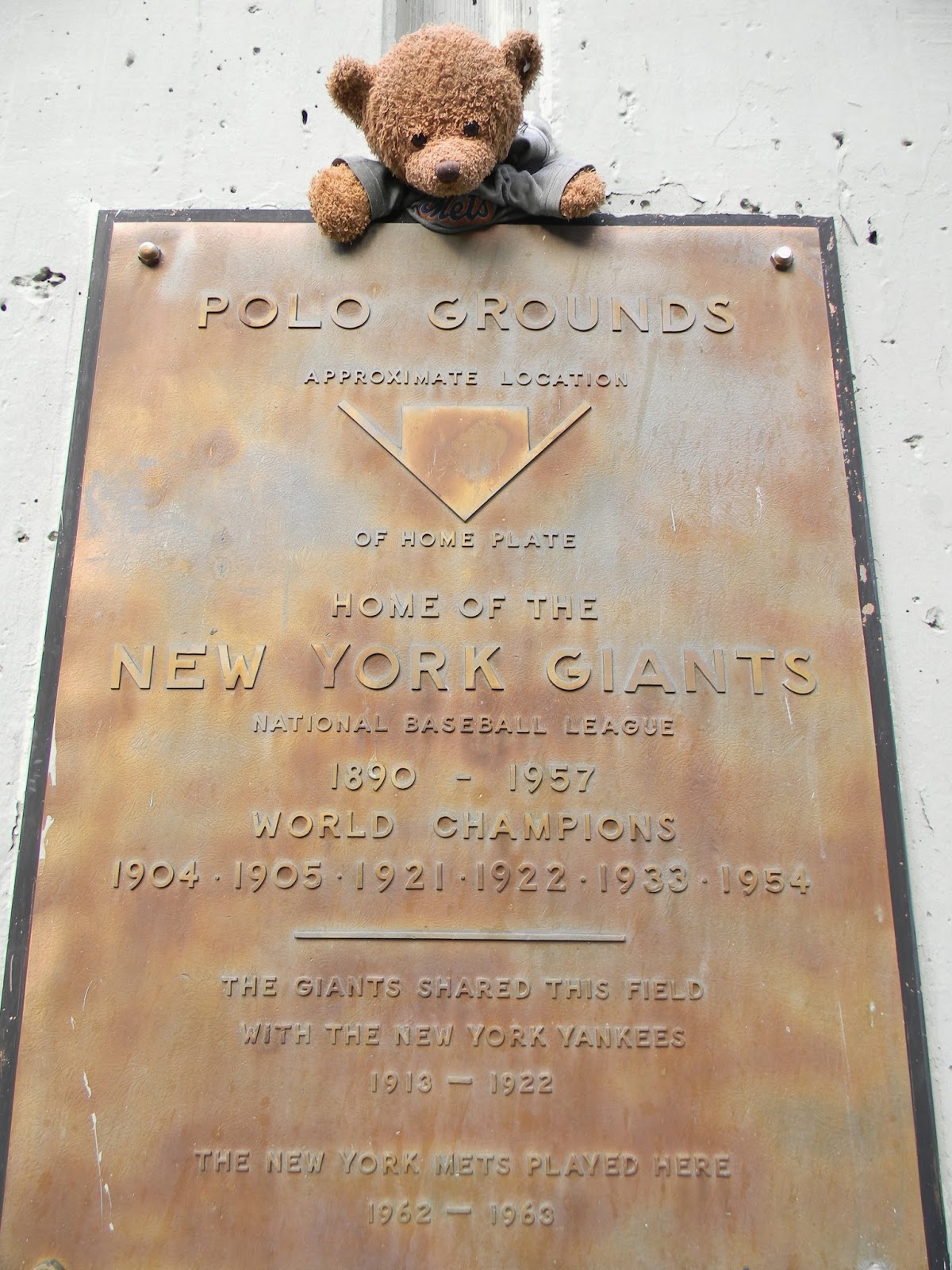
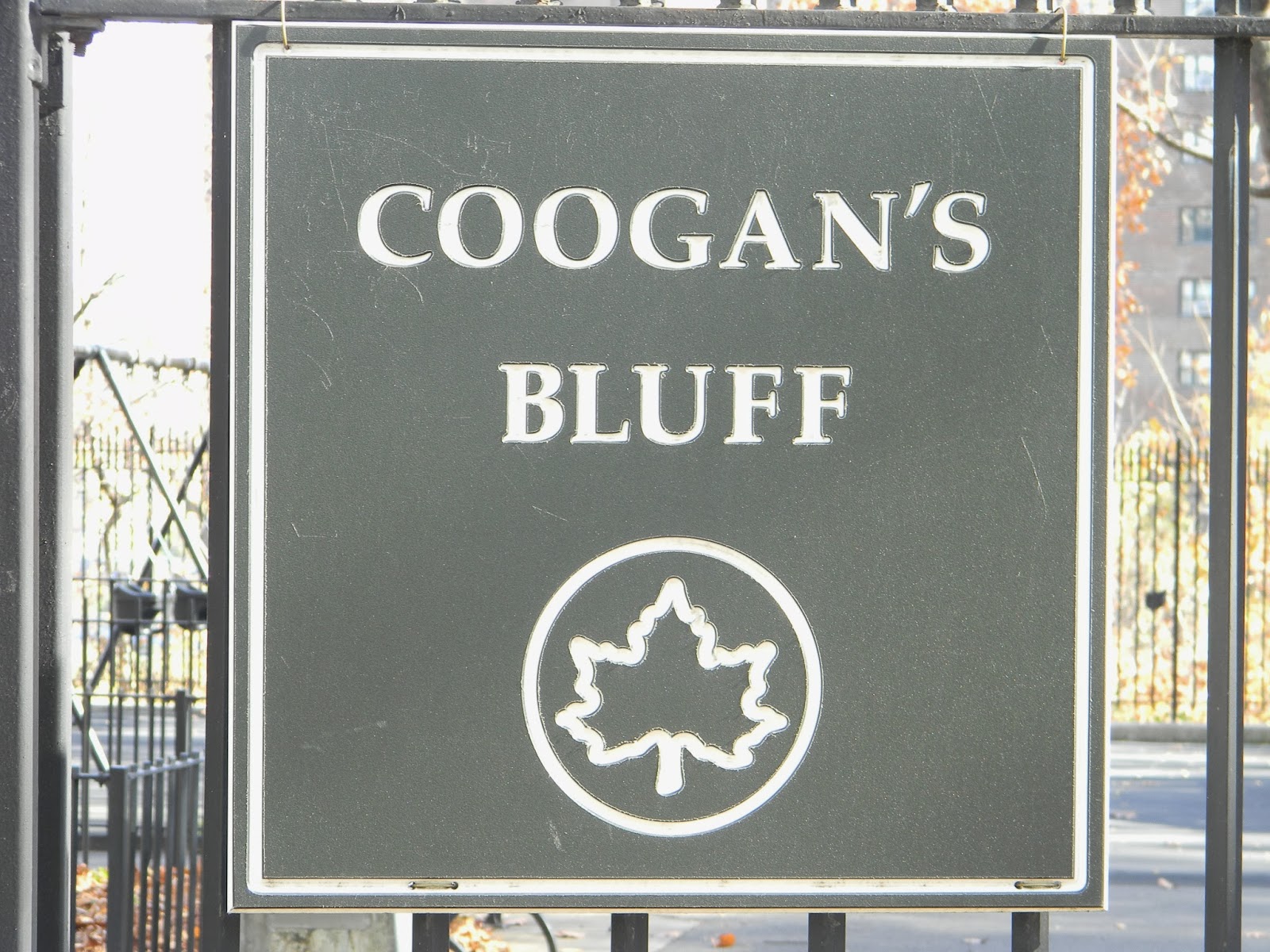
As we walked between the buildings, we came across a playground in front of the hill known as Coogan's Bluff.  Opposite that playground is an apartment building with a sign that reminds all who enter of the Hall of Fame center fielder who used to make brilliant catches with ease (see photo below, center).  Walking past that sign, we came across the final building in the complex, which was constructed on top of what used to be home plate at the old Polo Grounds.  A sign reminds us of this, and also informs us of the championships won by the Giants during the time they played there, plus the years in which the Yankees and Mets called the park home (see photo below, right).


In Brooklyn, there's really nothing left standing from Ebbets Field from the time it was still in use.  But unlike the Ebbets Field Apartments, there is still one thing left standing from the area around the Polo Grounds.

The John T. Brush Stairway, which would lead Giants fans down from Coogan's Bluff to the Polo Grounds, was never torn down when the Polo Grounds ceased to be.  However, the stairs (which were dedicated by the Giants to their owner, John T. Brush, in 1913, just months after his passing) were left in a state of disrepair for many years and were all but forgotten.  But the city of New York is now repairing the stairway, although they're taking their sweet time.

The stairway should have been re-opened in time for the 100th anniversary of its original dedication, but as you can see from the photos below, that clearly wasn't the case.  According to the New York City Parks Department sign (seen in the photo below, right) the expected completion date of the project was supposed to be in the summer of 2012.  Oops.

Despite the area being fenced in to keep the public out, that didn't stop me and my photographer from entering the wooded area around the site to take some exclusive photos of the stairway.  It was a little risky, but seriously, who was going to keep a bear away from his natural habitat in the woods?


Oh, and in the event you couldn't read it clearly, the platform on the stairway at the point where it makes a 90-degree turn says "The John T. Brush Stairway presented by the New York Giants".  To see what the stairway used to look like before its restoration, please click here.


That's all for this special edition of Joey's World's Tour.  I'd like to thank my photographer for accompanying me on my trip to Brooklyn and Upper Manhattan, and for not chickening out when I asked him to join me in the steep wooded area around the John T. Brush Stairway.  He gets two paws up for that.

I'd also like to thank you, the readers, for making these trips worth it.  I may just be a blogging bear, but it's because of people like you that I take great pleasure in touring current and long-gone ballparks.  Until next time, this is Joey Beartran.  Enjoy your offseason!

Sunday, November 10, 2013

Decisions, Decisions: Mets Starters Didn't Get Them


No-decisions.  Starting pitchers for the Mets got quite used to them in 2013.  Dillon Gee led the team with 23 decisions, followed by Jonathon Niese with only 16.  A dozen pitchers started games for the Mets this past season, combining to record 57 no-decisions.

Excluding the strike seasons of 1981, 1994 and 1995, there has never been a season in franchise history in which no starting pitcher earned 20 decisions.  But two teams came close.  In 1982, Mike Scott led the club in decisions with exactly 20, going 7-13 for the last place Mets.  Of course, that was also the year manager George Bamberger decided to use all of his starters out of the bullpen as well.

No starting pitcher made more than 24 starts for the Mets in 1982, as Charlie Puleo (24 starts, 12 relief appearances), Pete Falcone (23 starts, 17 relief appearances), Mike Scott (22 starts, 15 relief appearances), Craig Swan (21 starts, 16 relief appearances), Randy Jones (20 starts, 8 relief appearances), Pat Zachry (16 starts, 20 relief appearances) and Ed Lynch (12 starts, 31 relief appearances) were all used by Bamberger in every possible way, including save opportunities.  Of the seven pitchers listed above, only Randy Jones failed to earn a save.

The only other team in Mets history to have only one starting pitcher record exactly 20 decisions in a non-strike-shortened season was the 1980 squad.  Like Scott two years later, Ray Burris went 7-13 for the 1980 Mets.  But unlike Scott and his fellow moundsmen, all of Burris' 29 appearances in 1980 came as a starting pitcher.

For the record, Bobby Jones led the 1994 Mets with only 19 decisions, but that season came to an abrupt end in mid-August due to a players' strike.  In each of the other two strike-shortened seasons (1981, 1995), one Met did reach 20 decisions.  Pat Zachry went 7-14 for the 1981 club, while Bobby Jones finished 10-10 for the 1995 squad.

With 57 no-decisions in 2013, the Mets finished way up in the top ten for most no-decisions for a starting staff in team history.  Below is the current top ten.


Year
No-Decisions
Starting Pitchers With The Most Decisions
1980
65
Ray Burris (20), Mark Bomback (18)
1979
57
Craig Swan (27), Pete Falcone (20)
2013
57
Dillon Gee (23), Jonathon Niese (16)
1978
56
Nino Espinosa (26), Jerry Koosman (18)
2008
56
Mike Pelfrey (24), Johan Santana (23)
2004
55
Tom Glavine (25), Steve Trachsel (25)
1992
54
Sid Fernandez (25), Dwight Gooden (23)
2000
54
Mike Hampton (25), Al Leiter (24)
1997
53
Bobby Jones (24), Rick Reed (22)
2010
53
Mike Pelfrey (24), Johan Santana/R.A. Dickey (20)


The 2013 Mets tied the 1979 squad for second-most no-decisions in franchise history, surpassed only by the 1980 team.  Dillon Gee was the only pitcher to earn more than 16 decisions for the Mets in 2013, making this year's club the only one in team history to have just one hurler with at least 17 decisions in a season that wasn't curtailed by a strike.

No-decisions are the result of many things.  Sometimes they occur because starting pitchers don't go as deep into games as they used to, allowing for a reliever to vulture a victory or ten.  Bullpens also aren't as good as they used to be, causing starting pitchers to reach for antacid tablets every time a potential "W" turns into an "ND".  And occasionally a faulty offense doesn't give a starting pitcher much run support, causing him to leave a 2-2 game, 1-1 game, or scoreless pitching duel for a pinch-hitter.

This year's team was a victim of all three.  Matt Harvey pitched well enough to be among the league leaders in wins.  But a dozen no-decisions said otherwise.  Jeremy Hefner has to know how Matt Harvey feels, as he was saddled with 11 no-decisions in 23 starts.  And Dillon Gee was brilliant after his start against the Yankees on May 30.  But even a 2.71 ERA over his last 22 starts wasn't been able to prevent him from earning five losses and seven no-decisions in that time period.

Decisions, decisions.  This year's starting pitchers struggled to earn them.  And their drought was surpassed by just one team in team history.  It's tough to win many games when the starting pitchers aren't getting the Ws for the team.

Friday, November 8, 2013

Players Who Led The Mets In Unexpected Categories

When you think of the greatest home run hitters in Mets history, Darryl Strawberry, Mike Piazza, David Wright and Dave Kingman come to mind.  Similarly, no list of great Mets starting pitchers or relief pitchers can be generated without a mention of Tom Seaver, Dwight Gooden, Jerry Koosman, Jesse Orosco and John Franco.

All of those players led the team in several hitting and pitching categories over the years.  But what about those players who led the team in unexpected categories - categories they weren't known for as hitters or pitchers?  What about players who were never above-average at anything, but were fortunate to have one great season or two in a particular category?  And don't forget the handful of players who were strongly disliked by Mets fans, but still managed to lead the team in something other than boos.

Today, we'll discuss a dozen of those players.  You'll be educated.  You'll be amazed.  You'll be awestruck.  (But you'll probably still boo those players who you always booed in the past.)  Let's begin!


Johnny Lewis leads the 1965 Mets in runs scored

In 1965, the Mets were in their fourth year of existence, but they were still looking and playing like an expansion team.  After upping their win total in 1963 and 1964, the Mets regressed in 1965, losing 112 games.  The Mets also lost their manager as well, as the charismatic Casey Stengel was forced to retire as the team's skipper due to a hip injury.  But one bright spot on the 1965 team was the play of outfielder Johnny Lewis.

Lewis was playing in his first season with the Mets after being traded to New York by the St. Louis Cardinals following the 1964 campaign.  Through late July, Lewis was the best player on the team.  In just 81 starts, Lewis was batting .260 with 14 homers, 37 RBI and 49 runs scored.  He also was among the league leaders in outfield assists, finishing the year with 14.  But once Wes Westrum replaced the injured Casey Stengel as manager, Lewis' performance suffered.  Over the last two months of the season, Lewis batted .219 with just one homer, eight RBI and 15 runs scored in 53 games.  Despite his two-month post-Stengel slump, Lewis still managed to lead the Mets in runs scored with 64.

Lewis' run total in 1965 represented approximately two-thirds of the times he crossed the plate in his career, as he played in three other seasons in the majors and managed to score a total of 33 runs in those campaigns.

Honorable mention goes to Joel Youngblood, who paced the 1979 Mets with 90 runs scored.  Although he played 14 seasons in the big leagues, averaging over 100 games played per season, Youngblood finished his career with 453 runs scored (an average of 39.5 runs per season) and never scored more than 59 runs in any other season.


Ted Martinez leads the 1972 and 1974 Mets in triples

Players with good speed and an ability to hit the ball in the power alleys or down the right field line usually rack up their share of triples.  Ted Martinez played nine seasons in the big leagues without ever showing much speed (29 career stolen bases) or an ability to get hits that weren't singles (50 doubles, 16 triples, seven home runs).  But somehow he managed to lead the Mets in three-base hits twice.

In 1972, Martinez hit played six defensive positions for the Mets as their utility man.  He didn't hit much (.224 batting average) or walk much (.254 on-base percentage), but he did find a way to collect a team-leading five triples, one more than Bud Harrleson and Jim Fregosi.  What makes his feat all the more impressive is that Martinez only hit five doubles all season to go with his five triples.

Two years later, Martinez once again became an unexpected triples machine, leading the team with a career-high seven three-baggers despite posting a lower batting average (.219) and on-base percentage (.247) than he did when he was the team's triples leader in 1972.  Martinez had no real challenge to the team lead as Wayne Garrett finished second on the team with three triples.  His time as a top triples producer ended almost as soon as it began, as Martinez didn't collect another three-base hit until 1977 as a member of the Dodgers.


Dave Kingman leads the 1975 Mets in stolen bases

In the mid-'70s and early '80s, no Mets fan left his or her seat whenever Dave Kingman stepped up to the plate.  Prior to his arrival in New York in 1975, no Met had ever hit as many as 35 homers in a single season.  Kingman surpassed that total three times in Flushing, including a 37-HR campaign in 1982, when he became the Mets' first home run champion.  Kingman left the Mets after the 1983 season as the team's all-time home run leader with 154.  But his first season in New York saw him lead the team in something other than homers.

Kingman stole a team-leading seven bases for the Mets in 1975, a year that saw the club steal a league-low 32 bases.  None of Kingman's teammates stole more than four bases in 1975.  Kingman was also the only Met to reach double digits in stolen base attempts, as he was caught stealing five times in 12 tries.  Gene Clines was second on the team with eight attempts.

The Sky King was the Steals King in 1975, proving that he was more than just a home run and strikeout machine for the Mets.  But in reality, what it really proved was that the Mets were a station-to-station team, depending on their excellent pitching and ability to hit home runs (the team finished sixth in the league in homers) to claw out victories.


Richie Hebner leads the 1979 Mets in RBI

After suffering through their second consecutive losing season in 1978, the Mets felt the need to upgrade their offense. To do so, they traded one of their best starting pitchers, Nino Espinosa, to the Philadelphia Phillies for veteran third baseman Richie Hebner.  Although Hebner had hit 156 homers prior to coming to the Mets in 1979, he had never driven in as many as 75 runs in a season until his one year in Flushing.  But if you ask Hebner, he would have gladly traded that first 75-RBI campaign for a ticket out of the Big Apple.  In other words, let's just say John Rocker enjoyed his short stays in New York more than Hebner did.

Despite his disdain for the Big Apple, Hebner actually performed fairly well for the Mets.  The surly slugger hit .268 with 25 doubles, 10 homers and 79 RBI.  Although he only played in 136 games (five of his teammates played 150+ games), Hebner tied Lee Mazzilli for the team lead in RBI.  Hebner was also one of the team's best clutch hitters, batting .308 with men on base and .310 with a runner on third and less than two out.  He also fared well against division rivals, batting an even .300 (87-for-290) versus NL East pitchers.

Hebner was not long for New York, as his insensitive comments were hurting the team more than his bat was helping it.  Just days after the 1979 World Series ended, Hebner was traded to the Detroit Tigers and Elliott Maddox became the Mets' third baseman until top prospect and fan favorite Hubie Brooks was ready to take over the position in September.  Boos for third basemen stopped soon after Brooks' promotion.


Mark Bomback leads the 1980 Mets in wins

From 1971 to 1978, Mark Bomback was a minor leaguer in the Milwaukee Brewers organization.  In those eight seasons, his major league experience consisted of one start and one relief appearance.  But Bomback couldn't crack the Brewers' starting rotation in 1979, even after a career year at the Triple-A level in which he went 22-7 with a 2.56 ERA.  The Brewers traded Bomback to the Mets after the 1979 season and he was immediately given a chance to succeed in New York.

Bomback began the 1980 campaign in the bullpen, making three relief appearances in April before earning his first start on April 23.  Bomback was superb against the Phillies in that start, earning his first major league victory.  He was even better in his next start (also against the Phillies), as he pitched a complete-game two-hit shutout against the eventual World Series champions.

The Mets were marketing that "the magic was back" at Shea Stadium, and part of that magic came from the right arm of Mark Bomback.  Bomback won nine of his first 12 decisions in 1980, as the Mets made a surprising run at the .500 mark in mid-July.  But Bomback faded down the stretch, and his career came crashing down soon after.  Although Bomback led the team with ten victories in 1980, it was his only year with the Mets.  Bomback pitched three other seasons in the big leagues, making 20 starts and 18 relief appearances.  He was the winning pitcher in just six of those 38 appearances.


Pete Falcone leads the '80 and '82 Mets in strikeouts

Pete Falcone was drafted by the San Francisco Giants with the fourth overall pick in the 1973 June amateur draft.  Two years later, he won 12 games as a rookie with the Giants and won 12 more as a Cardinal in his sophomore season in the majors.  But St. Louis gave up on Falcone after he combined to post a 6-15 record with a 5.56 ERA in 1977 and 1978.  After surpassing 130 strikeouts in each of his first two seasons in the majors, Falcone's final season in St. Louis saw him strike out only 28 batters in 75 innings.  As a result, the Cardinals traded him to the Mets following the 1978 campaign.

Falcone posted a 26-37 record during his four-year tenure with the Mets, but his 3.91 ERA showed the lack of run support he got in New York.  Although he wasn't a dominant strikeout pitcher, Falcone led the team in strikeouts twice.  He needed just 109 strikeouts in 1980 and 101 strikeouts in 1982 to lead the team - the lowest totals for a team strikeout leader in a non-strike shortened season.  Ironically, neither total was Falcone's career high as a Met.  The lefty from Brooklyn's Lafayette High School (which also produced fellow southpaws Sandy Koufax and John Franco) fanned 113 batters for the Mets in 1979, which was second on the team to Craig Swan's 145 Ks.

How low were Falcone's team-leading strikeout totals in 1980 and 1982?  They were fewer than the 128 whiffs posted by Armando Benitez in relief in 1999.  Yeah, that low.  Falcone finished his ten-year big league career in 1984, having struck out just 865 batters despite making 217 starts and 108 relief appearances.  In four years with the Mets, Falcone pitched in 145 games (86 starts) striking out 379 batters, or three fewer than fellow Lafayette alum Koufax fanned in 1965 alone.


Anthony Young leads the 1992 Mets in saves

Mention Anthony Young's name to any long-time Mets fan and they'll tell you that his full name should have been Anthony L. Young since the letter "L" was seen next to his name in the boxscore quite often in 1992 and 1993.  But Young was more than just a hard-luck loser for the Mets in that awful Jeff Torborg era.  He actually was a team leader in a positive pitching category, as he tied John Franco for the team lead in saves in 1992 with 15.

After losing eight consecutive decisions as a starter in May and June, manager Jeff Torborg decided to give Young a chance as a closer, becoming the right-handed portion of a lefty-righty closer combo with John Franco.  The move seemed to pay off, as Young did not give a run in 20 straight appearances in July and August, recording nine saves and two holds along the way.  But Young was atrocious in September, blowing five saves and adding five losses to what became a major league record 27-game losing streak.  He would only save three more games as a Met following the 1992 season.

Young's 5-35 won-loss record is the worst for any Mets pitcher with 40 or more decisions in franchise history, but he truly wasn't a bad pitcher, posting a 3.82 ERA in 101 appearances.  And he also accomplished something that wasn't surpassed by a Met in over two decades, as no homegrown Met saved more than 15 games after Young did in 1992 until Bobby Parnell recorded 22 saves for the Mets in 2013.


Desi Relaford leads the 2001 Mets in batting and SB

On a team that was coming off a World Series appearance and featured Mike Piazza, Robin Ventura, Todd Zeile and Edgardo Alfonzo, it was Desi Relaford who led the team in batting average (.302) and stolen bases (13).  Relaford also nearly led the team in doubles, as his 27 two-baggers were second to Piazza's 29.  The 2001 campaign also saw Relaford finish second on the team to Piazza in slugging percentage (.472) and OPS (.836).  Relaford's .364 on-base percentage was tied for second with Benny Agbayani.

If leading the team in two offensive categories (and nearly leading the club in several others) wasn't enough for the utility infielder, Relaford also pitched a perfect inning of relief on May 17, 2001, striking out the first batter he faced on three pitches and inducing two fly ball outs from the next two batters.  It was the best pitching performance by a position player in Mets history.

Relaford played a total of 11 years in the big leagues and never had as complete a season as he had in only 340 plate appearances in 2001.  He finished his career with a .243 batting average, 147 doubles and 81 steals, averaging 12 doubles and seven stolen bases per season in the years prior to and after 2001.


Timo Perez leads the '02 Mets in doubles and triples

The Mets entered the 2002 season with high expectations and a plethora of new players, as newcomers Mo Vaughn, Jeromy Burnitz and Roberto Alomar joined veteran returnees Mike Piazza and Edgardo Alfonzo.  On paper, that team should have produced many extra-base hits.  But none of those players led the team in doubles in 2002.  Similarly, none of them led the team in triples.  But like Ted Martinez before him, the team leader in three-base hits (and two-base hits) was a versatile player with little power, not much speed and an aversion to drawing ball four.

Timo Perez was a cult hero for the Mets during their run to the World Series in 2000.  But he never lived up to the potential he showed during September and October of their pennant-winning campaign.  By 2002, he was playing almost every day, mainly because outfielders Roger Cedeño, Jay Payton and Jeromy Burnitz either underperformed or were injured.  As a result, Perez managed to collect 27 doubles and six triples in 136 games, leading the team in both categories despite being eighth on the Mets in plate appearances.

Perez played seven other seasons in the major leagues, but was only able to collect 64 doubles and four triples in those seven campaigns.  He also collected two other things in those seven seasons - World Series rings - as Perez was a member of the 2005 White Sox and 2006 Cardinals, playing a total of 99 games between the two championship teams.


Jason Phillips leads the '03 Mets in batting average

To many Mets fans, Jason Phillips was primarily known for two things.  He, along with Vance Wilson, was one of the catchers who allowed Mike Piazza to move to first base on a full-time basis (temporarily) and he was also known for the goggles he wore as a hitter.  But those goggles did the trick for Phillips in 2003, as he did what Piazza did regularly for the Mets for many years - he led the team in hitting.

When Mo Vaughn was lost to what became a career-ending injury, Phillips took over at first base, even though he was primarily a catcher.  Phillips was just so-so a hitter through June 16, batting .242 and giving no indication that he was going to compete for a batting title.  For a two-month stretch from mid-June to mid-August, Phillips produced a Piazza-esque .364/.420/.531 slash line.  Phillips was hitting .316 as late as September 7 before a slump over the last three weeks of the season caused his batting average to fall below .300.  However, his .298 average was the highest of all the regular players on the 2003 squad.  (Jose Reyes batted .307, but he only played in 69 games.)

Phillips was never able to repeat his 2003 success in ensuing seasons.  His average dropped 80 points to .218 as the Mets' primary catcher in 2004.  He played three more seasons in the majors for the Dodgers and Blue Jays after 2004, never hitting above .250 in any of those seasons.  His post-2003 batting average was just .227.


Kaz Matsui leads the 2004 Mets in hits, 2B and 3B

In a move that generated much pomp and circumstance in two countries, former Japanese League All-Star (and hot dog) Kaz Matsui became the first infielder from Japan to sign a major league contract when he agreed to a three-year deal in 2004 to play shortstop for the Mets, despite the team already having 20-year-old Jose Reyes playing the position.  Reyes, who only had half a season of major league experience under his belt, moved to second base for the 2004 campaign to allow Matsui to take over his former (and future) position.

Matsui, a former 30-30 player in Japan, couldn't reach 30 homers or 30 steals in two and a half seasons as a Met, totaling 11 homers and 22 steals from 2004 to 2006.  But somehow, amid the growing crescendo of boos emanating from every level of Shea Stadium, Matsui was the team leader in a number of offensive categories in his rookie season, despite missing 43 games in August and September due to an injury.

Although he only played in 114 games in 2004, Matsui led the team in hits (125), doubles (32) and tied for the team lead in triples (2).  The whole team had just 20 triples, or one fewer than Lance Johnson had by himself in 1996.  Matsui's numbers were good enough to make him finish sixth in the Rookie of the Year vote, behind future All-Stars Jason Bay and Matt Holliday.  But in the years following his rookie campaign, Matsui's career veered more toward Bay than Holliday.  By mid-2006, Matsui had played himself out of New York, as the infielder was traded to Colorado, where he enjoyed a wonderful postseason (.304 batting average, five extra-base hits, eight RBI in 11 games) during the Rockies' run to an unexpected World Series berth.


Daniel Murphy leads the 2009 Mets in home runs

When he was first called up to the Mets in 2008, Daniel Murphy was known as a hard-working player who could hit to all fields with extra-base power.  However, he was not much of a home run hitter.  In fact, in his first four seasons with the Mets, Murphy hit more than six homers just once.  But that one season came in 2009, when everyone and his mother ended up checking in to the DL Hotel.

Only three players had more than 380 plate appearances for the Mets in 2009.  One of them was Luis Castillo, who made jaws drop whenever he hit a ball that hit the outfield fence on three hops.  Another was David Wright, who took some time to get adjusted to Citi Field's pitcher-friendly dimensions.  Wright hit a career-low 10 homers in 144 games.  Castillo and Wright both made short visits to the disabled list.  Daniel Murphy did not, playing in all but seven games in 2009.

On a team that had Carlos Delgado, Carlos Beltran, Gary Sheffield and Jeff Francoeur on its roster at various points of the season, Murphy was the only one to hit more than ten homers.  He needed five long balls in September to take over the team lead, but his 12 homers for the year were good enough to make him "Daniel Murphy, Home Run Machine" for one season.

Saturday, November 2, 2013

Was The Johan Santana Trade Worth It For The Mets?

"Who does this stupid blogger think he is, trying to say I wasn't worth the money?  I didn't see him pitch a no-hitter."

After a six-year relationship with the Mets, Johan Santana is no longer on the team's payroll, as the Mets paid the lefty $5.5 million to buy out his $25 million option for 2014.  With Santana no longer part of the team, the time has come to analyze whether or not the Mets did the right thing by trading for him in 2008.

At the time of the deal, which sent Carlos Gomez, Philip Humber, Kevin Mulvey and Deolis Guerra to the Minnesota Twins, the Mets were trying desperately to make amends with their fans after their epic collapse in 2007.  To complete the trade, the Mets signed Santana to a six-year, $137.5 million contract, which at the time was the most lucrative deal ever given to a pitcher.

Johan Santana was very good as a Met - when he was healthy.  In his first year in Flushing, Santana was 16-7 with 206 strikeouts and a league-leading 2.53 ERA.  Santana became the first left-handed pitcher in franchise history to lead the league in ERA in 2008, and the fourth Met overall to accomplish the feat, following right-handed starters Tom Seaver (1970, 1971, 1973), Craig Swan (1978) and Dwight Gooden (1985).  Santana's 206 strikeouts are also tops for a southpaw in club annals, surpassing Jon Matlack's record of 205 Ks, which he accomplished in 1973.

In his final start of the season, Santana gave one of the gutsiest performances by a pitcher in the team's history.  With the Mets needing to win to stay alive in the race for a postseason berth, Santana fired a three-hit shutout against the Florida Marlins on just three days rest.  And he did it with a torn meniscus in his left knee.  The Mets failed to make the playoffs in 2008 but succeeded in finally having a true ace atop their rotation.  Or so it seemed.

Santana's start on September 27, 2008 came in the first year of his six-year commitment to the Mets.  He would only make one more September start for the Mets over the last five years of his contract.  An assortment of injuries kept Santana on the disabled list for all of 2011 and 2013, and curtailed his 2009, 2010 and 2012 seasons.  But that 2012 campaign saw Santana do something no Mets fan ever thought he'd see.

On June 1, 2012, Johan Santana threw the first no-hitter in franchise history in the team's 8,020th regular season game.  Just like every Mets fan knows where he or she was on that unbelievable night, most Mets fans remember that he needed 134 pitches to complete his gem.  After he struck out David Freese to enter no-hit nirvana, Santana suffered through pitching purgatory.  An 8.27 ERA over his next ten starts left Terry Collins and Mets fans wondering if the inflated pitch count needed to secure his place in team history contributed to his post-no-hitter blues.  They continued to wonder for a year and a half, as Santana never pitched again for the Mets after August 17, 2012.

Johan Santana went 46-34 in 109 starts as a Met.  His 3.18 career ERA in New York is lower than the ERAs posted by all-time Met greats Ron Darling, Al Leiter and Rick Reed.  But for $137.5 million, we expected a little more.

For example, Santana's 46 victories fell short of the win total posted by relief pitchers John Franco (48), Jesse Orosco (47) and Tug McGraw (47).  Santana's 109 starts are also nine fewer than the number of starts made by Jonathon Niese, a pitcher who was still playing for AA-Binghamton when Santana made his first start for the Mets.

Great pitchers are supposed to produce great moments.  But other than the penultimate game of the 2008 season and the no-hitter, can anyone honestly remember another memorable pitching performance by Johan Santana?

Photo by Ed Leyro/Studious Metsimus

Mention Tom Seaver and you immediately think of the "imperfect game" or his ten-inning performance in Game 4 of the 1969 World Series (the Ron Swoboda game), or any of a number of dominant performances in 1973 when the rest of the team was floundering.  Similarly, say Doc Gooden's name and visions of back-to-back 16-strikeout games in 1984 and his 14-game winning streak in 1985 become crystal clear in your mind.

Johan Santana had two games that will forever be etched in the hearts and minds of Mets fans.  That's the same number of complete seasons he missed.

Don't get me wrong.  As a Mets fan who agonized over every late-inning first hit allowed by a starting pitcher, it was a dream come true to see someone like Johan Santana pitch the first no-hitter in team history.  Better him than someone like Oliver Perez.

But $137.5 million is just a tad too much for a no-hitter and a season-saving gritty performance - one that saved the season until it was lost the following day.  Carlos Gomez, the main piece in the deal that pried Santana away from the Twins, is now a Gold Glove-winning All-Star in Milwaukee.  His 24 homers and 40 stolen bases for the Brewers in 2013 would have led the Mets in both categories.  (Marlon Byrd's 21 homers and Eric Young's 38 steals led the team.)  Since 1989, only one Met has led the team in home runs and stolen bases in the same season.  That was Mike Cameron, who paced the 2004 Mets with 30 homers and 22 steals.

Carlos Gomez just completed the first year of a four-year, $28.3 million deal with the Brewers.  That's just barely more than the $25.5 million Johan Santana was paid in 2013 to not throw a single pitch for the Mets.

The no-hitter was great.  But I would have liked to see Santana win more games than Jesse Orosco.  A monkey's paw-like wish for a moment 8,020 games in the making doesn't seem to be worth what the Mets doled out for their smooth former All-Star.
 

Friday, November 1, 2013

Mets Games Just Kept Going... And Going... And Going


The 1980s was a decade loaded with many popular television commercials.  One such ad featured the Energizer Bunny, who seemingly never ran out of battery life because it was being powered by Energizer batteries.  As the catch phrase said, the pink critter with shades "keeps going ... and going ...  and going ...".

The '80s was also a very popular time for the Mets, who won two division titles and one World Series championship during the second half of the decade.  The 1986 squad set or tied many team records, including number of wins in a season (108).  One of the more obscure franchise records they matched was the number of extra-inning games won in a single season.  The '86 Mets played a total of 23 overtime affairs, winning 13 of them.  That matched a team record originally set in 1971, a year in which the club won 13 of 22 extra-inning games.  But the 1986 Mets fell just short of the team record for total number of extra-inning games played in one season, as the 1978 club played 25 games that went past nine innings.  Unfortunately, that squad was only able to win eight of those contests.

In playing 25 extra-inning games in 1978, the Mets needed an additional 44 innings to settle those affairs.  Meanwhile, the 1986 Mets needed to play 51 extra innings to come up with a winner in their 23 overtime games.

This year, the Mets played 20 games that required free baseball.  Four of those games went past the 14th inning stretch, including a 20-inning marathon on June 8 against the Miami Marlins.  In total, the Mets played a total of 57 extra innings in 2013, which was more than both the '78 and '86 squads needed to play 25 extra-inning games.

By now, I'm sure you're well aware of where this post is going.  Here is a list of the ten seasons in which the Mets did their best Energizer Bunny impression - as they kept going ... and going ... and going ... playing as many extra innings as needed before someone broke through with a lead that was never relinquished.


Year
Extra Innings
X-Inning Games
W-L Record
Most Innings In A Game
1979
60
21
8-12-1
18
1985
60
22
12-10
19
1968
59
15
2-13
24
1971
57
22
13-9
17
2013
57
20
8-12
20
1973
53
19
7-12
19
1974
52
20
4-16
25
1986
51
23
13-10
15
1975
48
18
8-10
18
2010
48
16
7-9
20


As many innings as the Mets played in 2013, they barely cracked the top five for most additional frames played by a Mets team in franchise history.  However, they did become the eighth squad in club annals to surpass 50 extra innings in a single season and fell just three innings short of the team record of 60, set in 1979 and tied six years later.  That's still far from the major league record of 82 extra innings, which was set in 1918 by the Washington Senators.

Long games don't always end up well for the Mets, as seven teams on the above list had losing records in extra-inning affairs, including this year's team.  Only the 1971 Mets (13-9), 1985 Mets (12-10) and 1986 Mets (13-10) had a winning record in their extra-inning games.  However, considering that the '85 and '86 teams combined to go 206-118 during those two seasons, but only managed to go 25-20 in games that went past nine innings, that's not exactly something they should be proud of.

Ten years ago, the 2003 Mets played seven extra-inning games during the entire season, needing a total of ten extra innings to settle those games.  This year, on June 8, 2013, the Mets and Marlins needed to play 11 extra innings just to settle one game.

Although there have been four seasons in which the Mets played as many (or more) extra innings as they did this year, it sure seemed as if many games this season just went on and on and on.  The Energizer Bunny seemed to thrive on the extra action.  Too bad the Mets and their fans weren't able to say the same.