Showing posts with label The Dookie. Show all posts

Saturday, May 23, 2020

Jose Lima and the Final Destination of the 2006 Mets' Starting Pitchers

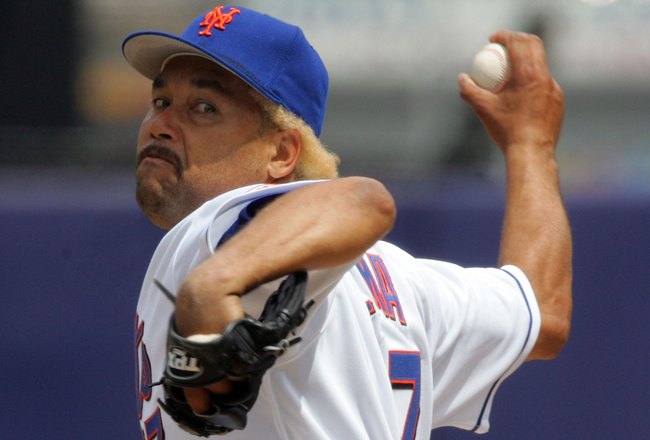
Here's to you, Mr. Lima.  Hope you're able to pitch past the fifth inning in Heaven.  (Victor Baldizon/Getty Images)

Ten years ago today, the baseball world lost one of its true characters in Jose Lima.  The former Met, who had heart issues before his untimely death on May 23, 2010, finished his career with an 89-102 record and 5.26 ERA in 235 starts, which is the highest lifetime earned run average in major league history for a pitcher who made that many starts. 

Lima was the second pitcher who started at least one game for the 2006 Mets to pass away, following the death of Geremi Gonzalez (who was then known by his hip-hop nom de plume, Jeremi Gonzalez) in 2008.  Gonzalez was tragically killed at the age of 33 after being struck by lightning in Venezuela.

Back in 2009, Studious Metsimus jokingly reported that after the Mets released Jose Lima in 2006, he put a hex on the franchise, lovingly referred to as "The Curse of Lima Time".  The whammy was supposedly the reason for the Mets' failure to reach the World Series in 2006, as well as their late-season collapses in 2007 and 2008.

But is the curse real?  Has it expanded beyond a Studious Metsimus story?  A look at the thirteen starting pitchers who took the mound for the Mets in 2006 seems to suggest that it might have escaped the confines of this blog and gone searching for the Unlucky Thirteen.


************* 


Tom Glavine (32 starts) - Failed to get more than one out for the Mets in the 2007 season finale.  Later went back to Atlanta where he picked up two wins and was released by the team in 2009.  By co-inky-dink, he ended his career the way he began it, by going 2-4 with a 5.54 ERA for the Braves in 2008.  He also went 2-4 with a 5.54 ERA for the Braves in his first season with the team back in 1987.

Steve Trachsel (30 starts) - After leading the 2006 Mets with 16 wins, the Human Rain Delay II (with apologies to the original Human Rain Delay, Mike Hargrove) signed a free agent contract with the Baltimore Orioles in 2007.  He was traded in August 2007 to the Chicago Cubs, then re-signed by the Orioles the following off-season, before being released by Baltimore in June 2008.  His post-Mets stats for the 2007 and 2008 seasons featured an abysmal 9-16 won-loss record and a 5.60 ERA.

(David Zalubowski/AP)
Pedro Martinez (23 starts) - Started off brilliantly in 2006, earning wins in each of his first five starts.  Then he was placed on the disabled list after pitching horribly in his return to Fenway Park on June 28.  After coming back from his injury exactly one month later, Martinez pitched poorly in the potential division clincher at PNC Park and was caught weeping in the dugout.  In July 2009, Pedro signed a one-year deal with the Philadelphia Phillies, but his affiliation with the Bloods (see photo, right) helped bring about his downfall.  Facing the Yankees in the that year's Fall Classic also helped, as Pedro lost the two starts he made, including the game that gave the Yankees their sole championship of the last 19 seasons.  Following his defeat in Game Six, the 37-year-old Martinez never pitched again in the major leagues.

Orlando Hernandez (20 starts) - It looked as if the Curse of Lima Time was going to escape Orlando "The Dookie" Hernandez.  After all, he was surprisingly effective for the Mets after being acquired in a trade from the Arizona Diamondbacks.  The Dookie went 9-7 for the Mets and struck out nearly a batter per inning (112 Ks in 116.2 innings).  However, The Dookie met The Curse right after he was named the starting pitcher for Game One of the 2006 NLDS.  While running sprints in the outfield, the then-57 year old (give or take a few decades) tore a calf muscle and had to be removed from the postseason roster.  Despite his AARP membership and injury history, the Mets signed Mr. Dookie to a two-year, $12 million contract that off-season.  They were rewarded by getting 24 starts from His Dookness in 2007 and no starts in 2008.  He then signed a minor league deal with the Texas Rangers in 2009, only to be released a month later.  No longer in baseball, The Dookerino has apparently been offered three lucrative deals to be the spokesperson for Geritol, Metamucil and Depends undergarments.

John Maine (15 starts) - Maine was originally the throw-in when the Mets unloaded Kris and Anna Benson to the Baltimore Orioles for Jorge Julio (who was then traded to Arizona for The Dookie).  Maine impressed so much as a rookie for the Mets in 2006 that he earned a spot on the postseason roster.  His victory in Game Six of the NLCS helped the Mets reach the do-or-die Game Seven against the Cardinals.  Although Maine won 15 games in 2007, his ERA increased annually through 2010, when he won one game and posted a 6.13 ERA in nine starts.  Maine never won a game in the majors after his 29th birthday and appeared in just four games as a thirty-something, all of them coming for the lowly Marlins in 2013.  The scowl that once helped Maine get hitters out is now solely seen whenever someone utters Jerry Manuel's name.


The look of a man who just heard Jerry Manuel say "gangsta" for the umpteenth time. (AP Photo)

Alay Soler (8 starts) - Pitched a complete-game shutout against the Arizona Diamondbacks in his fourth major league start.  Three starts later, he gave up eight runs to the Boston Red Sox.  After that game, he was told to watch tapes of his outing against the Diamondbacks to prepare for his next start against the Yankees.  The Curse of Lima Time struck again, as the tapes were misplaced and instead Soler watched the tapes from his Boston Massacre.  He learned well, as he gave up another eight runs to the Yankees.  So long, Soler.  That marked the end of his short-lived major league career.

Oliver Perez (7 starts) - When the Mets needed a reliever to replace Dominican food aficionado Duaner Sanchez, they traded Xavier Nady to the Pittsburgh Pirates for 41-year-old Roberto Hernandez and Oliver Perez.  Perez did not pitch well for the Mets after his trade, going 1-3 with a 6.38 ERA.  He did pitch in Game Seven of the NLCS and then went 25-17 over the next two seasons, fooling the Mets into giving him a three-year, $36 million contract after the 2008 campaign.  Perez "rewarded" the Mets with three victories over the length of the contract.  However, sales of antacids did increase exponentially in Flushing during his time with the team, which was good news if your name was Duane or Reade.

Brian Bannister (6 starts) - The son of former major league pitcher Floyd Bannister was a respectable 2-0 with a 2.89 ERA for the 2006 Mets before the Curse of Lima Time found him on the bases at the ballpark formerly known as Pac Bell, SBC and AT&T Park.  While trying to score a run, Bannister left his hamstring in San Francisco and missed the next four months of the season.  Bannister was not himself after his return, going 0-1 with an 8.10 ERA.  He was traded that off-season to the Kansas City Royals for future felon Ambiorix Burgos, proving that the Curse of Lima Time was contagious.

Victor Zambrano (5 starts) - I won't waste your time.  You already know his story.  He was cursed before Lima could get to him.

Dave Williams (5 starts) - Williams was never meant to make that many starts for the Mets, but the team's membership with the Injury of The Week Club forced him into action five times.  Williams went 3-1 for the Mets in 2006, but the good record was due to excellent run support, as his ERA was a high 5.59.  Williams was not as lucky in 2007, appearing in only two games for the Mets.  Perhaps his 22.85 ERA had something to do with the lack of appearances.  Although he was only 28 at the time, Williams never pitched in the major leagues again.

Mike Pelfrey (4 starts) - Appeared to have been born with the antidote to the Curse of Lima Time in his blood.  After his breakout 2008 season, Big Pelf struggled a bit in 2009, but was been the Mets' most dependable starting pitcher in 2010, going 15-9 with a 3.66 ERA while surpassing the 200-inning mark for the first time in his career.  Pelfrey's success was short-lived, as he followed up his 2010 campaign by becoming one of the game's worst pitchers from 2011 until his final game in 2017.  Over those seven seasons, Pelfrey went 25-62 with a 4.99 ERA and 1.56 WHIP pitching for the Mets, Twins, Tigers and White Sox.  By age 33, the former ninth overall pick was out of the game.

The reason my wife drinks.  (Reuters)
Jose Lima (4 starts) - Just like Lou Gehrig wasn't immune to the disease named after him, Jose Lima fell to the Curse that took his name. Lima never pitched again in the majors after his brief tour of duty with the Mets, a tour that included an 0-4 record, a 9.87 ERA and a grand slam allowed to opposing pitcher Dontrelle Willis (which my future wife didn't remember even though she was at the game because Lima's appearance on the mound caused her to become best friends with her section's beer vendor).  Lima did, however, reach one milestone while in New York.  On May 12, 2006, Lima was credited with his 100th career loss, earning the landmark defeat by allowing five runs in 4⅔ innings against the Milwaukee Brewers.

Geremi Gonzalez (3 starts) - Gonzalez started against Randy Johnson in the first game of the 2006 Subway Series at Shea Stadium and gave up four runs in the first inning.  The Mets eventually won that game on David Wright's walk-off hit off Mariano Rivera in the bottom of the ninth inning, making Gonzalez the answer to the trivia question, "Who sucked so badly in Game One of the 2006 Subway Series that the Mets needed a walk-off hit by David Wright to win the game?"  Unfortunately for Gonzalez, he made a better lightning rod than starting pitcher, as he was killed during a thunderstorm in his native Venezuela.


*************


The starting pitchers for the 2006 Mets, otherwise known as the Unlucky Thirteen, have suffered professionally and personally since that 2006 campaign. The so-called Curse of Lima Time has claimed careers and lives, including the man for whom it was named.

Although this blog was written as a humor piece, we do not mean to poke fun at the expense of Jose Lima, who passed away ten years ago today at the age of 37.  Lima was a fun-loving man who had a respectable major league career, if you don't look at his ERA or X-Rays of my wife's liver.  Lima was also a positive presence in the clubhouse and was loved by his teammates.

Jose Lima will always be missed in the major league community and of course, in the blogging community.  May he continue to rest in peace.


This is how most Mets fans remember Jose Lima.  (Howard Earl Simmons/NY Daily News)

Sunday, July 28, 2013

Not Everyone Ages Gracefully - Just Ask The Phillies

Photo by Howard Smith/USA Today

Prior to the 2007 campaign, Phillies’ shortstop Jimmy Rollins declared his squad “the team to beat” in the National League East.  Rollins made his claim mere months after the Mets won the division by a dozen games and finished with the best regular season record in the National League.

Rollins’ statement proved to be prophetic, as the Phillies took home the 2007 NL East flag on the season’s final day.  Philadelphia’s successful run atop the division lasted half a decade, with the team winning five NL East crowns, two National League pennants and the 2008 World Series championship.

But in 2012, everything came crashing down for the Phillies.  Philadelphia missed the playoffs for the first time since 2006, finishing the year with an 81-81 record, their worst full-season showing since they went 80-81 in 2002.

Chase Utley and Ryan Howard combined to miss 170 games for the Phillies.  Rollins and Shane Victorino (who was traded to Los Angeles prior to the trade deadline) hit .250 and .261, respectively.  Cliff Lee won one more game all year than R.A. Dickey won in the month of June alone.  And Roy Halladay finished the year with his highest ERA since 2000.

Why did the Phillies fail last year while teams like the Washington Nationals and San Francisco Giants didn’t?  It’s all in the birth certificates.

When the Phillies began their run of excellence in 2007, the core of Jimmy Rollins, Chase Utley, Ryan Howard, Shane Victorino and Cole Hamels were all in their 20s.  They were either already in their prime (which usually begins around age 27) or about to enter their most productive years.

But once 2012 rolled around, the same players who helped the Phillies achieve sustained greatness not seen in the city of Brotherly Love since the late ‘70s and early ‘80s had all entered their early-to-mid 30s.  In addition, Philadelphia added pieces to the team in Roy Halladay and Cliff Lee who were supposed to keep the team atop the NL East standings for years to come.  Halladay and Lee started off well in Philly but both suffered through subpar seasons in 2012.  Not coincidentally, both Halladay and Lee were in their mid-thirties in 2012.

To acquire the pieces that were supposed to complement the core that’s been in place since 2007, the Phillies have parted ways with a number of prospects – prospects that could have been the Rollinses, Utleys and Howards of the next generation.  Putting it simply, the Phillies are old and they’re not getting any younger.  (Welcome aboard, Michael Young!  You’ll fit right in!)

The Mets were also an old team in 2006.  Pedro Martinez and Orlando “The Dookie” Hernandez were in their mid-to-late 30s as October rolled around.  Cliff Floyd was just two months away from turning 34.  Neither player got to experience that month the way Carlos Beltran, Carlos Delgado, Paul Lo Duca and Billy Wagner did, as Martinez and Hernandez were both disabled for the Mets’ shorter-than-expected playoff run and Floyd should have been disabled.  (And for the record, Delgado, Lo Duca and Wagner were also well into their 30s, while Beltran was six months away from blowing out 30 candles on his cake.)

In 2007 and 2008, the Mets’ thirty-somethings continued to get older and had a new forty-something to share disabled list war stories with in Moises Alou.  Not surprisingly, the aging veterans on the Mets were lapped by the much younger Jimmy Rollins and the rest of his "team to beat" in both seasons.

Now it’s 2013.  The defending World Series champion Giants have young stars at many key positions.  Players like Buster Posey, Matt Cain, Madison Bumgarner and Pablo Sandoval (and don’t forget Tim Lincecum) are all in their 20s and hope to lead the Giants to more titles.  The Washington Nationals, who won a league-high 98 games in 2012, are even younger than the Giants, with the under-30 core of Stephen Strasburg, Gio Gonzalez, Jordan Zimmermann, Bryce Harper and Ian Desmond all contributing in 2013.  And the Oakland A's and Baltimore Orioles are using youth to make another postseason push after surprising all of baseball in 2012.

The Mets are trying to shed their old man image that led to heartbreak and disappointment in 2006, 2007 and 2008.  Players like Matt Harvey, Zack Wheeler and Travis d’Arnaud are either currently contributing to the team’s success or waiting in the wings to contribute.  As the team gets younger, the brighter future promised to us by the front office is getting closer and closer to the horizon.

The Phillies fielded a young team in 2007 that became a five-year dynasty in the NL East.  But Philadelphia did not replenish their youth when their core players began to show signs of getting older and becoming more fragile.  Instead, they gave multi-year deals to their fading stars (five years to Ryan Howard, three years to Jimmy Rollins) and acquired players who are now closer to retirement than they are to their arbitration years (Roy Halladay, Cliff Lee, Jonathan Papelbon, Michael Young).

Matt Harvey faced Roy Halladay at Citizens Bank Park back on April 8, and there was no question who the better pitcher was.  Halladay might have been a part of the Phillies’ past successes, but success has now passed him by.  Meanwhile, Harvey is pitching the way Halladay used to pitch before his age caught up to him.

Hall of Fame pitcher Satchel Paige once said “don’t look back – something might be gaining on you.”  The Phillies have looked back, and all they see is a youthful Mets squad that's gunning to pass them and stay ahead of them for years to come.  (The Phillies have currently lost eight consecutive games and are just a game and a half ahead of the Mets in the standings.)  The Mets don’t have any reason to look behind them.  Their road to a successful future is right in front of them.  And they intend to drive down that road long after the Phillies have run out of gas.

Not everyone ages gracefully.  The Mets learned that the hard way in 2006, 2007 and 2008.  The Phillies are finding that out for themselves right now.
 

Thursday, February 14, 2013

Heartbreaking Transactions: A Mets Valentine's Day Special

Mets chief cook and bottle washer Fred Wilpon has announced to the world that the team is no longer in debt and can spend on free agents if there are good players to be had.  Papa Smirk made the announcement yesterday as pitchers and catchers have been trickling in to training camp in Port St. Lucie.

The news was meant to coincide with the comments made by manager Terry Collins and general manager Sandy Alderson on the state of the team.  However, at Studious Metsimus, we know better than that.  We know that Wilpon wanted to make the announcement in time for Valentine’s Day, a day known for spending money on unnecessary gifts, an intense outpouring of love, and a famous massacre.  And who knows more about spending money on unnecessary things (Luis Castillo, Oliver Perez, Jason Bay), unconditional love (Sandy Koufax) and massacres (damn you, M. Donald Grant!) than the Mets?

In honor of Papa Smirk’s Valentine’s Day announcement, let’s take a look at what the Mets have done over the years when they’ve spent money for players they thought fans would love, only to see them revolt when those players failed to live up to expectations:

I'm in the mood for love...

In the 1970s, the Mets boasted wonderful starting pitching and a woeful offense.  Throughout the decade, the Mets tried to acquire a top slugger.  Joe Foy and Jim Fregosi were supposed to improve the offense.  Instead, they became answers to trivia questions about the worst trades in Mets history.  The closest they ever came to acquiring a top hitting talent was when they traded for Rusty Staub in 1972.  Of course, after the 1975 season, one-month wonder Mike Vail pushed the team to trade Staub to Detroit for Mickey “The Refrigerator” Lolich.  One can only imagine that if Twitter had existed in the mid-1970s, that deal would have been referred to as the #LOL-ich trade.  Have another donut, Mickey.

So the 1970s didn’t quite work out with regards to trading for a top hitter.  But once Frank Cashen came on board with his pedigree for winning (Baltimore won several American League pennants under his watch), it was assumed that the Mets would finally sign a premier slugger to give them a legitimate power threat in the lineup.  They thought they added that punch when they signed former home run champion George Foster to a five-year, $10 million deal in 1982.  A .300, 30 HR, 100 RBI season was commonplace for Foster in Cincinnati.  As a Met, he never hit .300, never hit 30 HR and never drove in 100 runs in a season.  Foster was as punchless at the plate as he was on the field.  The leftfielder refused to participate in a bench-clearing brawl against his former team in Cincinnati, citing that it would be a bad example for kids.  This, of course, from the same man who thought “Get Metsmerized” would be a hit rap album.

"I'm George Foster and I'm here to say - if there's a fight, on the bench I'll stay."

Cashen did well after learning from the George Foster fiasco.  But his replacement did not.  After Cashen’s departure in the early 1990s, the Mets tried to put together the best team money could buy, signing former All-Stars like Eddie Murray and Bret Saberhagen, as well as manager Jeff Torborg.  They also brought in the Bronx’s most famous tour guide, Bobby Bonilla.  Just as the Mets made Foster the highest paid player in baseball in 1982, they did the same one decade later for Bonilla.  The more things change, the more they stay the same.  Bonilla spent his hard(ly)-earned money on a wonderful pair of earplugs in four so-so seasons with the Mets.  Bonilla actually did reach the 30-HR mark that eluded Foster, but he also surpassed the ‘80s “slugger” in boos and phone calls placed to the official scorer.  Bonilla should have just stuck to being a tour guide to authors and reporters.  At least he was pretty good at that.

Sometime between being picked before Roger Clemens and Lenny Dysktra in the 1981 June amateur draft and being accused of sexual misbehavior as an ESPN baseball analyst, Steve Phillips was the Mets general manager.  Phillips continued the once-a-decade tradition of trying to upgrade the offense in a year ending in the number “2”, signing and/or trading for Mo Vaughn, Roberto Alomar, Jeromy Burnitz, Roger Cedeño, Shawn Estes, Jeff D’Amico and Pedro Astacio.  Had Stifler’s mom been available, he probably would have made a run at her, too.  (Rumor has it that she was already locked up in a deal with a relative of former Met phenom Sidd Finch.)  Phillips eventually took care of his sexual frustration when he became ESPN’s resident lothario.  His class of 2002 gave Mets fans a different kind of frustration.

Finally, Omar Minaya didn’t wait until a year ending in “2”, acquiring Pedro Martinez, Carlos Beltran, Carlos Delgado, Orlando “The Dookie” Hernandez, Duaner Sanchez, Roberto Hernandez, Oliver Perez, Guillermo Mota, Luis Castillo, Julio Franco, Moises Alou, Johan Santana (see a pattern forming here?) and honorary “Los Mets” players Paul Lo Duca, Billy Wagner and Jason Bay.  Under Minaya, the team had what can now be called a fluke season in 2006, claiming the NL East division crown with a league-best 97 wins.  Unfortunately, the 83-win Cardinals led the National League in World Series championships that year with one.  After two late-season collapses by the rapidly aging team in 2007 and 2008 and two injury-riddled sub-.500 campaigns in 2009 and 2010, Minaya was relieved of his duties.  He can now be seen signing players left and right on Metstradmus’ Facebook page and Twitter account.


For many years, the Mets were content to toss money at players, hoping they would produce in Flushing the way they produced with their former teams.  But for every player that actually does well after coming to New York (we miss you, R.A. Dickey), there are a handful of players that don’t (Vincenzo Grucci – you may know his as Vince Coleman – comes to mind).

According to Fred Wilpon, the team now has money to spend, which it will most likely do in 2014.  Wilpon made this announcement as a pre-Valentine’s Day gift to fans who have been forced to sit through four straight seasons of fourth place finishes.  We’ll see if Wilpon really does have money to spend or if he was just yanking our chains to get us to come back to Citi Field for something other than Pat LaFrieda steaks.  If we find out that he cut back on Valentine’s Day flowers and chocolates for high school sweetheart Sandy Koufax, then perhaps this time we might have to believe him.

Smooch, there it is!

Sunday, May 13, 2012

Mad Men

Jonathon Niese pitched six shutout innings.  Kirk Nieuwenhuis started yet another rally.  Mike Baxter got well-deserved respect as a premier pinch-hitter.  Justin Turner won another battle against Heath Bell.

And the Mets still lost.

After Nieuwenhuis started a two-run inning for the Mets in the fourth inning with a single, Niese continued to pitch shutout ball before being lifted for a pinch-hitter in the seventh.  Ramon Ramirez relieved Niese hoping to protect the lead.

Triple.

Home run.

Game tied at 2.

The Mets regrouped as they have been wont to do during the first month and a half of the season.  Against Marlins' closer Heath Bell in the ninth, the Mets got a one-out double from Daniel Murphy, Doubles Machine.  Two walks later (including an intentional walk to Mike Baxter, who carried a .438 batting average as a pinch-hitter into the at-bat), Justin Turner whacked a double to right to score two runs.  Then Frank Francisco came into the game to save it and give the Mets a series victory.

Triple.

Walk.

Single.

Hit the showers, Frank.

Stop sniffing yourself, Frank.  We all know you stink.


That was all for Armando Benitez-lite.  Frank Francisco was removed from the game by manager Terry Collins, but not before he stopped by home plate umpire Todd Tichenor to wish his mother a Happy Mother's Day.  (At least I thought I heard him say something about Tichenor's mother.)  Manny Acosta was summoned into the game to stop the bleeding but was "Acosta-ed" by the Marlins.

Sacrifice fly.

Tie game.

Pop out.  (I guess you can't put 'em all on base.)

Walk.

Hit by pitch.

Giancarlo Stanton.

Say hello to my little friend.

The Mets will now retreat to Citi Field after a 4-2 road trip against the Phillies and Marlins.  If you had asked me before the season started that the Mets would win four out of six against the two teams expected to compete for the NL East title, I would have been thrilled.  But I'm not.

I'm mad.

Very mad.

Smoke coming out of my ears mad.

Paul LoDuca mad.

Paul LoDuca SMASH!!!


Something has to be done about the bullpen situation.  Sandy Alderson did not have much money to work with during the off-season.  But what money he had, he used to upgrade the bullpen.  That "upgrade"  has now had a part in several late-inning meltdowns.

Both losses to the Marlins this weekend were charged to Frank Francisco.  Prior to Friday night's loss, the Mets' last loss was a 5-4 setback to Arizona on May 4.  That game was lost by Jon Rauch, who allowed three hits, two inherited base runners to score and a run of his own.  What about Ramon Ramirez?  He's allowed 31 base runners (21 hits, 10 walks) in only 19⅓ innings.

Even a certain holdover, wearing Oliver Perez's old No. 46, has pitched like dookie.  (And I'm not talking about Orlando "The Dookie" Hernandez, although I think he'd have better success right now than the current members of the Gasoline Brigade.)  Including today, Manny Acosta has faced 85 batters this year.  Almost half of them (36) have reached base.  Four of them reached base and then continued running around them.  That includes Giancarlo Stanton, who touched Acosta for a game-ending grand slam today.

The Mets have done quite well so far.  That doesn't mean they shouldn't play angry after games like today.  There should be 25 mad men in the dugout tomorrow against Milwaukee.  They should let it be known to each other that losses like today's will no longer be tolerated.  The bullpen must improve.  The team must improve.  They're better than that.  And they should know it.

Tuesday, March 20, 2012

Joey's Soapbox: What The Wilpons Should Do With Their Money


Over the past 24 hours, two seasons officially ended.  For those not involved in Ponzi schemes, winter turned to spring at 1:14 AM.  For those whose surname is Wilpon, your winter of discontent has also ended.  Now that the Mets’ owners and Irving Picard have settled for $162 million before the case went to trial, the focus can now shift completely to what’s happening on the field and not what could have happened off it.

But before we return to the action between the foul lines, I wanted to hop on my soapbox.  If I may, I’d like to share my thoughts with you on what I think the brothers-in-law Wilpon and Katz should do now that they won’t have to fork over $386 million to the Picard peeps.  Who knows?  Maybe they might actually listen to me this time.  Who am I?  I'm Joey Beartran, and I'm about to take you for a ride on my soapbox.


Sign a starting pitcher that can actually stay on the mound

In 2006, the Mets won 97 games.  They also used 13 starting pitchers, all of whom made at least three starts for the team.  Only Tom Glavine and Steve Trachsel were able to make more than 23 starts.  Of course, the Mets' lack of depth and health in the starting rotation caught up with them in the National League Championship Series, especially when both Pedro Martinez and Orlando "The Dookie" Hernandez couldn't pitch in the postseason due to injuries.

Two years later, the Mets traded for Johan Santana and gave him a six-year contract extension.  To date, Santana has given the Mets one DL-free season.  Looks like it's obvious here.  The Wilpons should use their money to sign a dependable starting pitcher that can actually stay on the mound.  The Phillies did it with Roy Halladay and Cliff Lee and they've been able to withstand all sorts of injuries to their everyday players.  The Mets should follow suit.  Or they should find a way to injure Roy Halladay and Cliff Lee.


How about a pitcher who can strike out a batter or ten?

In 1984, Dwight Gooden struck out 276 batters as a rookie, fanning ten or more batters in 15 of his 31 starts.  In 2011, a Mets' starting pitcher reached double digits in strikeouts in a single game twice.  That's two times in 162 games.  Only R.A. Dickey and Chris Capuano reached the level that Gooden reached regularly, and they were only able to do it once apiece.

Since 1992, the only Mets pitchers to strike out 200 or more batters in a single season have been Al Leiter (2000, 200 Ks), Pedro Martinez (2005, 208 Ks) and Johan Santana (2008, 206 Ks).  In each of the years they accomplished their hefty strikeout totals, the Mets finished with a winning record.  That's not a coincidence.

With Citi Field's fences moving in for the start of the 2012 season, it would behoove the Mets to find pitchers who can keep the ball in the ballpark.  Either that or they'll need pitchers with the ability to get opposing batters to hit the ball on the ground, preferably away from Daniel Murphy at second base.  Of course, we wouldn't even have to discuss this if the Mets had pitchers who could strike out a batter or ten.


Spend money on scouting and minor league development

Over the past decade, the only two pitching prospects to stick around have been Mike Pelfrey and Jonathon Niese.  Both players have losing records in the major leagues and neither has made the All-Star team.  In fact, other than Jose Reyes and David Wright, the last homegrown All-Star (regardless of whether he was a pitcher or everyday player) was Edgardo Alfonzo in 2000.  Who was the last homegrown All-Star pitcher?  You have to go back to 1997 and Bobby Jones.

Winning teams succeed with the right combination of veteran leadership and homegrown talent.  The Mets haven't been able to get this consistently right for over a decade.  A few extra bucks spent on their scouts and the development of players in the minor leagues should help the Mets in that regard.


Don't spend on a big-name free agent; spend on a big-name exorcist

On the night Citi Field hosted its first regular season game, a frisky feline darted onto the field and crept past David Wright, who was standing in the on-deck circle.  It was a scene reminiscent of the black cat that ran behind Cubs' third baseman Ron Santo at Shea Stadium in 1969.  Just as the black cat served as the superstitious impetus for the Cubs' demise, the Citi kitty might have done the same to the Mets.

I don't usually believe in curses or the supernatural, but surely a lower power must be involved in the Mets' misfortunes.  Therefore, instead of throwing cash at the next hot ticket free agent, why don't the Mets just hire the best exorcist money can buy?  Clearly, Fred Wilpon already used an exorcist on himself, as his head is no longer spinning due to the resolution of the Madoff mess.  Now it's time to use it on the team.  It might be our only hope.


Give Jeff Wilpon a makeover

New York is the media capital of the world.  Because of that, Jeff Wilpon has found himself in front of the TV cameras quite a bit over the years.  This would normally be a good thing for someone who bears a strong facial resemblance to a popular TV star, as Wilpon does.  However, when that popular television character is Alfalfa from The Little Rascals, it’s a sign that Little Jeffy needs a makeover.

Perhaps a new hairstyle would work.  It doesn’t have to be outlandish like the blond curls sported by the late Jose Lima during his month-long stay in New York in 2006.  (If you don’t remember Lima ever being a Met, it’s probably because you were in an alcohol-induced stupor due to his constant poundings on the mound.)  All his new "do" must do is say “I want you to believe that I’m going to put the best team on the field” instead of “I want you to believe that Darla will one day fall in love with me”.  It’s time for Jeff Wilpon to change the way he looks.  Even Buckwheat would say “o-tay” to that.


Invest in antivenom

In last year’s infamous New Yorker interview, Fred Wilpon stated that Jose Reyes would never get Carl Crawford’s money.  He was right.  He also said that David Wright was a good, but not great player.  With Wright’s latest injury keeping him out of action, he may be right on that front, too.  Papa Smirk is definitely not a saint, but he might be a prophet.

Since everything Wilpon said in the article has come true, then we should also believe him when he says “we’re snakebit, baby!”  In that case, I’d like to make a suggestion to our fearless leader.  Snakes have venom.  Antivenom can combat snake bites.  You now have extra money that won’t be siphoned out of your Sandy Koufax piggy back.  Do the math.


As things stand now, even if the Mets improve upon last year’s 77-85 record, they might still finish in last place.  Every team in the National League East is better on paper.  The Nationals and Marlins, who finished in third and fifth place in the division last year, respectively, are exponentially better this year.  The Nationals added Gio Gonzalez and Edwin Jackson to their starting rotation (not to mention a healthy Stephen Strasburg) and will now have Brad Lidge closing games for them.  Meanwhile, the Marlins added Mark Buehrle to anchor their rotation and All-Star Heath Bell to seal the deal in the ninth inning.  The Braves have the best one-two punch in the bullpen in Jonny Venters and Craig Kimbrel, in addition to a solid starting rotation.  Even with an off-year by rightfielder Jason Heyward, the Braves still competed for a playoff spot until the last day of the season.  And the Phillies?  They’re pretty good.

The Mets have a long way to go if they want to be mentioned in the same sentence as the other teams in the division.  Right now, the only way the Mets could realistically compete in the National League East is if they faced Cole Hamels every day.  That’s about as likely as Shane Victorino learning how not to complain like a little … ahem … sorry,  I got carried away there.  It’s just that I’m very passionate about my team, and I want them to do well.

Surely, the team’s owners want the same thing for their team as I do.  Throwing money at the best available free agent just won’t cut it anymore.  Doing that just gets you Oliver Perez or Jason Bay.  Perhaps Los Wilpons will read this and get an idea or six.  My suggestions can’t hurt as much as the Wilpons have hurt the fan base over the past few years, right?


Saturday, December 3, 2011

Where Are The 2006 Mets Now?

Don't let the title mislead you.  This post is not meant to inform you on what members of the Mets' last playoff team are up to.  On the contrary, it's meant to show you why that team might not have been as good as we thought they were at the time.

A total of 49 players suited up for the Mets in 2006.  As of this writing, only four of those players played for the Mets in 2011.  Those players were Jose Reyes, David Wright, Carlos Beltran and Mike Pelfrey.  However, Carlos Beltran was traded to the San Francisco Giants in July and Jose Reyes might have played his last game as a Met, leaving Wright and Pelfrey as the only two members of the '06 NL East champions who stand to be Mets in 2012.

Let's put it this way.  If Wright and Pelfrey are the only players left come Opening Day 2012, that'd mean the 2006 Mets would have the same number of players on the 2012 team as they have on the DL.  That doesn't stand for disabled list.  That stands for deceased list, as Jose Lima (four starts in '06) and Geremi Gonzalez (three starts in '06) are no longer with us.

The potential for having only two players left out of 49 a mere five years after that team steamrolled their way through the 2006 regular season is unusual in baseball, even in this day and age when free agents leave their teams frequently.  The 1996 Yankees, a team that won a World Series ten years before the Mets failed to get to one, had more players left on their 2011 roster (Derek Jeter, Jorge Posada, Mariano Rivera) than the Mets might have next April on Opening Day from their 2006 team.

But contrary to what it appears to be, this post is not about the few players left on the team from the 2006 roster.  It's not just that most of the players from 2006 are no longer members of the Mets.  It's that these players are no longer in major league baseball, period.

Of the 49 players who played for the 2006 squad, only 14 played in the major leagues in 2011.  Of those 14 players, two of them finished the season in the minor leagues (Aaron F. Heilman, Lastings Milledge) and another (Chris Woodward) collected only ten at-bats in the majors after spending the majority of the season playing at the Triple-A level.

It would take longer for you to read the list of 35 players from the 2006 Mets who did not make an appearance at the major league level in 2011 than it did for Steve Trachsel to deliver a pitch to home plate when there were runners on base, but we're going to do it anyway.  Here they are, in alphabetical order, with their current whereabouts and/or statuses.

  • Brian Bannister (retired)
  • Chad Bradford (retired)
  • Carlos Delgado (retired)
  • Victor Diaz (out of majors since 2007; played in Mexico in 2011)
  • Mike Difelice (out of majors since 2008; managed Kingsport Mets in 2009 and 2010)
  • Pedro Feliciano (signed two-year deal w/Yankees in 2011; might never pitch for them due to injuries)
  • Cliff Floyd (out of majors since 2009; broadcaster for FOX Sports Florida)
  • Bartolome Fortunato (out of majors since 2006; played in Canada in 2011)
  • Julio Franco (waiting for Omar Minaya's call from San Diego)
  • Tom Glavine (retired in non-devastating fashion)
  • Geremi Gonzalez (R.I.P.)
  • Shawn Green (retired; on book signing tours for his new book)
  • Anderson Hernandez (played w/Astros' AAA team in 2011)
  • Orlando Hernandez (played w/Nationals' AA team in 2010, left the team to walk the Earth)
  • Roberto Hernandez (retired)
  • Jorge Julio (out of majors since 2009; bouncing around in Pittsburgh's minor league organization)
  • Ricky Ledee (retired)
  • Jose Lima (R.I.P.)
  • Paul Lo Duca (out of majors since 2008; serves as a horse racing analyst)
  • John Maine (left Rockies' AAA team in 2011; might be walking the Earth with Orlando Hernandez)
  • Eli Marrero (out of majors since 2006; serves as batting coach for Reds' rookie affiliate)
  • Pedro Martinez (retired 10 minutes ago)
  • Kaz Matsui (out of majors since 2010; played in Nippon Professional Baseball league in 2011)
  • Henry Owens (out of majors since 2007; suspended for HGH in 2009 and hasn't played since)
  • Oliver Perez (played w/Nationals' AA team in 2011; not good enough to make AAA team)
  • Royce Ring (played w/Mariners and Red Sox AAA teams in 2011)
  • Duaner Sanchez (out of majors since 2009; played in Mexico and Independent League in 2010)
  • Alay Soler (retired)
  • Kelly Stinnett (retired)
  • Steve Trachsel (retired)
  • Michael Tucker (out of majors since 2006; played for various independent teams since 2009)
  • Jose Valentin (out of majors since 2007; player-owner for Santurce Crabbers in Puerto Rican league)
  • Billy Wagner (retired)
  • Dave Williams (out of majors since 2007; last played professionally w/Nationals' AAA team in 2009)
  • Victor Zambrano (don't ask)

Aaron F. Heilman and Lastings Milledge both ended their seasons at the minor league level in 2011.  Chris Woodward was lucky to get a late September call-up.  That leaves only 11 players from the 2006 Mets who played exclusively in the major leagues in 2011.  One of those 11 players (Ramon Castro) only played in 23 games with the White Sox in 2011, missing the majority of the season due to a right hand fracture.

That leaves only Heath Bell, Carlos Beltran, Endy Chavez, Philip Humber, Guillermo Mota, Xavier Nady, Darren Oliver, Mike Pelfrey, Jose Reyes and David Wright as the only players from the 2006 NL East champions to play exclusively in the majors only five years after they were teammates on the Mets.

Most of the players from 2006 are either retired, dead or Victor Zambrano.  It's also stunning to note that a large number of players who were good enough to be part of a division winner in 2006 were no longer worthy of playing in the major leagues just five years later.

If you recall, both Pedro Martinez and Orlando "The Dookie" Hernandez were scratched from the postseason roster in 2006 because of injuries.  Neither pitched well after 2006 (we don't recognize Pedro's renaissance with the Phillies in 2009 because that would be saying something positive about a member of the Phillies, which is taboo here).

Also, for those who blame Beltran for the Mets' failure to advance to the World Series in 2006, let me remind you that he wasn't the only Met to strike out with the bat on his shoulders in the ninth inning of Game 7.  Before Beltran, Cliff Floyd took strike three as a pinch-hitter with the tying runs on base and nobody out.  That's the same Cliff Floyd who was too hurt to start any of the games in the NLCS after Game 1.

The 2006 Mets steamrolled their way through the 162-game regular season.  But that team was full of players who were either one injury away from ending their careers or no-names who had no business being in the majors.  What do you know?  Only five years later, a great number of those players have suffered career-altering injuries or haven't sniffed the major leagues since Shea Stadium was still around.

A winning team needs a mix of veterans to guide the kids along.  But the 2006 Mets depended too much on veterans.  Now, those veterans are no longer around, succumbing to injuries and Father Time.  That has forced players who are still kids themselves (see Reyes, Jose and Wright, David) to be the team leaders.  Given those facts, is anyone surprised that the Mets have now trudged their way through three consecutive losing seasons? 

Monday, February 28, 2011

M.U.M.'s The Word (Most Underrated Mets): Rick Reed

Journeyman pitcher. Those two words imply that a pitcher is good enough to be in the major leagues, but not good enough to stick around with one team for very long. One such pitcher who kept his suitcase constantly packed started his major league career in 1988 for the Pittsburgh Pirates. It was then that the frequent flier miles started to pile up.

He was released by the Pirates prior to the 1992 season after pitching in only 31 games (18 starts) for Pittsburgh, signing a day later with the Kansas City Royals. After appearing in 20 games with the Royals (18 starts), he was signed by the Texas Rangers in 1993. But in parts of two seasons with Texas, he only started three games and relieved in three others. He was then selected off waivers by the Cincinnati Reds in 1994, hoping to make the team as a replacement player during the players' strike. Replacement players were never needed during the 1995 regular season, but he eventually made the Reds, appearing in four games (three starts) that year.

After the 1995 season, the Mets took a chance on the journeyman pitcher and he spent the 1996 season at AAA-Norfolk. He made the team in 1997 and became a key contributor to the Mets as they contended for the National League wild card until the final week of the season. After winning ten games in the major leagues from 1988-1995, he surpassed that total in 1997 alone, going 13-9 in 31 starts for the Mets. It was then that Rick Reed stopped being a journeyman pitcher and became of the most dependable pitchers in Mets history.

It took him almost a decade, but Rick Reed was finally able to unpack his suitcase in 1997.

After pitching well for the Mets during Spring Training in 1997, Rick Reed won the fifth starter's job. But despite the fact that Reed was ecstatic to make the team out of Spring Training, the joy wasn't reciprocated by the veterans on the team. Players like John Franco were not fond of having a former replacement player as a teammate. If Reed was going to win over his teammates, he was going to have to perform at his best on the field. That's exactly what he did, and it took him very little time to establish himself as one of the best pitchers on the team.

In his first start as a Met, Reed pitched seven shutout innings, holding the San Francisco Giants to three hits. Unfortunately, the Mets were also putting up zeroes on the board, and Reed received a no-decision for his efforts. Four days after his first start, Reed's next appearance came in relief against the Los Angeles Dodgers. If his start against the Giants was an appetizer, his outing against the Dodgers was the main course. Reed pitched five innings against LA, facing the minimum 15 batters (Reed gave up one baserunner, but he was erased on a double play), and striking out seven. The Mets went on to lose the game in the 14th inning, and yet again, Reed was not involved in the decision. However, with 12 shutout innings (allowing only four hits) to kick off his Mets career, Rick Reed had proven that he was going to be a pitcher to be reckoned with in the National League.

On June 1st, Reed's 1.81 ERA put him among the league leaders. However, he wasn't piling up the wins as his low ERA would suggest. In his first 12 appearances (10 starts), Reed was only credited with four wins. This was mainly due to the team's lack of hitting in his starts, as Reed left three of those ten starts with the game tied. Had the Mets scored one extra run in each of those games, perhaps Reed would have made the All-Star team, especially since he would have been among the league leaders in wins and ERA.

Despite the poor run support, Reed still managed the best year of his career by far, finishing with a 13-9 record and a 2.89 ERA, which was the sixth lowest ERA in the National League for the 1997 season.

In 1998, Rick Reed and Al Leiter were part of a formidable one-two punch at the top of the Mets' rotation. Together, they won 33 games, with Leiter winning 17 games (which to this day is the highest total by any Met since 1990) and Reed winning 16. Reed also continued to display the impeccable control that he displayed in 1997, as he walked fewer than one batter per start in 1998 (31 starts, 29 walks allowed). For his efforts, Reed was selected to his first All-Star team (he didn't get to pitch in the game).

Alas, the Mets lost their final five games of the 1998 season to fall one win short of ending a decade-long playoff drought. Although Reed had been in the major leagues since 1988 (the last time the Mets crashed the postseason party), he had never taken part in a champagne celebration. That would change in 1999, and Reed would be a major part of that change.

Despite being placed on the disabled list twice during the 1999 season, first with a tear in his left calf in April, followed by a month-long stay on the DL in August with a strained ligament on the middle finger of his pitching hand, Rick Reed was still able to make 26 starts. The 1999 Mets were the highest scoring team in franchise history, crossing the plate 853 times, so despite Reed's 4.58 ERA, he still managed to finish the year with an 11-5 record. Perhaps the biggest of those 11 victories came in his final start of the regular season.

The Mets were once considered a lock for the postseason in 1999. After defeating the Phillies on September 19, the Mets were comfortably ahead in the wild card race and only one game behind the Braves for the NL East lead. But then the Mets lost their next seven games, with four of those losses coming to Atlanta. The Mets had fallen out of the race for the division title and were now in danger of missing the playoffs altogether. Going into their final series of the season, the Mets were two games out of the wild card lead with three games to play. They were able to get one game closer to the wild card lead with a thrilling extra-inning victory over the Pirates in the first game of the series. Rick Reed was set to start the second game of the series, with the season hanging in the balance. What he gave was his finest effort in a Mets uniform.

Not known for being a strikeout pitcher, Rick Reed had not fanned more than six batters in any of his first 25 starts in 1999. However, against the team for which he made his major league debut in 1988 (which coincidentally was a 1-0 victory against the Mets on 8/8/88), Reed became Nolan Ryan for the night. The 35-year-old righty struck out a dozen Pirates and walked no one, allowing only three hits in the 7-0 complete game win. The victory, coupled with a loss by the Reds earlier in the day, put the Mets in a tie for the wild card lead. The Mets would go on to win the National League wild card berth two days later, with a 5-0 victory over the Cincinnati Reds. Rick Reed, the former journeyman pitcher, was now making his first journey into the postseason, and he would make it memorable for the Mets and their fans.

After splitting the first two games of the NLDS in Arizona, the Mets returned to Shea Stadium for their first postseason game since Game 5 of the 1988 NLCS. It was up to Rick Reed to break the tie and leave the Mets a win away from the 1999 NLCS. Just like he did against the Pirates a week earlier, Reed was in full command of his repertoire. He allowed two runs on four hits in six innings of work, as the Mets cruised to a 9-2 victory. The Mets would go on to win Game 4 on Todd Pratt's walk-off home run off Matt Mantei and advance to the NLCS, where Reed continued to show that his replacement player days were far behind him.

By the time Rick Reed took the mound in Game 4 against the Braves, the Mets had already lost the first three games of the series. It was not the first time the Mets had their backs against the wall for a Rick Reed start in 1999. They had been there two weeks earlier, when Reed came through with his complete game shutout of the Pirates. This time was different, as Reed wasn't going up against Francisco Cordova. Rather, he was facing John Smoltz, the pitcher with the best postseason record (12-3) of all-time.

Reed was dominant over the first seven innings, facing the minimum 21 batters and allowing only one of them to reach base (Bret Boone, who was immediately caught stealing after singling in the fourth inning). But with the Mets holding on to a precarious 1-0 lead, Reed allowed back-to-back home runs to Brian Jordan and Ryan Klesko. Fortunately, the Mets were able to score two runs in the bottom of the eighth inning to re-take the lead. After Armando Benitez pitched a 1-2-3 inning in the ninth, the Mets had staved off elimination on the night when the team was celebrating the 30th anniversary of the Miracle Mets' 1969 World Series championship.

Reed would not pitch again in 1999, as the Mets went on to lose the NLCS to the Braves in six games, but in 2000, Reed and the Mets were able to go where no Mets team had gone since 1986.

Although Rick Reed finished with his second consecutive 11-5 season in 2000, he was victimized by a lack of run support, which explained his team-leading 14 no-decisions. However, the Mets won 10 of Reed's 14 no-decisions, going 21-9 overall in his 30 starts.

Reed struggled early on, winning only four games through July 17. However, in his final 14 starts, the Mets were witnesses to the vintage Rick Reed. In those starts, Reed went 7-3 (the Mets won 10 of those 14 starts) with a 3.26 ERA. He gave up two earned runs or less in eight of the 14 starts, allowing the Mets to cruise to their second consecutive wild card berth, finishing only one game behind the Atlanta Braves in the NL East.

Given another chance to shine on the postseason stage, Reed put his game face on and accepted the challenge. Just like the year before, Rick Reed started Game 3 of the NLDS at Shea Stadium after the Mets had split the first two games on the road. Similar to his 1999 NLDS start against Arizona, Reed pitched effectively, giving up two runs in six innings against the Giants. However, this time the Mets' bats did not provide him with any runs to work with, as Reed left the game with the Mets trailing 2-0. Fortunately, the Mets were able to win the game when Benny Agbayani let the dogs out with his 13th inning walk-off blast off Giants' reliever Aaron Fultz. The Mets won the following night on Bobby Jones' one-hit masterpiece and advanced to their second consecutive NLCS, this time against the St. Louis Cardinals.

After three successful postseason starts, Reed suffered a setback in Game 3 of the 2000 NLCS, allowing five runs (four earned) in 3⅓ innings. Reed took the loss for the Mets, but that would be the only game the Mets would lose to St. Louis, as the Mets won their fourth National League pennant by defeating the Cardinals in Game 5 three days later. It would also be the only time the Mets lost a postseason game started by Rick Reed, who after more than a decade in the major leagues, was finally going to his first World Series.

From a replacement player looking for a job in 1995 to Game 3 starter in the 2000 World Series, Rick Reed personified the rags to riches story that Mets fans love to root for.

Making his first World Series appearance, Reed pitched like a veteran in Game 3. It was Reed's fifth career postseason start (all at Shea), and would be the fourth time Reed would give up two runs or less. In six innings against the crosstown Yankees, Reed allowed two runs (that seems like a pattern for him in the postseason - two runs in six innings) on six hits and struck out eight. Although Reed would not figure in the decision (why does that not seem unusual?), the Mets would go to win the game when they scored two runs in the eighth inning off losing pitcher Orlando "The Dookie" Hernandez. It was the first time in 11 postseason starts that The Dookie was charged with a loss.

In 2001, Rick Reed was having another tremendous regular season. He won seven of his first nine decisions and was among the league leaders in ERA. In addition, Reed was walking even fewer batters than his usual microscopic rate, having walked a total of five batters through June 4. In July, Reed was named to his second All-Star team, but again was not used in the game (perhaps it was because Mets manager Bobby Valentine was the skipper of the NL All-Stars). In his first start after the All-Star Game, Reed defeated the Toronto Blue Jays in an interleague matchup, giving up two runs on six hits in seven innings of work. He walked no one and struck out eight. Unfortunately, it would turn out to be Reed's final victory as a New York Met, as he was traded to the Minnesota Twins at the trade deadline for outfielder Matt Lawton.

Reed was devastated by the trade, especially after signing a three-year, $21.75 million contract with the Mets prior to the 2001 season. After the trade was consummated, Reed discussed the deal, explaining why he hadn't asked for a no-trade clause when he signed the contract:


"I assumed I'd be here three or four years and then that'd be it. I'm a little numb, to be honest with you. What do you do? Life goes on. I enjoyed my time here."


As shocking as it was to see the Mets trade away their All-Star pitcher, the team did not appear to be going anywhere in 2001. At the time of the trade, the Mets had a 49-57 record and were 11½ games behind the first place Atlanta Braves. Of course, once Reed was traded, the Mets embarked on a six-week long hot streak, winning 25 of 31 games from mid-August to late September. Although the Mets finished with their fifth consecutive winning season (82-80), they failed to make the playoffs for the first time in three years. Meanwhile, Rick Reed continued to make regular trips to the postseason, appearing in the playoffs in 2002 and 2003 for the Minnesota Twins.

Rick Reed was never the ace of the staff, but he was still one of the most dependable pitchers to ever put on a Mets uniform. In 1999, Reed walked 47 batters in 26 starts. Although those 1.8 walks per start might be considered great for most pitchers, it was an aberration for Rick Reed. In fact, in his other 112 starts for the Mets, Reed only walked 111 batters. That's less than one walk per start over 3½ seasons! Compare that to one of the other successful right-handed pitchers in Mets history, Ron Darling, whose 114 walks during his 16-win 1985 season were three more than Reed surrendered in 3½ years!

Over his 4½ year career with the Mets, Rick Reed won 59 games and lost only 36. His .621 winning percentage as a Met is second only to Dwight Gooden's .649, and he is one of only five pitchers in franchise history to win more than 60% of his decisions (the others are Gooden, Tom Seaver, Johan Santana and David Cone). Reed also ranks in the club's top ten in WHIP (1.15, 4th all-time), fewest walks per nine innings (1.6, 2nd all-time) and strikeout to walk ratio (3.7, 2nd all-time). Even sabermetricians would be happy to know that Rick Reed is 9th on the Mets' all-time list with a 14.8 WAR for pitchers.

Rick Reed bounced around from team to team for almost a decade before latching on to the Mets as a 32-year-old in 1997. At the time, few people gave Reed a chance to have any type of impact on the Mets. After all, how many pitchers become successful after winning only ten games before their 32nd birthday? But Reed defied the odds and became not only one of the best pitchers in Mets history, but one of the few pitchers who stepped it up when the games meant the most.

For all the regular season success Dwight Gooden had during his storied 11-year tenure with the team, he never won a postseason game for the Mets in seven career playoff starts. Other than his one start against the St. Louis Cardinals in the 2000 National League Championship Series, Rick Reed pitched exceptionally well in all of his other postseason appearances for the Mets, compiling a 2.88 ERA and a 1.04 WHIP in those four starts (all four of those games were won by the Mets). Yet despite his great success, both during the regular season and in the postseason, Reed never quite got the respect he deserved from his teammates, mainly because of the replacement player tag that followed him around like an albatross long after the 1994-95 strike was over.

He might have been disrespected by his own teammates, but the fans know a good pitcher when they see one. Rick Reed was underrated from the first time he put on a Mets uniform to the day he was traded in 2001. It's been a decade since Reed threw his last pitch as a Met, but the memories of one of the most underrated pitchers in franchise history will last far longer than that.

Note: M.U.M.'s The Word is a thirteen-part weekly series spotlighting some of the best Mets players of all-time who never got the recognition they deserved because they weren't the biggest names on the teams they played for. For previous installments, please click on the players' names below:

January 3, 2011: John Olerud
January 10, 2011: Sid Fernandez
January 17, 2011: Jon Matlack
January 24, 2011: Kevin McReynolds
January 31, 2011: Bobby Jones
February 7, 2011: John Stearns
February 14, 2011: David Cone
February 21, 2011: Rusty Staub


Tuesday, October 5, 2010

It's The End of Their World As They Know It (And We Feel Fine)

We interrupt your regularly scheduled day of blog reading to give you breaking news that's already been broken. Omar Minaya has been relieved of his GM duties and Jerry Manuel's option for the 2011 season was not picked up.

Of course, this wasn't even breaking news before it became official. It was a foregone conclusion that the man famous for inserting the words "that being said" into every other sentence and the man known as Dead Manuel Walking were not going to retain their positions after the completion of the 2010 season.

The team had underachieved since the end of the 2006 season. The players were performing below expectations and if there was camaraderie between the players, it wasn't as evident as it should be with winning teams.

It is the general manager's job to put the team together and the manager's job to get them to perform between the white lines.

Omar did his best to put Los Mets together. That being said, that also included offering contracts that were far too long to the ostracized Oliver "El Perez-idente" Perez and Luis "Squeam Queen" Castillo. Other players that were signed for more years than they should have been were Orlando "The Dookie" Hernandez, Pedro "I Left My Fastball In Beantown" Martinez and Carlos Beltran (sorry, we like Don Carlos, so we won't give him a demeaning nickname). He also traded for fan-favorite, but now increasingly fragile Johan Santana.

Jerry Manuel was forced to manage an oft-injured group of ragtag players, a job that most managers would have difficulty doing, although a fellow Manuel (Charlie) had no problem doing that when his star players were dropping faster than Citi Field's paid attendance figures.

Part of Charlie Manuel's success with being able to survive his club's injuries was that his GM, Ruben Amaro Jr., was able to provide him with the right players to fill in the holes left by the disabled players.

When Rip Van Winkle (Jamie Moyer) went down with an injury, Amaro swung a deal with the Astros for Roy Oswalt. All four infielders for the Phillies (Ryan Howard, Chase Utley, Jimmy Rollins, Placido Polanco) were also hurt at some point of the season. Amaro made sure each player had better than adequate replacements in Ross Gload, Ben Francisco and Wilson Valdez. Those three players combined to hit .266 (170-for-640), which was higher than the team's collective batting average (.260). In those 640 at-bats, which are about the same amount an everyday player would collect over a full season, the trio collected 37 doubles, three triples, 16 HR and 85 RBI, while scoring 77 runs and going a perfect 16-for-16 in stolen bases. They also excelled defensively, combining to make a total of four errors in 569 total chances.

While the Phillies didn't miss a beat when one of their star players got hurt, what did Omar Minaya give us? Either not yet ready for prime time players (Ruben Tejada, Jesus Feliciano, Lucas Duda) or the curious case of Joaquin Arias, who, like Benjamin Button, seemed to age backwards as seen by the photos below.


A general manager is the head talent evaluator. His job is to put together the best team possible so that his manager can put the best possible lineup on the field. Unfortunately for Jerry Manuel, the best team possible was never THE BEST TEAM. There were 25 guys, or 23½ as suggested by The Better Half in her recent post for Mets Merized Online, but these guys were never a team. Ruben Amaro has put together a team of guys in Philadelphia, not guys who were part of a team, like Omar Minaya put together in New York.

The new general manager has to realize that teams win games. He has to give the manager not just the best individual players, but the guys who stand the best chance to become a cohesive unit that can all contribute to winning ballgames. Twenty-five individuals don't lead teams to championships, but one team of players can do that.

Omar Minaya and Jerry Manuel had early success with the Mets because they had a team of guys. Over the past few years, that team dissolved into a group of guys whose only common trait was the shirts on their backs. The formula is simple: Have team, will win. If the new general manager can't get the new manager a team of guys to work with, then they stand a good chance of being shown the same door that Omar and Jerry were last seen walking through.