Saturday, October 5, 2013

Daniel Murphy Appreciation Day

This is where I tip my cap to Daniel Murphy. (Photo by Greg Fiume/Getty Images)

Before I begin, let me preface this by saying that if you're not a Daniel Murphy supporter, then in all likelihood you will not be a fan of this post.  (And for the record, the title of this piece was suggested by my Gal For All Seasons, so I'm not alone in my appreciation for the Mets' second baseman.)

Look back at the great second baseman in Mets history.  There's Edgardo Alfonzo and there's ... uh ... well ...  there's not much else.  Sure, there were some second basemen who had good years, like two-time All-Star and Rookie of the Year runner-up Ron Hunt, but he was mostly a singles hitters who made as much contact with the ball using his bat (.282 lifetime average as a Met) as he did with his body (41 HBP in four seasons in New York).

In addition to Hunt, the Mets have employed other fine second sackers such as Felix Millan (who made Ron Hunt look like an extra-base hit machine), Doug Flynn (ditto) and Wally Backman (double ditto).  Ken Boswell had some pop, if you want to call a career-high nine home runs in 1972 "some pop".

There have also been a number of second basemen who were great before they came to the Mets, then underachieved in New York.  Do the names Carlos Baerga, Roberto Alomar and Luis Castillo ring a bell?

Basically, after Alfonzo, the next-best second baseman in club annals might have been Jeff Kent, who had some solid years in Flushing when he wasn't thinking about being on his ranch in Texas.  And Kent probably couldn't concentrate much on that ranch with all those boos from the Shea Faithful permeating the daydream sensors in his brain.

But that No. 2 spot behind Fonzie on the unofficial list of greatest second basemen in Mets history might have a new resident taking off the vacancy sign very soon.  And that resident's name is Daniel Murphy.

Make room for Daniel Murphy at second base.

Daniel Murphy had one of the greatest seasons ever recorded by a Mets second baseman in 2013.  He finished the year with a .286 batting average, 38 doubles, 13 homers, 78 RBI, 92 runs scored and 23 stolen bases.  Prior to Murphy, the only second basemen in franchise history to reach double digits in both home runs and RBI in the same season were Gregg Jefferies and Roberto Alomar.  But neither player matched Murphy's totals in batting average, runs scored, runs batted in and stolen bases.  In fact, the only two players in team history who had better numbers than Murphy in all six offensive categories (batting average, doubles, home runs, RBI, runs scored, stolen bases), regardless of their defensive position, were Howard Johnson in 1989 (.287 average, 41 doubles, 36 HR, 101 RBI, 104 runs scored, 41 SB) and David Wright in 2007 (.325 average, 42 doubles, 30 HR, 107 RBI, 113 runs scored, 34 SB).

Murphy's 2013 campaign saw him finish among the National League leaders in a number of offensive categories.  Murphy was in the top ten in games played (161; 2nd in the NL), hits (188; 2nd), singles (133; 2nd), doubles (38; T-7th), total bases (273; 8th), runs scored (92; 8th) and stolen bases (23; T-7th).  The only other player in the National League to finish in the top ten in all of those categories was MVP candidate Andrew McCutchen.  (Oh, and did I mention that Murphy finished first in the league in stolen base percentage, as he was caught stealing only three times in 26 attempts?  Andrew McCutchen, on the other hand, was caught stealing ten times, making him one of only nine players in the National League to reach double digits in that category.)

Offensively, there are few second basemen in the league who can match Daniel Murphy's overall production.  However, there have been some questions posed about Murphy's ability to handle the defensive side of the position.  It's true that Murphy had an unfavorable defensive WAR (-1.5) and made 16 errors at second base.  But that doesn't mean he was a complete wash at the position.

Murphy finished second in the league in putouts to three-time Gold Glove winner Brandon Phillips.  In addition, Murphy finished third in the NL in assists (behind Phillips and Neil Walker) and third in double plays turned (behind Walker and MVP candidate Matt Carpenter).

Now let's look at the 16 errors committed by Murphy, a total that was surpassed in the Senior Circuit only by Chase Utley, who made one more miscue.  Murphy played 150 games at second base in 2013 (his other 11 games were at first base and pinch-hitter).  The three second basemen who finished directly behind Murphy in errors committed were Dan Uggla, Marco Scutaro and Rickie Weeks, who made 14, 13 and 10 errors, respectively.  But Uggla, Scutaro and Weeks all spent time on the disabled list, combining to miss 119 games this past season with each player missing at least 26 games.  Had they all remained on the field, perhaps one or more of them could have committed more gaffes at second base than Murphy.

Doubles, stolen bases, death-defying leaps over catchers.  Is there anything Daniel Murphy can't do?

For his career, Daniel Murphy has been known as a doubles machine.  He has the only 40-double campaign for a left-handed hitter in team history.  Murphy is also one of only two Mets (David Wright is the other) with three or more seasons of 35+ doubles.  And with 73 more doubles (about two average Daniel Murphy seasons), Murphy will pass Ed Kranepool to become the second-most prolific doubles hitter in franchise history.  But Murphy is more than just a producer of two-base hits.  He proved that (and then some) in 2013.

In my opinion, Daniel Murphy has not been appreciated enough by Mets fans.  Just like Carlos Beltran (who continues to be remembered more for keeping the bat on his shoulders as a Lord Charles curveball danced on by than for the complete player that he was), Daniel Murphy will always have detractors who will complain that he doesn't take enough walks or that he's a horrible defensive player.

To those detractors, I have one thing to say.  Be careful what you wish for.  Many players have been run out of town only to come back and haunt the Mets.  Don't let Daniel Murphy become another one of those players.  Take time to appreciate what Daniel Murphy has done for the team and what he hopefully will continue to do for the team as its second baseman.  The Mets have not had many productive second basemen like Daniel Murphy in their 52-year history.

Not everyone can be Edgardo Alfonzo at second base.  It's a good thing Daniel Murphy doesn't try to be.

Friday, October 4, 2013

A Year With No Harvey Days May Be A Good Thing


The 2013 season just ended for the Mets and their fans.  But the 2014 campaign has already come to a close for Matt Harvey before it even began.  The Mets' All-Star right-hander has decided to undergo Tommy John surgery, which will be performed later this month by Dr. James Andrews.

Anytime a team loses its ace in the rotation, it's a tough blow to take.  But Harvey's absence might not be a bad thing for the Mets.  Allow me to explain.

Clearly, the Mets are going to need to acquire a starting pitcher to replace Harvey in the rotation, preferably an innings-eater.  Since Harvey is expected to be back in 2015, plus with the eventual call-up of Noah Syndergaard, Rafael Montero, or both (assuming they're both not traded), the Mets only need to sign a starting pitcher to a team-friendly one-year deal.  If the Mets are out of the playoff race by the trade deadline, that veteran starter suddenly becomes trade bait.  In 2013, Marlon Byrd (playing with the Mets on a one-year contract) and John Buck (in the last year of his three-year deal) parlayed fine seasons into an August deal with the playoff-bound Pirates.  That got the Mets a solid relief pitcher in Vic Black and a good infield prospect in Dilson Herrera.  The same thing can happen in 2014, but this time with a starting pitcher being traded instead of a right fielder and a catcher.

But what if the Mets actually compete for a playoff spot in 2014?  Well, then they just keep the starting pitcher to complement the younger, less experienced pitchers in the rotation.  Look at what the more experienced Bob Ojeda did to the younger Dwight Gooden, Ron Darling and Sid Fernandez when he became a Met in 1986.  And don't forget the contributions by the late Don Cardwell as a member of the staff in 1969.

Without question, Matt Harvey will certainly be missed next year.  But his absence is not the end of the world, nor does it signify the end of the 2014 season six months before it has even begun.

The Mets will begin the season with Jonathon Niese, Dillon Gee and Zack Wheeler in the starting rotation.  The fourth starter's position can be filled by a veteran on a one-year deal (Dice-K Part Deux, maybe?  The Harang-atan?  Bronson Arroyo and his sweatshirt?), while the fifth starter can be either Carlos Torres or Jenrry Mejia (remember him?).  If the fourth and fifth starters perform reasonably well - great!  They'll immediately become attractive to other teams.  If they aren't dependable, Syndergaard and Montero will be more than happy to replace them by June.

Best case scenario - the Mets remain strong in the starting rotation and can trade some of their excess pitching for more pieces that will eventually make the team more complete in all facets of the game.

Worst case scenario - the fourth and fifth starters remind us of Shaun Marcum and Aaron Laffey and are quickly replaced by Syndergaard and/or Montero, who gain valuable experience before Harvey returns in 2015.

There will be no Harvey Days in 2014.  But that doesn't mean Mets fans will be left without happy days next season.  The rest of the starting rotation will make sure of that.
 

Thursday, October 3, 2013

Joey's Soapbox: My 2013 Unbiased Division Series Picks


What's going on?  Have you been enjoying the baseball playoffs yet?  In case you don't know who I am, I'm Joey Beartran, your fav'rit Studious Metsimus prognosticator.  And if I'm not your fav'rit, I should be.  After all, who correctly predicted that Pittsburgh and Tampa Bay would win their respective wild card games, huh?  Me, that's who!

So let's not waste any more time on idle chitchat and dive right into my picks for the four division series.  Will I be right on all four?  Does a bear poop in the woods?  (Actually, I poop in the bathroom of a Citi Field luxury suite, as you can see here.)  Here are my unbiased division series picks!


National League Division Series


Pittsburgh Pirates vs. St. Louis Cardinals

How great was it to see the Pirates win the wild card game in front of a packed house at PNC Park?  And how sweet was it to have former Met Marlon Byrd get the action started with a home run?  Word indeed!

Every few years, we see a team of destiny.  The 1969 season had the Miracle Mets.  Thirty-five years later, the Red Sox said goodbye to the Curse of the Bambino.  And who can forget the Rockies and Rays making unlikely runs to the World Series in back-to-back seasons just a few years ago?

This year, the Pirates appear to be that team, swashbuckling their way through the NL's best teams.  Despite hitting just .245 as a team, Pittsburgh showed great power (161 HR - 3rd in the league) and tremendous pitching.  Six pitchers made at least a dozen starts.  All of them had ERAs under 3.60.  Six relievers appeared in 50 or more games.  Only one of them had an ERA above 2.81, and it wasn't that much higher (Bryan Morris had a 3.46 ERA in 55 appearances).  Top that with a league-leading 55 saves from the bullpen and you have a team that can beat you in all kinds of ways.

Yes, St. Louis has far more playoff experience.  And yes, they also have home field advantage in the series.  But despite St. Louis going 46-30 against the NL Central, Pittsburgh won the season series, 10-9, giving the Cardinals one-third of their losses within the division.  The Pirates took one more game than St. Louis did in their head-to-head matchups during the regular season.  They'll do the same in the postseason.

Prediction:  Pirates in 5.


Los Angeles Dodgers vs. Atlanta Braves

After winning 14 consecutive division titles in the '90s and '00s, the Atlanta Braves did not win another division crown until this year, eight years after their last one.  But the Braves won the NL East despite having two everyday players (Dan Uggla, B.J. Upton) fail to hit .200 for the season.  They also had very little speed on the team, as only two players (Upton, Jordan Schafer) stole more than eight bases.  And how about their hefty strikeout total, as five players struck out 116 or more times, contributing to their league-leading total of 1,384 whiffs.

Basically, a case can be made that Atlanta won the division because of their 13-2 start and their 14-game winning streak shortly after the All-Star Break.  They went 69-64 in all other games.  But they also won because they hit a lot of home runs (a league-leading 181 HR) and had an unreal bullpen (Craig Kimbrel, David Carpenter and Luis Avilan combined to go 13-4 with 50 saves, a 1.50 ERA and a 0.94 WHIP).

But the Dodgers have a few good pitchers of their own in Clayton Kershaw and Zack Greinke, who will add a few more strikeouts to the Braves' already-embarrassing totals.  And Los Angeles can also hit.  A lot.  Even without Matt Kemp and a fully healthy Andre Ethier, the Dodgers still have a multidimensional lineup with speed (Carl Crawford, Hanley Ramirez, Yasiel Puig) and power (Ramirez, Puig, Adrian Gonzalez).

The Braves are too one-dimensional with their offense to expect to beat the Dodgers.  If they can't hit the ball out of the park, they can't score.  And if they can't score, their vaunted bullpen can't protect any leads.  Los Angeles should have no problem handling Atlanta.

Prediction:  Dodgers in 4.


American League Division Series


Tampa Bay Rays vs. Boston Red Sox

Can both teams win this series?  Absolutely.  And I wish both teams could.  But since only one can, it will come down to which team has destiny on its side (see Pirates, Pittsburgh).

Boston had the best record in the American League.  They also defeated Tampa in 12 of their 19 regular season meetings.  But most of that came during the first half of the season, when Tampa was struggling to stay above .500 (Boston won nine of 12 meetings prior to the All-Star Break).

Tampa Bay is red hot right now.  Including the wild card tiebreaker game against Texas and the wild card game versus Cleveland, the Rays have won 15 of their last 20 games.  Meanwhile, Boston took it easy over the season's final three weeks, going 10-8 after September 7.

Take out Clay Buchholz (12-1, 1.74 ERA) and the rest of Boston's starting rotation is just slightly better than mediocre (48-37, 4.01 ERA).  And Buchholz is only slated to start one game of the ALDS, as manager John Farrell is going to use Jon Lester and John Lackey in the first two games.

Meanwhile, Tampa has three aces in their starting rotation in Matt Moore (17-4, 3.29 ERA), David Price (10-8, 3.33 ERA) and Alex Cobb (11-3, 2.76 ERA and a scoreless outing against the Cleveland Indians in the wild card game.  Pitching wins championships.  But before you win a championship, you have to win a division series, and Tampa Bay will ride their starting pitchers into the ALCS.

Prediction:  Rays in 4.


Detroit Tigers vs. Oakland A's

Last year, the Tigers won a hard-fought division series against the A's, going the distance before defeating Oakland in Game 5.  This year, they'll have to put up a bigger fight if they want to return to the ALCS and World Series.  But how much fight does a wounded team have?

Detroit's big bopper, Miguel Cabrera, has been battling aches and pains over the last month.  And Justin Verlander, although seemingly healthy, has not looked like himself this year, going 13-12 with a 3.46 ERA.  As a result of Cabrera's maladies and Verlander's inconsistencies, the Tigers went 16-16 over their final 32 games, barely holding off the Indians in the AL Central race.

Oakland, on the other hand, finished strongly, going 25-10 in their last 35 games.  The A's might not have the sexy names in their starting rotation, but a staff comprised of 18-game winner Bartolo Colon, 14-game winner A.J. Griffin and 12-game winners Jarrod Parker and Tommy Milone can certainly get the job done.

The A's have power (seven players hit 12+ homers) and are willing to wait for their pitch, even if it means taking a walk (ten players walked 36 or more times).  They also have a great bullpen, as the four-headed monster of Grant Balfour, Sean Doolittle, Ryan Cook and Jerry Blevins combined to post 17 wins, 42 saves and a 2.85 ERA, while holding opposing batters to a .219 batting average.  That's something the Detroit Tigers just don't have.  It cost them last year and it will cost them this year.

Prediction:  A's in 5.

Tuesday, October 1, 2013

Joey's Soapbox: My 2013 Unbiased Wild Card Game Picks


Greetings and salutations, everyone!  I’m Joey Beartran and I’m ready to give you my unbiased picks for the upcoming wild card round of the baseball playoffs.  In the past, my picks have occasionally been biased because I would never pick the Yankees or the Phillies to advance to the next round.  But this October, the Yankees and Phillies are only fighting for who gets the first tee time on the golf course.

Do you know how long it’s been since the Yankees and Phillies both missed out on October baseball?  Well, this is only the second time since the Yankees started sending out invitations to their annual postseason party in 1995 that they forgot to invite themselves.  The only other time in that nearly two-decade period that they failed to make the playoffs was in 2008, when the Phillies won the World Series.  Now if you recall, because of the players’ strike, the World Series was canceled in 1994, but the year before the strike, the Phillies won the National League pennant.  They didn’t win the World Series in 1993 because Mitch Williams served up a fat pitch that made Joe Carter’s eyes get as big as Cole Hamels’ ego.

You have to go back to 1992 to find the last postseason that didn’t have the Yankees or Phillies in it to torment Mets fans, making them root for whoever was matched up against them.  And 1992 was also the last time the Pittsburgh Pirates received a playoff invite until this year.  Hmmm.  Maybe all we have to do is make sure the Pirates make it to the playoffs every year and then we won’t have to worry about seeing the only two teams whose players make Scott Atchison look like a young whippersnapper.

On that Geritol-sponsored note, let’s get to my picks for the National and American League wild card games, where we can talk some more about the Pittsburgh Pirates.


National League Wild Card Game


Cincinnati Reds at Pittsburgh Pirates

Last week at this time, this wild card game had a chance to be played at Great American Ballpark in the Queen City.  But then the Mets socked it to the Reds once again, just as they did in the 1973 NLCS and the 1999 wild card play-in game.  The Mets took two out of three from the Reds in Cincinnati, starting a season-ending five-game losing streak for Bronson Arroyo, Aroldis Chapman and the rest of the Shama-Lama-Ding-Dong crew.  That, combined with the Pirates’ three-game sweep of the Reds to close out the season, moved this do-or-die game to the Steel City.  Clearly, the hotter of the two teams is Pittsburgh.  However, as the old saying goes, you’re only as hot as that day’s starting pitcher, and Cincinnati’s starter is Johnny Cueto.

Because of injuries, Cueto only made 11 starts this year, but with a 5-2 mark and a 2.82 ERA, the Reds are confident he’s the man to lead them to the NLDS.  Pittsburgh, for all the success they’ve had this year, have rarely done well against Cueto over the years.  The Pirates have faced him 21 times and have only pinned four losses on him.  They’ve also had a difficult time scoring against the right-hander, as evidenced by Cueto’s 2.37 lifetime ERA against the Bucs.

Of course, Pittsburgh is sending their ace, Francisco Liriano (16-8, 3.02 ERA) to the mound, giving them their best chance to advance in the postseason for the first time since 1979.  But you don’t have to remind Liriano that three of his eight losses came at the hands of the Reds.  I’m sure he's already quite aware of that.

That being said, PNC Park will be rocking on Tuesday, hosting its first ever playoff game.  In a city known for the more successful Steelers and Penguins, the Pirates are finding their way back into the hearts of Pittsburgh sports fans.  And with two members of the Mets’ 2013 Opening Day roster now toiling for the Buccos (Marlon Byrd, John Buck), they have an extra rooter in myself.  The Pirates won’t let their success-starved fan base down.

Prediction:  Pittsburgh will advance to the NLDS.


American League Wild Card Game


Tampa Bay Rays at Cleveland Indians

Earlier today, I was listening to the radio and heard ESPN’s Mike Lupica mention that over the last six years, the Tampa Bay Rays have spent as much money on their entire roster as the Yankees spent on Alex Rodriguez.  Tampa has now made the playoffs four times in the last six years, while the Yankees have also made the playoffs four times in six years.   Clearly, the Rays are a team that knows how to get the most of their players.

Unlike Tampa, Cleveland was willing to spend money this past offseason, signing outfielders Michael Bourn and Nick Swisher to free agent contracts.  Both Bourn and Swisher had typical seasons (which for Swisher means 20 or more homers, lots of walks, even more strikeouts and the ire of opposing fans who pray on a nightly basis that he’s stricken with a severe case of laryngitis).  But one of the big finds for the Indians was former Mets’ first round draft pick, Scott Kazmir.  The Mets saw firsthand how dominant Kazmir can be when he had a 12-strikeout, no-walk performance against New York on September 6.  But Kazmir won’t be starting the wild card game for Cleveland.  Neither will ace Ubaldo Jimenez, who won 13 games for the Tribe.  Rather, it will be rookie non-sensation Danny Salazar.  Salazar will facing Alex Cobb, who was brilliant for the Rays in 2013, going 11-3 with a 2.76 ERA.

Basically, this matchup is the equivalent of Al Leiter facing Steve Parris in 1999 for the right to advance to the National League Division Series.  And we all know who get the better of who in that game.

It doesn’t matter that Tampa has to travel to Cleveland to play this game.  They traveled to Texas on Monday to play one game against a team they historically couldn’t beat after Game No. 162.  That history is now … uh … history.  Tampa has the right pitcher on the hill for this game while Cleveland does not.  Fans of “Bro-hio” will be singing “Bro-hi-NOOOOO!!” after this game is over.

Prediction:  Tampa Bay will advance to the ALDS. 

Saturday, September 28, 2013

If The Mets Win Sunday, Jonathon Niese Is A Goner

The shirt might be coming off Jonathon Niese's back if he wins on Sunday.

Did the title to this post get your attention?  It should.  Because recent history shows that winning a game at home on Closing Day usually leads to a starting pitcher's exit from New York.  Please allow me to expound on that statement.

The Mets moved from Shea Stadium to Citi Field following the 2008 campaign.  Since then, the Mets have won three of their first four Closing Day games at their new digs.  Citi Field's first Closing Day in 2009 saw Nelson Figueroa take the hill against the Houston Astros.  Figueroa pitched the only complete game shutout of his nine-year career on that final Sunday, holding the Astros to four hits in the Mets' 4-0 victory.  Figueroa never pitched another game for the Mets, as he was selected off waivers by the Philadelphia Phillies in 2010.

After losing their next Closing Day game in 2010, the Mets ended the 2011 season with another complete game shutout.  This time, it was Miguel Batista doing the honors, besting the Cincinnati Reds, 3-0.  By the following July, Batista had been released by the Mets.

Finally, in 2012, R.A. Dickey started for the Mets in their final home game at Citi Field.  Dickey made 13 Pirates walk the plank back to the dugout, striking out a baker's dozen to earn his 20th victory of the season in the Mets' 6-5 win over Pittsburgh.  Dickey made one more start for the Mets in Miami (a no-decision) before being traded during the offseason to the Toronto Blue Jays.

That brings to Sunday's Closing Day game against the Milwaukee Brewers - a game in which Jonathon Niese is scheduled to start.  The Mets have never won a Closing Day at Citi Field and had its starting pitcher in that game make it through the following season as a Met.  And in two of those three wins, that day's starter never threw another pitch for the Mets at Citi Field.

Sure, Jonathon Niese still has three years left on his current contract, but facts are facts.  Mets pitchers who win on Closing Day at Citi Field don't stick around to enjoy their end-of-season victories.  In fact, the last time the Mets won a Closing Day game at home and they kept that day's winning pitcher around was in 2004, when Tom Glavine defeated the Montreal Expos, 8-1 at Shea Stadium.  Of course, Glavine remained with the Mets until 2007 but the Expos didn't stick around in Montreal, moving to their new home in Washington the following season.

If only Glavine's last game had come in 2004 rather than 2007...

It's Not The Same, But...

I promise you won't be seeing this scene at Citi Field today.

Today at Citi Field, the Mets will not be scoreboard-watching.  They also do not have champagne being chilled.  And don't expect the Braves game to be on in the clubhouse.  However, there is a chance the Mets can "clinch" something today.

Should the Mets win their 4 o'clock game today against the Brewers and the Braves defeat the Phillies in their 7 o'clock tilt tonight, the Mets would officially clinch third place in the NL East, which would be their highest finish in the division since 2008, when the team still received its mail at Shea Stadium.

Technically, the Mets could clinch third before the Phillies take the field in Atlanta, as the Mets won their season series against Philadelphia, taking 10 of 19 games from Cole Hamels and the Phunky Bunch.  Therefore, finishing in a tie with Philly at season's end would essentially give the Mets third place anyway.

Of course, finishing in third place with a record that is still well below .500 isn't exactly a great accomplishment.  However, think of the 1968, 1983 and 1995 Mets.  The 1968 squad "improved" from last place to ninth place in the ten-team National League, then won the World Series a year later.  Naturally, no one expects the Mets to win the World Series next year, but many people do think the Mets will improve in 2014, similar to what the 1984 team did following a lackluster 1983 campaign.

In 1983, the Mets won 68 games, which on the surface looks like a bad year.  However, it was the most wins by the team during the seven-year Grant's Tomb era which began when the Mets traded away Tom Seaver in 1977.  One year later, the Mets shocked the baseball world by improving to 90-72.  The Mets were relevant again, and by 1986, they had won their second World Series championship.

But not too many teams win 22 more games from one year to the next as the Mets did in 1984.  If the 2014 Mets improve by 22 wins, they'd have a good chance to finish with the best record in the league.  Again, that might be too much to expect.  And that's why I bring up the 1995 Mets.

In 1995, the Mets finished the strike-shortened season with a 69-75 record.  Although it was a losing record, the team still managed to finish in second place, tied with the Philadelphia Phillies.  It was the fifth consecutive sub-.500 season for the Mets, but it was also their highest finish in the standings in five years (similar to what the 2013 Mets are shooting for).

The following season, in 1996, the Mets struggled, going 71-91.  But there were flashes that the team was about to turn the corner.  And in 1997, that's exactly what they did.

The Mets farm development paid dividends in 1997, with Edgardo Alfonzo (.315, 10 HR, 72 RBI, 11 SB), Butch Huskey (.287, 24 HR, 81 RBI) and Bobby Jones (15-9, 3.63 ERA) posting breakthrough seasons.  The team also made shrewd trades, acquiring John Olerud for Robert Person.  Olerud solidified the infield and gave the team a proven bat.  And don't forget the acquisition of Rick Reed following the 1995 campaign.  The Mets gave him a shot in the starting rotation in 1997 and he became the team's ace (13-9, 2.89 ERA, 1.04 WHIP).

The Mets finished in a lofty position in the division despite a losing record in 1995, then slowly but surely added more pieces to a young team that already had a good nucleus.  That's kind of like what the 2013 Mets are doing.  This year's squad has been about building a nucleus and this year's offseason is about patching up the holes with quality players who will help the team continue its ascent to relevancy and competitiveness.  It may take a few years for the Mets to be a perennial contender, but the pieces are there for it to happen.  They just have to be put together properly by Sandy Alderson and his Merry Men.

Despite a losing record, the 1995 Mets finished in their loftiest division position in five years.  The 2013 Mets are trying to repeat that feat.  It's not the same as clinching a division title, but I'd sure love the Mets to finish ahead of the Phillies for third place in the NL East this year.  History shows that that type of finish leads to better days in the near future.
 

Wednesday, September 25, 2013

What Do Michael Wacha and Tom Seaver Have In Common?

On Tuesday night, Michael Wacha of the St. Louis Cardinals was one out away from baseball immortality.  He had retired twenty-six Washington Nationals without allowing a hit.  All he had to do was find a way to get Ryan Zimmerman out and he would have completed his first no-hitter in just his ninth major league start.

But Zimmerman had other ideas.  The Nats' third baseman chopped a ball that grazed off the top of Wacha's glove and rolled in the direction of shortstop Pete Kozma.  Kozma's throw pulled first baseman Matt Adams off the bag, who could not apply the tag to a hustling Zimmerman.

The no-hitter was not to be for Wacha, as he fell one out short of immortality on September 24.  That date should bring back memories of a similar circumstance that happened to Tom Seaver in 1975.


Thirty-eight years ago, also on September 24, Tom Seaver took the mound against the Chicago Cubs.  Seaver had already taken two no-hitters into the ninth inning in his career.  But both of those gems were broken up with one out in the ninth.

On July 9, 1969, Chicago's Jimmy Qualls looped a clean single to left after Seaver had retired the first twenty-five Cubs to face him.  Seaver retired the next two batters, then stood on the mound with his hands at his waist wondering what might have been in the Mets' 4-0 victory.

Three years later, Seaver was once again two outs away from pitching the Mets' first no-hitter (although this one was not a perfect game, as Seaver walked four hitters) when he faced the San Diego Padres on July 4, 1972.  But Leron Lee channeled his inner Jimmy Qualls and lined a single to center to break up the no-no.  Seaver then induced the next batter, Nate Colbert, to ground into a game-ending 6-4-3 double play, giving the Mets a 2-0 win over the Padres.

After two near-misses in 1969 and 1972, Seaver took another no-hitter into the ninth inning on September 24, 1975 when he matched up against the Chicago Cubs.  But this time he was able to retire the batter he faced with one out in the ninth, striking out the Cubs' Rick Monday.  Needing one out to pitch nine hitless innings, Seaver allowed a two-out single to rightfielder Joe Wallis to break up the no-hitter.  However, even if Seaver had retired Wallis, he would not have been able to celebrate a no-hitter at that moment because the game would not have ended there.  Neither team had scored through the first eight innings and the scoreless duel continued into extra innings.  The Mets eventally lost the game, 1-0, when closer Skip Lockwood walked Bill Madlock to force in a run in the 11th inning.

Since 1975, when Seaver lost his no-hitter with two outs in the ninth, no Met had even taken a no-hitter into the ninth until Johan Santana did so on June 1, 2012.  But Santana finished what Seaver couldn't, striking out David Freese of the St. Louis Cardinals to complete the first no-hitter in franchise history.

Michael Wacha, now Freese's teammate in St. Louis, came within one out of throwing his first career no-hitter on September 24, 2013.  Tom Seaver, on September 24, 1975, also missed his first career no-hitter by one out, becoming the only Met to have a hitless game broken up with two outs in the ninth inning.

What do Michael Wacha and Tom Seaver have in common?  They both share a September 24 heartbreak.  Wacha hopes that's not the only thing he can share with Seaver before his career is over.
 

Tuesday, September 24, 2013

With Pittsburgh In, Who Has The Longest Playoff Drought?


After two decades of futility, the Pittsburgh Pirates have qualified for the postseason for the first time since Barry Bonds' cap was three sizes smaller.  (That's 1992 for all you kids out there.)  In clinching a playoff berth, the Pirates have become the last National League team to qualify for the postseason in the 21st century.  So now that Pittsburgh has ended its drought, which National League squad has gone the longest without appearing in the playoffs?

Well, the Braves, Cardinals, Reds and Dodgers are all joining the Pirates this year.  The Giants and Nationals were playing in October last year.  And in 2011, the Diamondbacks, Brewers and Phillies were competing for the pennant.  That's ten of the fifteen teams in the N.L. qualifying for the playoffs in the last three seasons alone.  So who's left?

The Rockies made the playoffs in 2009 and the Cubs last qualified in 2008.  Both the Mets and Padres won their respective divisions in 2006.  That's 14 teams.  Which team has the longest playoff drought in the Senior Circuit?

The Florida (now Miami) Marlins.

The Marlins won the World Series in 2003, defeating the Yankees in six games.  They haven't been invited to the postseason party since.  So in the last decade, every National League team has made the playoffs.  But there are two American League teams who haven't sprayed champagne since the 20th century.

The Toronto Blue Jays won their second consecutive World Series championship in 1993, defeating the Atlanta Braves in six games.  Twenty years later, they're still waiting for their next postseason appearance.  The only team with a longer playoff drought than the Blue Jays should never have won a World Series.

In 1985, the year before the Mets won their last title, Kansas City met intrastate rival St. Louis in the I-70 World Series (named because of Interstate 70, which connects the two cities).  The Royals won their lone World Series championship with the aid of first base umpire Don Denkinger's blown call in the ninth inning of the sixth game.  Kansas City won the title the next night.  Nearly three decades later, the Royals have not yet returned to the postseason.

It seems like an eternity since the Mets last qualified for the playoffs.  For many Mets fans, seven years does seem like forever.  But be thankful you're not a Marlins fan.  Or even worse, think about those Blue Jays and Royals fans out there.  It's only been ten years since the Marlins and their dozen fans celebrated a postseason appearance.  Fans in Toronto and Kansas City have been saying "wait 'till next century" for just a little bit longer.

Sunday, September 22, 2013

Exit Sandman - Studious Metsimus-Style

Screen shot courtesy of TBS Sports

Today at Yankee Stadium, Mariano Rivera's career was celebrated by the only team he's ever known.  The celebration included all the pomp and circumstance you'd expect for a player of Rivera's caliber, including a live performance by Metallica, whose "Enter Sandman" let opposing hitters know that Mariano was about to send them off to Never-Never Land.

As you all know, Rivera is the greatest closer in the history of the game.  His 652 regular season saves and 42 postseason saves are the most in major league history.  He also has a 2.21 ERA prior to October baseball and a 0.70 ERA during it.  Only 12 pitchers with 1,000 or more innings pitched have a lower regular season ERA than Rivera and no one has a lower postseason ERA.

To put Rivera's records in perspective, John Franco (276 saves) and Armando Benitez (160 saves) have the two highest career save totals as Mets.  The rest of the top ten (Jesse Orosco, Billy Wagner, Tug McGraw, Roger McDowell, Francisco Rodriguez, Neil Allen, Skip Lockwood, Braden Looper) have a combined 652 saves as Mets - the same number of saves Mariano Rivera had on his own as a Yankee.

Mariano has also registered nine seasons of 40 or more saves.  The Mets have had three - ever.  Furthermore, no Met has recorded more than 43 saves in a single season (Benitez saved 43 games in 2001).  Rivera has surpassed that number in six seasons, including this year at the age of 43.

But Rivera hasn't been infallible, especially against the Mets.

In 34 appearances against the Mets, Mariano Rivera has a 3.53 ERA, his highest against any National League team.  The only team in the majors against whom Rivera has a higher ERA is the Los Angeles Angels (3.75 ERA).  Since 2007, Rivera has allowed more earned runs against the Mets (7) than he has saves (4).  His ERA against the Mets since 2007 is 6.10.  And let's not forget his blown save and loss to the Mets this past May, which remains the only time Rivera has blown a save in his career without recording a single out.

The Mets have also defeated Rivera four times over his storied career.  Meanwhile, the rest of the National League has pinned just five losses on No. 42.  The only teams to beat Rivera more times than the Mets are the Orioles (9 times), Red Sox (7 times) and Rays (6 times) - all of whom play in the same division as the Yankees.  But Baltimore has faced Rivera 134 times, while Boston has seen him in 115 games and Tampa Bay has squared off against him 102 times.  That's far more than the 34 times the Mets have faced the Sandman.

Mariano Rivera has had his troubles against the Mets, but most of the time he's come through with the save.  Even with their success against him over the years, there's no question the Mets will not miss Rivera when the ninth inning comes around in future Subway Series matchups.  After all, they and mostly everyone else in baseball have been shipped off to Never-Never Land far too many times.

Where There's A Wil, There's A Way

Earlier today, when the Mets released the starting lineup for their series finale against the Phillies, I posted this tweet on Twitter, in the hopes that Wilfredo Tovar (who was making his major league debut) and Wilmer Flores (who was starting in place of the red-hot David Wright at third base) would have great games against the Phils.  Little did I know how much they'd contribute.


Tovar went 2-for-4 with an RBI and a stolen base, delivering the seventh-inning single that gave the Mets the lead.  Meanwhile, Flores contributed a key double in the fourth inning that helped lead to the Mets' first run of the game, after Phillies' starter Cliff Lee had retired the first nine batters in order.

The Mets defeated the Phillies, 4-3, to sweep the weekend series at Citizens Bank Park.  The one-run victory moved the Mets into a third-place tie with Philadelphia and gave New York the season series as well.  (The Mets won 10 of 19 games from the Phillies this year.)

There's always a way to win when the team wills itself to get it done.  Today there were two Wils in the Mets' starting lineup and they both found a way to lead the Mets to a satisfying victory.

Saturday, September 21, 2013

Dillon Gee Pitches His Way Into Exclusive Company

Photo by Ed Leyro/Studious Metsimus

Prior to his start on May 30 against the Yankees, Dillon Gee was on the verge of losing his place in the starting rotation.  The Texas native was 2-6 with a 6.34 ERA and was hearing Zack Wheeler's footsteps as the über-prospect was just weeks away from being called up for his first taste of big league action.

But everything changed for Gee with that late-May start at Yankee Stadium.  Gee pitched into the eighth inning, allowing one run on four hits.  He also set a career high by striking out 12 batters without issuing a walk.

After allowing four runs or more in six of his first ten starts, Gee has allowed two runs or less in 14 of his last 21 starts.  His 2-6 record is now just a bad memory, as Gee is leading the team with 12 victories.  Since Matt Harvey's season ended with nine wins and no other pitcher on the Mets has more than seven, it's safe to assume that Gee will remain the team leader in pitching victories.  Therefore, the 2013 campaign will mark the second time in three seasons that Gee has led the team in wins, after finishing first on the Mets with 13 victories in 2011.

In doing so, Gee will become only the 14th pitcher in team history to lead the team or finish tied for the team lead in pitching victories multiple times.  The chart below lists the 14 pitchers who have accomplished this feat.


Pitcher
# of Times as Wins Leader
Years as Team Wins Leader
Tom Seaver
7
1967, 1969-73, 1975
Al Leiter
5
1998-2002
Dwight Gooden
4
1984-85, 1987, 1993
Steve Trachsel
4
2001, 2003-04, 2006
Al Jackson
3
1963-65
Jerry Koosman
3
1968, 1974, 1976
David Cone
3
1988-89, 1991
Jack Fisher
2
1965-66
Nino Espinosa
2
1977-78
Craig Swan
2
1979, 1982
Sid Fernandez
2
1989, 1992
Bobby Jones
2
1995, 1997
Johan Santana
2
2008-09
Dillon Gee
2
2011, 2013

With 33 major league victories under his belt, Dillon Gee has the second-fewest wins of the 14 pitchers who led the team in wins in at least two seasons.  (Nino Espinosa had 25 wins as a Met.)  But there are 30 pitchers in Mets history with more wins than Gee and most of them never led the team in wins more than once.  In fact, two of the top ten winners in franchise history never became two-time team leaders in wins.

Ron Darling had 99 wins as a Met - 4th all-time - but only led the team in wins once.  And when he did so (1989), he shared the team lead with David Cone and Sid Fernandez.  Similarly, Jon Matlack recorded 82 victories for the Mets - 7th all-time - but never led the team in wins.  (He can thank Seaver and Koosman for that.)

Tom Seaver.  Jerry Koosman.  Dwight Gooden.  Sid Fernandez.  David Cone.  Johan Santana.  Those are some of the best pitchers who have ever taken the mound for the Mets over their 50-plus years of existence.  In addition to being six of the finest pitchers to wear the orange and blue, they also have another thing in common.  All six have led or tied for the team lead in wins multiple times.  Their exclusive club now has a new member, and his name is Dillon Gee.

Dillon Gee has come a long way to become a top starter for the Mets.  He was overlooked in the first twenty rounds of the 2007 amateur draft before the Mets selected him in Round 21.  After pitching well in the lower levels of the minor leagues, Gee had an ERA near 5.00 at AAA-Buffalo.  But he never gave up hope.  And now he's accomplished something that Seaver, Koosman, Gooden, Fernandez, Cone, Santana and a small group of others have done.  Not bad for a pitcher who almost lost his spot in the rotation just four months ago.

Friday, September 20, 2013

Gettin' Iggy With It: Mets Kick Ass In Philly


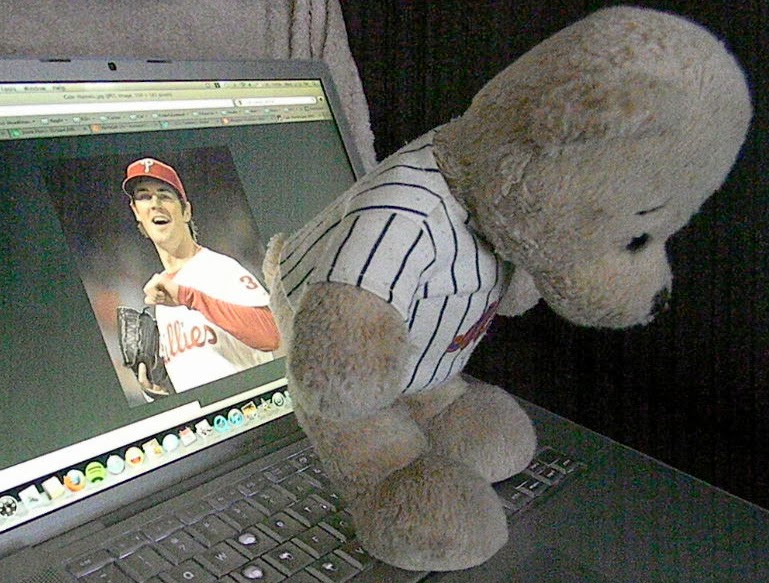
Hi!  This is Iggy Beartran, your expert on all things Cole Hamels.  On Friday, the Mets traveled to Philadelphia to face the richest ass in the world.  Naturally, they were on like Donkey Kong, scoring six runs on ten hits off the smarmy southpaw.  But that's nothing new for the Mets, who can be seen beating up on Hamels almost as often as Mo Vaughn can be seen at the head of the line at an all-you-can-eat buffet.  (Almost.)

Cole Hamels, who was gunning for his 100th career victory on Friday, has lost 13 of 20 decisions to the Mets in his career.  His 13 losses are the second-most defeats by a Phillies pitcher against the Mets.  Meanwhile, sixteen Phillies pitchers have defeated the Mets more often than that smiling ass has.

But wait, there's more.

  • Including Friday's game, Hamels has been touched for ten hits or more in eight of his 243 career starts, meaning that he allows double-digit hits approximately once every 30 starts.  But of those eight games with ten-plus hits allowed, four of them have come against the Mets.
  • Since the beginning of the 2011 season, Hamels has allowed six or more runs in a game half a dozen times.  Three of those six games came against the Mets.
  • David Wright is one of three players with 40 or more career at-bats versus Hamels to have a batting average over .340 against him.  (In 63 at-bats, Wright is hitting .349 against Hamels.)  The other two are Wright's former Mets teammates, Scott Hairston (.395) and Jose Reyes (.393).
  • Cole Hamels has never allowed more than five homers to any one batter.  He has also never allowed any hitter to collect more than 15 RBI off him.  What has Wright done against him in those categories?  Five home runs, 15 RBI.

The Mets have not performed particularly well over the past five seasons.  But that's just because they haven't been able to face Cole Hamels 162 times a year.  Because of his comments about the Mets being choke artists following the 2008 campaign, Hamels has been viewed as a gigantic ass by Mets fans.  But the Mets have done nothing but knock him around for loss after loss since then.  In essence, they have been quite literally kicking ass every time they face him.

It's enough to make even his identical twin brother smile.


Thursday, September 19, 2013

The Longest Nine

This afternoon, the Mets completed their 11-game homestand with a 2-1 loss to the San Francisco Giants.  The low-scoring game took a tidy two hours and 37 minutes to complete.  Today's game was an aberration of sorts, as it was one of only 21 games this year to be played to its completion in under two hours and 40 minutes.

If it seems like the Mets are playing more three-hour games than ever before, you're absolutely right.  In fact, 86 of their 152 games have lasted over three hours.  And of those 86 affairs, 69 of them lasted only nine innings.  Incredibly, a dozen of those nine-inning games have lasted 3:30 or more.  Only one other time in Mets history has the team played more than 86 three-hour contests, more than 69 nine-inning games and more than 12 games that lasted three-and-a-half hours or longer.  That occurred in 2000, when the Mets played 87 three-hour games, 70 nine-inning games of three-plus hours and 13 three-and-a-half hour nine-inning games.  And the 2013 Mets still have ten games left on their schedule to pass the 2000 team.

Wake me up for the seventh inning stretch in about two-and-a-half hours or so.

During the Mets' first quarter century in the league, games did not take an obscene amount of time to complete, especially nine-inning games.  In fact, after playing nine games that took three-and-a-half hours to complete in 1962, the Mets played a total of ten such games from 1963 to 1986.

On September 13, 1972, the Mets defeated the Phillies, 11-6, in a nine-inning game that took three hours and 35 minutes to complete.  Incredibly, the Mets did not play another 3½-hour, nine-inning game for nearly 13 years!  When the Mets lost to the Expos, 5-4, on June 14, 1985, it marked the first time in almost 2,000 regular season games that a nine-inning game took at least three-and-a-half hours to complete, and it just barely made it, lasting exactly three hours and 30 minutes.

With the advent of ESPN nationally televised games (more commercials) and specialized relievers (more pitching changes) in the 1990s, the Mets have played in far more long nine-inning games over the years.  After never having played a four-hour nine-inning contest prior to the new millennium, the Mets have played five such games since 2000.  And since 1999, the Mets have played a whopping 104 nine-inning games that took at least three hours and 30 minutes to complete.  In the 37 seasons the Mets played before that, they managed to crack the 3½-hour mark in a nine-inning contest just 66 times.

On Tuesday night, the Mets lost an 8-5 decision to the Giants.  It took three hours and 55 minutes for the final verdict to be handed down in the bottom of the ninth.  Prior to 1999, the Mets had never played in a nine-inning game that needed as much as three hours and 55 minutes to complete.  Less than two weeks ago, the Mets and Indians played a low-scoring, 2-1 game.  You would think that game would have sped right along.  The time of the game was three hours and 43 minutes.

This isn't the type of baseball your parents grew up watching.  And if games continue to drag because of television and the over-managing of the bullpen, your children will find something more exciting to do to pass the time, preferably something that takes less time to complete than a nine-inning baseball game.

Sunday, September 15, 2013

Vladimir Guerrero Retires: Is He A Hall of Famer?

Photo by Jed Jacobsohn/Getty Images

Vladimir Guerrero quietly announced his retirement from the game via a Spanish language newspaper earlier this month.  Guerrero ended his 16-year career with a .318 batting average, .553 slugging percentage and .931 OPS.  He also collected 2,590 hits, 477 doubles, 449 homers and 1,496 RBI, while scoring 1,328 runs and stealing 181 bases.

In addition to his offensive numbers, which earned him eight Silver Slugger Awards, Guerrero had a cannon for an arm, making him one of the most feared outfielders to run on.  Guerrero was a nine-time All-Star and finished in the top 15 in the MVP vote ten times, winning the American League Most Valuable Player Award in 2004 while with the Anaheim Angels.

Guerrero led the league in hits once (2002), runs scored once (2004) and total bases twice (2002, 2004).  He had four seasons of 200 or more hits, scored 100+ runs in six seasons, had nine campaigns with 30+ doubles, reached 25 homers a dozen times and collected 100+ RBI ten times.  Guerrero even had two 30/30 seasons (30 HR, 30 SB), missing a 40/40 year by one home run in 2002.  So feared was Guerrero at the plate that he led the league in intentional walks five times, including four consecutive seasons from 2005 to 2008.  And for a free-swinging player who didn't walk much unintentionally, Guerrero made excellent contact, striking out 985 times in his 16 seasons and never fanning more than 84 times in any one season.

Only Barry Bonds, Mike Piazza and Barry Larkin won more Silver Slugger Awards than the eight earned by Vlad the Impaler.  (Bonds won 12, Piazza took home ten and Larkin earned nine.)  Of the 58 players with a higher career batting average than Guerrero's .318 mark, 42 of them are in the Hall of Fame.  Several of the 16 players who aren't in the Hall are either still active (Joe Mauer, Albert Pujols, Miguel Cabrera, Ichiro Suzuki) or ineligible (Shoeless Joe Jackson).  Of the 24 players with a higher career slugging percentage than Guerrero, half of them have plaques in Cooperstown.  Five of the other 12 are still active, two are not yet eligible for enshrinement (Jim Thome, Frank Thomas) and three are still on the Hall of Fame ballot (Bonds, Mark McGwire, Larry Walker).  And of the 34 players ahead of Guerrero in OPS, 16 are already in the Hall, while another 16 are either active, still on the ballot, not yet eligible, or ineligible due to banishment (Shoeless Joe, once again).

So does Vladimir Guerrero belong in the Hall of Fame?  Let's put it this way.  Does Roberto Clemente belong in the Hall?  Of course he does.  And Guerrero's numbers were superior to Clemente, the player who he most resembles both at the plate and with his arm in right.  Clemente hit .317 and produced a .475 slugging percentage and .834 OPS.  He also collected 440 doubles, 240 homers and 1,305 RBI.  Guerrero surpassed Clemente in all of those percentages and cumulative numbers.  Clemente also struck out more (1,230 Ks) and walked fewer times (621 BB) than Guerrero.  Although Clemente had more hits (3,000) and scored more runs (1,416) than Guerrero, he accomplished those lofty totals in almost 1,300 more at-bats than Guerrero compiled.  Surely, Guerrero would have surpassed Clemente in both hits and runs scored had he remained in the game past his age 36 season.  And that means Guerrero would have reached the 3,000 hit plateau, which all but guarantees Hall of Fame enshrinement.

When Guerrero left the National League following the 2003 season, Mets fans breathed a sigh of relief.  Although many of them wanted to see Guerrero in Flushing, at least they knew that his defection to the American League meant they would no longer have to see him as a division rival at Shea Stadium, as Guerrero had a career .311/.402/.578 slash line against the Mets, with 21 doubles, 23 homers, 17 stolen bases, 58 RBI and 70 runs scored in only 98 starts.  The 17 steals were the most he had against any team in the majors, while his doubles, homers and runs scored were his second-highest total against any team in the Senior Circuit.

Mets fans rarely saw Guerrero after 2003, but they should be able to see him in Cooperstown when he becomes eligible for the Hall of Fame in 2017.  The only question left about Guerrero when it comes to the Hall is not whether he will make it, but what cap he will be wearing on his plaque.  Will he go in as an Angel or an Expo?  If he goes in as an Angel, he'd be the first to wear their cap on his plaque.  If he goes in as an Expo, he'd be the second to go in as an Expo after the team ceased to exist.

Vladimir Guerrero is most certainly a Hall of Famer.  Other than the cap on his plaque, there should be no other questions asked.